Ethical Lawyers? There’s an App For That!

At least in New York.

The New York bar has launched a Mobile Ethics App that allows judges, lawyers and law students to access legal ethics advice from their smartphones.



The State Bar has made its catalog of more than 900 legal ethics opinions,available on an app for iPhones, Android phones and BlackBerrys, as well as iPads, through their respective app marketplaces. “Ethics questions can arise in many different contexts. The NYSBA Mobile Ethics App will allow judges, lawyers and others to access the opinions of the Association’s Professional Ethics Committee on the spot from the convenience of their mobile devices,” said Association President Vincent E. Doyle III of Buffalo (Connors & Vilardo). “The State Bar is pleased to provide this service to its members and the legal community.”

This is a terrific idea, and it is to be hoped that other bar associations follow suit.

Now if someone will  develop an app for government ethics…

[Thanks to Robert Ambrogi for the news]

UPDATE: Shortly after this was posted, I learned that another bar association has an app for ethics: the Alabama Bar, which launched the first organized code of professional responsibility that was adopted by the American Bar Association in 1908.

Van Der Sloot’s Defense: Worst Rationalization Ever?

Yup: It's Natalee's fault.

Joran van der Sloot finally pleaded guilty yesterday to the murder of a Peruvian woman, Stefany Flores, whom he had met in a bar. His lawyer, Jose Luis Jimenez, blamed the crime on van der Sloot’s earlier arrest for the disappearance of Natalee Holloway in Aruba and the widespread suspicion that he was the missing teenager’s killer.

Defense lawyers, in the zealous representation of their clients, must often come up with creative theories bordering on the risable to try to wring every last drop of helpful spin out of a hopeless case. It bothers non-lawyers and legal ethicists alike when attorneys assert things about a case or their client that they couldn’t possibly believe is true, though it is enough to meet the low bar of the Rules of Professional Conduct for the lawyer to believe that such statements might be true, perhaps in a parallel universe. They are in the “well, how about this?” category. A defense lawyer with a despicable client like van der Sloot, who appears to be a stone cold sociopath, doesn’t have much to work with. Continue reading

More Unethical Fun With Twins: It’s Not Nice To Fool The Judge

You'll doubtless recall that the same tactic was used in the infamous "Parent Trap" murder trial....

Way back in May of 2010, I wrote about a lawyer who suspected that his criminal defendant had pulled a switcheroo, substituting his identical twin brother for himself in his trial. (He had, too.) That was bad enough, but when a lawyer pulls the same stunt, she has crossed some significant ethical lines that will land her in serious trouble with the judge and probably the bar. Thus when Dorothy Savory, a Kansas City defense attorney, placed her client’s identical twin at the counsel’s table just in time for him to be identified by a witness as the man who had snatched her purse, the judge was furious.

This sleazy tactic is older than Abe Lincoln, and has the theoretical purpose of establishing inherent reasonable doubt by showing that an eye witness has identified the wrong person. It has been long established, however, that doing this is a fraud on the court–deceiving not merely the witness, but the jury and, most important of all, the judge, unless a defense attorney alerts the judge to her intention and gets advance permission to try to fool the witness by seating a fake defendant where the real defendant would normally sit.  There were three things that made what Savory did unethical: Continue reading

Ethics Quote of the Week: David Argenter, of the Illinois Supreme Court Commission on Professionalism

"Yes, she's my legal secretary. Yes, she's exactly what I advertised for. Why are you looking at me like that? What??"

“Often, issues of ethics and professionalism raise complicated questions, involve shades of grey, and require serious thought and contemplation to resolve.  Sometimes, however, all it takes to figure out whether a given action or decision is the right one is to ask: ‘Is this stupid?'”

David Argenter, attorney and member of the Illinois Supreme Court Commission on Professionalism, commenting on the mind-boggling case of a lawyer recently suspended from the practice of law for one year for several ethics violations, including one that will live in legal ethics infamy.

Hold onto your hat.

The lawyer in question sought secretarial assistance for his law office on Craigslist.  Oddly, he posted his ad in the “Adult Gigs” section of the site, with the heading “Loop lawyers hiring secretary/legal assistant.” The ad continued…

“Loop law firm looking to hire am [sic] energetic woman for their open secretary/legal assistant position. Duties will include general secretarial work, some paralegal work and additional duties for two lawyers in the firm. No experience required, training will be provided. Generous annual salary and benefits will be provided, including medical, dental, life, disability, 401(k) etc.”

The ad also requested asked for “a few pictures along with a description of your physical features, including measurements.”

Hmmm!

When an applicant  responded with an e-mail inquiring about the “additional duties” referred to in the ad, the lawyer responded,

“As this is posted in the “adult gigs” section, in addition to the legal work, you would be required to have sexual interaction with me and my partner, sometimes together sometimes separate. This part of the job would require sexy dressing and flirtatious interaction with me and my partner, as well as sexual interaction. You will have to be comfortable doing this with us.” Continue reading

Comment of the Day: “Slaves, Whales, Humphrey the Hippo, and Captive Animal Ethics”

Marleen contributes a short and pointed comment to today’s post about PETA’s lawsuit alleging, absurdly, that Sea World’s performing whales are victims of slavery under the definition in the Thirteenth Amendment. Her commentary touches on a rich theme that has been explored on Ethics Alarms in the past: the obligation of issue advocates not to undermine the credibility of an important ethical argument by associating it with unfair, irresponsible or dishonest tactics.

Here is Marlene’s’ Comment of the Day, on “Slaves, Whales, Humphrey the Hippo, and Captive Animal Ethics”;

“PETA makes it difficult for me as a proponent of animal welfare. Pointing to PETA’s ridiculous antics (and this latest one really takes the cake) has become a trump card or Godwin’s Law of sorts when I occasionally discuss animal welfare topics with people. Rants about PETA ensue and the conversation is effectively killed.

“It distresses me that the only strategy they can come up with is to bastardize the courts and the Constitution for some publicity. Shout from the rooftops that captive cetaceans don’t afford us a true ability for observation and study because of the massive (and documented!) ill effects on their health and that it debases us to sacrifice them for our amusement. Play videos of orcas turning on their handlers non-stop. Don’t pull out a cockamamie argument that’s deeply insulting to any peoples familiar with true subjugation.”

Slaves, Whales, Humphrey the Hippo, and Captive Animal Ethics

The beginning of the end for this barbaric practice began with the publication of "Uncle Shamu's Cabin"...

Whether or not it is excessively cruel to killer whales to keep them at Sea World and train them to do tricks is an interesting ethical issue that turns on utilitarian principles: are whales as a species better served by the public learning to appreciate them through close contact in zoos than by having them be accessible only in the wild, and does this result justify keeping some whales in captivity, performing like seals? Good question. What isn’t a good question is posed by People for the Ethical Treatment of Animal’s lawsuit against Sea World, suggesting that it violates the Thirteenth Amendment to keep performing whales, because the practice constitutes slavery.

It’s a stupid question. It’s a silly question. It’s an offensive question, equating aquatic mammals with African-Americans. Continue reading

For the Attorney General, All Aboard For The Penn State Ethics Train Wreck!

That the Penn State child molestation scandal has metastasized into a full-fledged ethics train wreck can now hardly be denied. The proof is that, as pointed out by Solomon L. Wisenberg on the White Collar Crime blog, Pennsylvania Attorney General Linda Kelly trounced all over fairness to the accused in her statement to the press, violating the ethics rules governing prosecutors in the process.

Rule 3.8 of the Pennsylvania Rules of Professional Conduct states that the prosecutor in a criminal case..

“…shall, except for statements that are necessary to inform the public of the nature and extent of the prosecutor’s action and that serve a legitimate law enforcement purpose, refrain from making extrajudicial comments that have a substantial likelihood of heightening public condemnation of the accused and exercise reasonable care to prevent investigators, law enforcement personnel, employees or other persons assisting or associated with the prosecutor in a criminal case from making an extrajudicial statement that the prosecutor would be prohibited from making under Rule 3.6 or this Rule.”

Rule 3.6(a) forbids a “lawyer who is participating or has participated in the investigation or litigation of a matter” from making… Continue reading

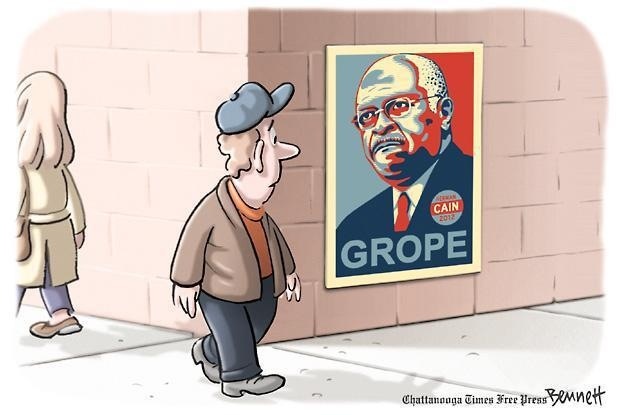
Final Verdict: The Unethical Media Persecution of Herman Cain, and Five Questions for His Critics

The media’s relentless coverage of the non-story of Herman Cain’s alleged sexual harassment 15 years ago continues in defiance of all previous standards of journalistic ethics, fairness and decency.It is a disgusting spectacle, yet the number of individuals, including many of my peers, friends and colleagues, who continue to manufacture ways to blame Cain himself for his outrageous treatment continues to grow.  It is almost a full week since Politico published its fact-free hit job, and still there is nothing substantive that would allow anyone to determine with certainty or even probability that Herman Cain did anything other than spark  opportunistic accusations from female employees seeking a swift pay-off. Astoundingly, people who readily assume that Cain was guilty of wrongdoing based on their undefined claims and resulting cash settlements pronounce themselves “shocked” at the Cain’s defenders’ suggestion that the women themselves had no basis for their accusations. Yet that suggestion is at least as supported by the facts, or lack of same, as the conclusion that Cain did anything wrong.

Anonymous sources have been cited as damning accusers without any information whatsoever regarding the nature of the inappropriate conduct Cain was accused of, without any objective determination regarding whether such conduct actually occurred or, if it did, whether it constituted sexual harassment.

Worst of all, and this has been true throughout the episode (which I regard as a journalism scandal rather than a political one), the news stories and news commentary about Herman Cain’s alleged sexual harassment have almost totally neglected to make it clear to readers what sexual harassment is. The story has been repeatedly referred to as a “sex scandal,” which is wrong and misleading: there is no sex in the form of sexual harassment at issue. The so-called charges (there are no charges at this point) are repeatedly being called “serious,” suggesting Cain did something genuinely substantial and wrong, when that is completely unknown. A lot of conduct that can be used to support sexual harassment allegations may be neither intentional nor objectively harmful in any way. The average member of the public who does not deal with the term sexual harassment as a legal term presumes that it always involves so-called “quid pro quo” sexual harassment: a superior’s solicitation of sexual intercourse or other sexual conduct from a subordinate, using threats, direct or implicit, to make the subordinate comply.

This is Bill Clinton-style sexual harassment, which the public heard enough about during the Paula Jones matter to imprint it indelibly on its mind. It is also the kind of sexual harassment usually on display in “Mad Men” and in other fictional venues. The news media knows this, or should know it, so it has an obligation to make clear that this is not what the two women who filed complaints with the National Restaurant Association  alleged, whatever it was that they alleged. This should be done as a necessary component off every single story and piece of commentary about the matter, because to do otherwise is affirmatively misleading.

Cain’s mysterious, undefined, unproven and never-described sexual harassment was what is called “hostile work environment” sexual harassment. Among the conduct that have been held in particular circumstances to constitute “hostile work environment” sexual harassment are using words of endearment or compliments of a physical nature that an employee considers inappropriate, a repeated request to get together socially that an employee considers unwelcome, jokes, songs, non-sexual touching (such as putting a hand on a woman’s shoulder), e-mails including jokes, stories or photos of a sexual or risqué nature, insults with sexual associations, such as “bitch” or “whore,” looks that an individual perceives as leering or uncomfortably intense, an individual repeatedly looking at a woman’s breast, legs or derriere…or an executive encouraging or permitting any of this conduct to occur repeatedly by other employees or, in the case of an association, members or customers. As far as sexual harassment law is concerned, it doesn’t matter whether the offender intended any of this to be disruptive or not, or whether more than one member of the extended staff finds it so.

Is this what the news reports and commentary about Cain’s phantom harassment charges have clearly suggested he was guilty of fifteen years ago? Absolutely not.

I challenge those supposedly fair and unbiased critics of Cain now arguing, in classic Big Lie fashion, that it is his reaction to the misleading and vague allegations that now condemn him, to answer these five questions: Continue reading

The Damage Incompetent Pundits Do: Criminal Defense Misconceptions

See? I WARNED you not to listen to Mercedes Colwin!

A couple of months back, I flagged some outrageously mistaken commentary on Sean Hannity’s radio talk show given out by Mercedes Colwin, who is a lawyer but prone to howlers whenever she shows up on Hannity or Fox News, which I suspect favors her for qualities that have nothing to do with her law practice. On the occasion that roused my ire, Colwin suggested that she could not defend a criminal client who told her he was guilty, because she was “an officer of the court.”

This is pundit malpractice grafted to legal incompetence: a defense attorney MUST maintain a client’s legal innocence whether the attorney knows the client is guilty or not, and being an officer of the court has nothing to do with it.

Colwin, who was discussing the Casey Anthony trial, represented herself as an expert and then reinforced the most persistent and most damaging popular misconception about the legal system, which is that there is something unethical about defending guilty criminal clients. The system has to be held to a high standard of due process, and even an “obviously” guilty defendant must be proven guilty with admissible evidence beyond a reasonable doubt. Defense attorneys are there to make sure the state meets its burden of proof by making the strongest argument for their clients’ innocence as possible, whether the defendant has confessed his or her guilt or not. For one thing, a defendant often doesn’t know if he is legally guilty, even if he “did it.” For another, even if he did it, the state still has to prove it.The defense’s job in to make sure it does, Continue reading

The Intern, The Lawyer and The Recycling Bin: A Cautionary Tale

We entrusted the job to our intern: what could go wrong?

Here is a story that should frighten all lawyers who employ non-lawyers to assist with various tasks in their practice, which is to say, every one of them. If you have a lawyer, or ever expect to hire one, maybe it should frighten you, too.

A young woman dumped documents containing private information from the clients of Ashley Bell, one of Gainesville, Georgia’s most respected attorneys, in a newspaper recycling bin at The Gainesville Times. The Times said that a majority of the documents remained in their original file folders, and no effort had been made to conceal the contents or redact sensitive information. The files included phone and Social Security numbers of former clients, information on juveniles and reports and evaluations conducted by the Department of Family and Children Services and Court Appointed Special Advocates regarding the physical and sexual abuse, which state law requires be kept confidential.  From the Times: Continue reading