“Cultural Appropriation” Indoctrination From Gonzaga University

From Campus Reform, one of two useful websites that peers into the sick culture of many indoctrinating left-wing educational institutions (the other is Campus Reform) comes the release of this jaw-dropping memo sent to students at Gonzaga University:

That Facebook entry links to a website listing “6 Ways To Celebrate Cinco de Mayo Without Appropriating The Mexican Culture.” The Gonzaga Facebook page includes a graphic with such advice as “don’t you dare put on that ‘sombrero,’” “acknowledge the stereotypes you have internalized and discover why they are problematic,” ““donate to organizations working for immigrant rights,”  and  “support AUTHENTIC Mexican businesses,” although “CHIPOTLE DOESN’T COUNT.”  “Try a family-owned restaurant run by actual Mexican people (They have better food anyway. We promise.),” the graphic says. “Maybe even enjoy some authentic Mexican music.”

My immediate reaction to this ham-handed, bigoted message would be, after the obligatory “Bite me!,” to have lunch at Taco Bell, pull out those old Bill Dana comedy albums,  and to watch “The Three Amigos.” Oh, and I will put on a sombrero (I own a great one, as well as an authentic Sioux headdress, three cowboy hats, a fez, a Viking helmet (not so authentic), a beret,  and Kaiser Wilhelm helmet, and a jester’s cap), because I will wear anything on my bald head that I goddamn please, and if my attire offends someone, that’s their problem. I don’t wear any of those costume pieces as insults, and as a member of the world community, I will borrow, honor, emulate and appropriate whatever part of it that appeals to me. For I am a free citizen of the United States of America, and don’t order me to express myself as you would prefer. Continue reading

Facebook’s “Ugly Memo” Is Completely Ethical.

Facebook employees were horrified last week by over a leaked 2016 memo from  Facebook VP Andrew “Boz” Bosworth defending the social network’s aggressive expansion plans. Naturally, since the news media is in a Hate Facebook mode, ever since it was discovered that the social networking giants didn’t just let Barack Obama and Hillary Clinton acquire personal, data from its users: Republicans got some of the “big data” too, the Bosworth memo, nicknamed “The Ugly,” was more fodder to declare Mark Zuckerberg’s baby evil.

It may be evil, but not on the basis of the memo. Here’s what Bosworth wrote:

The Ugly

We talk about the good and the bad of our work often. I want to talk about the ugly.

We connect people.

That can be good if they make it positive. Maybe someone finds love. Maybe it even saves the life of someone on the brink of suicide.

So we connect more people

That can be bad if they make it negative. Maybe it costs a life by exposing someone to bullies. Maybe someone dies in a terrorist attack coordinated on our tools.

And still we connect people.

The ugly truth is that we believe in connecting people so deeply that anything that allows us to connect more people more often is *de facto* good. It is perhaps the only area where the metrics do tell the true story as far as we are concerned. That isn’t something we are doing for ourselves. Or for our stock price (ha!). It is literally just what we do. We connect people. Period.

That’s why all the work we do in growth is justified. All the questionable contact importing practices. All the subtle language that helps people stay searchable by friends. All of the work we do to bring more communication in. The work we will likely have to do in China some day. All of it.

The natural state of the world is not connected. It is not unified. It is fragmented by borders, languages, and increasingly by different products. The best products don’t win. The ones everyone use win.

I know a lot of people don’t want to hear this. Most of us have the luxury of working in the warm glow of building products consumers love. But make no mistake, growth tactics are how we got here. If you joined the company because it is doing great work, that’s why we get to do that great work. We do have great products but we still wouldn’t be half our size without pushing the envelope on growth. Nothing makes Facebook as valuable as having your friends on it, and no product decisions have gotten as many friends on as the ones made in growth. Not photo tagging. Not news feed. Not messenger. Nothing.

In almost all of our work, we have to answer hard questions about what we believe. We have to justify the metrics and make sure they aren’t losing out on a bigger picture. But connecting people. That’s our imperative. Because that’s what we do. We connect people.

Anyone who thinks this is a horrible or unethical sentiment doesn’t understand the fallacy of consequentialism, doesn’t comprehend moral luck, and doesn’t understand ethics or the concept of liberty. The section in the memo that has the Left’s new moralists suffering from the vapours is this one:

“So we connect more people. That can be bad if they make it negative. Maybe it costs a life by exposing someone to bullies. Maybe someone dies in a terrorist attack coordinated on our tools.”

That’s not “ugly.” That is a statement of reality, though admittedly one that certain political groups can’t understand, or choose not to accept. The value of tools that expand human power and experience is not diminished because they can be, and predictably will be, misused by some people, sometimes tragically. The nation was built on a basic understanding and embrace of that concept. Recently, a powerful movement has arisen challenging the assertion that personal; liberty is a universal good, on the grounds that liberty can be abused..  Here are some of the parallel and equivalent statements that this group currently challenges, often in  angry and demonizing terms: Continue reading

Comment Of The Day: “On The Anti-Gun “Weapons Of War” Talking Point”

Second Amendment authority Chipper Jones. He’s an expert because he had a .303 lifetime batting average, and shoots deer….

It was gratifying that the weekend post about the “weapons of war” anti-gun rhetoric attracted a  great deal of thoughtful commentary here. I was thinking about the post again today when, as is increasingly the case, a sportswriter gratuitously injected politics into sports commentary. Baseball season is fast-approaching, and while one of the many reasons I follow the game so passionately is its ethics content, I look forward to the game to get away from politics, and incorrigible social justice warrior agitators like NBC’s Craig Calcaterra, lapsed lawyer, can’t resist misusing their sports platforms as a political soap box. 

Today he gleefully informed readers that Hall of Fame third baseman Chipper Jones had “denounced assault weapons,” telling Jeff Schultz of the Atlanta Journal-Constitution:

“I believe in our Constitutional right to bear arms and protect ourselves,” Jones said. “But I do not believe there is any need for civilians to own assault rifles. I just don’t.

“I would like to see something (new legislation) happen. I liken it to drugs – you’re not going to get rid of all the guns. But AR-15s and AK-47s and all this kind of stuff – they belong in the hands of soldiers. Those belong in the hands of people who know how to operate them, and whose lives depend on them operating them. Not with civilians. I have no problem with hunting rifles and shotguns and pistols and what-not. But I’m totally against civilians having those kinds of automatic and semi-automatic weapons.”

Calcaterra makes sure that we knew that the ex-Braves player is an avid hunter and owns a rife, because he apparently wants us to think that owning a gun makes an athlete an expert on the Bill of Rights. (It doesn’t, and I’m pretty sure Calcaterra knows that.)

Concludes Craig,

“While debate, often acrimonious, will no doubt continue about these matters indefinitely, it’s striking to see someone like Chipper Jones come out so strongly on the matter in the particular way that he has. It has to make people at the NRA and those who support it wonder if, when you’ve lost Chipper Jones, you’ve gone too far.”

Thus we have a lawyer appealing to the authority of a man who played baseball all through highs school, and signed a contract to be a pro baseball player at te age of 18. Call me skeptical, but I question whether he has devoted much research to the history and philosophy underlying the Second Amendment, or has read any of the judicial opinion and scholarship analyzing it. I especially question Jones’ flippant “denouncement”  given the tell-tale signs that he doesn’t understand the right to bear arms at all, beginning with the misnomer “assault rifles” and the assumption that the most popular civilian rifle in the U.S. is a “weapon of war.” He also makes the offensive assumption that he is qualified to decide what kind of fire arms other citizens “need,” a commonly expressed  attitude sharply discredited in this essay by playwright and screenwriter David Mamet.

I find myself increasingly impatient with uninformed opinions on important matters relating to our personal liberty, expressed by celebrities with no more understanding or special expertise than the typical semi-informed citizen, and often less. I am even less tolerant when I am told by journalists that attention must be paid.

Here is the Comment of the Day by Glenn Logan, who is informed on this issue, on the post On The Anti-Gun “Weapons Of War” Talking Point: Continue reading

On The Anti-Gun “Weapons Of War” Talking Point

I’m moving this essay up in the queue, because while walking my dog in the rain—such rote activities like dog-walking, showering and driving often trigger “right brain” activities and inspirations—it all became clear to me for the first time.

One aspect of the argument being offered by anti-gun zealots following this school shooting that is new compared to Sandy Hook is the sudden popularity of the term “weapons of war.”  it was used multiple times at the very start of the CNN “town hall,” for example. Rep. Deutch:

But, beyond that, the best way for us to show that is to take action in Washington, in Tallahassee, to get these weapons of war off of our streets.

and…

…and the answer to the question is, do I support weapons that fire-off 150 rounds in seven or eight minutes, weapons that are weapons of war that serve no purpose other than killing the maximum number of people they can, you bet I am.

…and

And that is making sure that we take action to keep our kids and our schools safe and to get dangerous weapons of war off of our streets. That has to be our priority and we’ve got to do it now.

My interest is not whether it is a wise or good thing to ban semi-automatic weapons. The U.S. Court of Appeals for the 4th Circuit ruled last year that Maryland’s ban was constitutional, and the Supreme Court, so far, at least, has not chosen to review it. A national ban, however, would certainly require SCOTUS assent, and my guess is that such a law would fail, and as I will continue to explain, should fail.

“Weapons of war” is nowa pejorative phrase designed to make the most popular rifle in America sound as if owning one is perverse. “Weapons of war” suggests not just self-defense, but active combat, and it certainly doesn’t mean hunting deer and rabbits. Following Sandy Hook, a lot of the anti-gun rhetoric, as from New York Governor Cuomo, involved the deceitful (or ignorant) argument that you don’t need a semi-automatic rifle to shoot a deer. This vigorous false narrative is as old as the Left’s anti-gun, anti-Second Amendment movement itself.

Thus  “weapons of war” is now the phrase of choice to persuade moderate, uncommitted citizens considering the gun controversy that it makes no sense to allow citizens to own such weapons. Hunting weapons, sure (at least until there’s a mass shooting in a school using those). A registered handgun to shoot a burglar, a rapist or a home invader?  Fine. But “common sense gun controls” can’t possibly allow citizens to have “weapons of war.”

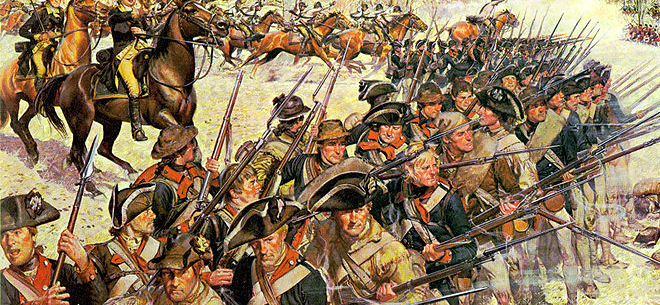
The problem is that allowing private ownership of weapons of war is exactly what the Founders intended. The Second Amendment was devised to ensure that citizens would  not be disarmed by a government that needed to be overthrown, or, in the alternative, that some citizens wanted to overthrow, but wrongly.

The Founders were, it should not be necessary to say, revolutionaries. They believed that citizens had the right and even the obligation to bring down abusive  governments. Jefferson stated it directly in the Declaration of Independence:

“Prudence … will dictate that Governments long-established should not be changed for light and transient causes; and accordingly all experience hath shewn that mankind are more disposed to suffer, while evils are sufferable than to right themselves by abolishing the forms to which they are accustomed. But when a long train of abuses and usurpations, pursuing invariably the same Object evinces a design to reduce them under absolute Despotism, it is their right, it is their duty, to throw off such Government, and to provide new Guards for their future security.”

Jefferson was a brilliant man, and no dreamy-eyed idealist. He could not have assumed, feeling the way he did about governments, government power, and the men who come to possess such power, that governments could always be dissolved peacefully. As a prudent and practical man, he was also saying that it is unwise to seek to change a government every time it fails or disappoints, and that long-standing systems deserve the public’s tolerance, patience and forbearance. Government should be a contract of trust, and that when that trust is irreparably broken by abuses of power, the people must have the right, and must have the ability to activate that right, to demand a new form of government.

This is, of course, exactly what the 13 Colonies did. The Constitution they adopted when they began their experiment in democracy naturally and necessarily included a crucial right without which future generations of Americans would not be able to “throw off” a government whose abuse of power had become odious. That was the right to bear arms, embodied in the Second Amendment. The arms one had the right to bear had to be weapons of war, because fighting—civil war, revolution, wars of resistance—was their explicit purpose. Continue reading

Comment Of The Day: “What Do You Get When You Add Anti-Gun Bias To Constitutional Ignorance To Anti-Trump Bias To Incompetent Journalism? THIS…”

Chris Marschner’s epic Comment of the Day arrived at 11:14 pm last night. My immediate reaction was that it validated all of the toil and time I have put into this blog since it was launched in 2009. I know I have indulged myself more than is professionally admirable of late, complaining about the traffic here, the lack of broader web circulation of essays that I believe are important and objectively superior to commentary elsewhere that routinely gets hundreds of thousands of clicks, likes and shares. In my lore rational moments I also know that, as Hymen Roth once pulled me aside and reminded me, “Jack, you idiot, this is the life you have chosen!” This is ethics. Most people don’t want to read about or think about ethics, and most people are bad at it and don’t want to get better. I make much of my living teaching ethics to lawyers who admit to me that if they didn’t have to get ethics credits to keep their licenses, they would rather be locked in a room with Slim Whitman recordings being blasted at them than sit through an ethics seminar.

Chris’s essay— “essay” doesn’t do it justice; perhaps “opus”–reminded me of what I set out to do here from the beginning, which was to create an online colloquy about applied ethics and ethics analysis, using events, issues, episodes and dilemmas from every aspect of our culture, national experience and daily life. As the 9th full year of Ethics Alarms begins, I can see that we have attracted, beyond the readership, which of course is hard to analyze, a remarkable, diverse, dedicated and passionate group of regular commentators whose output in the discussions and debates following the posts is the best it has ever been and getting better. I could not be more proud of that. I also complain about lost commenters, the many, many once regular and valued participants here who have fallen away, often without explanation. ( Spike Jones: Mary–“Bon soir, John. Prosit. Auf wiedersehen. Au revoir. Adios. Aloha.” John:  How do you like that? She didn’t even say ‘goodbye’! ) But this is the regular cycle of any blog; I know it. I just get attached to the faceless people I interact with daily, and take their exits personally, forgetting that lives and priorities change, and that I, too, am just a distant voice, who could, after all, be a dog.

I read many websites and blogs, and with the possible exception of the original Volokh Conspiracy before it moved to the Washington Post, no site’s comments approach the routine excellence I see here, in content, seriousness, and original thought. So you know just how excellent Chris’s comment is, when I say that it is among the very best that has been posted on Ethics Alarms.

Here is Chris Marschner’s Comment of the Day on the post,  What Do You Get When You Add Anti-Gun Bias To Constitutional Ignorance To Anti-Trump Bias To Incompetent Journalism? THIS…”

I suggest that you keep this link handy as you read it.

I wrote this for anyone willing to listen. Continue reading

Comment Of The Day (8): “An Ethics Alarms Holiday Challenge! Identify The Rationalizations, Logical Fallacies…”

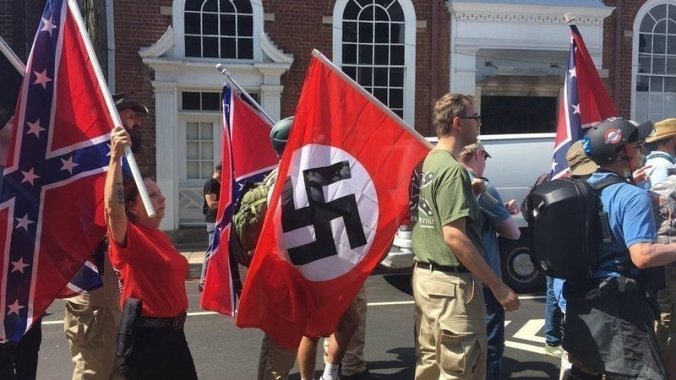
All good things must come to an end. This is the 8th and final COTD that arrived in response to my post about Noah Berlatsky’s disturbing call to gut the First Amendment because Nazis BAD. That idiot gets national publicity on an NBC sub-page called “THINK.” All eight of the authors of the Comments of the Day could squish Noah in Jeopardy, Scrabble, or a moderated debate, and all they got was a post on Ethics Alarms. Not even a lousy T-shirt. There is no justice.

Here is Steve-O-in NJ’s Comment of the Day on the post, An Ethics Alarms Holiday Challenge! Identify The Rationalizations, Logical Fallacies, Falsehoods And Outright Errors In This Essay Advocating Limits On Speech…

The upside and the downside of the internet is that almost nothing disappears once it’s posted, a lesson I myself should probably grasp before I post in anger. That said, I’m not angry right now, just disgusted with this article and the two I linked to above. (Here and here.) I’m not going to say that all of the left is like this, but it’s clear that a healthy core of the elite at the top of the left and their supporters are interesting in two things before all else: power and control. Some of these may actually believe that they are doing the right thing and helping people, but many, and I think both our last president and his chosen successor belong to this category, simply believe that they know best, and anyone who disagrees is simply wrong and not worthy of a hearing.

The fact is that this country was founded, indeed settled, with the idea in mind that everyone was entitled to be heard and no one’s opinion, no matter how wrong it might be, would be silenced by the heavy hand of government. We threw off the British yoke in part because they had resorted to trying to silence dissenting opinions and trying to arrest those who dared express them. In essence the British had failed to “co-opt” the colonies back into their way of doing things and tried to turn to the mailed fist when the velvet glove had failed.

Since then the U.S. has usually been strong on freedom of speech, even when it’s been odious. We’ve typically only slipped in time of war or national security emergency, with things like the Smith Act in WWI and HUAC during the early Cold War. With the publishing of the Pentagon Papers and the conversion of the journalism industry from a valuable service to unofficial watchdogs of government honesty, even clamping down a bit on freedom of speech in time of war or protecting certain important truths with Churchill’s proverbial “bodyguard of lies” has gone by the boards. Continue reading

Morning Ethics Warm-Up, 10/31/2017: A Hate Outbreak, A Bigoted Judge, A Lost Post, And More Halloween Ethics

Good Morning!

1 On Facebook, many of my progressive friends literally expressed glee at yesterday’s indictments, especially at the charge that Paul Manafort had engaged in “conspiracy against the United States.” Lots of social media users were expressing similar sentiments, the thrust being that they were excited that two individuals who worked for the Trump campaign were facing criminal charges…simply because they worked for the Trump campaign. This cackling mob hadn’t read the indictment, or if they did, they didn’t understand it. They just were engaging in free-standing hate by association.

The reaction is not sort of like, but exactly like, what I called  the “Ugliest moment of election night”: Trump’s crowd chanting “Lock her up!” as the upset electoral victory approached. Criminalizing the political process is not the way of democracy, and rooting for people’s lives to be ruined because of their partisan alliances is disgusting. Who among the people so thrilled to see Manafort and former Trump campaign foreign policy advisor George Papadopoulos being prosecuted know anything about them other than the fact that they worked for the President’s campaign? What do they think justifies cheering their indictment? Papadopoulos pleaded guilty for lying to the FBI about when he tried to meet with Russians claiming to have damning Hillary Clinton e-mails—which, I hope you know (and I bet the Facebook mob doesn’t) isn’t a crime.

Last night, Stephen Colbert, the full-time attack jester of “the resistance,” said of the indictments, “I know it’s almost Halloween, but it really feels more like Christmas!” What an idiotic and hateful thing to say, as well as a statement that is misleading to his audience, who naturally would think that the action implicates the President and the White House in something. (It doesn’t.)

2. Colbert also engaged in gratuitous race-baiting, because dividing the country along racial lines and promoting racial distrust is apparently what progressives think is funny and cool. Noting that the charges against Paul Manafort were filed on Friday but that he didn’t have to turn himself in until Monday Colbert smirked,  “Wow, we white people really do get arrested differently.” The “joke” is untrue, and racist in its own implications, suggesting that only whites commit white collar crimes and are regarded as low flight risks, while blacks commit the violent crimes and robberies that lead to immediate arrests.

These are ugly, mean-spirited people, poisoned by ugly, mean-spirited thoughts.

You can quote me.

3. Judge W. Mitchell Nance, a Kentucky judge, resigned after judicial ethics charges were filed against him as a result of his refusing to preside over any same-sex couple adoption cases. Nance announced that he would not  participate in  gay adoption matters in April, when he issued an order saying he was recusing himself from such case, arguing that adoption by a gay couple would never be in the best interest of a child.

The judicial misconduct complaint filed last month argued that Nance’s order violated the judicial ethics canons requiring judges to promote confidence in the integrity and impartiality of the judiciary, to be faithful to the law, and to refrain from showing bias or prejudice.

It does. Good riddance. Continue reading

Ethics Quote Of The Week, And A Few Related Diversions

My son is named after this President, incidentally.

The quote itself is by Ron Chernow, the historian who authored the recent well-reviewed biography of out 18th President, “Grant,”  “Hamilton,” the biography that inspired, we are told, the mega-hit musical. and “Washington” (won’t somebody send a copy to the fools at Christ Church?) was given to an interviewer as his description of another book, the Philip Roth’s historical novel  “The Plot Against America”:

[A] democracy can be corrupted, not by big, blaring events, but by a slow, insidious, almost imperceptible process, like carbon monoxide seeping in under the door.

Some random thoughts on this statement, which I believe is exactly right, and a lot more interesting than the more frequently used analogy about boiling a frog slowly:

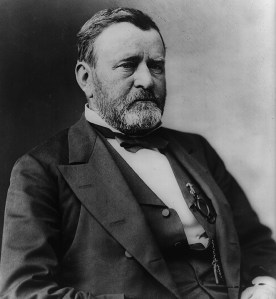
  • Grant, as Chernow’s book (among others of recent vintage) documents, was present at one of those points when democracy seemed to be in the process of being poisoned, and acted forcefully.

By 1868, when Grant was elected to succeed Andrew Johnson, who had done everything he could to allow the South to resist extending civil rights to the newly freed slaves, the KKK had evolved into a powerful terrorist organization that referred to itself as  “The Invisible Empire of the South.” Under the  Klan’s first  “Grand Wizard,” the brilliant former Confederate cavalry general  Nathan Bedford Forrest, whites from all classes of Southern society joined the Klan’s ranks. They attacked and punished newly freed blacks for crimes like  behaving in an “impudent manner” toward whites, brutalized the teachers of  schools for black children, and burned schoolhouses. It also terrorized and often murdered Republican party leaders those who voted for Reconstruction policies.  In Kansas over 2,000 murders were committed as the 1868 election approached; in Louisiana, a thousand blacks were killed in the same period.

Grant entered office knowing that the Civil War victory could come apart. He made some bad appointments–Grant was naive about politics and trusted too easily—but his choice as Attorney General, Amos T. Akerman, was masterful. With Grant’s support, and the with the help of the newly created Justice Department under Grant, he vigorously worked to enforce the Fifteenth Amendment, which gave the vote to black men in every state, and the First Reconstruction Act of 1867, which placed tough restrictions on the South and closely regulated the formation of their new state governments. Between 1870 and 1871, the Republican Congress passed and Grant signed into law the Enforcement Acts, which made it a crime to interfere with registration, voting, officeholding, or jury service by blacks. Congress also passed the Ku Klux Klan Act, which allowed the government to act against terrorist organizations.

  • When I was growing up and becoming interested in the Presidents, a life-long passion that led me to both law and ethics, Grant was routinely listed as one of the worst in the line. All one heard from historians was about the financial scandals that rocked his administration. Grant’s great success in subduing the Klan was literally never mentioned. The main Presidential historian then was Arthur Schlesinger Jr., a member of Jack Kennedy’s inner circle. His job as he saw it was to minimize the contributions of any Republican President, like Teddy Roosevelt (“near great” in his rankings), Eisenhower (“below average”) and Grant (“failure’). Meanwhile, Woodrow Wilson, who dragged the U.S, into the first World War, botched the Versailles Treaty and who actively revived the Klan, being a stone-cold racist, was “great.” Naturally, I believed all of his distortions, which were largely those of the historians at the time, then, as now, often partisans and propagandists. It took me a while to realize that this had been my first encounter with the Left attempting to alter present perception by controlling the past.

That is one of the major sources of Chernow’s carbon monoxide today, except that the disinformation now emanates from the schools, colleges, and the news media. Continue reading

Morning Ethics Warm-Up, 10/29/17: What’s Really Wrong With Single Payer, Incompletely Remembering Charles Kuralt, And Dana Milbank Boards The Ethics Train Wreck

(This is my favorite Arthur Sullivan hymn, even more than “Onward Christian Soldiers”…)

GOOD MORNING!

1 CBS’s “Sunday Morning” had a feature today on the late Charles Kuralt, the original host of the show, famous for his feature “On the Road” in which Kuralt visited “the real America,” meeting locals and revealing regional lore to the rest of the country. At the end of today’s segment, CBS bemoaned the fact that Kuralt, who died 20 years ago, was virtually forgotten, even among journalists if they had no grey in their hair.

This is an example of a larger crisis, cultural illiteracy, that often occupies my thoughts. The blame lies with our inadequate schools and its under-educated teachers, as well as popular culture. Barely knowing anything about George Washington, the root of the previous post, is an existential problem, but only slightly more dangerous are the multiple generations whose member can’t name ten U.S. Presidents, don’t know the dates of the Civil War or who the US defeated in World War II, and who have never heard of Jackie Robinson, Clarence Darrow, Brown v. Board of Education, Eugene McCarthy, Ingrid Bergman, or Lucille Ball.

CBS, however, was indulging its own special breed of disinformation by lionizing Kuralt. Yes, I remember well his plummy voice and avuncular style. I also remember, as CBS would have us forget, the fact that after his death it was revealed that being “on the road” allowed Kuralt to maintain one family in Montana and another, his official one, in New York City. His innovative proposal to CBS to fund his trek back and forth over the contiinent facilitated his betrayal of his family. Kuralt was a sociopath.

2. The most significant ethics story of recent weeks that I have thus far neglected was the announcement that Great Britain’s National Health Service will ban patients from surgery indefinitely if they are obese or smoke. Non life-or death operations, like joint replacements, will be put on hold  until such patients conform to the governement’s life style requirements

Obese patients “will not get non-urgent surgery until they reduce their weight” unless the circumstances are exceptional. Smokers will only be referred for operations if they have stopped smoking for at least eight weeks, with such patients breathalyzed before referral.

When the newly radicalized and Bernie-ized Democratic Prty going all-in for single-payer next year, this cautionary tale needs thorough debate. When the government controls health care, it has the power to constrict personal liberty. The British were horrified by this latest development, which can only be described as the other shoe dropping. What did they expect?

Of course, a party that controls a government that can withhold surgery until citizens conform to mandated life choices would never use that same power to demand other behavior from citizens. Or  assign priorities for surgical procedures to favored groups and constituencies.

Keep telling yourself that. You’ll feel better. Continue reading

Putting Gun Control In Perspective: The Second Amendment’s Purpose, And How To Protect It

A guest post by texagg04


[The following is a rare guest post. The author is a previous winner of an Ethics Alarms commenter of the year award, which comes with the privilege of a guest post, though no winners have ever cashed their prize in. I decided this effort warranted special status beyond a Comment of the Day, in part because of its length, in part because of its immediacy, and in part because I think it should be read. Only Paul Peterson, the child performer advocate and a personal hero and friend, has been a guest commenter in the past.]

This topic fatigues me every time it arises. Watching the videos of the concert-goers simultaneously brought out two emotions, one of compassion and sympathy for the victims of the crime, and one of sheer “pre-exhaustion” knowing I’d be called upon to rehash all the same, solid arguments to counteract the emotion-driven “do-something-ism.” I’ve resisted wading into the debates because it is all so tiresome, though I have chimed in on occasion. But that doesn’t mean my mind hasn’t been wrestling with this crime, the 2nd Amendment, and the deeper philosophy behind it.

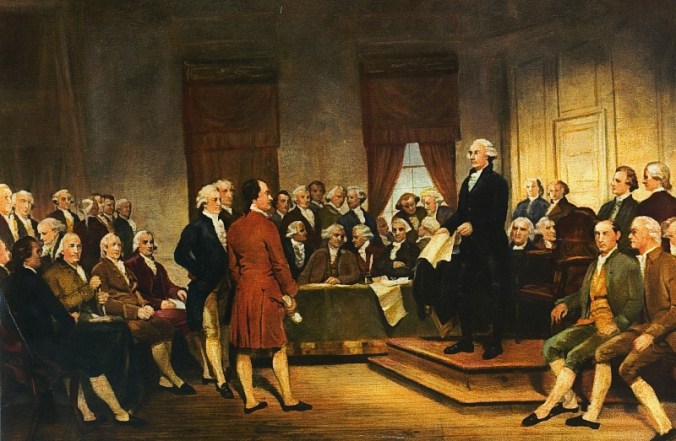
There are a handful of questions this debate inevitably boil down to. I will dispense with any notions that the 2nd Amendment exists for hunting or for fun, though those topics will arise shortly. No, we’ll start off on the honest premise that the 2nd Amendment exists as a democratization of force, where the Constitution, in a sideways manner, supplements the three branched checks-and-balances division of power, with a three tiered “balance of force”, where the National level retained control over the standing army, the States retained control over the Militias (when called out), and the People, armed, represented the lowest rung. And I am of the firm belief that the 2nd Amendment is STILL ultimately essential to liberty.

But that is really the first set of questions that the debate boils down to:

  • Can good modern governments still go bad or can we trust modern republics to not go bad?
  • How does one fix a bad government or a government on the way to becoming bad?
  • Can the citizenry oppose and correct those governments without force or threat of force?

I think that a perusal of the modern history of Western Civilization would tend to show us that yes, governments can most certainly go bad. The blood-letting of Europe from 1917-1945 and the follow-on competition that ended in the early 90s is proof that democracies and republics can flip rapidly into tyrannies. I think a simple survey of contemporary nations will show us that a large number of people are subjugated beneath the yokes of dictatorships. But what of the “good” nations that have disarmed their citizens? They don’t seem to be tyrannical, they seem quite free without a mass of armed citizens forever poised to check them.

I can easily concede that they are relying on the benevolence of their current leadership. It is working fine. For them. Right now.

Still, the essential check on malevolent people with force is the actions benevolent people with force. European nations currently have generally benevolent people with authority over them. We already know, however,  that this condition can change and can change rapidly. The peoples of other nations that descended into t oppression, as their culture and governments changed, thought they also lived in modern enlightened times, where tyrannies couldn’t happen to them. I’m moving to this segue because I think checks on these malign forces aren’t merely internal, but external as well. When the European central powers slipped into malevolent rulership, it was EXTERNAL forces of good that came and broke the dictatorships apart and restored the bad actors to republicanism.

I think a certain amount of “momentum” is maintaining that check on the rise of tyrannies in these disarmed nations with “benevolent” governments. That is, I think there’s still an aura of protection provided by the United States that deters any truly awful government from rising in Europe. Then again, that depends upon the presence of a benevolent people willing to use force to check the rise of a bad government. What then if the United States or other good actors stopped being good? I would submit that, disarmed, the people of Europe would have not one bit of ability to stop the rise of tyranny in their own nations.

So why does the United States seem to keep a government that is mostly good? (and it does, you naysayers) The answer is that it has a perpetual check against its getting out of hand: the armed populace. Does this political check absolutely require violent force or the threat of violent force? What about merely electing good actors to replace bad? What about protesting tyrants when they arise? What about petitioning the government for redress of grievances? What about speaking out freely against the dictators when they rise?

Those are all good measures to take when a citizenry must ensure it is in the right before a society slides past a point from which it cannot return from. All of them, however,  rely upon a generally benevolent government that will pause and consider the grievances listed by its people. History shows that a rising dictatorship  will not care, requiring the people to be more forceful in their demands than mere words can accomplish

Yes: governments, regardless of the advancement of the culture they preside over can still go bad. Yes, there are steps before a government goes bad to rectify the government without violence. No, if the government goes too far, the citizenry cannot fix the problem without violence or threat of violence. And if that the fix cannot come from benevolent outsiders, such as France aiding the colonists in 1776 or the United States and other Allies in World War II, then the citizenry is on its own.  Sans firearms, the citizenry will have little recourse, for tyrants don’t care about protests.

This leads to other questions. Are some cultures content with domineering governments that we would consider overbearing at the cost of our security against tyranny? If so, would it be a solution to our “gun problems” to become more like those cultures? Are some cultures more vibrant and energetic and assertive, in such away that all the positives that derive from that vibrancy and assertiveness are inherently accompanied by a set of negatives such as violence and discontent? If it is necessary to solve the violence and discontent by also throwing out the vibrancy and assertiveness worth the trade off?

I don’t want to dive into this too deeply here. It just seems obvious that our culture promotes assertiveness and vibrancy, which generally inculcates an attitude in its people that the government needs to primarily keep out of our business. That attitude, taken to the extreme, is ultimately manifested in a people that must be armed to check the government, as per the opening paragraphs of this essay. Is the violence we see more often in this nation than in others a negative by-product of assertiveness, ambition or individualism? Now, before our resident Europhiles complain, yes, many Europeans are similar, but in general, (and I’ve been to Europe), I’m not impressed. Make no mistake, they enjoy their culture, I’m not expecting them to change it, I just don’t think it’s a culture we want to adopt here, and it’s certainly not one that is any position to oppose a government that decided to overstep its bounds.

That being said, the violence in our nation, though on average now decreasing, still produces extremely violent acts.

(To be clear, I’m speaking of American culture as those values it has traditionally held to, not the “objective” culture that vast swathes of progressives would love us to morph into, a culture which is essentially European in flavor).

Where these two lines of questions collide—that is, the necessity of the 2nd Amendment, and the mass killings that occur at disturbing frequency—it probably is worth revisiting the concept of “Arms” and the right to bear them. I am certain that the ability of the citizenry to check the government is worth the gun violence in America. But can any real steps be taken to alleviate the scope of the violence when it occurs? Because make no mistake, that’s really all we’re discussing when we discuss disarmament: “Fewer people are killed by a mass murderer with a knife than with a machine gun”. Got it. The dude’s still a mass murderer, and you are only trying to keep the kill count down.

There is something to that logic. Yet even though preservation of life is BUT ONE value among many that our Republic perpetually balances, it really doesn’t possess trump-card power over other values. So, if we are to seek “minimization” of casualties as a goal, it can ONLY be found within a solution that preserves the 2nd Amendment’s goals.

Before proceeding, I’m going to take a moment to rehash an essay that I wrote a while back, which discusses the 2nd Amendment (bolded line was not bolded in original):

““A well regulated Militia, being necessary to the security of a free State, the right of the people to keep and bear Arms, shall not be infringed.”

We know the final clause “the right of the people to keep and bear Arms, shall not be infringed” is, on its face, fairly plain-spoken. That these words are hotly debated is baffling, they seem clear and obvious to me. Certainly, an amount of ambiguity exists about “What did the Founders mean by ‘Arms’”? Other arguments can be made about the meaning of “people”…did the founders mean to speak to a collection of individuals with individual rights or to directly to collection itself. But those ambiguities aside, the clause is concise and clear — the people have a right to bear arms; by extension of the philosophy enshrouded in the Declaration of Independence, it would be a natural right.

A review of contemporary documents would show that the term “keep and bear arms” does apply to individuals separately, that bear arms means to carry and use (for a variety of purposes). If this meaning does apply to individuals, then we have the meaning of the term “people”. As for the Founder’s meaning of “Arms”, that debate can rage on. A reading of the Federalist papers and scant few other documents and understanding them would indicate that the Founders intent in the balance of force is that the common man certainly at a minimum has the right to bear an equal firearm to the standard infantryman. It would seem the heavier weapons were relegated to the control of the separate states and to the national army (although the vagueness of Arms at the time does allow a wider definition – but even I don’t think their vision meant for the private citizen to own a tank or a nuke).

The prior phrase “….A well-regulated Militia, being necessary to the security of a free State..” is where I think the Founders are truly eloquent and packed a ton of meaning into 13 words.

Some would tell us that the strong full time army is enough to secure our country from invaders, therefore a ‘militia’ is no longer necessary, therefore the people no longer need the right to bear arms. But the Founders didn’t say “a military necessary to repel invaders”, they said “security of a free State.”They knew all too well that an unchecked central army can easily secure a State… but they wanted a free State. They knew from firsthand experience that centralized force is the primary tool of tyranny, and that only a heavily armed populace was a check against that.

Alexander Hamilton states in Federalist #29: “but if circumstances should at any time oblige the government to form an army of any magnitude that army can never be formidable to the liberties of the people while there is a large body of citizens, little, if at all, inferior to them in discipline and the use of arms, who stand ready to defend their own rights and those of their fellow-citizens.”

Some would tell us the militias existed because the nation couldn’t fund a large full time military. The Founders didn’t say “…Militia, being necessary to alleviate the financial burden of a large Army, and at which point it becomes financially viable, we will say ‘the Army, being necessary for the security of a free State.”

In the same Federalist Paper, Hamilton does assert that the militia does alleviate the financial and social burden of a large standing army, while immediately following with assertions that even should a large standing army exist, the militia would continue as a check against it.

Some would tell us the Militia was meant to be just a supplement. And, yes, all though that is one role of the Militia, that is not what the clause “being necessary” implies. They knew that a free State CANNOT exist WITHOUT a Militia at all! The phrase doesn’t say “A well regulated Militia, sometimes helps for the security of a free State…”. The Founders distinctly say the Militia is NECESSARY to the security of a free State. Because free States are not just attacked from without, but also from within.

What do we glean simply from “…Militia, being necessary to the security of a free State….”

A) the Founders, based on their experience, knew that security means secure from the outside AND the inside
B) the Founders specified precisely what is being secured…a *free* State
C) the Founders specified a non-military entity known as the “Militia”
D) the Founders didn’t just say the Militia was useful, but NECESSARY
E) the Founders considered that no *free* State can exist without the Militia.

Why all the emphasis on the militia and the citizen soldier versus a standing professional army? What is this “Militia”, what did the Founders mean by “A well regulated Militia…”?

The founders were certainly speaking about an organization of the separate people as a collected entity. But they understood that entity to be composed of everyone (yes, I know women and slaves etc didn’t count, but the spirit of the militia was that it was every individual). This, the collected, yet dispersed, force of *every* individual citizen, was the final force that was meant to be a check against the centralizing forces. A constant reminder to those wishing to impose non-republican and non-democratic will on the people, the militia and the right to bear arms (as individuals part of the whole) was viewed as indispensable to Liberty as the 1st Amendment, and all the others.

Since the earliest definitions of the militia clearly point to the notion that it is the entire body of the people derived from an INNATE duty of all individual citizens to safeguard the liberty of nation, I certainly do not think the National Guard or the Reserves or any of the armed federal agencies are the Militia. The various Acts and Laws forming those entities merely established professional standing armies, while co-opting the term “militia”. The militia – in terms of the necessary civic spirit of a vigorously liberty oriented people in opposition to the slightest pretext of centralizing and freedom-usurping forces – still and must exist.”

Okay, back on track:

I’m loathe to mention any compromises as the Left has demonstrated, for reason that a compromise today will merely be the next point to begin compromising tomorrow.  I think that we can seek some fair solutions to minimizing the casualties wrought by bad actors while still preserving the 2nd Amendment. I won’t call these “common sense” regulations, as I think the term is employed as a dirty trick of the Left to avoid having to make an argument. And fellow Libertarians, follow with me here and don’t get angry, as I’m stifling a certain amount of anger merely pondering this.

Let’s assume a premise, that yes, as Americans we shouldn’t have to be told what we can do with our possessions nor should we have to be told we can’t have something we want. I get it. I get that firearms have traditionally fallen into that category, but I also think that modern generations look at firearms much more differently than the Founders did.

[I feel it: you’re already bristling that I’m about to suggest that indeed, within the category of firearms, there may be more than just machine guns that the government can tell us we don’t need to have.]

Our modern culture has increased the “recreational” aspect of firearms to probably a level that the Founders would have found somewhat…troubling…? I personally don’t think it’s troubling, because MOST people can be trusted to shoot recreationally. But then again, Firearms at their essence are TOOLS of VIOLENCE, originally for sustenance and defense (against Criminals of all types). We have, as a consequence of our material and territorial success, been able to increasingly spend more time shooting for fun, such as targetry or hunting, than we have needed to spend shooting for defense, or for essential sustenance. Nevertheless,  you can’t divorce the modern luxury of shooting from its essential purpose.  Any sport and recreation derived from that purpose still arises from practicing the skills necessary to utilize firearms as a TOOL of VIOLENCE. Though the guns are “fun”, this does mean they are in a different class of “possession” than, say, your car, or your house, or your laptop. It does mean that maybe they need to be thought about as different sort of property, and a kind that  doesn’t get the automatic fruits of liberty pass of “I don’t need the government telling me what I can and cannot have”.

Though the firearms are private possessions and are…kind of fun…we can’t deny that there have to be some limits to firepower and potential destructive force  individual can possess, at without expensive permits and registration: Crew served machine guns…rockets…missiles…grenades… etc. Perhaps even these kinds of “potential casualty” considerations can apply to our small arms as well.

Now that I’ve lost most of my libertarian friends, the few hangers-on can possibly let out a sigh of relief, because the compromises I’m going to suggest are going to be seen partly as grossly stupid by the Left and partly as something that may be workable. Conceded: here must be a balance between the 2nd Amendment and the casualties that can come from misuse of firearms.

First, magazines.

You don’t need a 100 round drum…you don’t need a belt fed bullet backpack. Yes, they are fun. Yes, they support recreationally blazing away a lot of bullets without a reload. And I get it, I know you don’t need someone telling you what you don’t need, but, no, you don’t need them as part of the armed citizenry checking the power of an increasingly tyrannical government, which is the goal of the 2nd Amendment. In fact, I’d submit, you only need what an average infantryman carries: which is 7-10 x 30 round magazines. This will probably cause vapors among the Left who wouldn’t be content with anything more than a 3 or 5 round magazine, while simultaneously causing vapors among  libertarians who don’t want any limitations in this regard.

Tough. Your objections mean neither of you are considering the purpose of the 2nd Amendment. How does one actually enforce a limitation, not merely on magazine capacity, but on total magazines owned? I’m not sure yet, but maybe it’s possible. I’m more certain that magazine capacity CAN be easily limited to 30 round.  I don’t think total magazines owned could ever be limited due to the ubiquity of them across the community, but that may be made moot by a later suggestion.

Rate of fire modifications.

Much has been discussed of “bump firing” or “bump stocks” after the Las Vegas massacre. Yes, they are fun. Yes, they support recreationally blazing away a lot of bullets. And it’s crazy fun. Yes, I know you don’t need someone telling you what you don’t need. But, no, you don’t need modifications that replicate fully automatic firing as part of the armed citizenry checking the power of an increasingly tyrannical government. The primary infantry weapon carried has 2 firing modes: single shot and three round burst (and I only ever heard leaders telling their men to use single shot mode and to make every shot count). If the day ever came that armed insurrection is necessary, it will not consist of Johnny Rambo and his machine gun blazing down uniformed lines of cops; it will consist of many citizens likely with the backing of local or state governments. Those groups of rebels will operate effectively enough with weapons firing at a rate typical of semi-automatic weapons. This will probably piss off the Left, who would rather us be limited to bolt action weapons, this will probably annoy libertarians. But I submit that you aren’t considering the purpose of the 2nd Amendment, and  balancing that purpose against bad people killing a lot of innocent people. I think this would be noticeably easier to enforce than the first  suggestion, certainly there will be ingenious people who will make their own modifications, but it isn’t that simple.

Now it’s time to really piss off some people:

Ammunition possession.

Could there be a way to limit the total amount of ammunition possessed at any one time, without the burdensome “barcoded” ammunition that has been proposed? I don’t know. I do know that you don’t need 10,000 rounds of ammunition stockpiled. Yes, it’s fun. Yes, it supports the recreational ability to burn off rounds all day long without pause. Yes, I know you don’t need someone telling you what you don’t need. But, no, you don’t need enough ammunition to replenish a battalion through several firefights at any one time. I think, during the Founder’s era, anyone, as a member of the militia, would have been expected to have an ample amount of ammunition—for themselves—to last through a sustained firefight. I don’t know the numbers, but my guess is that would range anywhere from 30-60 rounds of ammunition. But those were different weapons and different standards of “firefight”. I could see a modern argument being made that the average soldier would need about 2-3 “battle loads” available…with a battle load being about 210 rounds of ammunition. Could there be a way to limit citizens to possessing at any one time 500-600 rounds of ammunition, without imposing onerous and invasive regulations? If so, then I could support that limitation. So far, I haven’t envisioned such a scheme. If that makes you angry, I don’t think you understand the purpose of the 2nd Amendment.

I do know this much, whatever schemes are in place, I would NEVER support them if they didn’t support anonymity of individual gun owners. With the rabidity of the Left’s hostility to guns, I would never trust a list of gun-owners to be collected anywhere. But, for example, if a limitation were placed on ammunition possession such that individual’s purchases were tracked and summed up, I would expect some sort of system would be in place to protect the identity of the purchaser unless the limit was reached. Maybe every gun owner has a type of license, with a unique identification number, such that, when an ammunition purchase is made, the unique identification number along with quantity of ammunition is passed on to the regulators, but no names are passed on. Unless at some point the unique ID number has associated with it, MORE ammunition that permitted, then that may trigger going down to the ammo supplier and getting the name of the individual (which would be on any receipts) and determining if there is reason to pursue legal measures. Of course, I have no way of figuring out how the ammo purchaser would reduce the number of rounds on their account based on firing them off so that they stay below or at the permitted amount when they purchase new. It might be completely unworkable.

Those are a handful of random brain-stormed ideas regarding the hardware of the 2nd Amendment that might work to protect the purpose of the 2nd Amendment while minimizing the potential casualties wrought by bad actors. Even then, I think the compromises still fall on the side of us just having to accept a certain level of killing as being the price of our freedom. All of the suggestions really unworkable, in which case, I’ll always default closer to the absolutist 2nd Amendment side of the debate every time, because checking the government that is also the world’s last great hope is WORTH IT.

What about the behavioral side of the 2nd Amendment?

As much as “mental health checks” prior to gun ownership sounds good, I don’t think I could get on board. I can foresee a future in which all manner of questions could be asked specifically to deny the maximum amount of people the ability to own firearms. It’s too easy to abuse and too easy to make the questions politically (or even religiously) flavored.

“Do you think the 2nd Amendment’s purpose is for the possible overthrow of the government?”

“Yes”

“You’re a nutjob, license denied”

or

“No”

“Ok, then you don’t need a firearm. Next!”

I think responsible exposure to and education about firearms from an early age IS a key component of people respecting the role of guns in society, and avoiding that dangerous fantasy that they are some sexy way to go out in a blaze of glory. Would mandatory firearms classes in middle school and high school be so bad? I don’t think so. In fact, I don’t think you can be a responsible and complete citizen if you aren’t at least familiar with the function and employment of firearms.

Should gun owners periodically demonstrate safe handling, possession, and use of firearms? Yes. But I can only back such a requirement if anonymity is maintained at the lowest level possible. That is to say, the only people who know you are due for a “firearms test” are the locals. I cannot support this if aggregated lists of gun owners were made state wide, or national.

Beyond these possible measures I have suggested— I’m not even satisfied by them, as they may be oo difficult to enforce or too easy to become tomorrow’s benchmark for the next round of “common sense” compromises leading us ever closer to total confiscation— I doubt there are many others that are enforceable without the country becoming a police state. That we cannot allow. We may have to live with periodic casualties of liberty.