I noted in the Morning Warm-Up that last night’s Red Sox-Yankee rumble put me in a good mood. I should elaborate: it’s not because I like seeing a New York Yankee player get a fat lip, although I do. It is because such episodes are usually rife with ethics good and bad, and this one was no exception. Here it is again…
It began with an earlier play. Yankee rookie DH Tyler Austin employed an illegal slide when he was forced at second base. A few years ago, the Dodgers’ Chase Utley broke a shortstop’s leg while sliding into him hard to break up a double play. The ugly injury was on national TV, because it was in the play-offs, and Major League Baseball enacted a major rule change.
From the beginning of professional baseball, runners had been allowed to plow into infielders trying to make the pivot at second base and complete a double play like linebackers blitzing a quarterback. The resulting collisions often wrecked knees, ankles and careers, and a ridiculous tradition developed. Umpires allowed infielders to come off the bag before they actually received the ball for the force-out, as long as they were close to the base. The out was called anyway: it was known as the “neighborhood play,” because the infielder’s foot was in the neighborhood of second. After Utley’s slide, baseball made the attempt to interfere with the double play by slamming into the fielder illegal, with the consequence being that the double play was called complete whether the relay throw to first was completed or not.
Ethically, I applauded the rule change. For one thing, the take-out slide was already illegal: runners aren’t allowed to interfere with fielders according to the original rules, but take-out slides were tolerated, indeed encouraged anyway. As often happens when rules are ignored, integrity suffered, resulting in that absurd “neighborhood” convention. The so-called baseball purists complained, and still are complaining, but trading illegal-but-allowed hard slides that required calling imaginary outs and needlessly injured players for some gratuitous violence in a non-violent sport was always an unwise exchange.
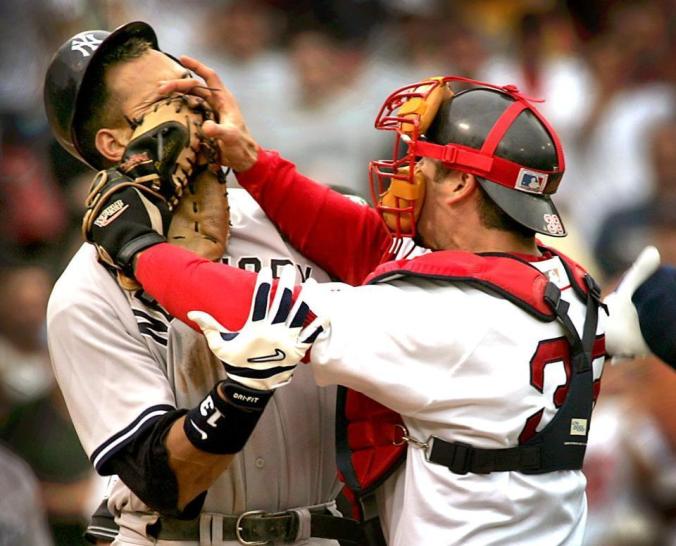
So now a baserunner bearing down on second base when a double-play may be in progress has to slide at the base, not at the fielder. But last night, Austin had his leg high as he slid, and spiked second baseman Brock Holt, Holt, who never threw to first, had words with the Yankee, and both dugouts emptied, though no punches were thrown. It was an illegal slide, no question about it, but because Holt wasn’t interfered with, the umpires did nothing. No penalty out was called. Austin wasn’t thrown out of the game.
This is when the ancient baseball code kicked in. A Yankee had tried to hurt a Red Sox player with an illegal slide, and had gotten away scot-free. If the Sox did nothing to retaliate, they would be showing weakness. I have literally seen this plot a thousand times. I said to my wife, watching the game with me, “The Red Sox are going to throw at Austin, and there will be a fight.”
Sure enough, Sox reliever Joe Kelly, who throws pitches between 96 and 100 mph, threw a fastball into Austin’s back later in the game. Austin charged the mound, as you can see, and all heck broke loose.
[Mickey is really playing that piano. Boy he was amazing…]
1 A Russian Jumbo! And it worked! In Russia, Irina Kudinova was charged with mocking the Church after she posted a photograph that prosecutors alleged was obscene and thus constituted the “deliberate desecration of a religious object” and “insulting the feelings of believers.” Gee, I can’t imagine why anyone would think THAT..Here’s the photo:
Few cases better illustrate the principle that in Bizarro World attempts at ethical acts become unethical. The problem is that Russia has laws that discourage free speech. In order to undermine an unethical law, the judge in this case made a ruling that is obviously contrary to reality, and what anyone can see with their own eyes. If judges can ignore evidence and deny reality to protect citizens from an unjust law, then they can do the same to unjustly punish citizens who break no laws at all.
I’m happy for Kudinova, but the Russian judge is a well-intentioned ethics dunce. His solution does as much damage as good.
2. “Thanks, Mom and Dad…and bite me.” The parents of GOP Senate candidate Kevin Nicholson each gave $2,700, the maximum allowed, to the primary campaign of the Democrat their son is challenging, Senator Tammy Baldwin. Continue reading →
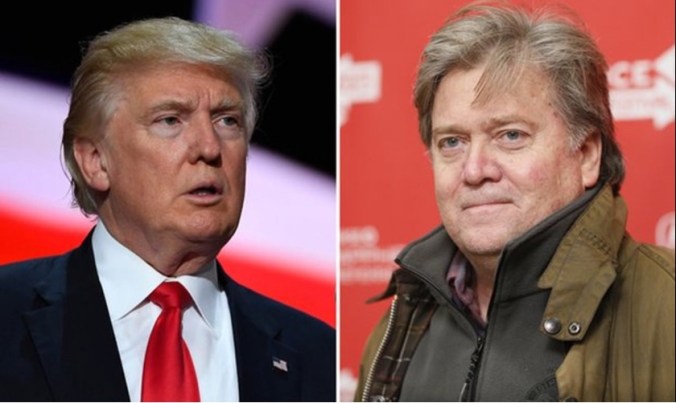
Excerpts from his new book revealed that journalist Michael Wolff extracted some highly inflammatory quotes from ex-White House aide Steve Bannon, who criticized his former boss, members of his family, and White House colleagues. In an unusually well-written, if unrestrained, response, the President used a rhetorical blowtorch on his former ally, writing,
“Steve Bannon has nothing to do with me or my Presidency. When he was fired, he not only lost his job, he lost his mind. Steve pretends to be at war with the media, which he calls the opposition party, yet he spent his time at the White House leaking false information to the media to make himself seem far more important than he was. It is the only thing he does well. Steve was rarely in a one-on-one meeting with me and only pretends to have had influence to fool a few people with no access and no clue, whom he helped write phony books.”
Observations:
Once again, we have the unforgivable spectacle of a once highly placed member of an administration team betraying trust to vent, to get publicity, to settle scores, or to cash in. It’s not whistle-blowing, and its not in the public interest. It hurts the current President and future Presidents, by making a breach of loyalty and confidentiality that was once unimaginable routine. David Stockman, Reagan’s bitter budget director, started this trend with a tell-all book after his star fell to earth, and now every Presidential appointee is a potential Judas. If any of these creeps were ethical, professionals or patriots, they would wait until the administration they had worked for were out of power and in the rear-view mirror, and ideally, way, way in the rear view mirror, like a decade or more. Better yet, they would take the secrets they were entrusted with to the grave.
But what’s the fun in that? More to the point, where’s the money in it? Ten years from now, Steve Bannon will be the answer to a trivia question. Continue reading →
(Nothing better than waking up to a light dusting of snow!)
1 When you can keep your head when all about you are losing theirs…Alan Dershowitz, a Democrat and legal expert who has prominently avoided the ravages of anti-Trump mania that have crippled so many of his distinguished colleagues, tried to clarify several issues in the Mueller investigation on Fox News.
On Special Prosecutor Mueller personally and professionally: “I don’t think he’s partisan, I don’t think he cares whether the Democrats or the Republicans benefit from this.I think he’s a zealous prosecutor and if he were going after Hillary Clinton, he’d be going after her with as much zeal.”
On his investigative team: “Now that’s not true for some of the people on his staff. He should never have allowed these people to serve on this investigative staff, if they had the points of view that they’ve had towards Hillary Clinton and towards Donald Trump. That was a mistake…when you’re going after a president or a presidential candidate, you have to be ‘Caesar’s wife,’ you have to be above reproach, and he didn’t do a good enough job in vetting the people that he brought on to the prosecution and the investigative team, and that hurts his credibility.”
Correct, and obviously correct. So why is the White House and Fox News being criticized daily for questioning the legitimacy, fairness, objectivity, and independence of the investigation? It doesn’t matter if Mueller is personally fair and objective if he appoints biased and conflicted lawyers to do the work. That still means the investigation is compromised and untrustworthy. It also means that Mueller undermined the investigation exactly the way he could not afford to if he wanted its results to be accepted.
There is nothing inappropriate about those being investigated pointing out bias, incompetence and conflicts of interest by the investigators. Criticism of a legitimate complaint, backed up by facts, indicates that those critics don’t care about bias, incompetence and conflicts of interest, if they lead to the result they crave.
2. Suspicion! Why would the NFL’s New England Patriots sign a washed-up, 39-year-old Pittsburgh Steelers veteran, James Harrison, with only one game left in the regular season, at a cost of about $60,000 for that game and for any play-off games the Patriots participate in? Harrison has barely played all season, is no longer a top performer, and was a discordant and disruptive presence in the locker room. Many sportswriters and fans believe that he is being paid by New England to be a turncoat, and to reveal Steelers’ secrets that might provide an edge if the Patriots, as many expect, have to defeat Pittsburgh on the way to another Super Bowl. The Patriots have been caught cheating more than once. Would this be cheating?
I assume not, unless Harrison had an enforceable non disclosure clause that prohibited him from revealing Steelers plays and strategies even after he was no longer on the team. Indeed, it would be unethical for Harrison not to help his new team in any way possible. When New England signed him, they signed his body, mind and accumulated experience. Continue reading →
Last year (to the day) when I posted the Ethics Alarms ethics guide to Frank Capra’s 1946 masterpiece “It’s A Wonderful Life,” one of the great ethics movies of all time, as this blog’s official welcome to the holiday season, I wrote, “I suspect we need it more in 2016 than usual.” As it turned out, we need it even more in 2017.
Multiple forces have been hard at work for a full year now, roiling the nation, painting the future as dire and the present as unbearable, trying to divide us and even to encourage discord and conflict during this special time when we are supposed to remember what is most important in life. In case you have been infected, it’s not politics and not partisan agendas, but love, family, community, kindness, and friends. The simple message of Frank Capra’s masterpiece—it has aged far better than his other films, including, and maybe especially, “Mister Smith Goes To Washington”—that no one is a failure who has friends, is vital to recall when so many are rejecting friends because they don’t conform to some ideological talking point. This is madness, and watching and heeding “It’s A Wonderful Life” is a better remedy than Thorazine.
Senate Minority Leader Chuck Schumer actually told his Twitter followers this week to bring a chart prepared by a think tank to attack the Republican tax plan during Thanksgiving dinner. This is part of the effort to politicize everything in our lives, by zealots who value power over humanity, country, and spirituality. They belong with Mr. Potter, not George and Clarence.
I need this movie more in 2017 than usual for other reasons. It has been a year in which I have lost many peers and cherished friends, and listened to too many of the living bemoan the passage of time and looming mortality. I don’t think like that—a lifetime gift from my brave and fatalist father—but I can’t pretend that the game clock isn’t running out, or not face the fact that I have not sunk anywhere near the baskets I could have and should have. Fortunately, what I wrote in an earlier year introducing this post still resonates…
Everyone’s life does touch many others, and everyone has played a part in the chaotic ordering of random occurrences for good. Think about the children who have been born because you somehow were involved in the chain of events that linked their parents. And if you can’t think of something in your life that has a positive impact on someone–although there has to have been one, and probably many—then do something now. It doesn’t take much; sometimes a smile and a kind word is enough. Remembering the lessons of “It’s a Wonderful Life” really can make life more wonderful, and not just for you.
Have a terrific Thanksgiving, everyone.
And here we go:
1. “If It’s About Ethics, God Must Be Involved”
The movie begins in heaven, represented by twinkling stars. There is no way around this, as divine intervention is at the core of the fantasy. Heaven and angels were big in Hollywood in the Forties. The framing of the tale seems to advance the anti-ethical idea, central to many religions, that good behavior on earth will be rewarded in the hereafter, bolstering the theory that without God and eternal rewards, doing good is pointless.
Yet in the end, it is an ethics movie, not a religious one. George lives an ethical live, not out of any religious conviction, but because step by step, crisis after crisis, he chooses to place the welfare of others, especially his community and family, above his own needs and desires. No reward is promised to him, and he momentarily forgets why we act ethically, until he is reminded. Living ethically is its own reward.
We are introduced to George Bailey, who, we are told, is in trouble and has prayed for help. One has to wonder about people like George, who resort to prayer as a last resort, but they don’t seem to hold it against him in Heaven. The heavenly authorities assign an Angel 2nd Class, Clarence Oddbody, to handle the case..He is, we learn later, something of a second rate angel as well as a 2nd Class one, so it is interesting that whether or not George is in fact saved will be entrusted to less than Heaven’s best. Some lack of commitment, there— perhaps because George has not been “a praying man.” This will teach him—sub-par service!
2. Extra Credit for Moral Luck
George’s first ethical act is saving his brother, Harry, from drowning, an early exhibition of courage, caring and sacrifice. The sacrifice part is that the childhood episode costs George the hearing in one ear. He doesn’t really deserve extra credit for this, as it was not a conscious trade of his hearing for Harry’s young life, but he gets it anyway, just as soldiers who are wounded in battle receive more admiration and accolades than those who are not. Yet this is only moral luck. A wounded hero is no more heroic than a unwounded one, and may be less competent as well as less lucky.
3. The Confusing Drug Store Incident
George Bailey’s next ethical act is when he saves the life of another child by not delivering a bottle of pills that had been inadvertently poisoned by his boss, the druggist, Mr. Gower. This is nothing to get too excited over, really—if George had knowingly delivered poisoned pills, he would have been more guilty than the druggist, who was only careless. What do we call someone who intentionally delivers poison that he knows will be mistaken for medication? A murderer, that’s what. We’re supposed to admire George for not committing murder.
Mr. Gower, at worst, would be guilty of negligent homicide. George saves him from that fate when he saves the child, but if he really wanted to show exemplary ethics, heshould have reported the incident to authorities. Mr. Gower is not a trustworthy pharmacist—he was also the beneficiary of moral luck. He poisoned a child’s pills through inattentiveness. If his customers knew that, would they keep getting their drugs from him? Should they? A professional whose errors are potentially deadly must not dare the fates by working when his or her faculties are impaired by illness, sleeplessness or, in Gower’s case, grief and alcohol.
4. The Uncle Billy Problem
As George grows up, we see that he is loyal and respectful to his father. That’s admirable. What is not admirable is that George’s father, who has fiduciary duties as the head of a Building and Loan, has placed his brother Billy in a position of responsibility. As we soon learn, Billy is a souse, a fool and an incompetent. This is a breach of fiscal and business ethics by the elder Bailey, and one that George engages in as well, to his eventual sorrow.
There are a lot of ethics issues, legal and otherwise, flying around in the shocking—this really is shocking—revelation that lawyer Al Gore’s Supreme Court lawyer (and loser) David Boies was working to help Harvey Weinstein intimidate and discredit the women who were preparing to accuse him of sexual harassment, sexual assault, and rape.
The New Yorker reports in an investigative reporting piece that the Boies firm was retained by Weinstein, and on his behalf hired Black Cube, an investigative company run by former Israeli intelligence agents to prevent the publication of abuse allegations by creating profiles on the targeted accusers, often using pretexting–that is, lies— to gain access to proprietary information. Black Cube’s work included psychological profiles and sexual histories of the potential Weinstein accusers. The engagement with Black Cube was presumably run through Boies Schiller Flexner to place the shady matter under attorney-client privilege.
David Boies personally signed the contract with Black Cube, which, according to the New Yorker, was to obtain ” intelligence which will help the Client’s—that is, Weinstein’s— efforts to completely stop the publication of a new negative article in a leading NY newspaper” and to “obtain additional content of a book currently being written [that] includes harmful negative information on and about the Client.”
Did you see “Michel Clayton,” where George Clooney played a law firm’s “fixer”? That’s what Boies was doing here. “Fixing.” And fixing is a dirty business.
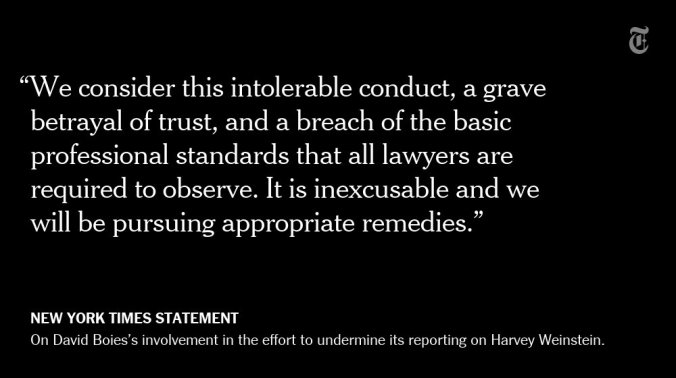
That “leading NY newspaper” was and is the New York Times, which, as we now know, was readying its own sensational story regarding the accusations against Weinstein.The New York Times was also a client of Boies Schiller Flexner, though on unrelated matters, hence the statement above. Unsurprisingly, the Times has sacked Boies and his boys.
[Aside: Here’s a lawyer ethics practice tip. If a client asks you to contract with a company called “Black Cube,” “CHAOS,’ “The Legion of Evil,” “The Black Hand,” or “Murder, Inc.”, just say no.]
I had to get this post up before the Morning Ethics Warm-Up, because it warmed ME up by almost exploding my head.
Lisa Bloom, the daughter of feminist muck-raking celebrity attorney Gloria Allred, has already shown the she has either no regard for legal ethics, or is spectacularly ignorant of them. She has publicly breached the duty of loyalty, attacking her former client, Harvey Weinstein; she took on Weinstein in the teeth of a blatant conflict of interest that she also publicized, as if it was something to be proud of. Yesterday, she showed that she is unfamiliar with, or perhaps just doesn’t give a damn about, the core legal ethics principle of confidentiality, perhaps the most important legal ethics duty of all.
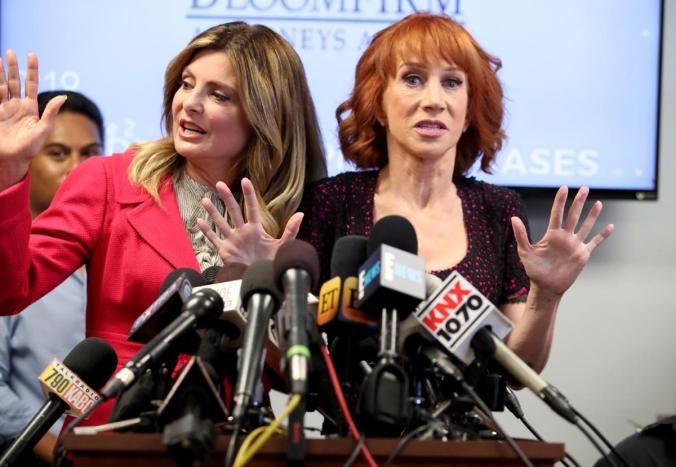
Her latest ex-client to be the victim of Bloom’s unprofessional conduct and disloyalty is Kathy Griffin, she of the severed head. Griffin announced that she had fired Bloom, and wasn’t nice about it—but then when is Griffin ever nice?—saying, “Yes, I got Bloomed. Yes, I didn’t have a good experience with her. Yes, I feel that she and her husband exacerbated my personal situation.” Disaffected clients can say anything they choose about their lawyers. They can do it on Yelp, on the lawyer consumer site Avvo, to the Hollywood Reporter or hire a skywriter. What a client says, mean or not, untrue or not, still does not alter a lawyer’s continuing ethical obligations one whit. A lawyer cannot get into a public fight with a former client over what did or did not occur during the representation. Every lawyer knows this, or is supposed to.
Yet Bloom—I would say “incredibly” had we not seen other examples of her professional ethics cluelessness—released this statement on Twitter:
[My head told me in a statement that it would have exploded over this but determined that doing so over Kathy Griffin and Lisa Bloom was demeaning to head-explosions. I concur.]
The fact that Bloom had prepared Griffin’s remarks for the press conference, the fact that they worked on them together, the fact that Griffin discarded them, the fact the performer “ad-libbed” and “extemporized” are all client confidences. For all we knew, Griffin’s claim during the press conference that she was ignoring her notes was part of a pre-planned strategy. I assumed it was; Griffin is an actress. “It’s best if you show that you are talking from the heart, Kathy,” is advice I would expect Griffin’s lawyer to give. A lawyer cannot tell the public that a client ignored her advice. Only the lawyer and the client know that. Revealing it is to disclose information the lawyer learned during the course of the representation that will harm or embarrass the client, a serious ethics violation and betrayal of trust Continue reading →
Now, don’t sue me, Lisa! Remember what it says in the “About” section (above), this is all just my opinion. When I say you are a stunningly unethical lawyer, that’s just my analysis; it’s true I know something about legal ethics, teaching and consulting on it full time, but I can’t assert my opinion as fact. I can’t read your mind or slog through your soul. I don’t know what a bar disciplinary committee would decide, though I know this is a famously gray area in legal ethics, so unethical conduct is unlikely to be punished. And when I say you’re a hack, remember that “hack” isn’t a description subject to objective proof, any more than, say, “asshole.” Perhaps your definition of “hack’ is different from mine. In fact, I’m sure it is.
That said, your conduct is a professional disgrace. I think. Who knows? I may be wrong.
In an interview with BuzzFeed News published this weekend, Bloom, speaking of her recently terminated representation of Harvey Weinstein, said
“I can see that my just being associated with this was a mistake. All I can say is, from my perspective, I thought, ‘Here is my chance to get to the root of the problem from the inside. I am usually on the outside throwing stones. Here is my chance to be in the inside and to get a guy to handle this thing in a different way.’ I thought that would be a positive thing, but clearly it did not go over at all.”
Bloom added that she will no longer represent men accused of sexual misconduct, “even those who convincingly tell me they are innocent….I will just make the best choices I can out of every situation. I have clearly not been successful. I think anybody who does big bold things fails. And I definitely failed on this one.”
What Bloom has failed at is called “being a trustworthy and competent lawyer.”
The next day, during an appearance on Good Morning America, Bloom even more explicitly threw her former client under the metaphorical bus:
“It’s gross, yeah,” Bloom told GMA. “I’m working with a guy who has behaved badly over the years, who is genuinely remorseful, who says, you know, ‘I have caused a lot of pain.’”
Did Bloom actually graduate from law school, or did she just apprentice in her mother’s office (she is Gloria Allred’s daughter) and somehow get an honorary license? Did she never learn about the a lawyer’s duties of loyalty and confidentiality? She obviously didn’t know about conflicts of interest, since she represented Weinstein while agreeing to let him turn her book into a TV miniseries.
Ethics Alarms has previously criticized lawyers who have publicly undermined their former clients. The most recent example was last year, when a former Trump lawyer used his experiences while representing the future Presidential candidate decades earlier to write a scathing mid-campaign attack on his former client in the Huffington Post. I wrote,
There is strong disagreement in the profession about whether the answer to “Is this unethical?” should be an outright yes. The status of loyalty among the legal ethics values hierarchy is as hotly contested now as it ever has been. If a lawyer wants to attack a former client in a matter unrelated to the representation and no confidences are revealed in the process, is that a legal ethics breach? If it is, it would be a very tough one to prosecute. I think it’s a general ethics breach, as in wrong and unprofessional. It is disloyal, and clients should be able to trust their lawyers not to come back years later, after a client let the lawyer see all of his or her warts, and say, “This guy’s an asshole.” It undermines the strength of the public’s trust in the profession.
I’m sure some will consider Washington Post writer Fredrick Kunkle some kind of a hero, a whistleblower and a truth-teller. He isn’t.
Kunkle authored a frontal attack on his boss, Post owner and Amazon gazillionaire Jeff Bezos, in another publication, the Huffington Post. He doesn’t allege any illegal activity or genuine abuse. he just doesn’t like the way Bezos runs his business. His screed, and it is a screed, comes down to a labor vs management, anti-capitalist, crypto-Marxist bill of particulars arguing that Bezos has so much money he should spread more of it around to his employees. Probably he should, but an employee who is being paid by such an individual is not ethically situated to make that accusation in public. This is disloyalty, and an intentional effort to harm his employer.
‘Bye!
What seems to have set Kunkle off was Bezos asking his Twitter follower how he should expand his philanthropic efforts:
But as Bezos, whose worth now exceeds $80 billion, loosens his pockets, it’s important to put his charitable giving — and the philanthropy of the super-rich — into perspective: Many people worked hard for Bezos to help make him so rich, and he has a record of treating them poorly. Amazon’s history of dodging taxes, its mistreatment of workers, and its ruthlessness toward even the smallest competitors have been well documented. It put ambulances outside distribution centers rather than install adequate air conditioning. It broke up a union organizing effort by closing the call center and dismissing everyone who worked there. The New York Times documented its punishing work environment in a front-page exposé. The company’s actions, as Forbes put it, hark back to an earlier time when workers were treated as “replaceable cogs in the machine.”
“Replaceable cogs in the machine” means “if you don’t like it here, there are many equally qualified people who would love to have your job.” That is certainly true of the struggling newspaper industry. He calls his boss a tax dodger (if you avoid taxes using legally available means and laws, you aren’t “dodging” anything); ruthless, an abuser of workers, and most questionable of all, uses a New York Times exposé as gospel. The Times is the Post’s rival. Its hit pieces on Bezos are hardly objective; heck, almost nothing the Times writes is objective (nor the Post, for that matter.) Continue reading →
Baseball finally installed a replay review system to address umpire calls that were shown by TV slow-mo to be clearly wrong. For all the complaining about the system, it was the only ethical choice. Mistaken calls were changing the results of games, and because of technology, this was now obvious to all. Only technology could solve the problem.
Unfortunately, however, human beings still control the technology. Bias, emotion and other impediments to ethics will still prevail more often than we like to think. Yesterday’s Red Sox Yankee game provided a classic example.
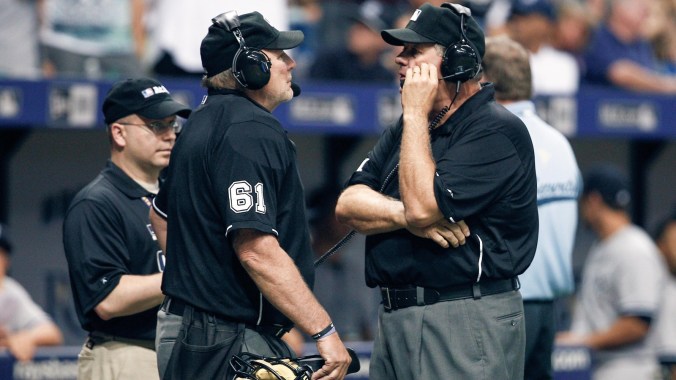
Yankees manager Joe Girardi challenged a safe call on the Sox’s Andrew Benintendi when he slid into second base for an apparent double. The video showed that the second base umpire had missed the play. Upon review—the umpires put on headsets to get the verdict from a New York studio where another set of umpires check the video from multiple angles—the call was reversed, and Benintendi was out.
In the same inning, Red Sox manager John Farrell challenged an inning-ending double play. The review showed Red Sox baserunner Mookie Betts safely reached second before the throw, allowing the Red Sox to score the game’s first run. For the second time in a single inning, Greg Gibson, the second base umpire, had his call reversed. I have never seen this happen before. For an umpire, this is not just embarrassing, it is professionally humiliating.
Later, in the seventh inning, the same star-crossed (cross-eyed?) umpire called Yankee Greg Bird out as he was doubled off second base after a lineout. The video this time was more conclusive than the first challenge: the umpire blew it, again. Bird had beat the throw.
While the challenge was being reviewed, the Red Sox broadcasters, who had concluded that Bir should have been called safe at second, were talking about the rarity of the same umpire being reversed three times in a single game. Sox color man Dennis Eckersley wondered aloud if professional courtesy and loyalty might affect the review. What he was really asking was whether the umpires in New York would allow a colleague to be exposed to the disgrace of being reversed three times in one game. This wouldn’t only make him look bad, after all. It would make umpires look bad. Three strikes and you’re out, after all.
Sure enough, the decision from New York was that the call at second was correct. Bird was out, even though the video showed he was safe.
The umpires have plausible deniability here: this was hardly the first time that a replay review seemed at odds with a video. Nonetheless, it was a sobering display. By all appearances, the umpires distorted the game to protect one of their own who was having a terrible night. They were employing the Golden Rule in the kind of setting where the Golden Rule works against an ethical result, not for it.
Fortunately for the umpires, allowing the third blown call at second was allowed to stand had no effect on the game’s outcome, but that is just moral luck. The umpires made a very clear statement. They regard loyalty to colleagues as more important than their profession, the game, their fans, or public trust. They, or at least the umpires involved, cannot be trusted to put aside their biases and conflicts when their duties demand it. Technology may be unbiased, but the humans using it are not. Professionals are not always professional when a colleague’s fate is involved.




 Ethics Alarms