Comment of the Day: “Ethics Quiz: Peeps Ethics”

Peeps Last Supper by Leonardo DiPeepchi

Peeps Last Supper by Leonardo DiPeepchi

Extradimensional Cephalopod’s thoughtful answer to today’s ethics quiz was instantly recognizable as a Comment of the Day, so here it is, EC’s musings on the ethical limits on peeps art, as posed by the post, Ethics Quiz: Peeps Ethics:

Full disclosure: I identify as a freethinker, which in my case means my opinions are informed by this idea: “It is the mark of an educated mind to be able to entertain a thought without accepting it.” –Aristotle (or so the Internet tells me)

With that in mind, offhand I’d say anyone who can’t handle the juxtaposition of a serious scene with a cutesy or comical medium is not emotionally mature enough to be trusted to react appropriately in today’s complex and nuanced culture, and their reverence is likely to be taken to unhealthy levels. I think it is not only ethical, but a requirement for intellectual health to be able to entertain different perspectives and styles of presenting even the most serious subjects. Before someone asks, yes, that includes depictions of the prophet Muhammad, along with all other historical figures on pedestals. I think taboos are unhealthy for a society because they limit critical thinking and creative free thought, both of which are necessary (yet seldom employed) to resolve social issues and differences in perspective.

Bad taste is still a valid concept, but it is context-dependent. It is possible that a subject is not appropriate for most contexts because it leads people to feel bad, but it is imperative that there be some place where it can be discussed, even if it is only under the Jester’s Privilege. My subjective judgment rules that depicting the Civil Rights Movement with marshmallows in this case is not intended with disrespect: the contest stipulated that the medium be marshmallows, and the artist chose a powerful scene without regard for the medium, as is the artist’s prerogative. I personally think the marshmallow scene is quite dignified, but then I am a bit out of sync with humanity as to what I take at face value and what I don’t. I form opinions of peeps by their actions, not by their countenance. It’s unethical for an artist to deliberately spread misconceptions about history, and it may be unethical for an artist to deliberately show disrespect to powerful agents of good. Disrespect is usually unethical because it causes so many problems. However, I’m not sure a sincerely respectful artist can be unethical in their art, unless they simply fail to do the research on the facts they depict and the cultural context for showing respect.

If depicting scenes from the Civil Rights Movement with marshmallows (and putting a good deal of effort into it) is wrong, though, what else is wrong? Crayon drawings by kids? Macaroni? Charcoal? Embroidery? Spray paint? Etch-A-Sketch? Is anything that looks insufficiently grandiose for depicting humanity’s legendary heroes an affront upon their memories? Are scenes of historical importance off-limits to mediocre artists, for fear the general public will lose respect for heroes drawn with funny expressions and ridiculous poses? What if an artist is deliberately depicting a heroic person comically, but without telling lies? Why can’t we be mature, and tell the history with respect while artists do their best in sincerity or spite? Why not simply say, “Well, it’s nice, but it really doesn’t do it justice,” and walk away?
Continue reading

Ethics Quiz: Peeps Ethics

peeps winner

I collect sentences that can safely be said to have never been uttered before in the history of mankind, and encountered one this morning in a letter of complaint to the Washington Post. It read…

“To take a sacred and historic event in our nation’s history and depict it using marshmallow candy is highly insulting and offensive to the legacy of the Rev. Martin Luther King Jr. and to all those who worked, and continue to work, for racial justice in this country.”

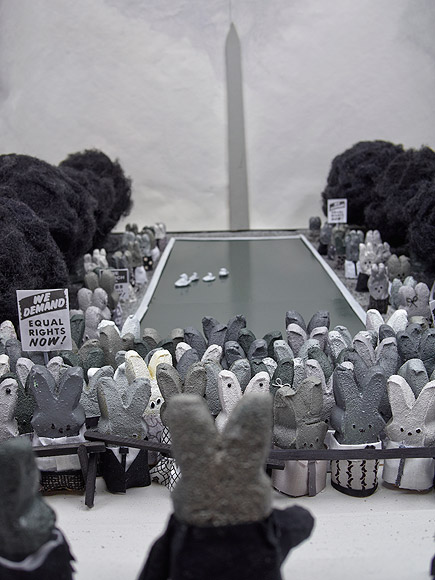
Like all of the sentences in my collection, my favorite being my sister’s immortal, “That fish looks so good, from now on I think I’ll wear my bra on my head,” this one requires some context. The Post holds an annual contest for its readers around Easter, challenging them to submit the best diorama of a scene, using marshmallow peeps. This year’s winner was created by Matthew McFeeley, Mary Clare Peate, and Alex Baker, and involved meticulously painting the colorful bunny stand-ins for King and his throng  at the 1963 March on Washingtonian eight shades of gray to evoke the black-and-white photographs of the event.

Your Ethics Alarms Ethics Quiz, in the sadly neglected field of peeps ethics, is…

Is it unethical to use marshmallow candy as a medium to portray serious, solemn, or other events that many feel deserve respect and reverence?

I know my answer, but this time, I’ll hold my fire until I hear from readers. I’d also be interested in whether any events—Gettysburg…JFK’s assassination…the Lindbergh baby kidnapping…the Crucifixion…Pearl Harbor…9-11…  are ethically off-limits for peeps creativity as inherently offensive, or if this is just  an unappetizing mixture of “ick,” art, humor, and candy.

When Bloggers Screw Up

Hey, who said that? (It's a trick question!)

Hey, who said that? (It’s a trick question!)

Ann Althouse is a quirky, well-respected blogger, a Wisconsin law professor who is liable to write wittily and perceptively about anything from dogs to politics from her barely right of center political perspective. Recently she banned all comments from her blog, meaning that she now pontificates without the safety net of informed readers being available to tell her when she’s jumped the track of rationality, which, without exception, we all do. This means that on the rare occasions that the erudite and perceptive Ms. Althouse is full of beans, there is no way to let her or anyone else know.

So I’m letting her know.

For some reason, Althouse is indignant over the $800,000 the Interior Department is spending to erase the incorrect quote negligently carved into the Martin Luther King Memorial. She writes with a sneer,

“Martin Luther King said “I was a drum major for justice, peace and righteousness,” which we will remember, even through it’s now off the memorial. It’s off the memorial because, in the “drum major” speech, there were some other words around it — as is always the case with snappy lines in speeches — and Maya Angelou and others felt some shades of subtlety were lost, making the man sound arrogant.Continue reading

Don Lemon For President

Ethics Hero.

Ethics Hero.

Bear with me: I’ll get to Don Lemon eventually.

In a mature, rational, respectful democracy with an objective and competent news media, difficult and contentious issues would be thoughtfully debated with open minds and fearless honesty, without the toxic influence of rigid ideologies, partisan loyalties, group identification, or biases. The objectives: reach the truth, identify problems, begin solving them.

This process is difficult under the best of circumstances, and in the United States, circa 2013, it is nearly impossible on any issue, and dangerous on the issue of race, with both the media and elected officials actively seeking to exacerbate racial divisions and misconceptions. A recent poll suggests that the perception of racial divisions in America has worsened by 25% since Barack Obama was elected President, following decades of steady improvement. Why is this? There are many reasons, but the cynical pandering to misconceptions in the black community is one major suspect.

President Obama, had he been fair and responsible, might have used his remarks about the George Zimmerman trial to point out that neither the incident itself nor the verdict of the jury were relevant to race issues, or created by a “stand your ground” law that has been a lightning rod for accusations of racism in the justice system. Instead, he talked about how he “understood,” and apparently agreed with, an interpretation of the events based on past African-American experiences with racism. This was irresponsible and wrong. It was as much an endorsement of irrationality, ignorance and bias as it would be to explain that current day racists see blacks through the prism, “those sets of experiences” in Obama’s words, of their region’s history of culturally acceptable slavery, and we have to respect their views as a result. The President has not, as would be a far more justifiable statement, explained that opponents of same-sex marriage are not bigots, but see the issue through the ” sets of experiences” of their religious upbringing. Serial rapists may also see women through the prism of their childhood abuse—those are rather damaging “sets of experiences”— at the hands of their mothers.

There are always powerful reasons why people have hatreds and biases, and reasons why hatreds and biases cripple their ability to interpret reality and act responsibly. We can all understand that, but it doesn’t justify distorting the facts. Blacks are not inferior to any other race, no matter what the “prism” says. Gay marriage poses no harm to society, and gays deserve the same rights as anyone else, and the Bible doesn’t change those facts. Rape victims are not responsible for the misogyny of rapists, no matter how their distorted thinking came to be.

And the acquittal of George Zimmerman was not evidence of rampant white racism, regardless of the African-American experience. The President had a duty to say that. He had a duty to say, “I understand, but you are wrong on the facts.” He did not. Instead, he encouraged and supported a distorted and biased narrative that is harming race relations and respect for the justice system, and far too many in the news media—which is to say, anyone in the media who is stooping to this—are trying to continue the process. For example, Abbe Smith, in the Washington Post this weekend, had an article on a topic I have discussed here more than once: the challenge of a defense attorney representing a guilty and heinous client. It was an excellent piece, but the Post headline writers and editors unconscionably and unethically decided to pander to the city’s  predominantly black population’s bias by publishing it under this:

“What motivates a lawyer to defend

a Tsarnaev, a Castro or a Zimmerman?” Continue reading

Ethics Quote of the Week: Moses (Charlton Heston) in “The Ten Commandments”

The evil that men should turn their brothers into beasts of burden, to be stripped of spirit, and hope, and strength – only because they are of another race, another creed. If there is a god, he did not mean this to be so.

—-Moses, as played by Charlton Heston and scripted by seven writers, in Cecil B. DeMille’s “The Ten Commandments.” answering to the Pharoah Seti’s question, “Then why are you forcing me to destroy you? What evil has done this to you?”

The Ten Commandments“The Ten Commandments” is so extravagantly fun and entertaining that, I must confess, I never watched it as an ethics film until tonight, as ABC once again broadcast the Biblical epic on an Easter weekend. This quote especially struck me as remarkable for a film made by an infamously rigid conservative, DeMille, in 1956.

On Dec. 1, 1955, Rosa Parks was arrested for refusing to give up her seat on a Montgomery city bus. The next twelve months were tense, difficult days in which the entire U.S. population was undergoing a wrenching cultural debate regarding human rights.  On Dec. 6, 1955, the civil rights boycott, led by Marin Luther King, of Montgomery city buses began. January 1956 saw Autherine Lucy, a black woman, accepted for classes at the University of Alabama in Tuscaloosa, the first African-American ever allowed to enroll.  On Jan. 30, the home of Martin Luther King, Jr. was bombed in Montgomery. February 4 saw rioting and violence on the campus of the University of Alabama and in the streets of Tuscaloosa. Lucy had to flee the campus, and the university’s Board of Trustees barred her from returning. On the 22nd of that month, warrants were  issued for the arrest of the 115 leaders of the Montgomery bus boycott. A week later, courts ordered Lucy readmitted, but the school expelled her. Continue reading

Ethics Hero: Jeffrey Warren

You’ve probably heard or read the story by now.

Wait! Maybe he’s Cherokee!

17-year-old Jeffrey Warren rose to accept the $1,000 college scholarship awarded by the local Martin Luther King Senior Citizens Club during seniors night at Martin Luther King High School in Riverside, California, and provoked both laughter and awkward gasps. He was obviously white—as white as Elizabeth Warren—and the scholarship for intended for black students, though Warren didn’t know that when he applied.

Later, Warren decided to give back the money. His family said they didn’t want the African-American women who gave out the award to be foiled in their attempt to help young black scholars, and that it was the right thing to do. I would say that it was a right thing to do, and showed exemplary kindness, compassion, empathy, generosity, charity and altruism. Jeffrey had every right to accept the money. The Club’s requirements were vague, and did not make it clear that he was not eligible when he applied. If he and his parents had wanted to make a political and philosophical statement about the hypocrisy of a race-based scholarship in the name of Martin Luther King, this was an ideal opportunity, and an argument could be made that this would have been the “right” thing to do as well, if not “righter.” Continue reading

The “I Have A Dream” Speech Ethics Train Wreck

Dr. King's familiy says this was a "performance" not a speech. Funny: I thought he was just speaking the truth. I guess I was dreaming.

Take Martin Luther King Day, turn right at the “Stopping Online Piracy Act” (SOPA/ PIPA) protests, and you get to the ridiculous fact that you are breaking the law anytime you circulate a recording or video of the Martin Luther King’s immortal “I Have A Dream” speech.

Through a baroque combination of expediency, legal maneuvers, luck and greed, this vital part of American thought, rhetoric, culture and history is restricted by the copyright laws, and will not be in the public domain until 2037, or more than 70 years after King’s words were spoken in front of the Lincoln Memorial. Now, under SOPA/PIPA, if it passes, any educational website that includes a video of the King Video could be taken down by the Feds, but that’s a side issue. I am no expert on the bill, but you can brief yourself on what all the fuss is about here, here, here, and here, the bill itself. Similarly, if I tried to explain the legal process by which courts agreed that a critical chapter in American history should be unavailable to Americans unless they pay a fee, it would 1) bore you stiff, 2) confuse you, and 3) probably be wrong. So I recommend this post by Alex Pasternak over at Motherboard, who does a great job laying out the whole, tortuous, tragic story.

I’ll concentrate on the ethics train wreck feature, of which the basic elements are these: Continue reading

Ethics Quote of the Day: Rev. Martin Luther King (January 15, 1929 – April 4, 1968)

“On some positions, Cowardice asks the question, ‘Is it safe?’ Expediency asks the question, ‘Is it politic?’ And Vanity comes along and asks the question, ‘Is it popular?’ But Conscience asks the question ‘Is it right?’ And there comes a time when one must take a position that is neither safe, nor politic, nor popular, but he must do it because Conscience tells him it is right.”

—-Rev. Martin Luther King Jr., in his Feb. 6, 1968 speech in Washington D.C. entitled “A Proper Sense of Priorities.”

Ethics Hero AND Ethics Dunce: Secretary of the Interior Ken Salazar

U.S. Interior Secretary Ken Salazar scores a rare twin honor: He is an Ethics Dunce and an Ethics Hero in the same week.

Occupier, or just a vistor, Mr. Secretary?

First the good news, the Ethics Hero part.  Salazar has given the National Park Service  30 days to fix the inaccurate, misleading and truncated quotation on the Martin Luther King Jr. National Memorial. He did this after giving the inept King Memorial Foundation plenty of time to do its job. It didn’t, and he took the initiative. Harry Johnson, president of the Foundation, told the AP he wasn’t sure what changes could be made. Well, how about using a real quote instead of a made-up one that makes Martin Luthor King sound like a preening Newt Gingrich?

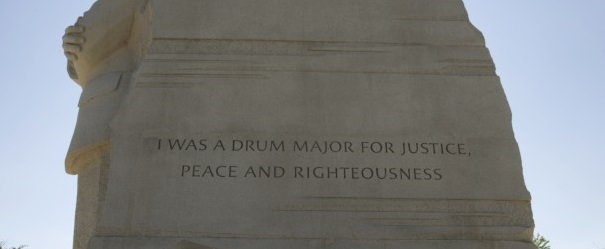
Chiseled into the monument’s left flank because there wasn’t room for the actual quote is “I was a drum major for justice, peace and righteousness.” What King really said in a 1968  speech was: “If you want to say that I was a drum major, say that I was a drum major for justice. Say that I was a drum major for peace. I was a drum major for righteousness. And all of the other shallow things will not matter.” When Maya Angelou and others complained that the pompous-sounding non-quote make King sound like a boasting egotist (and one speaking from the grave!), the Foundation shrugged and erected the monument unchanged. Continue reading

More Quotation Ethics: The Martin Luther King Memorial Strikes Again…But It’s Maya Angelou’s Fault

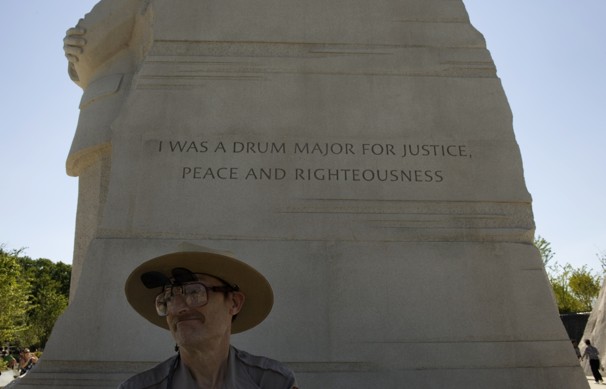
Who said that quote inscribed on the MLK monument? Not Rev. King! Maybe that guy in the hat...

When I saw the Martin Luther King quote engraved on the north face of his monument at the Martin Luther King Jr. Memorial, my immediate thought was: “A little full of ourselves there, are we, Marty?”

It reads: “I was a drum major for justice, peace and righteousness.”

Personally, I’ve always hated drum majors—prancing, flashy show-offs with big hats. I never thought of Martin Luther King as a drum major, or as someone prone to self-glorifying descriptions. I was relieved, therefore, to learn that what he really said was this, in a sermon two months before his death, speculating on what his eulogy might sound like:

“If you want to say that I was a drum major, say that I was a drum major for justice. Say that I was a drum major for peace. I was a drum major for righteousness. And all of the other shallow things will not matter.”

Ahh! Now that’s the Rev. Martin Luther King I remember! Unfortunately, it’s not the one future generations of America will know, because a false quote, mischaracterizing his meaning and his character, is immortalized in stone on the National Mall. Continue reading