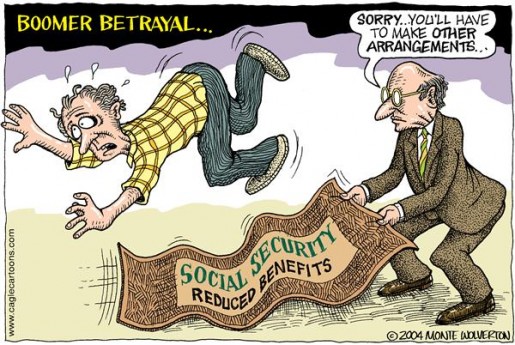
A typical nuanced view of the problem…
My father was in the private pension business before he died, and the idiocy of how Social Security was set up drove him to distraction. I’m pretty sure he voted for Ross Perot in 1992 because Perot argued that it made no sense not to means test the program. I’m tempted to take a copy of Robert J. Samuelson’s op-ed last week to Arlington National Cemetery and leave it on his gravestone.
Samuelson is reliably one of the most rational, thoughtful and probing of all the op-ed columnists. Last week he wrote about how the life-expectancy gap between the wealthier segments of U.S. society and the poorer ones made Social Security as it is currently constituted a significant contributor to the income gap that progressives desperately want to make a key issue in the 2016 election, because dividing the nation by class (and race, ethnicity, religion and gender) is a big part of their playbook.
“The figures come from a new report by the National Academies of Sciences, Engineering and Medicine, which estimated life expectancies for workers born in 1930 (now 85) and 1960 (now 55) at age 50. The findings are stark. For the richest fifth of men, there was a 7.1-year increase in life expectancy, from 81.7 for those born in 1930 to 88.8 years for those born in 1960. Meanwhile, for the poorest fifth of men, life expectancy fell slightly, from 76.6 years for those born in 1930 to 76.1 for those born in 1960. The changes for the remaining men also parallel income: For the second richest fifth, the increase was 8 years to 87.8 years; for the third richest, 5.3 years to 83.4 years; and for the fourth richest, 1.1 years to 78.3 years.”
Nobody should be surprised that wealth equals health. It is difficult to pinpoint why the gap is so large, but should we have to? It seems intuitively obvious. Many disadvantages–race, upbringing, family stability, good roles models, education, character, intelligence, opportunities, culture, neighborhoods—that undermine quality of life simultaneously or in combination with each other handicap earning ability and health before we even get to the question of medical care.
Samuelson goes on… Continue reading
 Ethics Alarms