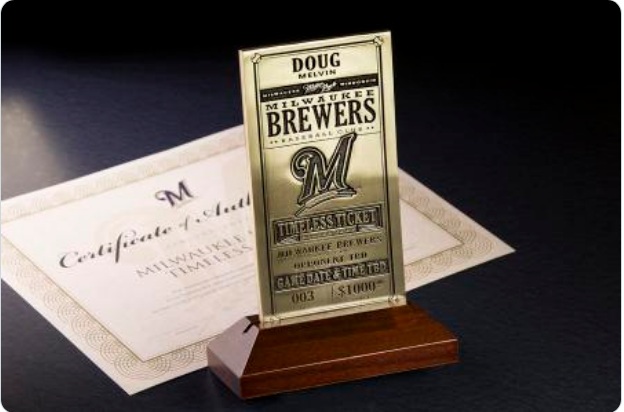
The Milwaukee Brewers’ Unethical Promise

It’s one of the oldest and most valid of all ethics warnings. “Don’t make promises you can’t be sure that you can keep.”

In 2015, apparently seeking fast cash, the Milwaukee Brewers , now the 2026 National League Champions, offered a promotion that sold fans a “Timeless Ticket” for $1,000. It would guarantee the purchaser not only admission to any future game,”but the best available seat locations, subject to ticket availability at the time of redemption.” A Timeless Ticket also allowed the holder to buy three additional tickets to the selected game at full retail price.

Well now the Brewers are in the World Series, and it’s time to fulfill that commitment. Many of the “Timeless Ticket” buyers have been waiting to use it for a Brewers World Series if and when one occurred.

TT holder Danny Fochesato is ticked off, and he isn’t alone. He told the Associated Press, “They really touted, ‘Hey, this is going to be the best available seats. You’re getting the priority just behind season ticket holders. Anything the season ticket holders don’t have, you’ll have dibs at it for the World Series.’ That’s kind of the story they sold.” But he was given a choice between nosebleed seats or standing room as his only options for the World Series, and he could not select the specific game he wanted to attend. That wasn’t the deal.

“We subsequently erred in our internal communications on the logistics of fulfilling the requests,” Brewers president of business operations Rick Schlesinger tried to explain. “While we were able to accommodate all with seats, we received feedback from some that they were unhappy with their seat locations. Clearly, even with extraordinary limitations on available seats, we did not live up to the spirit of the program, and we have been working through a resolution.”

No, you didn’t live up to the letter of the program. This was a bait-and-switch.

To attempt to make amends, now the Brewers will allow any fans who accepted the subpar seats through the Timeless Ticket program to keep those seats for the World Series and still use their “Timeless Tickets” for redemption for another game in any future season.

“We regret our mistake and look forward to welcoming them to American Family Field for their World Series experience,” Schlesinger said. Their crummy World Series experience that they paid $1000 bucks for based on the team’s promises.

Not good enough.

The last time the Brewers were in Series was 1982, 44 years ago. The next time the team will be in the Fall Classic may be even a longer wait than that. It will be 55 years from 2015 in 2070, and most of those Timeless Ticket holders will be out of time.

I have been through this kind of scam myself. I purchased a lifetime gym membership and the gym chain was acquired by another gym company a few years later. They honored my lifetime contract for a while, as they were legally obligated to do, then just told me, “You’ve gotten more than your money’s worth, so get lost.” I was in no position to sue them, so I just joined another gym. But those cash-for-benefits-far-in-the-future deals are unethical unless they include iron-clad commitments to compensate the buyer if the fulfillment of the promise becomes impossible.

The Brewers should refund the full amount of the “Timeless Ticket” to any purchaser who prefers money back to another promise from an organization they foolishly trusted in 2015.

________________

Pointer: JutGory

Ethics Quiz: The Aborted No-Hitter

Friday night, Miami pitcher Adam Conley  was pitching a no-hitter against the Milwaukee Brewers with two outs in the eighth inning, meaning that he was just four outs away. A no-hitter—no hits, no runs, for an entire game—places a pitcher name in the  Hall of Fame. It makes him an instant part of sports history. In today’s hyper-celebrity culture, it means interviews and endorsements.

Moreover, the Marlins needed something to make their fans feel better. Dee Gordon, the team’s star second baseman, had just tested positive for steroids and was suspended for 80 games. Nonetheless, Marlins manager Don Mattingly lifted Conley because he had exceeded his pitch count. Though baseball paid little attention to the statistic for 70 years, today teams carefully monitor how many pitches a hurler throws, both to anticipate ineffectiveness, and to guard against injury.

In Conley’s case, he had never thrown more than a hundred pitches in a game, and had topped out at 116. To Mattingly and Marlins pitching coach Juan Nieves, that meant that even on the verge of immortality, Conley had to be removed. Conley was angry, though he said all the right things after the game. Still, knowing the alleged risk to his arm and career, he wanted to try to finish his masterpiece. (The Marlins blew the no-hitter and the shutout in the 9th, though still managed to win 5-3.)

Your Ethics Alarms Ethics Quiz of the Day:

Was removing Conley “for his own good” when he wanted to have the chance at a no-hitter fair?

Continue reading →

Ethical Apology Of The Month: Ryan Braun—Finally

Better late than never, Ryan...I'd almost given up on you.

Better late than never, Ryan…I’d almost given up on you.

Ryan Braun, the 2011 National League MVP who was suspended for the rest of this season for his use of illicit performance enhancing drugs and accepted that suspension without protest or appeal, has released a statement admitting steroid use and apologizing to all, including the testing sample collector whom he had earlier implicitly accused of trying to frame him with a false positive.

I think this ranks as a #1 on the Ethics Alarms Apology Scale, and we don’t see those very often from public figures. That apology is defined as…

An apology motivated by the realization that one’s past conduct was unjust, unfair, and wrong, constituting an unequivocal admission of wrongdoing as well as regret, remorse and contrition, as part of a sincere effort to make amends and seek forgiveness.

Already, critics are taking pot-shots at Braun’s statement. This is, I believe, one reason people so seldom give full apologies: they are never accepted by so many angry pundits, who pick them to pieces. Baseball fans and others in the game have a lot of reasons to be furious with Braun, it is true. His genuine apology comes late, after a terrible one, and there is probably some truth to the theory that he or his PR advisors saw an opportunity to contrast his conduct with that of Alex Rodriquez, who is continuing to deny his PED use and is forcing steroid-hating fans and players to watch him play anyway, while he appeals and collects 5 figures in compensation per at bat. Braun is no Ethics Hero, for his options were limited. Nonetheless, I see nothing to criticize in his apology, and we want to see more apologies that rank at the top of the scale, we need to applaud them when they appear.

Here is Braun’s statement: Continue reading →

Ryan Braun’s Unethical Apology

ryan-braun-2011Ryan Braun, the Milwaukee Brewers star who has just accepted MLB’s decision to suspend him without pay for the remainder of the 2013 season for violating baseball’s anti-drug policies, issued the kind of public statement that helps us understand why the athlete thought using banned substances to improve his performance was acceptable. It is the statement of someone’s whose ethical instincts are not merely underdeveloped, but malfunctioning on an epic scale.

Braun released this mea culpa in the wake of the announcement of his disgrace, which also pretty much ends the already faint chances of his team for a successful season:

“As I have acknowledged in the past, I am not perfect. I realize now that I have made some mistakes. I am willing to accept the consequences of those actions. “This situation has taken a toll on me and my entire family, and it is has been a distraction to my teammates and the Brewers organization. I am very grateful for the support I have received from players, ownership and the fans in Milwaukee and around the country. Finally, I wish to apologize to anyone I may have disappointed – all of the baseball fans especially those in Milwaukee, the great Brewers organization, and my teammates. I am glad to have this matter behind me once and for all, and I cannot wait to get back to the game I love.”

This is about what one would expect from a guy who avoided being busted for steroids by the skin of his teeth two years ago on a technicality, and reacted by not only playing the martyr, but also by impugning the character of the man who handled his incriminating urine sample. Let’s look at this non-apology apology’s various and nauseating features. As usual, my comments are in bold : Continue reading →

Ethics Dunce: Suspended Milwaukee Brewers Outfielder Ryan Braun

If John Edwards could hit...

If John Edwards could hit…

When National League 2011 MVP Ryan Braun escaped suspension when an arbitrator ruled that his positive urine sample was invalid due to an interruption in the chain of custody, I concluded my commentary with this:

“If he was guilty of cheating, the vote didn’t make him innocent, and if he was innocent, he wouldn’t have become guilty if the arbitrator had voted the other way. Thus Braun’s successful appeal alters forever the consequences Braun will suffer, but it doesn’t dictate how reasonable fans should feel about him. In 2012, there are great baseball players who have been excluded from baseball’s Hall of Fame, or will be, because baseball writers suspect them of being steroid users, even though they never tested positive in any test, tainted or otherwise. Jeff Bagwell, Sammy Sosa and Roger Clemens head the list. If Ryan Braun goes on to  be one of baseball’s all-time greats, will he join the suspected and snubbed, barring a complete turnaround in the sport’s attitude toward performance-enhancing drugs?

I think he will. And in his case (unlike that of Jeff Bagwell), I don’t think it will be unfair. Though Braun’s tests were correctly thrown out, it seems far less likely to me that Laurenzi inexplicably decided to frame Ryan Braun than it does that Braun was the undeserving beneficiary of moral luck. But if we have to choose between competing unfairness, isn’t it better to risk allowing a cheater to have an undeserved second chance at a clean reputation, than to take the alternative risk, less probable but more unjust, of forcing an innocent athlete to have his career and reputation forever blighted by something he didn’t do?

“I’m not sure, and the added problem is this: even if I agree with that last sentence, I can’t help how I think.  I think, based on what I know, that Braun cheated and lucked out.

“And if he’s innocent, that’s terribly unfair.”

Now we know he was not innocent, and that Braun, to put it in the colorful lexicon of NBC Sports baseball blogger Matthew Pouliot, ” is baseball’s biggest dipwad.” It is impossible to dispute that diagnosis. The Milwaukee outfielder has agreed to sit out the rest of the 2013 season without salary in the wake of convincing evidence that Braun is a steroid cheat, making him the first casualty of the unfolding performance enhancing drug scandal involving the lab Biogenesis that is expected to eventually implicate many Major League stars.  Pouliot collects some of Braun’s quotes after he dodged the suspension bullet in 2011, and for some one who was guilty and knew it, they set a high bar for dishonesty and gall:  Continue reading →

Broken Bats, Barn Doors, and Murder

Craig Calcaterra, a former lawyer who now does baseball blogging over at the NBC sports site, has once again called for baseball stadiums to include protective netting along the stands from home plate to first and third base. This time the impetus is a frightening incident in Milwaukee at a Brewers game, in which a broken bat handle went flying into the stands and hit a child. These types of incidents have been happening with greater frequency in recent years, although these is some disagreement about why. Some say it is the more brittle maple bats, others that it is the whip-thin handles of the bats now in vogue, and still others blame the new glut of baseball parks seating fans closer to the field. Continue reading →