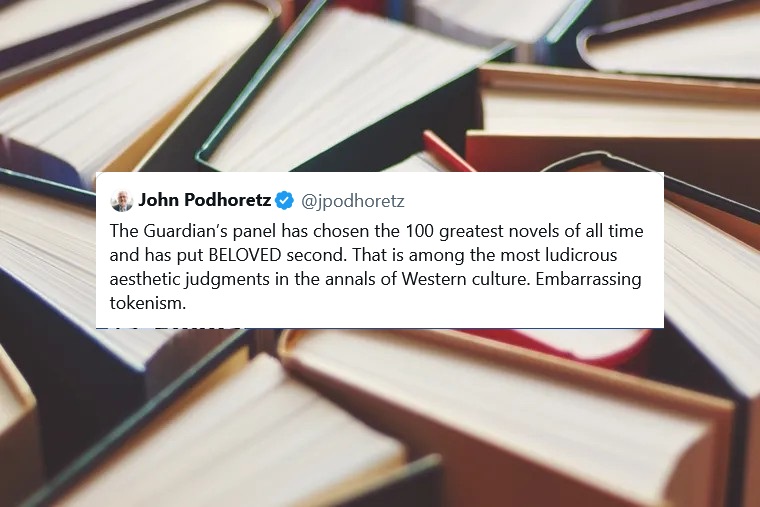
Well yes, John, I’d say that’s a fair and accurate assessment.
Read the Guardian’s explanation of how they got this list. It’s even worse than the list itself, but it does explain the bias creating this mess with this single phrase: “Atwood’s horribly prescient The Handmaid’s Tale.” Prescient? I guess I missed the U.S. turning women into involuntary full-time baby machines.
This is a DEI list, and not a very smart or informed one. No Mark Twain, because “Huckleberry Finn” has been cancelled. Jack London was too much of a toxic masculine writer for these weenies, I guess. “Treasure Island” is too full of men and boys too. “The Three Musketeers” is nowhere to be found; nor is “The Count of Monte Christo.” The women in “Ivanhoe” are too girly. But knee jerk political correctness kicked three of the very best novels, all written by women, off the list: “To Kill a Mockingbird,” “Gone With The Wind,” and “Uncle Tom’s Cabin,” almost certainly the most influential and important American novel ever written. Humor is pretty much verboten, unless it’s anti-war humor (“Catch 22”). P.G. Wodehouse wrote the funniest novels of all time: the problem with including him would be picking which were the best. Yes, ancient odd-ball novel “Tristram Shandy” is on the list: I challenge anyone to claim it has even half the outright belly laughs of Wodehouse at his best.
Not including Tolkien is inexplicable (and I don’t even like his writing); similarly, the greatest novels that engage children while reaching adults as well were cut: “Wind in the Willows,” Watership Down,” and especially the two Lewis Carroll classics, “Alice in Wonderland” and “Alice Through the Looking Glass,” both among the cleverest, most original, most quoted and influential novels in the English Language.
Meanwhile, one entry on the list, “The Turn of the Screw,” isn’t even a novel. I thought the vocalist list was absurd because it was lazy and ignorant, but “The Hundred Best Novels of All Time” is even worse, because it is overtly political. “Never has such a list been more needed,” The Guardian says. Why would incompetent, biased, misleading lists ever be “needed?” Amusingly, the explanation of this thing starts with the correct assessment in its very first sentence: “[C]ompiling a list of the greatest novels of all time is an impossible task.”
Here is the stupid list. Go crazy…


Here is another list. There’s not much overlap of best novels. I wonder how many of either list most people have read or even recognize the titles? Apparently I need to read more “classics”, because I haven’t read many.
https://www.librarything.com/list/9659/all/Times-All-Time-100-Novels
I read 16 of these, and many more from the original list.
-Jut
Demeter,
I was thinking the same thing…or maybe not. It’s highly likely that ranking “the best” anything “of all time” is super subjective and only good for starting arguments. And books – especially works of fiction – are even more subjective, because it’s all about personal taste and perception. I love most of Robert Ludlum’s work, and Dale Brown, and Tom Clancy, but none of those books would ever sniff a top-100 list. And you might hate those authors and what they produced. If I want to list “the 100 fastest cars of all time”, that’s pretty easy to do, since there is a concrete yardstick (top speed) by which one can rank. But to rank “the 100 best cars of all time”?…can’t do it. “Best” is like “greatest”…too vague and immeasurable. Every list will have its detractors and no argument will ever be settled to anyone’s satisfaction.
I think the best we can hope for with the “greatest 100 novels” or “greatest 100 musicians” or “greatest 100 flavors of Kool-Aid” is to read the list, note the places where we concur, chuckle at the places where we differ…and then simply move on.
I’ve only read a handful of books from the Guardian’s list, and a slightly bigger handful from LibraryThing’s list, and I really don’t have much interest in reading the others.
This is true. I am an avid reader, but I don’t like war, depressing tales, or stories where they are grieving (yes I’m thinking specifically of Bridge to Terabithia, which my kid and I suffered through in 3rd grade reading). It was simply a slog. The Handmaids Tale was a terrible book. It was one of the worst written I’ve ever been unfortunate enough to read. Maybe one day I will have read enough of the classics to have an opinion other than if Handmaid’s tale makes the list it’s not worth looking at, unless it’s on the worst books that became bestsellers list.
I read Beloved.
I appreciated it.
I did not particularly like it or enjoy it.
It might make my Top 100 American Novels list.
I am not familiar with Wodehouse, but I am glad Tristram Shandy was included. It is worthy of a spot here.
But, yeah, lots of DEI here. Some of them I like but, yes, it seems to value inclusivity.
At the same time, it does include four Dickens novels. On that, I have not read Our Mutual Friend, but Tale of Two Cities was excluded and Bleak House ranked the highest (because it is his only novel with a female narrator?).
-Jut
Read 26 on this list.
I take my DEI comment back.
They compiled the list by asking 170 authors for their Top Ten books.
Garbage In, Garbage Out. Stephen King said he could not fit Dickens into his Top Ten. I don’t know if I could either.
But, asking contemporary writers for their Top Ten could easily explain the number of “diverse” books here. It certainly could explain the modernist slant.
-Jut
It’s still DEI. #2 is a smoking gun.
yes, except this list is basically a poll. You know, polls. I can see enough of 170 writers voting for it to make it number 2, especially if they are collectively inclined to promote their opinions as the best.
and, while I did not care for Beloved, it was acclaimed enough that it could get that rank in a poll of like-minded people
have not read Middlemarch, but looking into it, it sounds like an interesting novel.
still, there are many more I prefer
They must have polled the NAACP and Black Lives Matter. I guess Moby-Dick was penalized because the whale was white.
My late wife, an English literature major, felt that “Ulysses” was the most over-rated, pompous, self -indulgent piece of crap ever published, with “The Great Gatsby” a close second.
Wodehouse is quite possibly the funniest novelist of them all. He wrote over 200 novels. You have a wonderful time ahead of you. I’d recommend starting with “Carry On, Jeeves.”
“The Count of Monte Christo.”
The list is garbage, but I wouldn’t have put this book anywhere near it. Dumas is a great writer, but what he did with this book is the most boring, anticlimactic revenge story I’ve ever read. The movie (at least the Jim Caviezel one) is perhaps the only movie I would put miles ahead of its book counterpart.
No Verne? 1984? Catcher in the Rye? The Odyssey? Harry Potter? Lord of the Flies?
How disappointing.
1984 is #16, you might’ve missed it because they spelled it out.
Ah, my mistake. TY.
I’d wager that none of the book selectors ever read “Don Quixote” in the original Spanish. And “100 Años De Soledad”? Probably not.
jvb
I read the article and it said it only needed to be published in English to be considered.
-Jut
Not in the original Spanish, but I loved that “Don Quixote”. I read it years ago.
Great point. And it applies to many not on the list, like all Jules Verne and Victor Hugo.
No “Grapes of Wrath”? It’s the best book I’ve read this year and I’ve gotten through about 70 of them, only 24 of which were on this list. No, “The Good Earth”? It’s about Chinese peasants! That’s not diverse enough? No H.G. Wells or Jules Verne? Modern sci-fi owes them a debt of gratitude. It’s a sin to leave off “Uncle Tom’s Cabin”.
I loved “Treasure Island”, “Mutiny on the Bounty” Robinson Crusoe” and even “Twenty Thousand Leagues Under the Sea”. Yes, I learned this year that I really like books about sea voyages.
“Heart of Darkness” is a novella, but sure. “Wuthering Heights” may have contributed to gothic novels, but its toxic romantic relationship was off-putting. Hemingway’s long-form prose is overrated.
All in all, a vastly imbalanced list.
These types of lists are always imbalanced one way or another. One problem with the Guardian’s list is that they say that such a list is needed to counteract the trend of people not reading. My observation is that some of these books will do nothing to achieve that goal. Books to entice non-readers need to be engaging, imaginative, and shorter than 500 pages.
Anyway, I’ve read 33 of the books on the Guardian’s list and 31 on the Library Thing’s list. I didn’t count any of the books I started and didn’t finish, and there were a number of them on both lists.
No “Dungeon Crawler Carl”? This list is obviously bogus.
I wonder what would be different on this list if you asked Copilot or Chat GPT to make a list of the best novels.
“Middlemarch?” Number One? Lots of Austen but no “Pride and Prejudice?” I love Wodehouse, but Kingsley Amis’ “Lucky Jim” is non-stop hilarity on speed. And speaking of hilarity, no Evelyn Waugh? No Proust?
Maybe the worst omission is “No “The Killer Angels”? American Heritage voted it the greatest American historical novel, and I can’t imagine a greater one.
Pride and Prejudice is number 9. I’m a big Austen fan, but I can’t agree with Persuasion and Mansfield Park being on the list of the 100 greatest novels of all time. They’re very creditably done, but top 100? Not nearly.
Way too much Jane on the list. What’s the obsession with “Emma”? I like all of Austen’s novel, but you read one you’ve read ’em all.
Ooops.
I liked “Persuasion.” But I think “Pride and Prejudice” is head and shoulders above all the rest. It’s just remarkable. The characters are all well rendered and the dialogue is tremendous. All her other books are comparatively uneven but there doesn’t seem to be a wrong note in “Pride and Prejudice.” Uncanny. And it was her first. She could have just quit and called it good.
Grace loved loved loved “Pride and Prejudice,” and made me watch the Greer Garson/Olivier film version whenever she was depressed.
She had impeccable taste in literature.
P.J. O’Rouke once wrote that he was OK with being called a Nazi because no woman had ever fantasized about being ravished by a liberal. Why is it that liberal women have fantasized about being raped (and now impregnated) by conservatives for 50+ years? Now with this Handmaid’s Tale thing, it seems to make sense. Conservatives aren’t paying attention to this. For most conservative men, having a child with a leftist woman is their biggest nightmare. I think these leftist female fans of “The Handmaid’s Tale” actually want to be mothers, but they can’t because it would betray their feminist, environmental, and anti-white racist beliefs. If they ever became pregnant, they would be pressured to have an abortion. The only mechanism for them to actually become mothers and stay in the good graces of their friends and family would be if they were forcibly impregnated and forced to give birth. Because it is all forced by ‘evil conservatives’, their motherhood makes them victims instead of traitors.
“The Handmaid’s Tale” is no conservatives’ fantasy, but it does seem to be the fantasy of a lot of liberal women. That doesn’t make it prescient, but it does make it revealing of leftist ideology that women fantasize about the government forcing them to become mothers.
Okay, Michael. That goes down as the most interesting and trenchant analysis going. It kind of pairs with the Dem campaign ad a few years ago featuring the purportedly admirable and run of the mill, and part of a huge demographic, woman who simply relies on the government in lieu of having, you know, a husband.
I just noticed that “107 Days” didn’t make the list (it didn’t make LibraryThing’s list, either). Among the great works of fiction, it has to rank way up there…