Lincoln Chafee’s Batty Ethics Argument For The Metric System

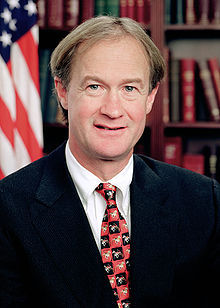
Lincoln_Chafee_official_portrait

Ugh. I can’t let this pass.

Yesterday I happened upon Lincoln Chafee on one of the Sunday shows, giving his elevator pitch for why he should be President. You may recall that Chafee, former Republican Senator and Governor of Rhode Island, turned independent after being defeated for re-election and now is following Bernie Sanders’ example, declaring himself a Democrat for the purpose of getting nominated. Chafee is another politician, like the Bush bothers and Hillary Clinton, who owes his initial political prominence to being related to a popular political figure rather than his own innate abilities. As he made obvious the more he spoke…

His two primary campaign positions were 1) “Wage peace”—whatever that means. This is right up there with John Lennon songs as serious policy discourse,  though I’m sure ISIS is fascinated by the concept, and 2) Adopt the metric system. Chafee borrowed this from the idea machine known as the Andrew Johnson administration, as Andy was the first President to officially acknowledge the benefits of the U.S. adopting the less eccentric measurement system used by Europe. I’m sure we all can agree that this is one of the most pressing issues facing the country today.

However, Chafee really got my attention, and sparked this post, when he attempted to combine his two prime objectives, which is no mean trick. I tried to find a transcript, video or a news report to document this, but so far I have failed: maybe everyone is trying to be nice. I swear I am not making this up, though I wish I were.

Chafee argued that the United States should adopt the Metric system because it invaded Iraq and didn’t find the weapons of mass destruction.

He really did. Continue reading

Slate: ‘How Dare A Billionaire Donate $400,000,000 to Harvard?’

See, Ozmandias? You should have opted for school of engineering.

See, Ozmandias? You should have opted for the school of engineering.

Slate’s article by Jordan Weissmann, its senior business and economics correspondent, about the largest donation ever made to Harvard University is one of those monstrosities that has great value as an ethics test. If you think his argument is reasonable, then you need help.

Essentially, the Slate piece is the ultimate example of an unethical argument I have focused on before, which can be summarized as, “If you give to what you care about rather than what I care about, then your donation is unethical.”

Unless your contribution is to ISIS, or isn’t really a contribution but an attempt to buy access for your own purposes (like with, to pick an example out of the air, a donation to the Clinton Foundation), there is nothing unethical about a $400,000,000 donation, which is what John Paulson just gave to Harvard University’s endowment for the School of Engineering and Applied Sciences. The school will be renamed after Paulson, which Weissman also finds repugnant. The title of the piece: “Billionaire’s Ego Donates $400 Million to Harvard.”

Let me pause here to note that I refuse to give my money to Harvard, which solicits me regularly. The university is rich, I’m not, and I prefer to give my charitable gifts to Georgetown Law Center, specifically to the student theatrical organization I founded there, which like all theater groups, needs funds. I am sure Weissman finds my contribution unethical as well, because, really, what good are the arts compared to what he has decreed is worth giving to as the “more pressing causes in the world”?  As he sees it, that is, but that’s all that matters.

Let me go through Weissman’s many objections that cause him to sneer at Paulson’s charity:

1. “Gestures to Ivy League schools …inevitably have as much to do with the giver’s ego as their sense of altruism.” Yes, and so do almost all philanthropic donations, regardless of source and objective. The motto in fundraising (I was a professional fundraiser for a decade) is that donors give money for their purposes, not yours. People who give a lot of money to good causes like to have some recognition, and they deserve it.  Apparently Weissman believes that the only ethical donations are anonymous ones, because that’s modest. I’m impressed by anonymous gifts, though they often have selfish motivations as well: the donors don’t want to be hounded by more fundraisers. Nevertheless, that lack of modesty is so trivial as a flaw in large charitable contributions that to harp on it is perverse. Successful people tend to have egos that are often in proportion to their accomplishments. The construct of the left is, we know, that accomplishments and success are just randomly distributed fruits of privilege, ergo the self-esteem that often results from such success is as unsavory as the privilege that generates it.

This is, to be blunt, un-American crap.

2. Harvard “does not strictly need more money, especially compared to the financially strapped colleges that typically educate lower-income students.” First of all, this is demonstrably false. Harvard does need more money if it is going to expand and improve its School of Engineering and Applied Sciences, secure that school’s financial health in perpetuity, and do so without sacrificing other objectives it deems important. Harvard also educates lower-income students, the best and brightest of them, and thus the best resources money can buy are expended on the students most likely to make the best use of them for the benefit of society. Weissman believes this is wrong, and that the 400,000,000 should be given to lesser schools, with less of a track record of spending money wisely, while educating less promising students.

I am in sympathy with that argument to some extent. The marginal utility of all that money is less at Harvard than anywhere else, and I can envision the donation having a far more sweeping impact elsewhere: giving it to Sweet Briar, for example. That does not mean there is anything wrong in any way with bolstering Harvard’s School of Engineering and Applied Sciences. The donation is an unequivocal, absolute good.

The money could have been spent “better”? That’s your opinion. It’s not your money. Shut up. Continue reading

Is There An Ethical Obligation Not To Shock, Nauseate, Or Blind Your Neighbors? Of Obese Joggers and #FreetheNipple

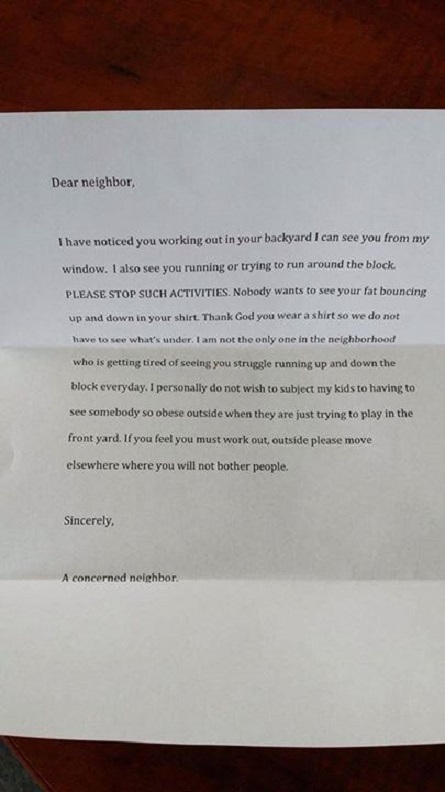
A Facebook friend posted the following letter, posted by one of her friends, and supposedly passed along by the target of the letter. The individual subjected to the complaint is reputedly trying to overcome obesity and various health issues. The letter:

Mean letter

I have my doubts regarding the authenticity of this, but it doesn’t matter to this post. I assume we can all agree that the letter itself, if genuine, is cruel, mean-spirited, cowardly (it is anonymous), hurtful, and indefensible. It does raise an valid ethics question, though, which is this: Do we have any ethical obligation any more to exhibit modesty and a degree of public decorum out of doors, when we are likely to come under the gaze of others? If so, what are that obligation’s parameters? Continue reading

More Airport Ethics: The TSA, the Bedonkadonk and the Slobs

Badonk

I’m not sure what to make of this scene, which I witnessed at Washington’s Reagan National airport as I waited to be scanned prior to my flight to Miami. I have some thoughts, though.

The young, zaftig, fascinatingly-shaped African American woman in front of me was wearing one of tightest, most revealing, shape-hugging, leaving-nothing-to-the-imagination knit dresses I or anyone has ever seen, especially in an airport. The garb was obviously chosen to highlight, as in broadcast world-wide, her most prominent and unusual asset: an awe-inspiring derriere, which appeared to be fit, toned, and suitable for showing a drive-in movie. She was attracting side-glances and open-mouths from all around her, male, female, and probably the machinery too, and obviously reveled in the attention.

When she stepped into the imager and was told to raise her hands over her head, she giggled and did a spontaneous bump and grind move, threatening the integrity of the structure. That did it. The young African-American male TSA agent was launched into smiles, winks, and a stream of comments on the women’s super-structure, along the lines of, “Damn, girl! Don’t go distracting me like that! How am I supposed to do my job? And man, I am distracted! Why, some big old terrorist could walk right by me while I’m taking you in, and then where would we be?” Laughs all around from the other agents, giggles and more gyrations from the woman, more banter from her admirer. Continue reading

Ethics Hero Emeritus: Jack McDonald (1915-2013)

Jack McDonald

Before today, I had never heard of Jack McDonald, and outside of his co-workers , family and friends, not many had. That was the way he wanted it, for he was an unassuming man with a conventional career, including three decades as an attorney for the Veterans Administration. He clipped coupons, dressed humbly and allowed himself few luxuries. He got around his home town of Seattle using public transportation. Most who knew him thought he was struggling.

When Jack McDonald died this past September, his death received little notice in the local news, and none nationally—until about a week ago, when it was revealed that his will provided for the creation of a $187.6 million charitable trust for the benefit of Seattle Children’s Research Institute, the University of Washington School of Law and the Salvation Army. Continue reading

The Unprofessional Cause Of Unprofessional Lawyer Brian Zulberti

Brian ZYoung Brian Zulberti may be nice guy. He may even be a competent lawyer, though the chances of his being able to demonstrate that are diminishing daily. Nevertheless, his quixotic and misguided, and dare I say it, really stupid, quest to show that professionalism, judgment and character are not properly relevant to the practice of law is an exercise in hubris that must fail, deserves to fail, and of course, will fail, leaving him to pick up the pieces of fifteen minutes of media fame purchased at the price of a reputation. It looks like he’s having fun, and that’s something, I guess. Ten years from now, I doubt that he’ll think it was worth it.

Shortly after passing the Delaware Bar, Zulberti, a 2009 law school grad,  emailed the entire Bar membership asking for a job. In lieu of his résumé;  he attached a photo of himself in a Villanova Law muscle shirt that would be more at home on a dating site for the shallow. The web also contained his half-naked selfies, and various websites with varying motives picked up the story. Interviewed on YouTube, Zulberti proclaimed that being true to himself was more important to him than getting hired, and that he wasn’t about to change his Facebook privacy settings to portray himself as a traditional, dignified, applicant for legal work.

Let me pause here to say that in many ways I sympathize with Zulberti. Continue reading

Of Hero Ethics, Credit, Fame, And Angel Cordero

Angel Cordero, unsung hero. And in good company.

Angel Cordero, unsung hero. And in good company.

Apparently a Cleveland man named Angel Cordero is every bit as deserving of accolades in the rescue of the three kidnapping victims of Ariel Castro [of alleged kidnapper and rapist Ariel Castro, that is. Reflect on this case the next time someone puffs themselves up to reprimand you for a missing “alleged” and lectures you about how the accused are “innocent until proven guilty.” Yes, we know—and that means we can’t lock them up and throw away the key until they have had a fair trial and been officially proven guilty beyond a reasonable doubt in the judgment of a jury. It does not mean,  in a situation where there is literally no possible interpretation of the facts that would not end with the conclusion that the man who owns the house where three women have been kept prisoner for ten years and who have told interviewers that he beat them, starved them and raped them, that to state the obvious is some kind of human rights violation. By the way, O.J. is guilty too.] as the more colorful, more publicized–and more ridiculed—Charles Ramsey.

I want Cordero to receive the credit and admiration he deserves. I don’t want him to feel bitter and unappreciated. If the media, public and popular culture is inclined to bestow its goodies on the heroes of this horrible story, I hope he gets his fair share. Still, I also hope that he would be sufficiently large of soul and solid of values to adopt the attitude that what is important is that the women were rescued, and not who gets credit for it, now or in the future. Continue reading

Law, Ethics and Gender: California’s “Bathroom Bill”

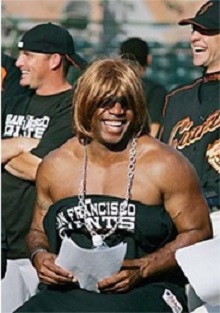
Barry Bonds identifying as female...kind of like he identified as "not being on steroids"

Barry Bonds identifying as female…kind of like he identified as “not being on steroids”

The fur is flying in California and also in the internet culture wars over California’s latest foray into social engineering, officially known as Assembly Bill 1266, and popularly known as “the bathroom bill.” In its current form, the proposed legislation states…

“A pupil shall be permitted to participate in sex-segregated school programs, and activities, and facilities, including athletic teams and competitions, and use facilities consistent with his or her gender identity, irrespective of the gender listed on the pupil’s records.”

Here is such a wonderful example of the inherent limitations of laws as opposed to ethics that I’m considering having it framed and mounted. Continue reading

Ethics Hero Emeritus: Charles Durning, 1923-2012

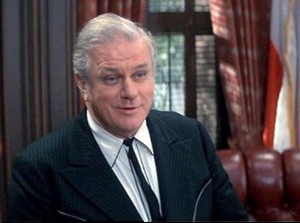
Charles DurningWorld War II veterans are dying by the thousands every year now; “the Greatest Generation” is running out of members. When one of the survivors of World War II combat who became famous in subsequent pursuits leaves us, it is important to remember that their brave service to their country was probably the most important thing they did in their lives, and was their invaluable gift to all of us. In most cases, that is how the veterans looked at it too. I know my late father did.

I can’t be sure about the great character actor Charles Durning in this regard, because he generally refused to talk about his World War II experiences, which resulted in his being honored by a Silver Star and three Purple Hearts. This too is admirable. His military service was his duty, but having to kill other human beings, no matter who they are, is something that throw most ethical people into a searing conflict of values and emotions. Durning, who died today at the age of 89, preferred to discuss his acting.

He was as talented and brave at entertaining us as he was in combat. Never a leading man, Charles Durning could play drama and comedy with equal deftness, and given the chance to be in a musical, the (awful) film version of “The Best Little Whorehouse in Texas,” he proved that he could sing and dance well too. He was outstanding in such classic films as “The Sting,” “Dog Day Afternoon” and “Tootsie,” an actor who seemed incapable of seeming false or inauthentic  while never playing the same kind of character twice. Perhaps the performance that was closest to the real Charles Durning was in his Emmy-winning role on “NCIS” in the episode “Call of Silence,” in which he played an elderly Marine veteran and Congressional Medal of Honor recipient who is tortured by the belief that he had been responsible for the death of his best friend in combat.

Durning’s own military service would have made an exciting movie on its own.  His highest rank was Private First Class, and like many others, he did the most dangerous and dirtiest work of the war. On D-Day, June 6, 1944, and was among the first troops to arrive at Omaha Beach in Normandy, after overshooting  his landing zone and having to fight his way to the beach.  He was severely wounded by a German “S” Mine on June 15, 1944 at Les Mare des Mares, France, but despite suffering from the effects of shrapnel in the left and right thighs, the right hand, his head, and his chest, he declared himself fit to return to the lines, which he did just in time for the Battle of the Bulge. During that battle he was wounded again, captured, and survived the German massacre of American prisoners at Malmedy, one of the most heinous war crimes perpetrated in the field.

We should honor the memory of Charles Durning as a wonderful actor who contributed a great deal to films and popular culture, entertaining millions in the process. We should also honor him as a patriot, a soldier, a citizen, a World War II veteran and a hero, not because he was unique, but because he was not, and when we salute him as he passes from this world, we also honor all the anonymous and forgotten fighting men like him who never became famous, saved the United States and the human race, and who, like Charles Durning, refused to boast about it.


An Easy Ethics Call: The Flasher In The Girl’s Locker Room (UPDATED)

Proudly defending the right to freak out little girls.

How society should treat individuals with one gender’s genitalia but who identify with the opposite gender is a question that involves much more than ethical considerations. At this point, I haven’t been able to devote sufficient thought and research to the problem to propose an answer. The current controversy of Colleen Francis, however, inspires no such hesitancy on my part, because the correct solution to that problem is purely a matter of ethics. I’ll stipulate, for the time being, that it is right, legal and proper for Colleen, a transgendered student at Olympia College in Evergreen, Washington, to use the women’s locker rooms there, despite the fact that the 45-year-old still has a complete set of male genitalia, since she identifies as a woman, and as far as the school is concerned, a woman she is. Sold. I buy it.

However, Colleen apparently likes to display her alien genitalia with abandon in the ladies locker room, despite the fact that she often is surrounded by members of a high school swim club and a children’s swimming academy, many of whom are high school age or younger, and some of whom are as young as six.

Unethical. Inconsiderate. Offensive.

Disrespectful. Irresponsible.

Wrong. Continue reading