Abraham Lincoln: Good Lawyer, Bad Lawyer, Conflicted Lawyer

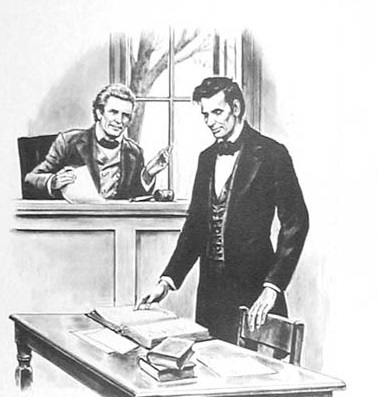
Lincoln in trialI recently quoted a fairly well-known section from some notes Abe Lincoln made for a lecture he was to present to young lawyers in 1850. Some of you asked if would post the whole document, which I am happy to do. Here it is:

I am not an accomplished lawyer. I find quite as much material for a lecture in those points wherein I have failed, as in those wherein I have been moderately successful. The leading rule for the lawyer, as for the man of every other calling, is diligence. Leave nothing for to-morrow which can be done to-day. Never let your correspondence fall behind. Whatever piece of business you have in hand, before stopping, do all the labor pertaining to it which can then be done. When you bring a common-law suit, if you have the facts for doing so, write the declaration at once. If a law point be involved, examine the books, and note the authority you rely on upon the declaration itself, where you are sure to find it when wanted. The same of defenses and pleas. In business not likely to be litigated, — ordinary collection cases, foreclosures, partitions, and the like, — make all examinations of titles, and note them, and even draft orders and decrees in advance. This course has a triple advantage; it avoids omissions and neglect, saves your labor when once done, performs the labor out of court when you have leisure, rather than in court when you have not. Extemporaneous speaking should be practised and cultivated. It is the lawyer’s avenue to the public. However able and faithful he may be in other respects, people are slow to bring him business if he cannot make a speech. And yet there is not a more fatal error to young lawyers than relying too much on speech-making. If any one, upon his rare powers of speaking, shall claim an exemption from the drudgery of the law, his case is a failure in advance.

Discourage litigation. Persuade your neighbors to compromise whenever you can. Point out to them how the nominal winner is often a real loser — in fees, expenses, and waste of time. As a peacemaker the lawyer has a superior opportunity of being a good man. There will still be business enough.

Never stir up litigation. A worse man can scarcely be found than one who does this. Who can be more nearly a fiend than he who habitually overhauls the register of deeds in search of defects in titles, whereon to stir up strife, and put money in his pocket? A moral tone ought to be infused into the profession which should drive such men out of it.

The matter of fees is important, far beyond the mere question of bread and butter involved. Properly attended to, fuller justice is done to both lawyer and client. An exorbitant fee should never be claimed. As a general rule never take your whole fee in advance, nor any more than a small retainer. When fully paid beforehand, you are more than a common mortal if you can feel the same interest in the case, as if something was still in prospect for you, as well as for your client. And when you lack interest in the case the job will very likely lack skill and diligence in the performance. Settle the amount of fee and take a note in advance. Then you will feel that you are working for something, and you are sure to do your work faithfully and well. Never sell a fee note — at least not before the consideration service is performed. It leads to negligence and dishonesty — negligence by losing interest in the case, and dishonesty in refusing to refund when you have allowed the consideration to fail.

There is a vague popular belief that lawyers are necessarily dishonest. I say vague, because when we consider to what extent confidence and honors are reposed in and conferred upon lawyers by the people, it appears improbable that their impression of dishonesty is very distinct and vivid. Yet the impression is common, almost universal. Let no young man choosing the law for a calling for a moment yield to the popular belief — resolve to be honest at all events; and if in your own judgment you cannot be an honest lawyer, resolve to be honest without being a lawyer. Choose some other occupation, rather than one in the choosing of which you do, in advance, consent to be a knave.

This is uniformly excellent, and justly cited to show Lincoln’s high ideals as a man and a professional. This quote, however, is also cited for that purpose, and I am not so fond of it. Since it comes to us second-hand, a.k.a as hearsay, from Lincoln’s law partner, friend and biographer William Herndon, I hesitate to hold it against him too much, for it may be a misrepresentation. I am more concerned with the fact that what follows is sometimes packaged with the notes above, as if they are equally worthy of emulation. No, they are not. Continue reading


Ethics Hero: Judge Richard Posner

Sure, you have a right to think there's something wrong with that, but the state has no business acting as if it thinks so too.

Sure, you have a right to think there’s something wrong with that, but the state has no business acting as if it thinks so too.

Because Judge Richard Posner of the 7th Circuit Court was appointed by Ronald Reagan, he is usually describes as a conservative judge. He’s better described as an unusually smart, articulate, thoughtful and courageous judge, and in responding to oral arguments  lawyers for Wisconsin and Indiana defending their state’s marriage bans, he proved it.

I have frequently attempted to draw a distinction between those guided by archaic religious morality that causes them to regard same-sex marriage as sinful, and the attempt to use the government, which must not be guided by religion to make such marriages illegal. Morality doesn’t have to be defended by logic—God works in mysterious ways, you know—but laws do. A complete evisceration emanating from a place of authority of the specious and often absent reasoning behind gay marriage bans was much needed, and knowing that he risked criticism as a “judicial bully” for doing so with gusto, Judge Posner came through.

Here is a sampling of the barrage he placed on Indiana Solicitor General Thomas Fisher and Wisconsin’s assistant attorney general Timothy Samuelson: Continue reading

Ice Bucket Challenge Ethics

Ice Bucket Challenge

The “Ice Bucket Challenge” is a silly, brilliant fund-raising device that has simultaneously increased public awareness of Amyotrophic lateral sclerosis (ALS), better known as Lou Gehrig’s disease, brought over 14 million more dollars of donated funds into the ALS Association than last year for research, and provided some priceless YouTube fare, ranging from celebrity drenchings to this…

Entertainment! Celebrities! Medical research! Charity! Public Education! How could there be anything unethical about such a phenomenon? Well, ethics often throw cold water on all manner of activities human beings crave, so it should not be too great a surprise that the “Ice Bucket Challenge” has generated quite a few ethics-based objections. Let’s examine the potential, alleged and actual ethical flaws of the current fad, and rate them on an Ethics Foul Scale from zero (No ethical concerns at all) to ten ( Very Unethical).

1. It’s dangerous.

Anything can be dangerous if you are not sufficiently careful, and the Ice Bucket Challenge had its consequentialist moment when four firefighters were injured, one very seriously, trying to help the marching band at Campbellsville University get dumped with ice water this week. Two firefighters were in the bucket of their truck’s ladder preparing to douse the students using a firehose when a surge of electricity jumped from nearby power lines and electrucuted them and two colleagues. This was just a freak accident, however. Unlike the so-called Facebook Fire Challenge, the ALS fundraisng stunt shouldn’t be perilous to anyone, as long as practitioners don’t get too grandiose or creative.

Ethics Foul Score:

0

2. It wastes water.

Continue reading

Comment of the Day: “The Humiliation of Jessica Urbina”

catholic church

I confess to priming Patrice, an old friend and the resident Catholic theologian here, for this. I have known here for many years, and she is what I would call a passionate and rebellious Catholic scholar, and hoping she would weigh in on my criticism of the Catholic Church in the wake of the treatment of high school senior Jessica Urbina, which I view as symptomatic of the Church as it is of the schools. As I expected, however, Patrice makes a strong case.

Here is her Comment of the Day on the post, The Humiliation of Jessica Urbina:

Well, you knew I was going to respond, right?

“The cruel treatment of Jessica is one more indication of the sorry state of the Catholic Church, which appears to be a fatal cesspool of hypocrisy, desperate public relations, and an integrity vacuum. There are two kinds of Catholics, it seems: those who profess the be devout followers of the Church but who discard and violate its doctrine and core principles whenever they seem too burdensome, unpopular or embarrassing, and those who blindly follow the dictates of the Church, no matter how clearly they have been proven wrong and wrongful by the accumulated experience and wisdom of civilization, because morality never changes.”

So, what am I? The feckless “Cafeteria Catholic” or the “Fundamentalist Catholic”? I really take exception to your gross generalizations about Catholics as being one or the other of your versions. Knowing me, Jack, how could you make such generalizations?

As a sometime student of Theology, I prefer to see myself as a Catholic who dissents in good conscience from certain teachings of the Church — not because they are “too burdensome, unpopular, or embarrassing,” but because I believe that there is more to be learned from the core teachings of Jesus than what we have thus far proclaimed. And for the record, I am saddened by what happened to Jessica. What the school did (notice I say school, not church) was not compassionate, kind, or tolerant.

The Catechism of the Catholic Church states the following:
“A human being must always obey the certain judgment of his conscience. If he were deliberately to act against it, he would condemn himself.”

The problematic part comes after that: “Yet it can happen that moral conscience remains in ignorance and makes erroneous judgments about acts to be performed or already committed.” It’s kind of a Catch 22. Does the Church see a well-formed conscience as one that has been properly educated (indoctrinated?) in the “truths” that the Church has put forth, and therefore agrees with the Church on all matters? Maybe. I suspect that this conscience thing was intended to give courage to Catholics who would have to disobey their “Catholic conscience” to do something they were being encouraged or forced to do in the secular world that is against Church teachings. Thus, martyrs. Regardless, I stand by my educated conscience.

I hold up the subjects of my senior thesis, which was about dissent in the Church: Hans Küng and Charles Curran. Both censured for their dissent, but still voices in the wilderness. Look at Pierre Telhard de Chardin. Got into a lot of trouble for his writings, but somewhat “rehabilitated” in today’s world of theological thought.

With regard to Jessica, I see this as an educational system problem, because it might have happened at any school. The fact that it happened at a Catholic school makes it look like a Catholic problem, but I sense that you would find the same problem in schools in various places around the country, as well as other denominations which teach (yes, there are others) that homosexuality is wrong/forbidden/whatever. I’m sure I’m breaking one of your principles here, but really I do see this as an authoritarian school problem first and foremost. It’s also a self-expression issue.

I personally wish Jessica great success as she, no doubt, continues to break the barriers that keep her and others from being and expressing who they are.

The Humiliation of Jessica Urbina

JESSICA_URBINA

Every year at this time, Ethics Alarms covers one or more ethics controversies over a yearbook photo that has been deemed inappropriate for a high school graduation yearbook. The 2014 controversy, I think, has more significance than the others. Like other examples of rigid school administrator enforcement of poorly though-out rules and blatant cruelty to children, what was done to Jessica Urbina demonstrates the peril of allowing those in what no passes as the education profession to have power over our children, since they so frequently abuse it, or influence over the development of our children’s character, as the administrators display such flawed character themselves. The more I think about this incident, however, the more I conclude that it foretells the dying of a major religion in this country, and why it may deserve to die.

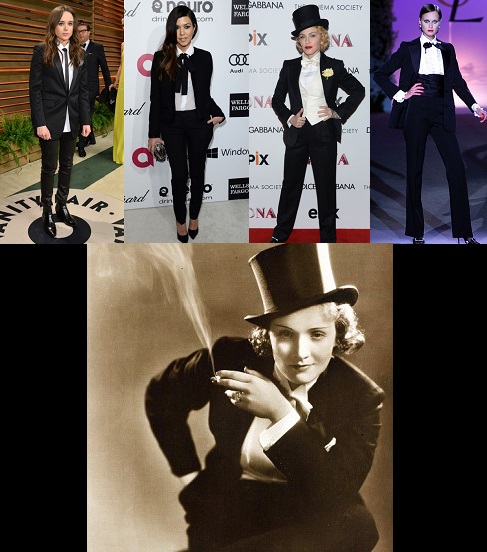
The yearbook photo of senior Jessica Urbina was deleted from her class  yearbook because she wore a tuxedo. School officials at San Francisco’s Sacred Heart Cathedral High School said  she violated the Archdiocese of San Francisco’s policy because she didn’t wear the dress that’s required for female students in yearbook photos. This is the no-tolerance version of yearbook photo rules, sexist, anti-gay, cruel and stupid. Jessica isn’t dressed inappropriately or unkempt; in fact, she looks great. She took care to make herself presentable for her yearbook, and succeeded. Quite reasonably, however, she decided to appear in clothing that made her feel comfortable, given her sexual orientation, for she is reputedly gay. Tuxes are not a gay uniform by any means; hetero and gay women have worn them as fashion for decades. Below are, clockwise, Ellen Paige, Kim Kardashian, Madonna, super-model Danielle Luquet de St Germain, and the immortal Marlene Dietrich:

Celebs in Tux

I know: yecchhh! How disgusting!

Seriously–there is nothing, nothing, provocative, inappropriate or wrong with Jessica’s attire. She is nicely groomed, her clothing is impeccable, the photograph is impeccable, and she looks cute and happy. The school officials knew what to do about that.
Continue reading

Cincinnati’s Swinger Parochial School Teacher Principle*

Sexy nun*The reference in the title is to the “Naked Teacher Principle,” discussed often here. In brief, it holds that a teachers whose nude (or in some cases, almost nude or sexually provocative) photographs become publicly available cannot object when they are terminated as unfit to teach.

Teachers employed in the Catholic schools in the Cincinnati archdiocese are being asked to sign a new restrictive contract that denies them the option of engaging in acts outside the classroom that are in opposition to Catholic teachings. It expressly forbids a “homosexual lifestyle” as well as any public support of homosexuality. It forbids abortions or advocacy of abortion rights, surrogacy, and in vitro fertilization.  A teacher who signs the agreement agrees not to live with a partner as a couple outside marriage,  engage in sexual activity out-of-wedlock,  and not to endorse either practice.

New York Times columnist Frank Bruni is offended by this, and feels it is unethical. “Does a Catholic-school teacher relinquish the basic privileges of citizenship?” he asks, pointing to political engagement and free speech. Continue reading

Comment of the Day: “Clayton Lockett Is Dead, Right? Then 1) Good! and 2) His Execution Wasn’t “Botched””

capital-punishmentThere are well-established group of ethics topics that will always cause spirited debates here, because they are issues that have always divided public opinion and always will: morality vs ethics, drug legalization, abortion, war, social justice, socialism, plus various controversies involving race, sexuality and gender. I try to wade into these only when a current even beckons, as to some extent the arguments are futile and familiar, and too many people refuse to think or listen anymore, retreating to slogans and reflex positions articulated by others.

I decided to wade into one of the most polarized, of these, capital punishment, when the Clayton Lockett execution in Oklahoma sparked a national debate that seemed strange to me, and indeed driven by the unwarranted assumption, uncritically accepted by the news media, that the painlessness of executions were a crucial feature of making them ethical as well as societally palatable. It also opened the question of whether one execution that doesn’t follow the script necessarily calls capital punishment itself into question. I confess: both in my post’s title and in the tone of my responses to anti-death penalty commentators, I intentionally sought to roil the waters of debate, and was determined not to allow the nice people who usually express compassion for the pain and suffering of humanity’s worst and deadliest escape with the usual pieties.

Sure enough, this annoyed the heck out of some readers. Responding to the emphatic objections of one, Isaac delivered a personal and powerful rebuttal. Here is his Comment of the Day on the post Clayton Lockett Is Dead, Right? Then 1) Good! and 2) His Execution Wasn’t “Botched:” Continue reading

Clayton Lockett Is Dead, Right? Then 1) Good! and 2) His Execution Wasn’t “Botched”

Capital punishment foes have no shame, and (I know I am a broken record on this, and it cheers me no more than it pleases you), the knee-jerk journalists who have been squarely in their camp for decades refuse to illuminate their constant hypocrisy. In Connecticut, for example, holding that putting to death the monstrous perpetrators of the Petit home invasion was “immoral,” anti-death penalty advocates argued that the extended time it took to handle appeals made the death penalty more expensive than life imprisonment—an added expense for which the advocates themselves are accountable.

A similar dynamic is at work in the aftermath of the execution of convicted murderer and rapist Clayton Lockett in Oklahoma.Witnesses to his execution by lethal injection said Lockett convulsed and writhed on the gurney, sat up and started to speak before officials blocked the witnesses’ view by pulling a curtain. Apparently his vein “blew,” and instead of killing him efficiently,  the new, three-drug “cocktail” arrived at as the means of execution in Oklahoma after extensive study and litigation failed to work as advertised.  Why was there an excessively complex system involving multiple drugs used in this execution? It was the result of cumulative efforts by anti-death penalty zealots to make sure the process was above all, “humane.” Of course, the more complicated a process is, the more moving parts it has, the more likely it is to fail.

Continue reading

All Right, I Can’t Let This Pass: Reading Comprehension At The Chicago Tribune, Or Why Do We Rely On People Like This?

THINK, Jack---if the best of the breed was a biased dimwit, why do you still want to trust these people?

THINK, Jack—if the best of the breed was a biased dimwit, why do you still want to trust these people?

I am grateful for the Chicago Tribune website readers who have followed blogger Eric Zorn’s link to the Ethics Alarms Noah post, but is it too much to expect a major newspaper’s  columnist to read and comprehend the plain meaning of a post before criticizing it? Zorn, who authors the Trib’s Change of Subject blog, was cheering on Bill Maher’s atheistic take on God, the Bible and the Noah story, and then quoted me, writing…

I found this refutation of Maher particularly unconvincing and circular:

“God makes the rules, he is literally incapable of being immoral; it is a contradiction in terms. If God kills, it is by definition right and good, because God himself defines right and good. Does Bill really not get this? … If you don’t believe that God “works in mysterious ways” and that everything he does in the Old Testament is justifiable as part of some greater plan, Maher is indisputably right. God is a mass murderer.”

How more wrong could Zorn be?

1. I wasn’t refuting Maher, but defending his anti-God statement as completely accurate from his narrow and biased point of view, which includes a basic misunderstanding of what morality is and what it means to believe in an infallible deity. Continue reading

Comment of the Day: “Noah” Ethics

noahs-beaver-problem

Patrice, the Ethics Alarms resident Catholic theologian (and a dear friend), weighs in on the “Noah” controversy, in the this Comment of the Day on the post, “Noah” Ethics:

My undergraduate theology degree is indisputably from a Catholic perspective, although many of the scholars we studied were not Catholic, nor even Christian. I was required to take only 4 semesters of biblical literature, but even those few academic hours of biblical studies taught me enough about biblical analysis to understand how “The Bible” (which, as I’m sure you know, is just a mutually-agreed upon canon of literature which omits as much as it includes) came to be. I often think that it is a shame that true knowledge about biblical literature mostly seems to reside only in academia. Unfortunately, most of the zealots out there would and probably do regard biblical scholarship as an attack on God. The battles over the centuries over biblical inerrancy/infallibility/literalism are merely unread footnotes to most people. Continue reading