Four Supreme Court Decisions: Abortion, Guns, Affirmative Action, Corruption…And Ethics. Part 3: Whole Woman’s Health v. Hellerstedt

shrinking-number-of-abortion-clinics-in-texas

[The Supreme Court came down with four controversial and ideologically contentious decisions in June, and I apologize for taking almost a month to cover them all. One of the reasons Ethics Alarms occasionally launches a series like this one is to ensure that developing ethics stories of importance do not push important issues to the sidelines. The fact that this four part series had only finished parts 1 and 2 was an irritant to me, as well as some readers.]

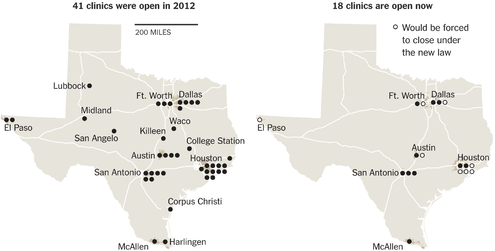
In Whole Woman’s Health v. Hellerstedt, decided on June 27, the Supreme Court held in a 5-3 majority that two provisions of a Texas law, one requiring physicians who perform abortions to have admitting privileges at a nearby hospital and another requiring abortion clinics in the state to have facilities comparable to an ambulatory surgical center,  places a substantial and unconstitutional obstacle in the path of women seeking an abortion, because they constituted an undue burden on abortion access.

Life would be so much simpler if our elected officials and activists employed an adaptation of the Golden Rule, and looked objectively at issues from the other side’s point of view. This is especially true in the realm of rights.  Second Amendment absolutists insist that virtually any laws regulating who can purchase guns, when and where they can purchase them, and how and how quickly they can be purchased are efforts to whittle away the right to bear arms. They also argue that such regulations have the ultimate goal of  eliminating that right entirely, which, in many instances is the case, especially if you listen carefully to the rhetoric of the legislators proposing such measures. There is little difference from this and what anti-abortion advocates are attempting to do with laws like House Bill 2 (H. B. 2).

The bill ostensibly is designed to make abortions safer, thus protecting women’s health, just as many gun laws are promoted as safety measures. Oddly, virtually all of the supporters of the Texas bill would make abortion illegal if they could. I’m sure it’s just a coincidence, just as it’s a coincidence that the authors of bills requiring potential gun owners to jump through increasingly burdensome hoops and deal with mandatory trigger locks and “safe gun” technology would gladly repeal the Second Amendment if they could. The ethical principle is the same in both matters: a right isn’t a right if legal obstacles make it difficult to exercise that right.

The question is, what’s a reasonable obstacle? Any regulation imposed on a constitutional right must not create “a substantial obstacle” and must be reasonably related to “a legitimate state interest.” The Supreme Court uses the language and logic of case precedents, which are its previous examinations of these issues and the balancing they require. One such case, though I did not find it mentioned in the majority opinion or dissents in Hellerstedt, would be the voter ID decision of many years ago, in which a strong majority ruled that the state interest in preventing fraudulent voters and maintaining the integrity of the election process justified inconveniencing those who were subjected to the extra burden of obtaining appropriate identification. In recent years, this decision has been questioned because many believe the motive behind voter ID laws is not really to protect the franchise, but to keep likely Democratic voting blocs from the polls.

Is there a difference legally between a bill that is authored with the intent to restrict the right to vote of older, poorer, and darker citizens while claiming that its sole purpose is to make sure non-citizens don’t affect the results of elections, and an identical  bill that is genuinely intended to safeguard the voting rolls, without any political motive at all? No, or at least there shouldn’t be. The Court’s job is to evaluate what the law does, not try to read the minds and hearts of those who wrote it. Justices only should try to do the latter when there is a debate over what the law says.

Ethically, however, there is a significant difference between a law using a public purpose as a sham to accomplish unethical ends, and a law with a legitimate purpose that has some negative side effects. Trying to restrict a citizen’s rights because one doesn’t respect those rights (or perhaps the citizen) is unethical.

The SCOTUS majority, in its typical examination of a balancing case like this, looked at whether there was a sufficient public safety benefit to a law that had resulted in a precipitous reduction in abortion services: Continue reading

Planned Parenthood Videos Surprise: Forced To Defend Abortion Ethics Acknowledging The Existence Of A Second Human Life In The Equation, Advocates Run Out Of Arguments, Part Two: Bad Analogies

The involuntary liver transplant from Monty Python's "The Meaning of Life." Why, you're RIGHT, Amanda! It's EXACTLY like a pregnancy!

The involuntary liver transplant from Monty Python’s “The Meaning of Life.” Why, you’re RIGHT, Amanda! It’s EXACTLY like a pregnancy!

(Part One is here.)

If an advocate has persuasive, honest, strong arguments not based on fallacies and rationalizations, I assume that those would be the ones he or she would use.

The recent Center for Medical Progress videos featuring employees of Planned Parenthood and StemExpress describing in graphic detail the process by which fetal tissue is harvested for research, and in some cases showing the process itself, have made abortion advocates squirm by making it difficult for them to deny that a tiny, growing human being is sacrificed in the act of abortion. This makes the evasive “choice” defense of abortion inadequate. Why shouldn’t unborn lives matter? Either because of neglect (“It’s legal” and “it’s my right” have been used to cut off debate for decades), because the rationale for debate has been built on a convenient fiction (“Life? I don’t see any life!”), or because there really aren’t any ethically satisfying justifications for abortion on demand, the pro-abortion lobby’s attacks on the videos have been notable for their lack of substance and abundant desperation.

This has been especially true of the analogies offered for the relationship between a mother and unborn child, and the fetus itself.

In the Washington Post last week, Margo Kaplan, who as an associate professor at Rutgers Law School should be skilled at analogies, attacked anti-abortion advocates with what she seemed to think was a definitive “gotcha!” She notes that there is nowhere near the same level of attention paid to frozen embryos that are donated to research as aborted fetuses, and from this concludes all manner of horrible things about abortion opponents: Continue reading

Apology Scale Rating Verdict: Dzhokhar Tsarnaev’s Pre-sentencing Statement

boston-marathon-newsnyork.com_

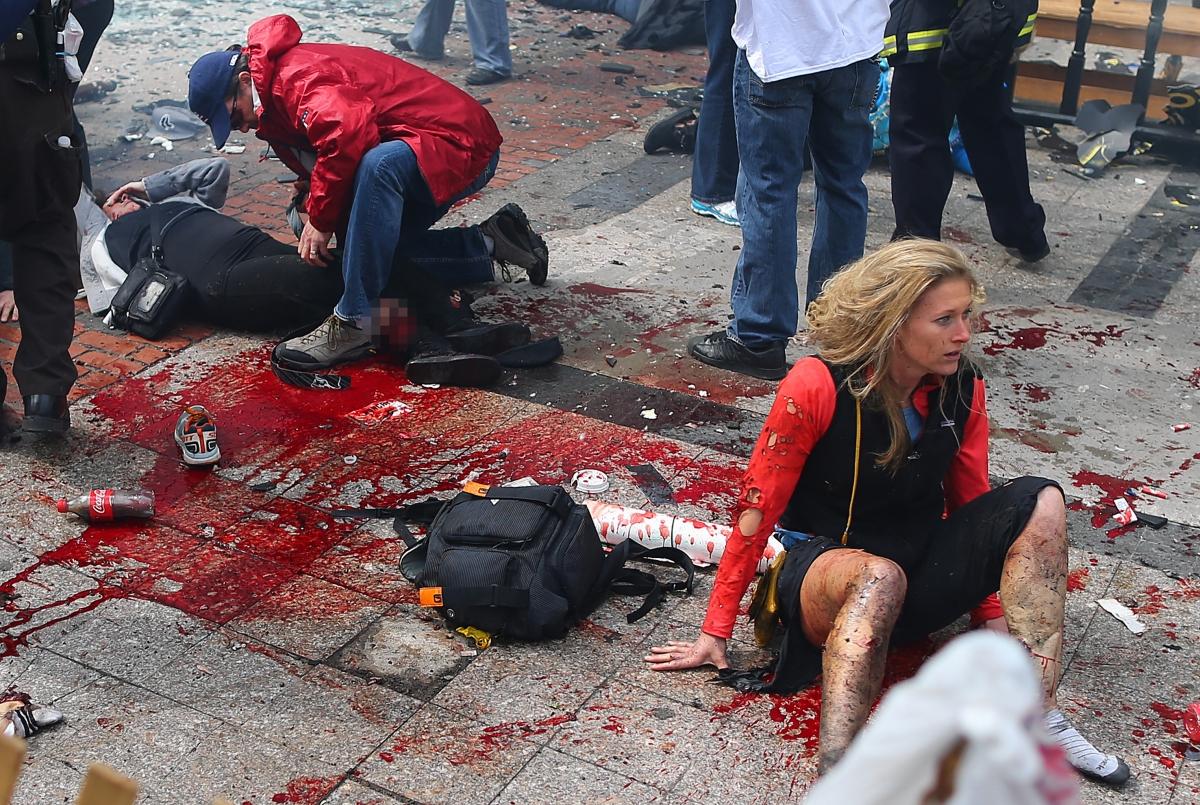
Dzhokhar Tsarnaev, the young terrorist who was formally sentenced to die for his role in the April 2013 Boston Marathon bombing,, finally said something in court before judgment was passed: he apologized, somewhere in the middle of an infomercial for Islam.

You can read the whole statement here. This is the apology section:

The Prophet Muhammad, peace and blessings be upon him, said that if you do not — if you are not merciful to Allah’s creation, Allah will not be merciful to you, so I’d like to now apologize to the victims, to the survivors.

Immediately after the bombing, which I am guilty of — if there’s any lingering doubt about that, let there be no more. I did do it along with my brother — I learned of some of the victims. I learned their names, their faces, their age. And throughout this trial more of those victims were given names, more of those victims had faces, and they had burdened souls.

Now, all those who got up on that witness stand and that podium related to us — to me — I was listening — the suffering that was and the hardship that still is, with strength and with patience and with dignity. Now, Allah says in the Quran that no soul is burdened with more than it can bear, and you told us just how unbearable it was, how horrendous it was, this thing I put you through. And I know that you kept that much. I know that there isn’t enough time in the day for you to have related to us everything. I also wish that far more people had a chance to get up there, but I took them from you.

Now, I am sorry for the lives that I’ve taken, for the suffering that I’ve caused you, for the damage that I’ve done, irreparable damage.

Now, I am a Muslim. My religion is Islam. The God I worship, besides whom there is no other God, is Allah. And I prayed for Allah to bestow his mercy upon the deceased, those affected in the bombing and their families. Allah says in the Quran that with every hardship there is relief. I pray for your relief, for your healing, for your well-being, for your strength.

Where does this apology rate on the Ethics Alarms Apology Scale? There are few important features to note: Continue reading

The News Media Giveth, The News Media Taketh Away…Now If Only We Could Trust Its Motives

Today, Johnny's old quiz show would have to be re-titled, "Who CAN You Trust?"

Today, Johnny’s old quiz show would have to be re-titled, “Who CAN You Trust?”

When the remains of hundreds of children were found in what appeared to be a mass grave under an Irish orphanage, another Catholic Church scandal seemed to be rising. Last week, the Associated Press, which broke the story, released this amazing “correction”:

DUBLIN (AP) — In stories published June 3 and June 8 about young children buried in unmarked graves after dying at a former Irish orphanage for the children of unwed mothers, The Associated Press incorrectly reported that the children had not received Roman Catholic baptisms; documents show that many children at the orphanage were baptized. The AP also incorrectly reported that Catholic teaching at the time was to deny baptism and Christian burial to the children of unwed mothers; although that may have occurred in practice at times it was not church teaching. In addition, in the June 3 story, the AP quoted a researcher who said she believed that most of the remains of children who died there were interred in a disused septic tank; the researcher has since clarified that without excavation and forensic analysis it is impossible to know how many sets of remains the tank contains, if any. The June 3 story also contained an incorrect reference to the year that the orphanage opened; it was 1925, not 1926.

Or, to summarize, “Never mind. We rushed this story onto the newswires because of  preexisting biases of our reporters and editors, and breached the basic fact checking standards of our “profession” because, come on, only saps do that stuff any more. Sorry if this gave Catholic-bashers and anti-religion zealots false ammunition—we’ll work on digging up more dirt that will stand up to scrutiny. Besides, most people who saw the original story won’t see this correction, so it’s no big deal.”

How can we trust a news organization that could misrepresent a story this badly? We can’t, that’s all, and it isn’t just the Associated Press. All aspects of the news media have abandoned any pretense of objectivity, fair reporting and professionalism. Even when they do something right, one has to wonder why….for  they might not really be doing it ethically after all, no matter how it appears.

Case Study #1: Faking Hillary’s “town hall” Continue reading

Harvard’s Black Mass: An Ethics Problem With No Answer


Impossible.

Impossible.

P versus NPthe Hodge conjecturethe Riemann hypothesisthe Yang–Mills existence and mass gap The Navier–Stokes existence and smoothness. The Birch and Swinnerton-Dyer conjecture. These are some of the unsolved problems of mathematics, but they are child’s play compared to the unsolvable ethics dilemma concocted at Harvard College.

Is Harvard right to allow students to hold a historic recreation of a Black Mass? Is Harvard wrong? Is it unethical for the students to engage in the project? Is it gratuitously insulting to religion, particularly Catholicism? Does it even matter if it is?

To bring you up to date:

The Harvard Extension Cultural Studies Club is planning to recreate a “satanic black mass” on campus next week, enacted by Satanic Temple, a New York-based, Satanist group that engages in outrageous displays to draw attention to First Amendment rights. “Our purpose is not to denigrate any religion or faith, which would be repugnant to our educational purposes, but instead to learn and experience the history of different cultural practices,” the HECSC said in a statement.

The statement lays the foundation for a hung jury in seeking an ethics verdict. Since the Black Mass was originally devised to denigrate the holy mass, saying that recreating the mass isn’t intended to denigrate religion is the kind of thing Captain Kirk used to say to evil, logic-bound computers to make smoke come out of their hard drives. “It-is-true-but- it’s-not-true-but-nothing-can-be-true-and-not-true–KABOOM! Continue reading

Gift Horse Ethics: The Babe, The Splendid Splinter, and The Ethics Of Self-Promoting Virtue

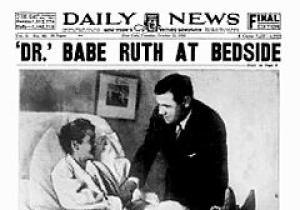
sick child and-babe-jpgBaseball slugger Babe Ruth was famous for visiting hospitals and orphanages to give kids a thrill. Babe always had reporters in too to record his noblesse oblige , of course. He was an orphan himself, and nobody should doubt the Bambino’s genuine dedication and generosity when it came to kids. He just wasn’t going to let his good deeds go unnoticed.

Other baseball greats, notably Ted Williams, made most of his visits without fanfare or publicity, and he didn’t tip off the press. “The Splendid Splinter” wasn’t visiting kids in cancer wards because he wanted his fans to know what a good guy he was. He did it because he wanted to make sick children feel better.

Was the Babe less ethical than Williams? Did his self=promotion take the ethical sheen off of his good deeds? This is the issue raised by the activities  of the  “Magician Prankster” who calls himself “Magic of Rahat” on YouTube and Twitter. He recently posted a video called “Homeless Lottery Winner” showing him playing  a prank on a homeless man, who ends up with $1,000. He is understandably grateful:

Slade Sohmer however, on HyperVocal, is hearing ethics alarms: Continue reading

Comment of the Day: “The Cabbie and the Jewelry”

Prodigal Commenter Penn re-entered the ethics fray with two anecdotes about ethics and Japanese culture in reaction to the Ethics Alarms quiz, “The Cabbie and the Jewelry.” This was the second COTD to be inspired by that story of the ethical—or pragmatic—cabbie who rescued $100,000 worth of jewelry left in his cab by a careless fare.

Here is Penn’s “Comment of the Day”:

“70s, Tokyo, 2 anecdotes: Continue reading

Comment of the Day: Ethics Quiz: “The Cabbie and the Jewelry”…Ethics or Pragmatism?

Karl Penny puts the perfect topping on this post, about the praise being heaped on the NYC cabbie who returned $100,000 in jewels to an absent-minded fare, when he could have made a dash for the Bahamas. I obviously couldn’t say it better myself, because I didn’t.

Here is Karl, a long-time and cherished reader, on Ethics Quiz: “The Cabbie and the Jewelry”…Ethics or Pragmatism?

“Well, it would be a pretty swell world if everyone did the right thing in cases like these, simply because it never occurred to them to do it any other way.  But that’s not the world we live in.  But, in either type of world, people like Mr. Jalloh should be highly praised:  in the world as it is, because he becomes an exemplar of the way things should be; and in the better world, because virtue never goes out of style and should be reaffirmed whenever an example of it occurs.”

Ethics Quiz: “The Cabbie and the Jewelry”…Ethics or Pragmatism?

Cable news, the New york press and the blogosphere are singing the praises of Big Apple cabbie Zubiru Jalloh, who, when he discovered that an absent-minded passenger, John James, had left a bag containing about $100,000 worth of jewelry in his back seat (“Doh!”) of his cab, rescued the bag from the next passenger, took it home for safekeeping, and eventually got it back to its rightful owner. Continue reading

Ethical Quote of the Month: President Barack Obama

“You see, when a tragedy like this strikes, it is part of our nature to demand explanations – to try to impose some order on the chaos, and make sense out of that which seems senseless.  Already we’ve seen a national conversation commence, not only about the motivations behind these killings, but about everything from the merits of gun safety laws to the adequacy of our mental health systems.  Much of this process, of debating what might be done to prevent such tragedies in the future, is an essential ingredient in our exercise of self-government.

“But at a time when our discourse has become so sharply polarized – at a time when we are far too eager to lay the blame for all that ails the world at the feet of those who think differently than we do – it’s important for us to pause for a moment and make sure that we are talking with each other in a way that heals, not a way that wounds.

“Scripture tells us that there is evil in the world, and that terrible things happen for reasons that defy human understanding.  In the words of Job, “when I looked for light, then came darkness.”  Bad things happen, and we must guard against simple explanations in the aftermath.

“For the truth is that none of us can know exactly what triggered this vicious attack.  None of us can know with any certainty what might have stopped those shots from being fired, or what thoughts lurked in the inner recesses of a violent man’s mind.

“So yes, we must examine all the facts behind this tragedy.  We cannot and will not be passive in the face of such violence. We should be willing to challenge old assumptions in order to lessen the prospects of violence in the future.

“But what we can’t do is use this tragedy as one more occasion to turn on one another.  As we discuss these issues, let each of us do so with a good dose of humility.  Rather than pointing fingers or assigning blame, let us use this occasion to expand our moral imaginations, to listen to each other more carefully, to sharpen our instincts for empathy, and remind ourselves of all the ways our hopes and dreams are bound together….

“…If this tragedy prompts reflection and debate, as it should, let’s make sure it’s worthy of those we have lost.  Let’s make sure it’s not on the usual plane of politics and point scoring and pettiness that drifts away with the next news cycle.

“The loss of these wonderful people should make every one of us strive to be better in our private lives – to be better friends and neighbors, co-workers and parents.  And if, as has been discussed in recent days, their deaths help usher in more civility in our public discourse, let’s remember that it is not because a simple lack of civility caused this tragedy (it did not), but rather because only a more civil and honest public discourse can help us face up to our challenges as a nation, in a way that would make them proud…”

—- U.S. President Barack Obama, speaking at the memorial event, “Together We Thrive: Tucson and America,” at the McKale Memorial Center in Tucson, Ariz., eloquently and sensitively rejecting partisan and media efforts to exploit the Tucson shootings for political gain, and calling for a unified quest for an end to rancor and violence.