For the first time since my son was about to turn 9 almost 16 years ago, our home is without the extraordinary sweetness and aggressive unconditional love of Rugby, my son’s (but really the whole neighborhood’s) extraordinary Jack Russell Terrier.
He peacefully expired after an injection, as he was held tightly by my son Grant, whom he loved beyond explaining, wrapped in the tattered baby blanket that a toddling Grant himself once held for comfort, and that had lined Rugby’s dog bed in my son’s apartment.
In the end, these decisions always come down to ethical values. We received from our vet the not entirely unexpected news that our dog’s sudden lack of energy and stability as well as labored breathing was almost certainly caused by progressive heart failure. Dickens, his more flamboyant and occasionally diabolical predecessor of the same breed, had perished of the identical malady just short of 15 years of mischief. The first question— Is there anything you can do?— was met by an answer we have heard before in earlier animal companion tragedies: “Maybe, but even under the best circumstances, the time will be short.” Continue reading →
Desperately trying to salvage the day with the next one looking worse, and a lot of important ethics matters being swept toward the falls, were they risk being swamped by rapidly moving events…
1. Great sequence, unethical to make it…Not only was D.W. Griffith a film pioneer and a racist, he was also quite mad. If you haven’t see this sequence from D.W. Griffiths’ “Way Down East,” you must. That’s Lillian Gish on the ice floe, and actor Richard Barthelmess trying to rescue her for real. It was shot on a frozen river as the ice broke up, and Gish was really headed over the falls, though they were only a few feet high. No stunt actors were used; Gish’s hair froze and she lost feeling in her hand from the cold. Her right hand was never quite right after that.
Things like this are what made actors’ unions necessary.
2. What a mess. The President’s Secretary of Defense nominee, Patrick Shanahan, resigned from the Acting-SOD role and removed his name from consideration in order to keep his family from being dragged through some awfully ugly mud, very little of which, it seems was of his making or germane to his qualifications for office.
Before their divorce, Shanahan’s ex-wife was arrested after punching him in the face; after the divorce, his son was arrested after attacking and nearly killing his mother with a baseball bat. The Waltons this wasn’t. Shanahan tried to defend his son after that episode, arguing in a message sent to his ex-wife’s brother that his son had acted in self-defense and writing…
“Use of a baseball bat in self- defense will likely be viewed as an imbalance of force,” However, Will’s mother harassed him for nearly three hours before the incident.”
It was expected that Democrats would weaponize the memo against him in hearings, #MeToo-style.
Shanahan told The Washington Post that he wrote the memo in the hours after his son’s attack on his ex, before he knew the full extent of her injuries, to prepare for his son’s initial court appearance. He said never intended for anyone other than his son’s attorneys and his brother-in-law to read it, but, of course, by showing the message to his brother-in-law it was no longer confidential.
Somehow, in a civilized culture, private tragedies like these should not become an impediment to public service. Yet it is hard to imagine how Shanahan thought it would not, since this is not a civilized political culture. Continue reading →
My father loved Sousa marches. So do I. Sousa was a genius in a very narrow range, but a genius he was. The Liberty Bell was one of my dad’s favorites. Here is a great websiteto familiarize yourself with the great march-master’s creations; it has instant links to each march.
1. Since it has done such a superb job ensuring world peace, the U.N. moves on to the important stuff… Unesco has issued a report claiming that having female voices in machines like GPS’s, smartphones and personal assistant devices reinforces gender stereotypes and enables the oppression of women. From the Times:
“Obedient and obliging machines that pretend to be women are entering our homes, cars and offices,” Saniye Gulser Corat, Unesco’s director for gender equality, said in a statement. “The world needs to pay much closer attention to how, when and whether A.I. technologies are gendered and, crucially, who is gendering them.”One particularly worrying reflection of this is the “deflecting, lackluster or apologetic responses” that these assistants give to insults. The report borrows its title — “I’d Blush if I Could” — from a standard response from Siri, the Apple voice assistant, when a user hurled a gendered expletive at it. When a user tells Alexa, “You’re hot,” her typical response has been a cheery, “That’s nice of you to say!” Siri’s response was recently altered to a more flattened “I don’t know how to respond to that,” but the report suggests that the technology remains gender biased, arguing that the problem starts with engineering teams that are staffed overwhelmingly by men. “Siri’s ‘female’ obsequiousness — and the servility expressed by so many other digital assistants projected as young women — provides a powerful illustration of gender biases coded into technology products,” the report found.
Gee, that’s funny: I thought the reason a woman’s dulcet tones were used in such devices is because they were easier on the ear than, say, HAL. Nor would it occur to me that a woman was being subservient or submissive when the female voice was coming from a lump of metal and plastic on a table.
FACT: Yes, a consumer should have the option of having a device speak in a male or female voice.
FACT: If the owner of such a device wants to insult it, make sexual comments to it, or crush it with a hammer, that’s none of the U.N.’s business.
FACT: Programming AI to be adversarial to its owner, whatever voice the device is using, is unethical, and, obviously, bad business.
Unesco’s report is the epitome of manufactured offense. Continue reading →
I should begin by noting that there is no way I’m going to see this movie, unless I’m in the hospital, it’s on TV and my best alternatives are “Ellen” and Don Lemon. I’m sick of CGI movies, sick of super-hero movies, and have never been enamored of the genre since Christopher Reeve took Margot Kidder flying. As for this particular super-hero movie, the fact that it is 3-hours is a minor problem, overwhelmed by the fact that I would have to watch the previous long Avengers movie, “Infinity War” to have a prayer of knowing what the hell’s going on.
However, many fans of such films are annoyed by the fact that “End Game” is so long yet has no intermission. They should be. One should be able to see the entertainment one has paid for without having to miss a chunk because nature calls. Movies don’t have intermissions any more, but that doesn’t mean there’s a good reason for them not to. Continue reading →
For some reason, the question about which sports movies are the “best” or individual favorites has turned up in all sorts of places this week, I have no idea why. When it turned up during tonight’s Red Sox broadcast, I decided it was time to give my list.
(The Red Sox and Rays are tied in the 7th, 4-4.)
Most sports movies are ethics movies, and my favorite five all fit that description.
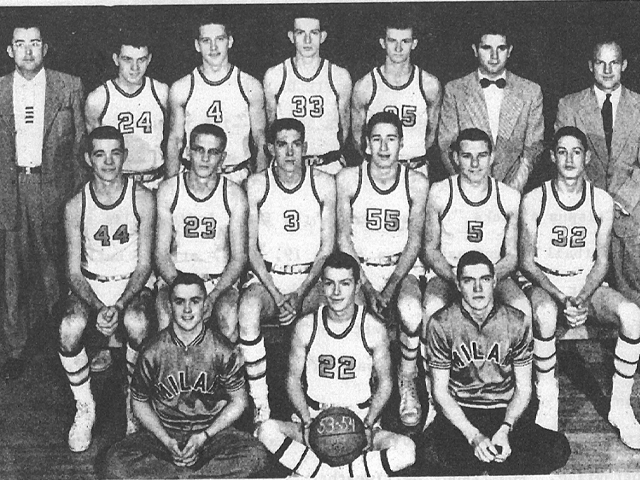
1. ” “Hoosiers“(1986) The Gene Hackman movie about a tiny Indiana town’s surprise victory in the state basketball tournament (the actual 1954 team is above), covers many ethics themes, including leadership, integrity, sacrifice , redemption, learning from past mistakes, and moral luck. The basketball games are surprisingly realistic, and Jerry Goldsmith’s score, evoking bouncing basketballs on a court, is one of my all-time favorites. Favorite ethics moment: after training the team to obey him without question, and teaching them to play as a team, not individuals, coach Hackman tells his players with one play left in the championship game that they will use their star, Jimmy, as a decoy, and let another player take the final, game deciding shot. After a long pause, Jimmy tells him, “I’ll make it.” And like all good leaders, Hackman knows when to trust his subordinates. He let’s Jimmy countermand his order, and Jimmy indeed wins the game. Continue reading →
1. Record ethics. Kansas City Royals second-baseman Whit Merrifield is a fine young rising star, but the nation will never turn its lonely eyes to him.Playing against the Mariners this week, Merrifield beat out a squeeze bunt that not only tied the game, but also extended his hitting streak to 31 games. That set a new franchise record, beating Hall of Famer George Brett’s 30 game consecutive hitting streak set in 1980. That seems unfair, you say? Most of Merrifield’s streak was last season, you say?
I agree with you. Baseball takes the position on consecutive game streaks of all kinds that the six months between seasons don’t matter or count. I see the logic, a bit: why should a player’s chance at a record be arbitrarily ended because the season runs out? I also have the answer: tough noogies. There is a material difference between hitting in consecutive games over a single grueling season and doing so with a vacation in the middle. I guarantee that if Merrifield’s record got close to Joe DiMaggio’s iconic 56 games, set in the single, famous season of 1941 (when Ted Williams also hit .406), Major League Baseball would have rushed in and disqualified Merrifield for the consecutive game record because it wouldn’t be set in a single season. THAT, of course, would have been redolent of the controversial asterisk put after Roger Maris’s 61 home runs in 1961, which broke another iconic record, Babe Ruths’s 60. (Maris’s record was set in a 162 game season, Ruth’s in a 154 game season.)
Fortunately, Merrifield’s record chase was stopped at 31 the very next day.
This is as good a time as any to mention that the player who got me hooked on baseball, former Red Sox shortstop Eddie Bressoud, whose 87th birthday is coming up (May 2), had a knack for hitting streaks at the start of season. he hit in 15 straight in 1962, his first with the team, and set the team record for a consecutive streak at the start of the season in 1964, with 20.
2. “Don’t be evil” a distant memory. R. Emmett Tyrrell, Jr. , the founder of mainstream conservative magazine “The American Spectator” announced that the publication had been blacklisted by Google, following an investigative report by The Daily Caller that revealed, Continue reading →
The day got off to a grand start when the first thing that came up on TV was the ending of John Wayne’s “True Grit.” When the Coen Brothers did their (dark) remake starring Jeff Bridges as Rooster Cogburn, I wondered which version would survive as the definitive one. Sometimes remakes of classic films obliterate the originals, like “The Thing,” or “Invasion of the Body-Snatchers.” Sometimes the original films are so obviously superior that the remake just vanishes. Sometimes it should vanish, but doesn’t, like the ugly “Charlie and the Chocolate Factory” created by Tim Burton. Both “True Grit’s ” are excellent, but so far, at least, the Duke’s Oscar-willing performance has prevailed. Good.
1. From the “You can’t fool all of the people all the time, especially if you’re a callow, arrogant fool” files: Rep. Alexandria Ocasio-Cortez offended an audience made up predominantly of African Americans when she slipped into assumed regional slang to lecture them about the dignity of menial jobs for life
“I’m proud to be a bartender, ain’t nothing wrong with that!” Ocasio-Cortez proclaimed. [CORRECTION NOTE: Originally, the version of this statement I had was an Ebonics-fest that I got off of a tweet from an attendee. This was incorrect: thanks to Chris Marschner for the fact check.]
Actually, the real offense was her content, not her delivery. This is communist cant for the proles: don’t aspire to more than your hum-drum jobs, for you are serving the greater good (and your superior overlords). That’s not the American values system, or American culture, which encourages productive dissatisfaction, personal initiative, and determination to be better and do better.
2. I knew Harvard wouldn’t be able to duck the college admission scandal! Harvard has launched an “independent investigation” into a series of suspicious events that occurred in 2016. Wealthy businessman Jie “Jack” Zhaopaid inexplicably paid $989,500 for a home in the Boston suburbs that was valued at only $549,300. Seventeen months later he sold that home for $665,000, for a loss of $324,000. Continue reading →
I would give you all a big hug, a squeeze, and maybe a sniff, but that’s not me...
1. This is fake news, you know. Today’s headline on the Times front page: “Barr Understated Mueller Findings, Some on Team Say.” Naturally, “some” are never identified. All this headline means is that some involved with the Mueller investigation wouldn’t have summarized the report as the AG did, and some had a different opinion, and, presumably, some disagreed with them. Who didn’t assume this? This isn’t news. This is just pot-stirring and innuendo in service of a political agenda. Now if the Times’ sources went on the record and explained what findings they are referring to and why, that would be news. This isn’t.
2. Maybe just Ick, not ethics, but still, ICK! Kendall Jenner, who is famous exclusively because her half-sister sister bared all in a sex video that launched the Kardashian reality show empire, made $26.5 million for just 53 sponsored Instagram posts, according to Captiv8, a marketing firm that connects brands to “social media influencers.” Let’s see: is there anything wrong with Jenner letting companies pay her to send out social media hype? As long as she isn’t lying in her posts, I guess not...but if she becomes part of a fraud without doing her due diligence, its not just unethical, it’s illegal. Is there anything unethical about paying a narcissistic waste of space who would lose a game of Scrabble to a sea sponge millions to promote a company’s product or event? No, if it works. Is there anything unethical about trusting a barely-educated celebrity because of her looks? Unethical, no…stupid, but not unethical.
3. On the suspension of ethics during wartime. Freddie Oversteegen, who died September in her native Netherlands, was just 14 when she joined the Dutch resistanceTogether with her older sister Truus and their friend Hannie Schaft, she murdered as many Nazis as she could, using a firearm hidden in the basket of her bike. The women had a method: first approach a Naz in bars, seduce them, ask if they wanted to “go for a stroll” in the forest (wink-wink, nudge-nudge) and then, shoot the bastards, or as Freddie put it, “liquidate” them.
“It was a necessary evil, killing those who betrayed the good people,” she told one interviewer. When she was asked how many people she had killed or helped kill, she demurred: “One should not ask a soldier any of that.”
Freddie also blew up bridges and smuggled Jews out of concentration camps, so she was more than a black widow assassin. Is she justly regarded as a hero?
4. “The Highwaymen” My wife and I watched this new Netflix release starring Kevin Costner and Woody Harrelson as the real life aging Texas Rangers who were handed the assignment of “stopping” Bonnie and Clyde’s deadly rampage through Texas in 1934. We liked it a lot, but then it’s an ethics movie, raising and debating the question—see #3 above—of how far one can ethically go to fight evil. Bonnie and Clyde were evil despite their folk hero status at the time, and despite the sick glamorizing they received in the 1967 film starring Faye Dunaway and Warren Beatty, which made them the romantic rebels fighting a corrupt establishment—you know, like the arrogant creeps who shut down my college a year later.
The Highwaymen barely shows the two psychotic love-birds until they are being riddled with bullets, focusing on the real heroes of the saga, the law enforcement officials who hunted them down.
The two ex-Rangers break quite a few laws in the pursuit of the greater good, and it is odd that there seems to be a resurgence in sympathy in the entertainment media for brutal police methods. In Dick Wolf’s “Chicago PD,” for example, Sergeant Hank Voigt (Jason Beghe) regularly threatens, extorts and beats people up to solve crimes–and he’s the moral center of the show. Is law enforcement more like war than we like to admit, where the ethical rules can be, are, and maybe need to be suspended?
Best line in “The Highwaymen”: Kathy Bates, as Texas Governor “Ma” Ferguson—I’ll tell her weird ethics story tomorrow—tells reporters that she is making sure that Bonny and Clyde are hunted down, and one of them references their image as Robin Hood figures. “Did Robin Hood ever shoot a gas station attendant in the head for four dollars and a tank of gas?” she asks.
5. Now THIS is weird…Twin ethics! In Brazil, when identical male twins refused to say which one of them had fathered the child (DNA test proved inconclusive because they their were identical twins) assuming they would then be able to escape having to pay, a judge ordered that they both had to pay child support. Each twin was ordered to pay 230 reais; ($60; £45) a month, or 30% of the minimum salary in Brazil. Judge Filipe Luís Perucaalso ruled that the names of both men would be on the girl’s birth certificate.
The twins had used their resemblance to impersonate each other and date as many women as possible, and then defend themselves from allegations they were cheating on girlfriends. Ah, memories! I see a reboot coming!
But they’re irresponsible illegitimate fathers!
Identical illegitimate fathers, and you’ll find
The look alike, deny alike, they go in court and lie alike!
1. Synchronicity! Note that today’s first post and yesterday’s last one (on “peer pressure”) essay are integrally related. I had thought, or hoped, that the latter would prompt considerable discussion, but to the contrary: all commenting has seemingly dried up. Surely Facebook’s embargo can’t be THAT effective. Well, I’ve never understood the ebb and flow here, and lately I understand it less than ever.
2. Nah, Democrats don’t want open borders! While House Democrat were in the midst of passing HR1, the entirely symbolic “elections reform” bill that is an open admission that loose election controls elect Democrats, Republicans forced a vote on proposed language stating: “Allowing illegal immigrants the right to vote devalues the franchise and diminishes the voting power of United States citizens.”
All but 6 Democrats voted against the addition. All but one Republican voted for it.
3. Stop making me defend Tucker Carlson! Media Matters, the one-way-only media watchdog that makes its opposite number “Newsbusters,” look like a paragon of objectivity by comparison, pulled a version of the Hader Gotcha! on Fox News pundit Tucker Carlson. Instead of unearthing old tweets to attack him, MM found audio of old interviews with Tampa shock jock “Bubba the Love Sponge” during which Carlson made some less than nuanced comments that Media Matters pronounced “misogynist” and “sexist.” Some were; most were not. Media Matters, like the party it swears allegiance to, is addicted to gender-baiting: Carlson’s belief that rape shield laws “totally unfair” is a valid opinion that many non-sexists, including me, agree with.
To Tucker’s credit, he responded to Media Matters’ hit with this statement: mailed to the Washington Post:
“Media Matters caught me saying something naughty on a radio show more than a decade ago. Rather than express the usual ritual contrition, how about this: I’m on television every weeknight live for an hour. If you want to know what I think, you can watch. Anyone who disagrees with my views is welcome to come on and explain why.”
Adds Althouse, “I’m resistant to getting excited about something somebody said years ago because somebody is telling me that’s what everyone is supposed to get excited about today.”
4. Speaking of Althouse...she does an epic job taking apart Democratic hopeful John Hickenlooper, until recently Governor of Colorado, who exposed himself on “Face the Nation” yesterday as a mealy-mouthed weenie who if he lasts until the debates, will be this cycle’s version of Lincoln Chaffee.
Here’s the cringe-producing transcript. Hickenlooper isn’t just mealy-mouthed (Ann’s description), he’s a coward. He wants to run as a moderate but is afraid to say he’s a moderate, choosing instead to argue against “labels.” The best is this part:
GOV. HICKENLOOPER: Well try- if I’ve tried to avoid this all the labeling that goes on. You know, I mean…. I’m running for president because I believe I could beat Donald Trump… but I also believe that can bring us together on the other side and begin getting stuff done. And that’s one thing I think that I bring to the table is I’m a doer. I’m not someone who’s- I mean I’m a dreamer too and I- I believe in big visions….
Snarks Althouse, most appropriately: “A doer who’s a dreamer, a dreamer of big visions. In his dreams, he beats Donald Trump. Noted. ” Continue reading →
Perusing the Ethics Alarms essays on casting ethics (there are a lot of them), I think I finally understand the rules. It’s wrong to cast a black actor to play a black character when the original character was white, but if the black character is playing a white character as white, that’s OK. Casting an African-American actor to play a fictional Arab sheik in “Ben-Hur” is fine, but casting a black Samoan-American as fictional black icon John Henry is unacceptable. It’s wrong to cast an abled actor to play a disabled character, wrong to cast a cis actress to play a real life woman who pretended to be a man, wrong to cast that same actress to play an animated heroine who was originally drawn as Japanese, but brilliant to cast black and Puerto Rican actors to play Alexander Hamilton and the Founders. Oh! I nearly forgot! It’s wrong to cast a white actor to replace a black actor who replaced a white actor playing the role of a white character.
Clear?
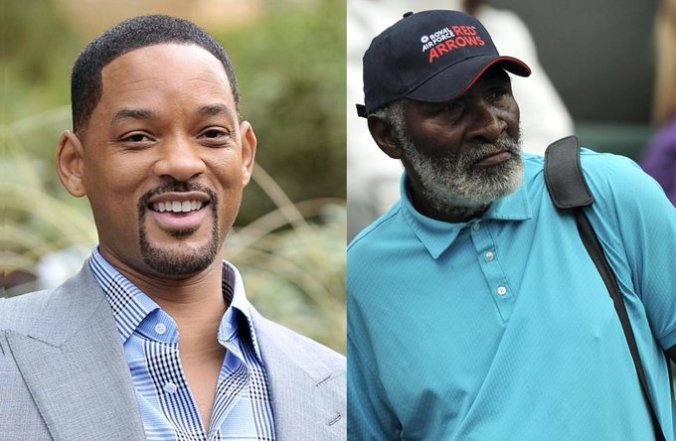
Now we have a casting ethics controversy that has raised its empty head before: Will Smith is on the verge of being cast to play Serena and Venus Williams’ father Richard in a film, and critics and social justice warriors are calling it “colorism,” because Smith isn’t as dark and the tennis stars’ dad. Black sports writer Clarence Hill Jr tweeted, “Colorism matters..love will Smith but there are other black actors for this role..” Another indignant political correctness warrior (in Great Britain) wrote, “Why are they whitewashing the dad with Will Smith? Colourism is constantly subconsciously fed to us and we just eat it up…”
Except, you know, casting Smith as Williams isn’t colorism. It is “casting a prominent actor for the role who will put fannies in the seats-ism.” Who cares how dark or light Richard Williams is? What does his skin shade have to do with the reason he’s worthy of a film portrayal? Would Venus and Serena be better or worse athletes if he were the shade of Will Smith?
I’m pretty sure that I’ve finally figured out what’s going on. Just as rape isn’t about sex but about asserting power, so the progressive complaints about casting aren’t truly about race, or color, or fairness, or white-washing, or any of the supposed justifications for manufactured outrage. They virtually always for the purpose of asserting and cementing the power to bend others to their will, to establish the precedent that whatever they demand, even when it is the opposite of what they may have demanded in the day before, even if it is obvious that they are making up the rules as they go along, must be accepted. It is the equivalent of an abusive boss ordering a subordinate to strip, get down on all fours, and bark like a dog. They do it because they can.
The only way to end this nonsense is to defy it, but as we have seen in most of the casting controversies, since actors are generally too shallow and too cowardly to articulate ethical principles much less take a stand in favor of them, the actor who is the target of the complaint usually grovels an apology and withdraws. I’m hoping that Smith is made of sterner stuff, but I wouldn’t bet on it.