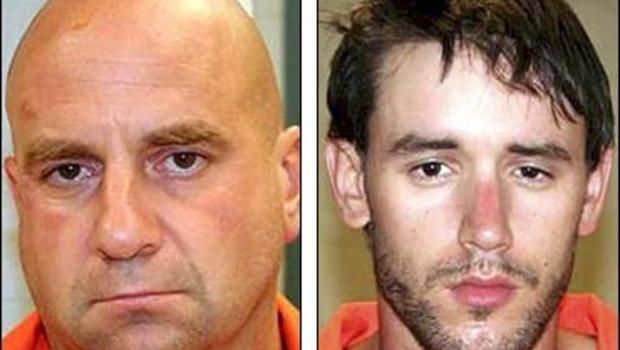
Hayes and Komisarjevky, the Cheshire, Conn. killers
Steve-O-in NJ’s Comment of the Day on my post about the recent SCOTUS capital punishment opinion spawned another COTD. The immediate catalyst was my answer, within the post, to Steve’s query about what crimes I think warrant executions. One of my answers referenced the Cheshire, Connecticut home invasion and murders, which I wrote about extensively here.
“The Cheshire, Conn. murders.” This is the crime that broke my opinion of the death penalty. I was initially ultra-liberal on this issue, thinking that the death penalty was just not acceptable today, but moderated considerably.
My initial view was a rather unexamined belief, essentially unchanged from what I had expressed in a middle school essay a few years before the home invasion. In that middle school essay, I decried the state of Connecticut for “murdering” Michael Ross, a jolly good chap who killed 8 souls before the age of 24. (Stipulated, even in middle school, I conceded wooden jails of the Wild West, etc, could not reliably contain dangerous individuals, necessitating the death penalty.)
My main argument was that killing was WRONG. This was axiomatic, not allowing counter argument. The only mitigating factor for execution, the need to protect the public, was adequately addressed with modern maximum-security prisons.
Ross was the last criminal successfully executed by Connecticut, making the opportunities to reflect on an actual case study vanishingly rare. However, Connecticut had several placed on its death rolls, each hopelessly tied up in appeals (mostly by design). A distressing number of capital indictments came from prosecutors in Waterbury, the major city in northwestern part of the state. Waterbury has a unique reputation for corruption second to none (in a state with Hartford, New Haven, and Bridgeport, mind you); disgraced ex-governor Rowland was employed by the city when he was released from prison. Continue reading →
In Part 2of the New York Times editorial board’s examination of the ethical and legal complexities of conflicting laws protecting the right to kill a fetus, the rights a fetus does have, and the mother’s rights, the question is posed:
Katherin Shuffield was five months pregnant when she was shot in 2008. She survived, but she lost the twins she was carrying. The gunman, Brian Kendrick, was charged with murdering them. Bei Bei Shuai was eight months pregnant and depressed when she tried to kill herself in 2010. She was rushed to the hospital and survived, but her baby died a few days later. Ms. Shuai was charged with murder.
Both cases are tragedies. But are Ms. Shuai and the man who shot Ms. Shuffield really both murderers?
It is an ethical question, a legal one and a logical one. Unfortunately, and typical of the entire series, the Times cannot play straight, or begin with basic principles. No, the questions is asked with an assumption in hand: the right to abortion must trump everything, even logic and justice The editors go on:
“Ms. Shuai is one of several hundred pregnant women who have faced criminal charges since 1973 for acts seen as endangering their pregnancies, according to National Advocates for Pregnant Women, which has completed the only peer-reviewed study of arrests and forced interventions on pregnant women in the United States. In many cases, the laws under which these women were charged were ostensibly written to protect them. Ms. Shuai, for instance, was charged under a law that was stiffened after the attack on Ms. Shuffield.
These criminal statutes are results of a tried-and-true playbook, part of a strategic campaign to establish fetal rights, reverse Roe v. Wade and recriminalize abortion. The sequence begins with anti-abortion groups seizing upon a tragic case in which a woman loses her pregnancy because of someone else’s actions. Public outcry then helps to strengthen a state feticide law that recognizes such lost pregnancies as murder or manslaughter. It’s a backdoor way of legally defining when life begins.”
In other words, the Times relies on ideology to duck an ethics conflict that points in a direction that radical abortion advocates don’t like, and thus refuse to acknowledge, because they don’t have a good answer for it. Here’s my answer: Yes, they are both murderers. If a mother who is gestating a child that she and her husband intend to have, and the child is killed by the act of a third party, a human being has been murdered, and charges are just. In the Sheffield case, her twins were within the protection of abortion limitations, though I would hold that this doesn’t matter, if they were both going to be delivered. If you don’t call this a murder, then a manic could perform an involuntary abortion on a 9 month’s pregnant women, ripping her fetus out of her with murderous intent, and still face no murder charges as long as the mother recovered. Were it not that all obstacles to abortion must fall, even logical ones, no woman, no human being would call such an act anything but murder. Once any rights are assigned to the unborn at all, however, such logic is impolitic. Continue reading →
A beautiful, naked Frasier Fir is standing in my living room like an unpaid debt.
1. Speaking of Christmas...The first installment on the Ethics Alarms ethics guide to “Miracle on 34th Street” went up late yesterday, and was immediately blocked on Facebook for violating community standards. Nice. It appears my Facebook “friends” took revenge for my chiding their juvenile and unending “Orange Man Bad” posts.
In a surprising admission, the author if the controversial dossier used to secure the secret surveillance on Trump officials admitted that it was paid for by Clinton campaign as a type of insurance to challenge the election. At the same time, the reporter who helped break the story, Michael Isikoff now says that many of the specific allegations remain unproven and are likely false.
The Washington Times reported that Steele stated in a declaration in a defamation case that the law firm Perkins Coie wanted to be able to challenge the results of the election based on the dossier. In an answer to interrogatories, Mr. Steele wrote: “Fusion’s immediate client was law firm Perkins Coie. It engaged Fusion to obtain information necessary for Perkins Coie LLP to provide legal advice on the potential impact of Russian involvement on the legal validity of the outcome of the 2016 US Presidential election. Based on that advice, parties such as the Democratic National Committee and HFACC Inc. (also known as ‘Hillary for America’) could consider steps they would be legally entitled to take to challenge the validity of the outcome of that election.”
In his typical fashion when he is in mealy-mouth mood, Turley says this is “concerning,” since this document was used to get judicial leave to spy on the Trump campaign. The news is only surprising if you had your fingers in your ears and were shouting “Nanananana” for the past year. This issue, you will recall, is what led a previously well-regarded commenter from the Left here to noisily withdraw as a participant because I was, he said, obviously in the throes of irrational Right Wing conspiracy mania because I posted this.
Certain exiles, if they have any integrity at all, owe me a large, effusive, groveling apology—and I still might not accept it.
Concludes the Professor: “The Steele admission only magnifies the concerns over the purpose and the use of this dossier, but has received little media attention.”
Gee, I wonder why THAT is!
3. “And now for something completely stupid” Department. I guess former “Fresh Prince of Bel Air” star Alfonso Ribeiro’s career isn’t going so well. He is suing the makers of the video game Fortnite for allegedly stealing his “Carlton dance.” You know, this…
It was a big deal at the time because Ribeiro’s character was a geek, and ignorant viewers didn’t know that the actor was professional dancer who had starred in “The Tap-Dance Kid” on Broadway as a child. The fact that a video character does similar moves…
…is no basis for a lawsuit. Choreography copyrighting is a murky intellectual property area, and suing because of an animated figure’s moves is pathetic, as well as an abuse of the civil justice system. The has-been star is angling for a nuisance suit settlement. He should try “GoFundMe” instead. Continue reading →
In 2017, Kellie Collins (above, left) ran as a Democrat against incumbent Rep. Jody Hice, a Republican, to represent Georgia’s 10th District. She ultimately dropped out of the race, but while she was running, her major theme was gun control and responsible gun ownership.
Now her former campaign treasurer, Curtis Cain (above, right, in better days), has been found dead inside her apartment, apparently the victim of a gunshot wound. Collins turned herself into the McDuffie County Sheriff’s Office just as authorities in Aiken County, South Carolina found Collins, who had been dead for at least four days.
She must have noticed him.
The conservative news media is implying that this constitutes hypocrisy on Collins’ part. It isn’t. If she had shot him while she was campaigning for responsible gun ownership, then it might have been hypocritical. She might have changed her mind about guns in the intervening months, however. Hypocrisy is when you advocate a principle while you are violating it in a manner that proves you don’t believe in the principle at all. That’s not what happened here.
Even if she had shot him in 2017 in Georgia, though, it wouldn’t necessarily have been hypocrisy. She could still have been a responsible gun owner. Maybe she was acting in self-defense. She did not argue in 2017 that it was irresponsible for gun owners to ever fire their weapons; that would be ridiculous, not that gun control zealots don’t often say ridiculous things. It isn’t even correct to call this ironic. Responsible gun owners kill people.
It may well be that the evidence will show that Kellie is a murderer. Base on what we know, however, its is unfair to call her a hypocrite.
The basic facts of the Curtis Flowers murder case are these: On the morning of July 16, 1996, someone walked into a furniture store in downtown Winona, Mississippi, and shot four employees in the head. Police charged Curtis Flowers with all four murders. After 22 years of trials, mistrials and reversals, Flowers has faced juries six times for the same crime. He has been on death row since the first conviction, and the most recent one is being appealed. Many believe he is innocent.
I think it can be stipulated that this has been a badly botched prosecution, whether Flowers is innocent or not. There is no limit on how many times someone can be tried for the same crime, as long as the trials end in mistrials or convictions. The Flowers case suggests that we need a limit. If the system can’t get a conviction properly after a reasonable number of attempts—I don’t know what a reasonable number is, but I am confident that it is less than six—then the accused should go free. So far, Flowers has been in prison for over two decades without being convicted. That’s wrong.
It would be nice and reassuring if a knee-jerk liberal columnist like the New York Times’ David Leonhardt, whose background is in journalism and mathematics, not law, could inform the public about an outrageous case like this without mucking it up with ideological leaps of logic, unwarranted conclusions and progressive talking points. He can’t help himself, though.
Pity.
For his entire op-ed, he relies on this podcast about the case. A podcast about a legal case is like a documentary: it has a point of view baked into it. I admire the podcast, but it isn’t evidence. It isn’t the trial transcripts, or the decisions overturning the three convictions that were found to be flawed. Never mind: the Times writer sees “no good reason to believe that Curtis Flowers is guilty.” Continue reading →
1 O.J. was guilty??? I’m shocked! I was going to run a quiz about whether Fox broadcasting the 12-year-old O.J. Simpson interview in which he “hypothesizes” about what really happened—when Nicole Simpson and Ron Goldman ended up with the lives stabbed out of them and a trail of O.J.’s blood leading from the scene to his home—was unethical or just icky, as in “revolting taste.”
Never mind: I’m willing to say it was unethical. Fox was aiding and abetting a murderer’s efforts to cash in on his crimes. Yes, yes, I know: in the eyes of the law, Simpson is innocent. But Fox, and you, and I, and O.J.’s lawyers and certainly O.J. all know beyond a shadow of doubt that he did it, and Simpson deserves a full shunning from the culture in every respect.
Fox, many forget, produced this interview as part of the promotion for O.J.’s book, “If I Did It,” written by a ghostwriter after interviews with Simpson. Simpson got $600,000 in the deal, denying later that he had anything to do with the project, and saying, “Hey, they offered me $600,000 not to dispute that I [wrote] the book…Everybody thinks I’m a murderer anyway. They’re not going to change their mind just because of a book.”
The consensus is that the Simpson’s statements in the Fox interview amount to a confession to double murder. I saw the key portion in a promotion,, where O.J. says that he remembers being at Nicole’s home, grabbing a knife, then seeing lots of blood…but not remembering what happened in between. But Simpson is a liar and a sociopath, and because of double-jeopardy, he can say that he watched Nicole and Ron get attacked by an army of zombies he recruited and it wouldn’t make any difference.
The degree to which Fox debased itself by running this offal cannot be exaggerated, and anyone who watched it without being paid to do so is an accessory after the fact to the unjust enrichment of O.J. Simpson.
2. Bonus O.J, ugliness:Read this hateful, racist, biased and legally ignorant essay by Michael Herriot at “The Root.” Herriot is another of many contributors to CNN whose anti-white racism is palpable, but deemed acceptable mainstream punditry. How deep and widespread is this kind of blind, unreasoning hatred of white Americans in the black community? How can anyone read something like this and wonder where the upsurge in white nationalism comes from?
“It meant so much to us, and, you know, I have to let you know how it is for us now. We had you. We had the Obamas in the White House. Even on a bad day, you had a north star. You had some hope. And then it was like the universe looked just said, psych! And threw us in the toilet and closed the lid and now we’re just stuck in this crazy situation, swirling…Help us, though, help us though!…I go out there and I try to tell people, let’s not become what we are fighting. Let’s not be what we’re fighting. They tell me, shut up, Van, because we got bigots out here, we got Nazis out here, we’re getting bullied, we are tired of going high. We want to go low and kick them in the private parts!”
There is disturbing evidence that “the resistance” and the anti-Trump mob, including the news media, is heading into a new and even more deranged stage, which is scary, since the previous stage has been putting unprecented stress on the nation’s mental and political health. We saw this deterioration with Jill Abramson’s open admission that she keeps a totem of Barack Obama in her purse to stave off despair. We are seeing more and more alternate-reality rants, like this one by David Remnick in “The New Yorker.”
The rhetoric is getting more shrill and hyperbolic every day, even when the news is good. At least Paul Krugman is consistent: his rhetoric about Trump has been shrill and hyperbolic from the start. Here he is this morning:
“Now, it’s a commonplace, but also a euphemism, to say that Trump has authoritarian instincts. A more accurate statement would be that he expects the kind of treatment tin-pot dictators demand, free from any criticism inside or outside his government and greeted with constant hosannas of praise. And everyone who isn’t willing to play the full game, who has tried to play by something resembling normal democratic rules, seems to be fleeing the administration. Soon only the shameless sycophants will be left. This will not end well.”
Sigh. All of America’s strong Presidents have had autocratic instincts, with the arguable exception of George Washington. Jackson, Polk, Lincoln, Cleveland, Teddy, Wilson, FDR, Truman, Ike, LBJ, Nixon, Reagan, Clinton. Obama did as well, though he wasn’t a strong President. It’s just that people like Krugman are so offended by Trump being President that when he behaves essentially like the rest, they think it’s sinister. The complaining about this President surrounding himself with yes-men is especially hypocritical, since there were few complaints from the same critics about President Obama’s dangerously deferential inner circle, bolstered by a worshipful rather than properly objective press.
Krugman’s title is “Springtime for Sycophants.” Trump is Hitler, get it? Continue reading →
I wasn’t at the trial, but I will break my usual rule by saying that this jury, which acquitted the officer of murder charges, does not deserve the benefit of the doubt, because there is no doubt. I cannot see any path by which the actions of the officer in shooting Shaver can be called reasonable, or anything but murder.
Brailsford said he thought Shaver might have been reaching for a weapon. If he wasn’t lying, and I’ll assume he wasn’t, then he was paranoid, and so devoid of normal senses of perception that the police force was negligent all owing him to carry a gun, or to be on the force at all.
Still shaking…
How could it have not been clear that Shaver was terrified? Or that he was not desperately trying to follow the officer’s instructions?
Are officers in Mesa trained to talk like that? I assume that they are trained NOT to talk like that, which can only be expected to escalate panic and anxiety and cause the situation to go out of control.
Michael Piccarreta, Brailsford’s attorney, convinced jurors that his client acted as reasonably, as a police officer, considering the totality of circumstances. That means that Brailsford acted like any reasonable officer would have when he fire his AR-15 at a terrified young man crawling toward him as he had directed. The officer had been called because someone had been reported as pointing a rifle outside of hotel window. Obviously, Shaver had no rifle on him.
(Although it was reportedly a rough morning for the former Eleanor Coulouris 67 years ago_)
Or so I was told.
1. It’s NOT okay to be white? CNN Commentator Angela Rye, formerly executive director of the Congressional Black Caucus, told CNN audiences that “white, liberal women” were the cause of the pressure on iconic Michigan Representative John Conyers to resign from Congress. House Minority Leader Nancy Pelosi would have never called for Conyers to resign if it weren’t the other “white, liberal women” pressuring her to do so. Rye, who earlier in the week said that a racist double standards was causing Conyers to be pressured to resign while white Democratic Senator Al Franken was not, said,
“I think Nancy Pelosi made a commitment to the members of the Congressional Black Caucus that she would not call for Conyers resignation before due process was allowed to take place. Now she’s being faced with the pressure of white, liberal women for the most part who have told her she needs to say something different.”
Race-baiting and using racism as an excuse for any criticism of black politicians is still the reflex response of far too many Democrats, in part because they face no consequences for doing so, and because any whites who object are tarred as white supremacists.
Until the news media and progressives have the integrity to treat this tactic for what it is, and as exactly as intolerable as white racism, the nation will continue to split hard along racial lines. I guess that’s what the Left wants.
How can CNN justify continuing to employ a “contributor” like Rye—it has some others, too—who is a stone-cold racist?
How can anyone who abhors racism in all its forms continue to patronize an intentionally racial division-promoting news source that does employ someone like Rye?
Here, for people like Rye—you know, stupid people—are some reasons Al Franken’s situation is distinguishable from that of Conyers: he is thirty years younger and shouldn’t have retired about a decade ago anyway; he, unlike Conyers, hasn’t flatly denied all of the allegations against him as they keep on coming; a Senator resigning is a bigger deal than a Representative resigning; and Nancy Pelosi doesn’t oversee Senate Democrats.
Also there are no reports of Franken habitually meeting with female staffers without his pants on. It’s small thing—well, not that small—but still…
2. No, really, it isn’t OK...In related news,Texas State University student journalist Rudy Martinez wrote an article entitled “Your DNA Is An Abomination”—referring to white DNA, of course—for The University Star, the University of Texas student publication. The piece also advocated the death of whites, which is unpleasantly close to calling for them to be killed. If you think I’m going to point out that any student who wrote this about blacks in a student newspaper would be quickly disciplined, while the newspaper editor responsible for publishing such vile material was hounded of campus, you’re right. If the University of Texas administrators had any integrity, common sense or guts, it would, this is what would happen. At least the president of Texas State, Denise M. Trauth, said that “The column’s central theme was abhorrent and is contrary to the core values of inclusion and unity that our Bobcat students, faculty, and staff hold dear.” That’s nice. Why is Texas State graduating racists? From the column:
“Ontologically speaking, white death will mean liberation for all. Accept this death as the first step toward defining yourself as something other than the oppressor. Until then, remember this: I hate you because you shouldn’t exist. You are both the dominant apparatus on the planet and the void in which all other cultures, upon meeting you, die.”
Denise Cervantes, The University Star’s editor-in-chief, pulled the column and apologized, saying “We acknowledge that the column could have been clearer in its message and that it has caused hurt within our campus community. We apologize and hope that we can move forward to a place of productive dialogue on ways to bring our community together.”
1 Self promotion Dept. I’m going to be back on NPR (WBUR, D.C.) in what I think is a live panel discussion (“Barbershop” is the show—I wonder what a ‘barbershop” is? ) hosted at 5: 30 pm, EST by the estimable Michel Martin. The topic is The Harvey Weinstein Ethics Train Wreck, though that’s not what they’ll be calling it.
2. “For every time, Spin Spin Spin, there is a season..” I may mention this New Republic article, or at least be ready to torch a fellow panelist who cites it favorably. The tortured reasoning of writer David Dayen led him to assert that the “sexual harassment crisis” resulted from ” a broken justice system.” Let me summarize it for you: men harass women in the workplace because it’s too hard to convict people and put them in jail. When did liberals start being the ones who want to dispense with civil rights protections and due process assurances in court?
“But we should identify the real culprit for this state of affairs: the long, slow abandonment of the rule of law in America. The reason adjudicating sexual misconduct claims has been left to the media and the crowd is that people have no expectation that the legal system will adjudicate those claims fairly. How can anyone blame them? They have witnessed endless instances of powerful people, mostly wealthy men, getting away with criminality and deception, in every context imaginable. When you don’t have a working justice system, you get a kind of vigilantism as a result. The problem isn’t the vigilantism—it’s the broken framework that leads desperate people to take matters into their own hands. That powerful people face little sanction for misbehavior is an old story, as true in gender as it is in class. But brazen impunity for the powerful is a hallmark of our era. The worst financial crisis in America in nearly a century led to practically no convictions for those whose actions facilitated the meltdown. The Catholic Church shuttled around sex-abusing priests for decades with little reckoning. Cops shoot black people and go back on the job….”
None of this has much to do with sexual harassment, which isn’t a crime, and the three examples cherry-picked by Dayen don’t support his stated argument. The Wall Street wheeler-dealers operated primarily within loopholes and gray areas in the laws and regulations. There were few convictions because it was hard to prove that laws were broken. When the molesting priests were identified, still living, and in the U.S., many were sent to prison. (That the Catholic Church behaved abysmally doesn’t show that the U.S. justice system is broken, obviously). And “Cops shoot black people and go back on the job” is deceitful, simple-minded agitprop. Colin Kaepernick, is that you?
The article is a desperate and clumsy attempt at ethics jujitsu, with the recent exposure of progressive hypocrites as sexual predators being flipped to pivot to the talking point that “everything is rigged against the poor, blacks and women.” What Dayen ends up arguing is that we need to make it easier to prove criminal guilt when we just know the defendants are bad dudes (white, male and rich) —shouldn’t that be enough?— and all the “beyond a reasonable doubt” stuff should be junked…except when black “non-violent drug offenders” are involved.
3. It’s still illegal. Fark.com called this story “a woman being arrested for mothering while black.” Nice. David Dayen, is that you? Continue reading →
As one might expect, abortion is one of the topics that can be relied upon to spark a lively discussion every time it is raised on Ethics Alarms. This is because abortion is a true ethics dilemma, where valid ethical considerations point in opposite directions. In addition, this ethics dilemma cannot easily be solved by balancing, because determining which of the ethical values involved, personal autonomy and the primacy of human life, should hold the superior priority involves resolving conflicting definitions.Complicating things further is the fact that the three main ethics systems—reciprocity, Kantian ethics, and Utilitarianism— reach disparate conclusions.
The subject of this intense and extensive comment by Zoltar Speaks! is another commenters assertion that the unborn do not qualify as “persons” within the protection of the law because they do not, as far as we know, have self awareness and are incapable of thought. I personally detest this argument, but I’ll leave the exposition to Zoltar. He got extra credit for beginning with the trademark quote that Ethics Alarms uses to designate a “Popeye.“
“I ain’t gonna take it, ’cause I can’t take no more!”
My understanding from your comments is that you don’t agree with a lot of what abortion activists use as arguments. However, you’re regurgitating intentionally modified long standing definitions to fit an agenda instead of using the definitions as they are. You are not parsing the words of an existing definition, you are not simply misunderstanding an existing definition, you are literally adding things to the definition of “person” that do not exist in the definition.
You are saying that a person is not a person until they can think and feel, and that is by definition false (see below.)
You say that “intelligent, informed pro-choice advocates” talk about thinking and feeling is when a person becomes a person. I don’t care who presents that as an argument, it’s false. It is literally uninformed, and since you used it in this way it is literally showing a low level of intelligence. It’s bastardizing the English language into agenda-driven rhetoric:
Bastardizing:corrupt or debase (something such as a language or art form), typically by adding new elements.
I looked up as many definitions for the word “person” as I could find and I found an obvious common thread: Person:A human being regarded as an individual. A human individual. A human being. A human being as distinguished from an animal or a thing. An individual human. The common thread is human and individual. Tthere is nothing in any definition I could find that could be construed as holding that a person is only a person if he or she can think and feel.
Human Being, furthermore, is a man, woman, or child of the species Homo sapiens, distinguished from other animals by superior mental development, power of articulate speech, and upright stance. Is an unborn child a human being? Yes. Continue reading →






“Man! I am BORED out of my GOURD!”
As one might expect, abortion is one of the topics that can be relied upon to spark a lively discussion every time it is raised on Ethics Alarms. This is because abortion is a true ethics dilemma, where valid ethical considerations point in opposite directions. In addition, this ethics dilemma cannot easily be solved by balancing, because determining which of the ethical values involved, personal autonomy and the primacy of human life, should hold the superior priority involves resolving conflicting definitions.Complicating things further is the fact that the three main ethics systems—reciprocity, Kantian ethics, and Utilitarianism— reach disparate conclusions.
The subject of this intense and extensive comment by Zoltar Speaks! is another commenters assertion that the unborn do not qualify as “persons” within the protection of the law because they do not, as far as we know, have self awareness and are incapable of thought. I personally detest this argument, but I’ll leave the exposition to Zoltar. He got extra credit for beginning with the trademark quote that Ethics Alarms uses to designate a “Popeye.“
Here is the Zoltar Speaks! Comment of the Day on the post, Morning Ethics Warm-Up, 11/13/17: Rushing In Panic Around My Boston Hotel Room Because I Didn’t Get My Wake-Up Call Edition: