Comment of the Day 2, “All That Jazz” Edition: “Does Jazz Really Need DEI?”

I never know when a relatively obscure topic will strike a chord and produced a bumper crop of terrific comments. “Does Jazz Really Need DEI?”turned out to be such a post. Here is the second standout response, a Comment of the Day by johnburger 2013 on the post, Does Jazz Really Need DEI?

***

Here I thought Berklee College of Music was a serious institution. Silly me. Any institution with the following mission statement should be dismissed:

“The mission of the Berklee Institute of Jazz and Gender Justice is to support and sustain a cultural transformation in jazz, with the commitment to recruit, teach, mentor, and advocate for musicians seeking to study or perform jazz, with gender justice and racial justice as guiding principles.” (emphases added).

Just out of curiosity, what the hell does “gender justice” mean and what does it have to do with vamping in E flatMinor? Do we only study songs written by women? Do women prefer major modalities over augmented fifths? Do women avoid playing the F#maj13add4addflat7 chord?

Music is the one medium where gender and race are monumentally irrelevant. Is Within Temptation fantastic because the lead singer is a woman? No. The combo is great because their music is complex and full of surprises. The Warning (my most recent favorite band) isn’t great because it consists of three Mexican sisters. No. They are great because their music is intricate and heavy. The fact that they started out very young and have gained world-wide recognition as a family band is interesting but they are phenomenal musicians and songwriters. Kiki Wongo isn’t great because she is a woman, but because she has talent and tone, and can melt your heart or tear your face off with her guitar playing (Smashing Pumpkins realized her greatness when they selected her out of 10s of thousands of applicants for their lead guitarist on their latest tours). Linda Ronstadt wasn’t great because she is a woman; she was great because her voice compelled attention and takes you on all kinds of sonic adventures. [Editor’s note: Linda cannot sing any more because of Parkinson’s, but she was indeed great, and is still a great interview.)

As for “racial justice,” does that mean that only minorities are allowed to play jazz? Dizzie Gillespie, Miles Davis and John Coltrane are not considered jazz geniuses because they were African American. No, they were great because they wrote and played the vocabulary for modern jazz. What about Buddy Rich? Was rich great because he was white? Hardly: he is great because he could play drums like nobody’s business and had a sublime sense of rhythm.

Authority Malpractice, Broadway Division [Corrected]

Looking back over the nearly 17,000 posts here, I realize that the ethical issue of authority abuse has come up often, apparently because it drives me crazy. Experts and authorities, alleged, self-proclaimed or otherwise, are supposed to make everyone else better informed and smarter, not more ignorant and stupid. The “experts” that Ethics Alarms has fingered most frequently are pundits, politicians, historians (notably partisan Presidential historians like Jon Meacham, Michael Beschloss, and the late Arthur M. Schlesinger Jr. ) elected officials and baseball writers (with a special place reserved in Baseball Writer Hell for Tom Boswell).

One of the requirements for this sub-category on Ethics Alarms is that I personally know enough about the topic the expert is mangling to detect the authority abuse. Musical theater happens to be one of those topics on which I am qualified to speak and write with some credibility, so I was annoyed yesterday to hear Sirius/XM’s Broadway channel host Seth Rudetsky emit an inexcusable whopper.

Rudetsky is what is called an “industry star,” meaning that the Broadway community knows and appreciates his work though he is largely unknown to anyone outside that community except certifiable American musical nuts. He does have a little empire on Sirius, though, hosting and commenting upon about 50% of the content on the Broadway channel while apparently going out of his way to sound as screamingly gay as possible. (I believe this indulgence damages the popularity, cultural status and prospects of musical theater, but that’s a topic for another day).

Rudetsky styles himself as an “expert on Broadway history and trivia” (as it is phrased on his Wikipedia page), so I was gobsmacked when I heard him say, in his introduction to the “Annie Get Your Gun” duet “Old Fashioned Wedding,” that “there was this thing that Irving Berlin did” in his musicals where two characters would sing different songs and then Irving put the songs together, and they “fit.” Rudetsky recalled the “You’re Just in Love” duet in Berlin’s “Call Me Madam” (above) as an example, and said that “Old Fashioned Wedding” from the revival of “Annie Get Your Gun”was another instance of Berlin’s “thing.”

Continue reading

Yes, “Auld Lang Syne” Is an Ethics Song [Corrected]

New Year’s is the one holiday that has a single ethics song permanently associated with it: “Auld Lang Syne,” despite the fact that almost nobody knows what the words mean if they know all the words at all. One problem is the title and the phrase, which is best translated as “old time’s sake.” The other is that it shares a text-setting flaw with the National Anthem, beginning with a question. Nothing in the music makes the line “Should old acquaintance be forgot and never brought to mind?” resonate as a question; if fact, I’m ashamed to admit, for a long time I thought “should” was used in the sense of “if.”

I was stunned to learn recently that singing the song on New Year’s Eve is not an ancient tradition. In fact, the practice as a tradition began in 1929, when bandleader Guy Lombardo needed something to play at the stroke of midnight and chose “Auld Lang Syne” because it had a sentimental vibe and the band knew it. Then Lombardo’s (somewhat whiney, annoying version) continued to be a staple on New Year’s Eve TV broadcast as long as Guy was still kicking.

The full poem, usually attributed to the Scottish poet Robert Burns (1759–1796) but probably with other contributors, reads,

1. Should old acquaintance be forgot, and never brought to mind?

Should old acquaintance be forgot, and auld lang syne?

For old times since, my dear, for auld lang syne,

We’ll drink a cup of kindness yet, for auld lang syne.

Chorus:

For old times since, my dear, for auld lang syne,

We’ll drink a cup of kindness yet, for auld lang syne.

2. And surely you’ll have your pint cup! and surely I’ll have mine!

And we’ll drink a cup o’ kindness yet, for auld lang syne.

Chorus:

For old times since, my dear, for auld lang syne,

We’ll drink a cup of kindness yet, for auld lang syne.

3. We two have run about the slopes, and picked the daisies fine;

But we’ve wandered many a weary foot, since auld lang syne.

Chorus:

For old times since, my dear, for auld lang syne,

We’ll drink a cup of kindness yet, for auld lang syne.

4. We two have paddled in the stream, from morning sun till dine;

But seas between us broad have roared since auld lang syne.

Chorus:

For old times since, my dear, for auld lang syne,

We’ll drink a cup of kindness yet, for auld lang syne.

5. And there’s a hand my trusty friend! And give us a hand o’ thine!

And we’ll take a right good-will draught, for auld lang syne.

Chorus:

For old times since, my dear, for auld lang syne,

We’ll drink a cup of kindness yet, for auld lang syne.

6. Should old acquaintance be forgot, and never brought to mind?

Should old acquaintance be forgot, And auld lang syne!

The song tells us to remember the good times and not to forget that in the end it is human relationships, good will and kindness that matter most. We should sing in the new year with confidence that whatever happens and whatever it brings, we can endure if only we can keep our priorities straight.

Happy New Year, everybody.

Mid-Friday Ethics, 6/12/2020: The Fame Edition

Good afternoon!

1. On Fame. One of my pet peeves is the pursuit of fame as a life objective. It is inherently unethical, because fame itself is unrelated to good or evil; it is a neutral value, and its pursuit is pure self-interest mixed with ignorance.

First, as too many celebrities to count have informed us, fame is at least as much of a burden as a boon, and second, there is no such thing as “immortality” through fame. As Shelley wrote,

I met a traveller from an antique land,
Who said—“Two vast and trunkless legs of stone
Stand in the desert. . . . Near them, on the sand,
Half sunk a shattered visage lies, whose frown,
And wrinkled lip, and sneer of cold command,
Tell that its sculptor well those passions read
Which yet survive, stamped on these lifeless things,
The hand that mocked them, and the heart that fed;
And on the pedestal, these words appear:
My name is Ozymandias, King of Kings;
Look on my Works, ye Mighty, and despair!
Nothing beside remains. Round the decay
Of that colossal Wreck, boundless and bare
The lone and level sands stretch far away.”


The lyrics of the theme song from the movie and TV series “Fame” so annoyed me that I refused to view either:

Remember my name, fame
I’m gonna live forever
I’m gonna learn how to fly, high

I feel it comin’ together
People will see me and cry, fame
I’m gonna make it to heaven
Light up the sky like a flame, fame
I’m gonna live forever
Baby, remember my name!

Yeah, good luck with that life plan. Who remembers Irene Cara, the star of the film who sang the song? If you enter the field of performing, or any field, to become famous rather than to contribute something of value to society, you’re an asshole.

Chasing it is a fool’s pursuit, but sometimes fame finds you. I just read that former MLB baseball player Claudell Washington died. I remember him, but few do: he arrived heralded as a future superstar, but never reached that status. He is famous, however, because a foul ball he hit in a game of no importance is “immortalized” in “Ferris Bueller’s Day Off,” a cult classic, as the ball Ferris (Matthew Broderick) catches in the stands while playing hookie.

It’s more immortality than most of us get. Continue reading

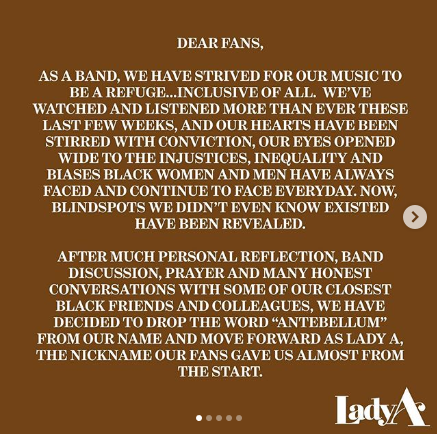
Virtue-Signaling Grovel Of The Day: Lady Antebellum

Here is the group’s announcement:

Observations: Continue reading

Wuhan Virus Ethics Updates, Part 1

1. Why keep calling it the Wuhan virus? Because the largely successful news media and political correctness assault on the completely legitimate (and non-racist) label continues to bolster Chinese Communist propaganda and blame-shifting, and because the effort emerged as yet another use of Big Lie #4: “Trump Is A Racist/White Supremacist.”

As for me personally, I will keep using the term because I resent being told that what cannot possibly be racist is racist, especially when my capitulation enables similar political correctness bullying. See the Third Niggardly Principle.

2. Because it’s so darn difficult to maintain social distancing while playing tennis... About  200 yards from my home in Alexandria, Virginia, the public tennis courts have their nets removed by another proto-fascist. Yesterday, I saw two people playing on one of the courts using a self-rigged net.  Good for them.

3. The problem is, you can’t force bank employees to come to work. Our bank, a large national chain, has all of its offices closed in this area, Banking is certainly an essential  service, but the fact is that you can’t do banking completely remotely, though the bank is pretending you can. Its website asks for a social security number at the same time as scammers are sending out fake emails that lead you to an authentic-looking clone of the bank’s site so they can steal your personal data. Try to call to clarify or address any problem, and you get a message about how wait times are longer than usual. I’ll say they are: to try to get a fraudulent $4000 charge to our account cancelled, I had to wait for an hour and 40 minutes, then be transferred to wait another 35 minutes, then be cut off when a transfer failed.

Meanwhile, the bank’s on-hold music is played at an unbearable volume, and is an endless loop of some hellish arrangement of a melody that would have been rejected for a theme park ride. I am certain that the recording is designed to make you hang up, or, in the alternative, go crazy and run into the street naked.  It is exactly like the deliberately uncomfortable seats and garish color schemes fast food outlets use to ensure you vacate the premises the second you finish eating. I swear that there cannot be a single person on the globe who would find this music anything but torture. The genre is “loud, abrasive, repetitious semi-music,” and there is no market for that. It makes hip-hop seem like Chopin.

Banks are essential, and rather than stopping stores from selling “non-essential” items, the government ought to require really essential services to have open outlets to serve depositors and bank customers experiencing their own emergencies. If a 7-11 clerk can come to work, so can a bank employee. Banks have my property within their control, and in exchange for the privilege, they are obligated to respond when I need service related to that money. Continue reading

Pop Music Ethics History: “My Sweet Lord” And “He’s So Fine” [UPDATED]

The ABA Journal finally provided a brief, clear, fascinating account of exactly how it was that George Harrison was found to have  “unintentionally” plagiarized  the Chiffons’ “He’s So Fine” when he wrote his biggest hit single as a solo artist, “My Sweet Lord.”

It also clarifies what I always suspected: when courts have to decide the question of when a song is too much “like” another, anything can happen.

George Harrison’s first solo album “All Things Must Pass” was released  in 1970, the same year the Beatles officially broke up, with “My Sweet Lord” the triple album’ s signature hit. I remember the first time I heard the song, and thinking, “Wow, that reminds me a lot of ‘He’s So Fine’!”  Others thought so as well, including  Bright Tunes Music Corp., which held the copyright on the Chiffons’ 1963 classic. It sued Harrison’s publishing company, Harrisongs Music Ltd., for copyright infringement.

As  litigation proceeded, Harrison admitted in court filings  that he was familiar with “He’s So Fine”—how could he not be?—but denied that he had used it to create “My Sweet Lord.”  At trial, Harrison  brought his guitar to  the witness stand to demonstrate how  he had composed “My Sweet Lord.” This, onlookers agreed,  was sufficiently convincing to persuade the judge that George was not guilty of intentional infringement. Continue reading

Happy Saturday Ethics Warm-Up, 4/27/19: Conniff, Cohen, California, And Co-opting A Classic

http://www.youtube.com/watch?v=w1xjwzQf7DI

Weekends, unfortunately, are only a rumor when you run a business out of your home…but I’m still HAPPY!

1. “To Kill A Mockingbird” ethics. I asked an old friend and talented director to give me her review of the controversial “To Kill A Mockingbird” on Broadway (previously discussed here, and here…). What I was most interested in was whether the new version (by “The West Wing” auteur and liberal political advocate Adam Sorkin) actually meets the contractual requirement insisted upon by Harper Lee’s estate, that “the Play shall not derogate or depart in any manner from the spirit of the Novel nor alter its characters.”  Well, I knew it would not be; Sorkin and the producer held out for being able to make a “woke” “Mockingbird” reflecting “current sensibilities,” and Lee’s greedy relatives wanted the money more than they cared about what Harper Lee might have wanted, like preserving the integrity of her novel.

Sure enough, my friend reported that the play was full of anachronisms and felt nothing like a story set in a small Southern town in the 1930’s. Most jarring of all, she said, was the oft repeated message that the racially prejudiced individuals in the town were “bad people.” This is the exact opposite of what Atticus Finch tells his daughter in the novel.

2. The GDP. Today the New York Times had the good and unexpected GDP news on its front page, so I’ll retract yesterday’s criticism  of the Times for burying that important news, and evidence of some Trump success. Instapundit pulled out this LA Times article  from 2017. It begins, Continue reading

Give My Regards To Broadway

http://www.youtube.com/watch?v=NiyYrIJ6GZQ

Broadway is officially irrelevant to American culture, and it’s their own damn fault.

A half-century ago, Broadway fare provided rich common content for Americans of all classes, creeds and ages. It was rare when a song from a Broadway musical wasn’t on the Top 40. Cast albums were found in most households. Broadway dramas provided the sources for a high percentage of non-musical movies.

Books could be written and have been about the forces that sent The Great White Way reeling toward irrelevancy, from popular music moving away from forms that told stories taking musical scores off the charts for good, to TV supplanting both movies and live stage as  the primary source of drama. Substantially, however, the problem is financial. Unions drove the prices of live theater to an unsustainable level, to the point where most American have no opportunity to see a professional stage show and no desire to spend their resources so recklessly if they did. Broadway shows are routinely priced at three figures, and even far away from Broadway, like near me in Arlington, Virginia, single tickets for musicals often top a hundred dollars. Well, as the Ancient Greeks and Elizabethans knew, live theater is important cultural connective tissue, permitting common experience, group bonding, and mass emotional release. It’s healthy for society, and was once thought to be essential. No more.

The Broadway League has released the results of its annual audience survey, which are being called “good news.” I call the results death throes. The survey already cooked the books by only surveying Broadway ticket buyer, which is a tiny and shrinking percentage of the public.

Among the findings:

  • That good news was that the average age of the Broadway theatergoer last season was 40.6, the lowest it’s been since 2000. 15% of all theatergoers are under 18 years old,, with the average age at a musical at 39,  51.5 at a play. Got it: more very rich people are taking their kids to see Broadway shows. Meanwhile, the family-friendly shows are not teaching new things or breaking new ground, for they are mostly re-hashes of movies the less affluent kids can see for almost nothing, and are better versions too.. Here are current shows deemed “family friendly”: “Frozen,” “Harry Potter and the Cursed Child,” “Mean Girls” and “SpongeBob SquarePants,” as well as the continuing runs of “Aladdin,” “Anastasia,” “Dear Evan Hansen,” “Hamilton,” “The Lion King,” “The Play That Goes Wrong,” “School of Rock” and “Wicked.” Let’s see: four adaptations of Disney animated films, an animated TV show, Harry Potter, two hit movie comedies about schools, teachers and parents, and a couple others.

So Broadway producers pandering to families seeking low-brow “culture” have succeed in masking the aging of the core Broadway audience.

  • The percentage of the Broadway audience made up of people from the New York area continues to rise, with 38 % of Broadway patrons were from the New York metro area, with 20% from New York City. Increasingly Broadway is a local phenomenon.

A question nobody asked: How many people from west of the Mississippi saw a Broadway show last year? Or wanted to? Continue reading

Comment Of The Day: “Racist Political Correctness, Casting Ethics, Double Standards, And The Rock”

Yes, this comment has little to do with ethics, but it’s so interesting as a supplement to the main post that it deserves greater circulation.

Here is Pennagain’s fascinating Comment of the Day on the weekend’s post, Racist Political Correctness, Casting Ethics, Double Standards, And The Rock:

I knew there were at least two versions of the song, “The Ballad of John Henry,” but I’ve so far found dozens more online, most of them having umpteen verses, and a work-song rhythm – the most basic of which my 7-year-old self stomped in that driving stop-rhythm around the classroom (chanting?), with that hammer-driving oomph! at the end of each line, to lyrics like “gonna die with the hammer in mah han’, Lord, Lord”.

For what it’s worth, a “real” John Henry is pretty well authenticated in at least one version of the story, ending fatally at the C&O’s Big Bend Tunnel in Talcott, West Virginia.

From KPBS’ “The African-American Railroad Experience”, built on Theodore Kornweibel’s photographic history: The entire southern railroad network built during the slavery era was built almost exclusively by slaves. Some of the railroads owned slaves, other hired or rented from slave owners [later from contracted freedmen or convict work-gangs]. And. . . women as well as men were actually involved in the hard, dangerous, brutal work. … several of the song versions finish with John Henry telling his wife to pick up the hammer and continue the job.

Negative evidence of Henry’s race would be that none of the many, many verses of the songs (recorded by 38 singers besides Ives) nor folk references – negro dialect aside (arguably stretched to “Suthun,”) – refer to that figure as being other than black. And as a black man, and a real, live “Everyman” working-man’s hero, he is proudly and fiercely claimed by South Carolina, Alabama, Virginia, Georgia, Kentucky . . . and Jamaica. Continue reading