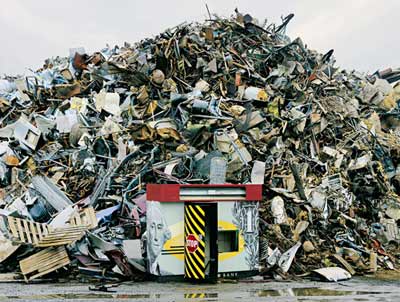
Unethical Website of the Month: Facebook Event—“If Boehner shuts down the government I am taking my trash to his house”

Hypothesis: If you can't persuade your adversary he is wrong, dump this on his lawn.

Two guys who shouldn’t be allowed out of the house, or near a laptop, without adult supervision have launched an unethical Facebook event, entitled “If Boehner shuts down the government I am taking my trash to his house.” See, if the federal government shuts down, one of the District’s services that will stop is trash pickup. Clever boys.

The organizers of the event are Jonah Goodman, who is listed in the Democratic National Committee network and Nolan Treadway, the political and logistics director for the liberal group Netroots Nation, lead off their “event” announcement saying that… Continue reading

The Final Proof That Michael Vick Doesn’t Get It

In the finale of “Animal House,” after the expelled Delta House members have sabotaged Faber College’s parade causing wanton destruction, mayhem, panic and riots, the fraternity’s  president approaches the dean (who is lying in the ruins of the stands toppled by the Delta House “Deathmobile”) and hopefully asks for “one more chance.”

I thought of this classic moment when I read that Michael Vick, the serial dog-abuser now seeking redemption by winning football games for the Philadelphia Eagles, had told an interviewer that he really missed owning a dog and hoped to have one as a pet some day. Continue reading

Spin or Fairness? Fox News and “the public option”

Media watchdog Howard Kurtz’s latest column for “The Daily Beast” illustrates how tricky achieving both objective and accurate journalism can be difficult, and sometimes impossible.

Examining Fox’s coverage of the health care reform debate, he discloses that after Republican pollster Frank Luntz tipped off Fox Tea Party booster and talking head Sean Hannity that the public was favorable to something called “the public option.” but suspicious of the same provision when it was referred to as “the government option.” Shortly thereafter, when the Senate Democrats introduced a health care bill with a public insurance option, Fox News vice president and Washington managing editor Bill Sammon sent the news  staff a memo: Continue reading

As Sick Children Suffer for Congressional Incompetence

For reasons no one has yet explained, a provision in the new health care reform law removes a previously Congressionally-mandated discount to children’s hospitals for drugs used to treat so-called “orphan diseases,” illnesses that are not common enough for the drugs to be profitable. Pharmaceutical companies have begun notifying the hospitals that they no longer qualify for the discounts, and the change will cost  hundreds of millions of dollars, as well as put sick kids at risk. Continue reading

Jesus, Ants, Art, and Republican Abuse of Power

The Republicans haven’t even taken over the House of Representatives yet, and they are already emulating Islamic extremists—and I’m not exaggerating. Continue reading

Be Thankful Tom DeLay Is Going To Jail

“As for DeLay, his time will probably come. He has ethical blind spots galore, and is only getting bolder with time. The more the Republicans move to protect “The Hammer,” the more damaging DeLay’s inevitable fall will be to the party. As the old newspaper columnists used to say, “You read it here first!”

I posted that almost exactly six years ago. In the years I have been doing ethics commentary, no figure inspired (or perhaps depressed) me more than Tom DeLay when he was G.O.P. Majority leader in the House. Now he has finally been convicted of the legal violations that his contempt for ethics virtually guaranteed.  From “Too Dumb to be Ethics Dunces,” posted in 2005: Continue reading

Ethics Quote of the Week: Rep. Greg Walden

“Our focus on the transition is looking at other things that are much more important. And that is how the House operates, how to open it up. We’re not focused in on the ethics side of things at all. We’re not working on that issue at all.”

— Rep. Greg Walden (R-Or.), who is heading up the transition to a Republican-led Congress, to ABC News, when asked if the new majority is going to change the process of House ethics oversight.

This statement is the epitome of res ipsa loquitur (“The thing speaks for itself”), don’t you think?

Anyone who expects the new G.O.P Congress to improve on the wretched level of corruption of Nancy Pelosi’s Democratic majority  House, or the even more extensive corruption of the last Republican House under Dennis Hastert and Tom DeLay, raise your hand…and slap yourself in the face with it.

At least Pelosi had the sense to say that ethics were important.

Ethics Dunce: Nancy Pelosi

Speaker of the House Nancy Pelosi is currently engaged in a demonstration of how the objectives of public service can become so distorted in the minds of those with power that they lose their ethical bearings completely.

By many standards of legislative success, Pelosi’s tenure as the leader of the House of Representatives has been a triumph. Nevertheless, she has become the face of the epic rejection of Democrats at all levels of government in the recent election. Her personal approval rating outside her native San Francisco hovers in single digits, and the Republicans successfully made “Fire Pelosi” a successful campaign slogan. Voters did fire Pelosi. Fairly of unfairly, she came to symbolize the arrogance of power, a contempt for the opinions of ordinary citizens, and runaway government. Like Harry Reid, her counterpart in the Senate, Pelosi’s talents lie in getting things done behind the scenes, not making herself look good in front of them. Now, with the country no longer mesmerized by Barack Obama and souring on the Democratic leadership and agenda, she needs to get off the stage.

But she refuses to go. Historically, most speakers whose party has been turned out of power accept responsibility for the defeat and allow new leadership to emerge. It is the logical course: only raw ego argues for anything else. Many believed that Pelosi would resign her seat and leave the House altogether. To the surprise of political observers, however, she announced that she would seek the post of Minority Leader, setting off a power struggle in her party. Current Majority Leader, Steny Hoyer, announced that he would seek the #2 power role of Minority Whip, pitting him against current whip James Clyburn,  and also pitting Democratic moderates, represented by Hoyer, against the influential African-American leadership in the party, represented by Clyburn.

Meanwhile, Republicans are rejoicing. Pelosi’s return will look like one more Democratic refusal to respect the will of the public, and the prospect of having the same leadership trio of Obama, Reid and Pelosi leading the party after its electoral dressing down seems like a dream come true.

Pelosi’s decision is bad for her party and her colleagues, who have been loyal to her. It is also bad for the country, even if one believes, as many do not, that her imperious leadership style is justified by the legislative success it produces for progressive policies. Washington and the public trust are being poisoned by anger, cynicism and partisanship, and Pelosi shares the blame for all three. The Democrats desperately need a new style and a new symbol in Congress, and most in and out of the Democratic Party know it.

Nancy Pelosi’s refusal to step aside places her own ego above the needs of public service and country, and is as blatant an example of power corrupting judgment as one can imagine. At a time when all ethical considerations argue for her to swallow her pride and let others take over, she is willing to jeopardize not only her party’s comity, unity and image but her own legislative achievements.

In politics, having one’s most dedicated adversaries  cheering your decision is a strong clue that you are missing something. In this case, what Nancy Pelosi is missing are accountability, humility, fairness, and common sense.

Ethics Alarms and ProEthics Presents “The Untrustworthy 20”: Making Ethics the Priority in Election 2010

The key word, in ethics, in government, in all relationships that matter, is trust. Trust is the connective tissue that holds societies together: it can be strengthened by demonstrations of ethical values like integrity, loyalty, honesty, civility, responsibility, competence, and courage, and weakened by proof of unethical traits like fecklessness, dishonesty, lack of independent judgment, selfishness, lack of diligence, greed and cowardice. For decades, the American public’s trust in its elected representatives and governmental institutions—and other critical institutions like the news media and the legal system—has been in steep decline. This is not because of some inexplicable public fad or the poisoning of public perceptions by an unholy alliance of the pop culture and Fox news. The decline in trust has occurred because a significant proportion of America’s elected leaders have not been trustworthy, and the reason this has been true is that American voters have thus far refused to make proof of ethical values their main priority in electing them. Because politicians know this, they feel empowered to engage in corruption, self-enrichment and deception in the confidence that partisan supporters will vote for them anyway, as long as they mouth the same policy positions and deliver their quota of pork, earmarks, and government contracts.

This, of course, does not benefit of  country in the long run, but weakens it. It also creates an increasingly arrogant and power-obsessed political class to which ethical values are like Halloween costumes, donned at regular intervals to disguise who they really are. The core principles of the democratic process do not matter to many of these people, and they don’t see why they should matter: witness House Speaker Nancy Pelosi’s refusal to debate her opponent because she knows she can win easily without giving her constituents a fair chance to compare the competing candidates. For most voters, over all, this approach still works, at least at the polls, so obviously untrustworthy officials continue to be elected, and by their conduct continue to destroy public trust.

I was discussing this issue at recent seminar in regard to the candidacy of Richard Blumenthal, the Connecticut Attorney General who is running for the state’s U.S. Senate seat. Blumenthal, to be blunt, is a proven liar and fraud on a grand scale. He intentionally misled the public for years about his military record, and assumed the false mantle of a combat veteran. When his deception was uncovered, he refused to be accountable, absurdly casting the repeated lies about his own past as mere slips of the tongue. Yet a Connecticut citizen at my table proclaimed that he “didn’t care;” that Blumenthal’s policies were what mattered, not his ethics. This is an astoundingly illogical mindset, but a common one. Power tends to tempt and corrupt individuals who have scruples and integrity: what is it likely to produce with an elected official that has neither integrity nor scruples to begin with? If we elect representatives who are untrustworthy, we are likely to be betrayed sooner or later, one way or the other. Worse, we send the message to future candidates, both in and out of office, that integrity and honesty don’t matter to voters, like my Connecticut friend. We thus get more untrustworthy candidates, more untrustworthy representatives, and constantly declining public trust in government on all levels.

Public trust cannot keep declining indefinitely, you know. Eventually, a government that cannot be trusted will collapse.

Just as addressing America’s fiscal crisis will take hard measures and sacrifice, addressing its equally dangerous crisis in trust requires sacrifice too. It will require voters to establish the principle that being “effective,” experienced or having the “right” policy positions will not be enough to justify electing or re-electing individuals who are demonstrably trustworthy. Voters must establish  untrustworthiness as absolutely disqualifying a candidate for election to public office. Any ethical, honest candidate with integrity must be seen as per se preferable to a corrupt, dishonest or unethical candidate, regardless of past achievements or policy views.

To this end, Ethics Alarms presents its list of the least trustworthy candidates for national office in the upcoming election. For reasons of space and convenience, it is limited to twenty members, which is obviously and sadly far too few: in the more than 500 races for Congress, the U.S. Senate and governorships nation-wide, the number of untrustworthy candidates undoubtedly numbers in the hundreds. This list is illustrative, not inclusive, but it is my assessment of the worst of the worst.

What makes a candidate so untrustworthy that he or she deserves to be rejected no matter who the opposition may be? This is what I like to call the “Lawn Chair Principle,” when electing a lawn chair is preferable to electing the human alternative. Let’s begin with what doesn’t justify determining that a candidate is necessarily untrustworthy: Continue reading

Accountability Alert: The “Embarrassment” Was the Nation’s, Not Colbert

In a stunning failure of perception, accountability and responsibility, the second most powerful Democratic House leader, Steny Hoyer of Maryland, actually had the gall to criticize Stephen Colbert for Hoyer’s own party’s disgraceful conduct, which was egregious enough to humiliate the institution of Congress, the democratic process, and the nation as well.

“I think it was an embarrassment for Mr. Colbert more than the House,” Hoyer told “Fox News Sunday.”
“What he had to say was not the way it should have been said.”

Unbelievable. Hoyer’s party’s own committee invited Colbert, a comedian whose shtick is mocking conservative Republicans, to testify about the wisdom of allowing illegal migrant workers to harvest crops despite the fact that he has no special expertise or credibility on the subject whatsoever. Continue reading