What’s Wrong With The Anti-Jihad Ads?

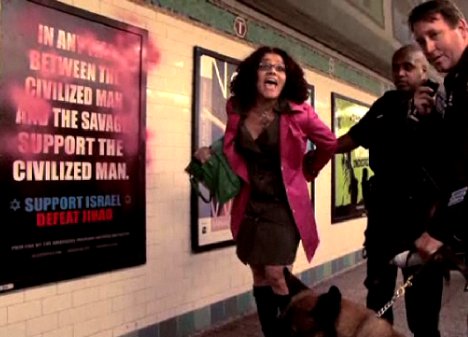
Mona Eltahawy, as police infringe on her exercise of the rarely invoked Eleventeenth Amendment, which protects a citizen’s right to spray any message she doesn’t want others to see with pink. paint.

The controversial ads went up in DC Metro stations today, after efforts by the city to have them blocked were declared, properly, to be unconstitutional by a sane and objective judge. The ads read,

“In any war between the civilized man and the savage, support the civilized man. Support Israel. Defeat Jihad.”

The controversy over the subway ads started heating up in the wake of the “Innocence of Muslims” debacle, when a crude internet trailer for a crude anti-Islam movie was used by extremists and fanatics around the world as an excuse to demonstrate against or attack U.S. embassies. The Obama Administration’s less-than-ringing defense of free speech in its efforts to minimize the violence had the undesired effect of emboldening domestic censors, among them  Mona Eltahawy, a free-lance Egypt-born journalist, who spray-painted one of the anti-jihad ads, the creation of the American Freedom Defense Initiative, in a New York subway station where it had been hung on September 24. She argued, as she sprayed, that censoring someone else’s protected speech was her First Amendment right. No, it’s not. A 2011 naturalized citizen, she needs to bone up on her American Constitution before she speaks at any more college campuses. She was arrested. Good. Continue reading

New York’s Stop and Frisk Ethical Dilemma

The problem with racial profiling is that it is wrong and unfair, but it works.

Crime rates, especially gun-related killings, have dropped precipitously in New York City since Mayor Bloomberg approved an aggressive “stop and frisk” policy.  Stop and frisk, where police are allowed to stop, question and pat down an individual whom the officer has reasonable suspicion may be involved in the commission of a crime, was approved by the Supreme Court long ago. The rub is that, as documented by the ACLU, New York cops seem to automatically find blacks (54%) and Hispanics (31%)  suspicious, as they account for 85% of those stopped. Bloomberg is under fire to ease up on the program, which he says demonstrably saves lives, even though the vast majority of those stopped and frisked are innocent. Bloomberg, using statistics derived from pre-policy shooting deaths and the numbers of illegal guns the frisks have discovered, told the press that 5,600 New Yorkers live today because of police suspicions. Continue reading

Ethics Hero: Actor Ryan Gosling

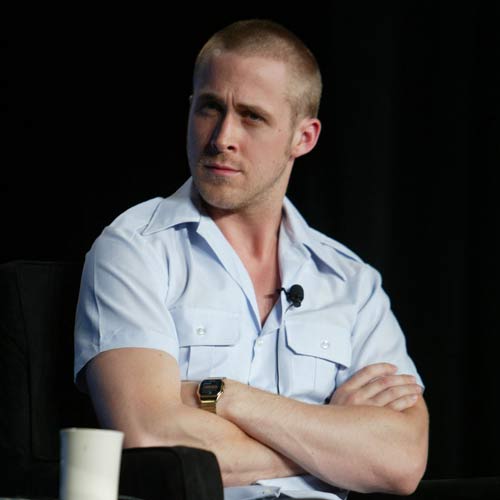
Ryan Gosling....ready for action!

Caught on video: Hollywood hunk Ryan Gosling (“The Notebook”) saw a fight developing on the streets of NYC, dropped his bag of groceries and used his personal-trainer toned bod to break it up.

Stopping violence in public can be dangerous, and I wouldn’t recommend it for everyone. Gosling obviously knew what he was doing, however, and what he was doing was fulfilling the citizen’s duty to fix a problem when he or she can. Proactive participation in society, including discouraging misconduct whenever possible, is profoundly ethical, and too rare. The actor not only stopped a brawl, he also established himself as a member of that endangered species, the celebrity who deserves to be a role model.

Gosling doesn’t just play heroes in the movies—-he knows how to be the real thing.

Religious Tolerance Ethics: Con

Muslim cab drivers in Manhattan, as well as some other cabbies of discriminating moral tastes, think that they ought to have  the right to veto the placing of advertising on the tops of their cabs that they consider objectionable, notably ads for strip clubs.  Good luck with that, and I am being sarcastic.

The owners of taxi medallions who lease the medallions to drivers, according to Taxi and Limousine Commission rules, now get to decide what advertising to sell for the roofs of their cabs. It’s a privilege they pay for, since the medallions cost $600,000 or more. The cabbies, however, especially those who own their vehicles but still lease the medallions from the cab companies, want the rules to change so that a cabbie wouldn’t have to drive under the image of a professional “girl gone wild.”

The medallion owners are strongly opposed to any change, arguing that they have to cover the costs and liabilities for the cabs, so they should be able to sell any legal advertising, including for strip clubs. And they are 100% right. Continue reading

Flashback: “What Hugo Alfredo Tale-Yax Can Teach America”

The Late Hugo Alfredo Tale-Yax

[Not many people were checking in on Ethics Alarms when I wrote this post in response to yet another example of bystanders choosing to do nothing when a human being was in peril. Some of the comments to the Alameda post, those making excuses for the 75 faint-hearted or apathetic citizens in that city who would rather gawk at a tragedy than try to stop it,  caused me to recall the essay, which explores related issues.  I wrote it, but I had nearly forgotten about the story; when I re-read it today, I got upset all over again.Here, for the second time, is “What Hugo Alfredo Tale-Yax Can Teach America.”]

The one with the premium-grade ethics alarms bled to death on the sidewalk. The people who never had theirs installed at all took pictures. Is this the way it’s going to be? Continue reading

Should It be Illegal to Buy Counterfeit Designer Goods?

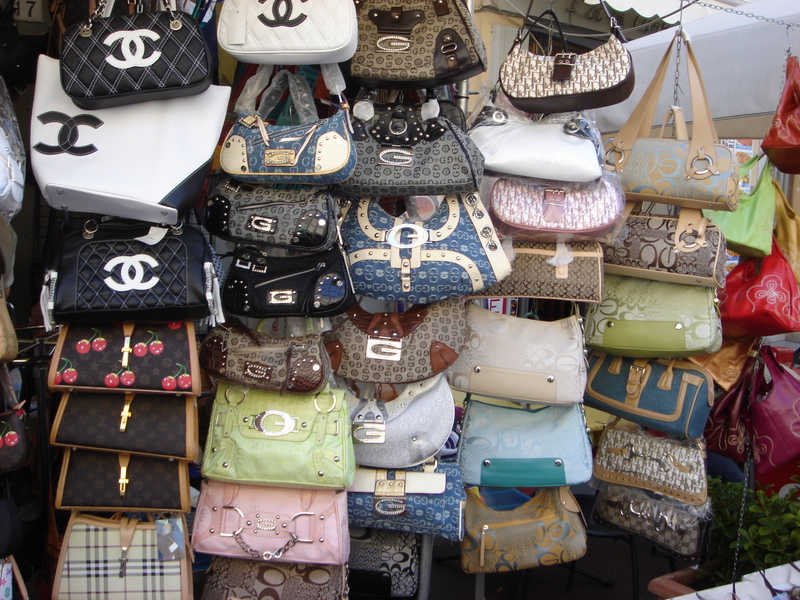
The ethics of this issue are clear, I think. The mystery is: Why did it take so long, and why isn’t there a national law?

New York City councilwoman Margaret S. Chin, whose district includes Chinatown, has introduced a bill would make it a misdemeanor  to  buy fake designer merchandise on the street or anywhere else. Violators would face a $1,000 fine, a year in jail, or both.

The New York Times interviewed a tourist who articulated the argument against Chin’s bill.
“I come down here, I will continue coming down here, and I will follow the Chinese people wherever they take me,” the New Jersey resident told the Times reporter “as she stood amid the purse and sunglass vendors on Canal Street.” “I don’t believe in child labor and I don’t believe in supporting terrorists, but if I want to buy a knockoff, that’s my business.” Continue reading

Teachers Unions: Not Unethical, Just Uninterested in the Public Welfare

His union is competent; it's just that he isn't

Public unions and their Democratic supporters (and supported) are not going to have much luck winning the public relations battle with Republicans as long as teachers unions are front and center. Teachers unions are not— I repeat not-–primarily concerned with the welfare of schoolchildren, or the public, or the deficit, or even education. Their priority is the welfare of their membership, and if any of those other stakeholders have to take it on the chin to make sure that the teachers have good salaries, benefits and iron-clad job security, well, that’s just the way of the world.

This doesn’t make teachers unions unethical any more than lawyers are unethical to represent their clients. But it does mean that any time a teacher’s union official claims to be concerned with anything but his members, he or she is lying through their teeth. And that is unethical. Continue reading

Comment of the Day: “The Cabbie and the Jewelry”

Prodigal Commenter Penn re-entered the ethics fray with two anecdotes about ethics and Japanese culture in reaction to the Ethics Alarms quiz, “The Cabbie and the Jewelry.” This was the second COTD to be inspired by that story of the ethical—or pragmatic—cabbie who rescued $100,000 worth of jewelry left in his cab by a careless fare.

Here is Penn’s “Comment of the Day”:

“70s, Tokyo, 2 anecdotes: Continue reading

Comment of the Day: Ethics Quiz: “The Cabbie and the Jewelry”…Ethics or Pragmatism?

Karl Penny puts the perfect topping on this post, about the praise being heaped on the NYC cabbie who returned $100,000 in jewels to an absent-minded fare, when he could have made a dash for the Bahamas. I obviously couldn’t say it better myself, because I didn’t.

Here is Karl, a long-time and cherished reader, on Ethics Quiz: “The Cabbie and the Jewelry”…Ethics or Pragmatism?

“Well, it would be a pretty swell world if everyone did the right thing in cases like these, simply because it never occurred to them to do it any other way.  But that’s not the world we live in.  But, in either type of world, people like Mr. Jalloh should be highly praised:  in the world as it is, because he becomes an exemplar of the way things should be; and in the better world, because virtue never goes out of style and should be reaffirmed whenever an example of it occurs.”

Ethics Quiz: “The Cabbie and the Jewelry”…Ethics or Pragmatism?

Cable news, the New york press and the blogosphere are singing the praises of Big Apple cabbie Zubiru Jalloh, who, when he discovered that an absent-minded passenger, John James, had left a bag containing about $100,000 worth of jewelry in his back seat (“Doh!”) of his cab, rescued the bag from the next passenger, took it home for safekeeping, and eventually got it back to its rightful owner. Continue reading