The Ben Rhodes Confession: Apparently The Corruption And Dishonesty Of The Obama Administration Isn’t Even News Any More

I would at least think the revelation that The Simpsons' Nelson Muntz was a White House foreign policy advisor would be news...

I would at least think the revelation that The Simpsons’ Nelson Muntz was a White House foreign policy advisor would be news…

From today’s Washington Post:

“One of President Obama’s top national security advisers led journalists to believe a misleading timeline of U.S. negotiations with Iran over a nuclear-disarmament agreement and relied on inexperienced reporters to create an “echo chamber” that helped sway public opinion to seal the deal, according to a lengthy magazine profile.

Ben Rhodes, the deputy national security adviser for strategic communications, told the New York Times magazine that he helped promote a “narrative” that the administration started negotiations with Iran after the supposedly moderate Hassan Rouhani was elected president in 2013. In fact, the administration’s negotiations actually began earlier, with the country’s powerful Islamic faction, and the framework for an agreement was hammered out before Rouhani’s election.

The distinction is important because of the perception that Rouhani was more favorably disposed toward American interests and more trustworthy than the hard-line faction that holds ultimate power in Iran.”

In other words, the Obama Administration manipulated the news media to deceive the American public. The objective was to make the public less concerned about the trustworthiness of the Iranian government and the motives of the Obama administration regarding an agreement that resulted in Iran receiving billions  of dollars in exchange for a promise to do what it has never done before, adhere to an international nuclear treaty.

Since this information arrived in the form of a boast from Obama’s chief foreign policy advisor, in a tone reminiscent of the revelations of Obamacare architect Jonathan Gruber, it qualifies as a smoking gun indictment of the President’s integrity, honesty, competence and transparency.

Let me correct that: another smoking gun.

Yet the Post published this in its Style section, with the movie reviews, gossip columns and crossword puzzle. The Rhodes profile itself was published by the New York Times Magazine, not the newspaper itself. In other words, the two major U.S. dailies that were among the news sources duped by Rhodes and Obama, think this is interesting, entertaining even. They don’t perceive it as news and apparently they don’t think it is wrong. Continue reading

Post-Debate Ethics, Part I (of 4): The New York Times And The Biased Media’s Disrespect For Mitt Romney

"Boy, what a jerk, warning the public against a power-mad, narcissist blow-hard before they make him President...."

“Boy, what a jerk, warning the public against a power-mad, narcissist blow-hard before they make him President….”

Since the last GOP debate, several ethics issues have emerged, for those inclined to see them:

1. The New York Times and the Media’s Anti-Romney Bias

The biased news media helped sink Mitt Romney’s chances four years ago, and now, perhaps by habit, it can’t stop itself from bashing him even for doing something indisputably good. Though Mitt did a thoroughly statesmanlike, honest, accurate and unprecedented job eviscerating any argument for supporting Donald Trump, his own party’s front-runner for the nomination, most of the media couldn’t bring themselves to give him credit. Democratic operative Matt Lauer, on the “Today Show,” asked Romney if his direct attack was “betrayal,” as Trump portrayed it. (Hint, Matt: any time Trump stakes out an ethics position, you can assume it’s either self-serving or stupid.). The theory behind Matt’s Mistake is that Romney asked and received Trump’s endorsement in 2008, so he owed Trump the same in 2016. Let me explain to you Matt, the concepts of patriotism and statesmanship, as well as truth-telling, and how loyalty works.

You see, Matt, Mitt Romney’s loyalties in this matter, in order of priority, are individual, party, and country. If returning Trump’s courtesy had no negative impact on the Republican Party or the future of our nation, then yes, he would be ethically obligated to return Trump’s courtesy. That is not the situation, however, as I’m sure you know, but want to pretend otherwise in order to try to blunt Romney’s message and ensure that the  Democratic nominee, either the unqualified Bernie Sanders or the corrupt Hillary Clinton, has to face the weakest opponent possible, now that Ben Carson has finally withdrawn.

When Romney sought and got Trump’s endorsement, Trump didn’t predicate it on a future endorsement when Donald ran, because nobody in their right mind, even Trump, would have seriously suggested that Trump would or could mount as credible campaign. Mitt was seeking the endorsement of a businessman, a reality TV figure with high visibility, celebrity and a potential donor, and that’s all he was doing. That doesn’t obligate Romney to return the favor. Lauer apparently thinks Mitt is in “The Godfather” : accept the favor from the Don(ald), and you must do whatever you are asked at a later date, even if it means shooting someone. No, you are not obligated to do anything. What you asked before was a favor; what is being asked of you now is a wrong.

For nominating Trump will wreck the Republican party. It will dissolve its values, embarrass its members, soil its reputation and legacy, and when Trump turns out to be the new Silvio Berlusconi, or a modern day Huey Long, or an American Hitler, or, as I suspect, being an optimist, just a more destructive version of Evan Meacham, the car salesman turned Arizona Governor who became the first U.S. governor to simultaneously face removal from office through impeachment, a scheduled recall election, and a felony indictment, or, in the best case scenario, a national version of Jesse Ventura. Under any of these scenarios, however, the GOP will be crippled, accountable and ultimately doomed, and that’s just what journalists like Lauer want in their heart of hearts. What they don’t seem to realize is that there is a real risk that Trump could win.

Romney owes his first loyalty in this matter to his party, and his highest to his fellow citizens. His speech was not a betrayal of either of these, but an ethical act to its core.

Even worse than Lauer was the New York Times editors, who wrote yet another embarrassing editorial, one of many they have authored in the past 12 months or so as the paper has almost completely shed its mantle as the exemplar of U.S. journalism. Rather than an objective and fair editorial praising Romney’s courageous and well-aimed broadside at a juggernaut, the Times used the opportunity to play partisan politics while expanding and re-using old cheap shots at Romney: Continue reading

Unethical Donald Trump Quote Of The Day: Whatever It Was That He Told The New York Times “Off The Record” That The Times Unethically And Unprofessionally Allowed Its Staff To Talk About, Putting Trump In An Impossible Bind That He Should Have Been Able To Rely On A Respected News Source Not To Put Him In…

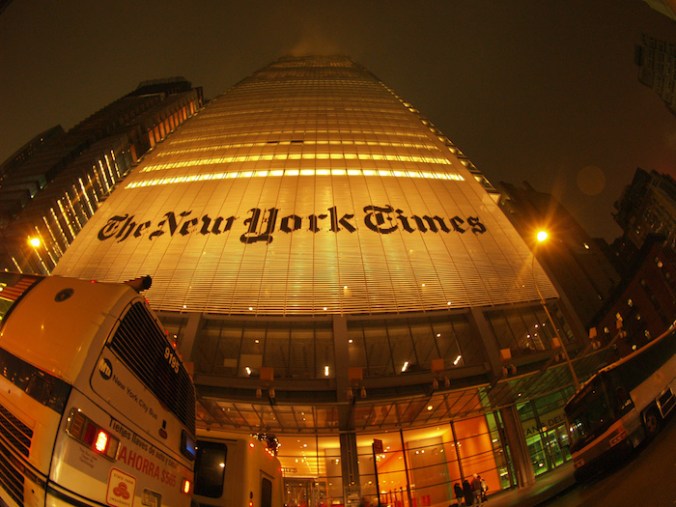
new-york-times-nytimes-building-cc

Let me be clear: The New York Times has shown itself to be partisan, untrustworthy, and no longer fit to be regarded as the flagship of American journalism. The fact that they did this at the expense of Donald Trump, an existential danger to U.S. culture and governance, in no way mitigates the betrayal of journalistic ethics the Times’ conduct represents.

From Buzzfeed:

The New York Times is sitting on an audio recording that some of its staff believes could deal a serious blow to Donald Trump, who, in an off-the-record meeting with the newspaper, called into question whether he would stand by his own immigration views.

Trump visited the paper’s Manhattan headquarters on Tuesday, Jan. 5, as part of a round of editorial board meetings that — as is traditional — the Democratic candidates for president and some of the Republicans attended. The meetings, conducted partly on the record and partly off the record in a 13th-floor conference room, give candidates a chance to make their pitch for the paper’s endorsement.

After a dispute over Trump’s suggestion of tariffs on Chinese goods, the Times released a portion of the recording. But that was from the on-the-record part of the session.

On Saturday, columnist Gail Collins, one of the attendees at the meeting (which also included editor-in-chief Dean Baquet), floated a bit of speculation in her column:

The most optimistic analysis of Trump as a presidential candidate is that he just doesn’t believe in positions, except the ones you adopt for strategic purposes when you’re making a deal. So you obviously can’t explain how you’re going to deport 11 million undocumented immigrants, because it’s going to be the first bid in some future monster negotiation session.

Sources familiar with the recording and transcript — which have reached near-mythical status at the Times — tell me that the second sentence is a bit more than speculation. It reflects, instead, something Trump said about the flexibility of his hardline anti-immigration stance.

So what exactly did Trump say about immigration, about deportations, about the wall? Did he abandon a core promise of his campaign in a private conversation with liberal power brokers in New York?

Sure, I’d like to know. I’d love to know if the single issue that has made Trump the most unqualified and unfit Presidential nomination front-runner in U.S. history has been manipulated by him to gull his easily gullible, “poorly educated” supporters. Maybe the knowledge that he has no intention of deporting millions and building a wall would make them see him as the cynical con man he obviously is. That doesn’t matter, though. We shouldn’t know what Trump said off the record, and we shouldn’t  know that any off-the-record comments were made. That the New York Times’ staff is so undisciplined and unethical that it would gossip about such a session shows the paper’s commitment to principles of journalism ethics to be inadequate for a small town weekly rag. Continue reading

David Brooks’ Dirty Hit On Ted Cruz: How Pundits Lose Credibility

That's some role model you've chosen there, David

That’s some role model you’ve chosen there, David

…or at least deserve to.

Here is how New York Times columnist David Brooks begins his character evisceration of Ted Cruz:

“In 1997, Michael Wayne Haley was arrested after stealing a calculator from Walmart. This was a crime that merited a maximum two-year prison term. But prosecutors incorrectly applied a habitual offender law. Neither the judge nor the defense lawyer caught the error and Haley was sentenced to 16 years.

Eventually, the mistake came to light and Haley tried to fix it. Ted Cruz was solicitor general of Texas at the time. Instead of just letting Haley go for time served, Cruz took the case to the Supreme Court to keep Haley in prison for the full 16 years.

Some justices were skeptical. “Is there some rule that you can’t confess error in your state?” Justice Anthony Kennedy asked. The court system did finally let Haley out of prison, after six years.”

From this, Brooks goes on to conclude…

…Cruz’s behavior in the Haley case is almost the dictionary definition of pharisaism: an overzealous application of the letter of the law in a way that violates the spirit of the law, as well as fairness and mercy….Cruz’s speeches are marked by what you might call pagan brutalism. There is not a hint of compassion, gentleness and mercy. Instead, his speeches are marked by a long list of enemies, and vows to crush, shred, destroy, bomb them.

Cruz’s behavior in the Haley case [Dretke v. Haley] does nothing of the sort. The columnist intentionally—I’m assuming that he read the case, now—misrepresented what the case was about, how the court reacted, and what Cruz’s ethical duties were regarding it. As it happens, I share much of Brooks’ dislike of Cruz’s rhetoric. This case, however, tells us nothing about Cruz’s character. It tells us that that as Solicitor General of Texas, Cruz did his job, which was to represent his client’s position.

James Taranto, the pretty damn brilliant Wall Street Journal blogger, wit and conservative pundit, nails Brooks to the wall. He writes in part… Continue reading

More Hoax Site Web Pollution

Not funny, jerks.

Not funny, jerks.

Conservative sites are mocking the New York Times for linking to a hoax site story about California instituting a ban on the future sale and ownership of all .45 ACP ammo. The link was included in an editorial calling for states to be more aggressive in banning types of weapons, magazines  and ammunition. “Ammunition” linked to the fake story on a site called “The National Report.” That particular story is neither particularly satiric, not is it funny; it’s just a lie. But I’m sure the staff is really proud of themselves, fooling the Times (though as Glenn Reynolds pointed out on Instapundit, the Times itself is looking more and more like a hoax  itself).

Admittedly, having never used The National Report before, whoever found the link should have vetted it. If they just scrolled down a bit from the story the Times used, they would have seen such obvious fake headlines as “Good Cop Will Speak Up Once He’s Witnessed His 15th Unlawful Killing,” “Koko the Gorilla Just Endorsed Donald Trump for President,” and “Starbucks Reveals Plans To Open New Chain Of Gun-friendly Cafés.” Or maybe they believed those too.

I’m not going to mock the Times: these hoax sites are all unethical unless they make their satirical status clear to all readers, on the home page, up front, unmistakably. The ethical objective is humor; the objective of fooling readers and hopefully legitimate news sources is neither funny, nor ethical.

Conservative sites that cheer such deceptions because they have ill will toward the liberal media victims are simply encouraging and enabling the unethical conduct.

FACT: The New York Times’ Front Page Anti-Gun Editorial Was Misleading And Deceitful, And Here’s Why

silencers and guns

I already posted on the ethics deficits in the New York Times front page editorial (First time since the 1920s! AHHHHHHH!!!) that was gaining such embarrassing hosannas from liberals and anti-gun zealots over the weekend. To sum up that post, the Times wrongly connected its hype to a terrorist incident irrelevant to its argument, simply to gain emotional traction; made an impossible and largely symbolic demand, focused on a class of guns that has minimal impact on national gun deaths; and, like most calls for “gun control” of late, including the President’s, was aimed at gaining incremental public acceptance of gun confiscation and banning, while pretending otherwise.

That post did not point out, however, that the Times intentionally neglected to inform its readers and those it hoped to persuade (or mislead, panic, or stampede) of the above essential news that is not only “fit to print,” but that must be printed if a newspaper is going to claim that “the attention and anger of Americans should also be directed at the elected leaders whose job is to keep us safe but who place a higher premium on the money and political power of an industry dedicated to profiting from the unfettered spread of ever more powerful firearms.”

The fact is that per-capita murders in the U.S. are at their lowest level since FBI records began (in 1960), and they are trending downwards. There is no “crisis,” at least no gun crisis. Terrorism is another story.

The Times makes the point that “motives do not matter to the dead” (a failed attempt to justify piggy-backing the grandstanding editorial on a terrorist attack that no plausible gun regulations would have stopped), but it is just as true that lethal weapons “do not matter to the dead.” If it is, as the Times piously says in accusing them of callousness and corruption, the job of elected leaders “to keep us safe,” our elected leaders, by the evidence of the statistic, are doing an excellent job. Continue reading

Wow! Trump Tries a JUMBO!

Elephants from the Ringling Bro. and Barnum and Bailey Circus perform a nine-trunk salute.

Donald Trump is apparently testing yet another piece of political conventional wisdom. Having already conquered such long standings assumptions as “A Presidential candidate shouldn’t talk and act like a sixth grader” and  “A candidate shouldn’t embarrass his party every time he opens his mouth,” Trump is now setting his sights on the classic, “It’s not the crime, it’s the cover-up,” but with an impressive extra challenge.

He is now trying to cover up the fact that he grotesquely mocked the disability of a New York Times reporter in a public appearance that was videotaped.

Trump actually is denying that he did what he was obviously doing. Very bold, very intrepid. It will be fascinating to see if he can pull it off.

Here’s Trump, after the Times excoriated him for ridiculing reporter Serge Kovaleski, who has arthrogryposis, a malady that  limits flexibility in his arms:

“Serge Kovaleski must think a lot of himself if he thinks I remember him from decades ago – if I ever met him at all, which I doubt I did. He should stop using his disability to grandstand and get back to reporting for a paper that is rapidly going down the tubes.”

Odd that Trump didn’t remember him, since before doing his “man with weird arm movements” bit he said quite clearly, “Now, the poor guy — you’ve got to see this guy…” One doesn’t normally call a reporter “a poor guy” for no reason, nor does one say, “You’ve got to see this guy” if you aren’t going to show the crowd what it is they have to see.”

Never mind, Trump is going for it: the full “Who are you going to believe, me or your own eyes?”, or as Jimmy Durante put it, in the show that gave the Ethics Alarms category it’s name, “Elephant? What elephant?” Continue reading

The New York Times Goes Full Orwell

ralphie_soap

Expanding on the recent alarm sounded here about the Democratic Party and progressives increasingly resorting to the tools and values of totalitarianism in order to by-pass democracy in their quest for power, I must flag today’s editorial by the New York Times, calling for the “retirement” of the word “alien.” As in all disguised efforts to indoctrinate by making opposing views impossible to express or even think, the Times uses a set of false arguments to achieve its goal, which is apparently open borders. Why does the most preeminent newspaper in the country have such a sickening and irresponsible view? I don’t know. These are the people who determine the content of the news, however. I’m not sure which would make this screed more frightening, the fact that the editors don’t recognize the methods of totalitarianism, or the fact that they do, and are embracing them.

Here, in part, is the editorial’s argument for “retiring,” as in “banning,” the word “alien,”  with my comments in bold:

Over the years, the label has struck newcomers as a quirky aspect of moving to America. Many, understandably, have also come to regard it as a loaded, disparaging word, used by those who regard immigrants as less-than-human burdens rather than as assets.

[ Straw man. Who that was not immediately condemned far and wide has ever described immigrants as less than human in the last 50 years? The Times is engaging in deceit: this editorial isn’t about “alien,” but illegal aliens—you know, the people that Donald Trump was obviously talking about and the Left and illegal alien advocates intentionally misrepresented his comments to push their agenda. As for the term “illegal immigrants,” damn rights it’s disparaging, because they are illegal, and citizens and newspaper editors ought to regard law-breakers as “burdens rather than as assets.”]
Continue reading

Yoga Class Discrimination Based On Race: It’s Benign Because Gay, Non-White Progressives Are Doing It!


Yoga

“War is peace, freedom is slavery, ignorance is strength”—I wonder how George Orwell missed “Segregation is Integration”? Maybe because that was too obviously ridiculous even for Big Brother to pull off….or so he thought.

Apparently yoga and meditation studios in multiple locales in the U.S. are running “no whites allowed” classes in the interests, say the operators, of making Eastern self-help disciplines more accessible to “people of color” [ I detest this phrase, but I’m quoting] by excluding people of less valued color—that is, whites. The New York Times just published an uncritical profile of such a place in Oakland, by a reporter who shrugged off the fact that she was refused in her request to attend a class because she was too little “of color.” Incredibly, the Times reporter just accepts the Bizarro World logic and utter hypocrisy fed to her as if it makes as much sense as “freedom is slavery” makes to poor Winston after his brain cells have been scrambled by the threat of rats eating his face.

“Specific classes at the center bar white or straight people — in order to be inclusive of some, they exclude others. Those who run the center say that the practice ultimately makes the center community more diverse…Brenda Salgado, the director of the center, said that as part of its diversity efforts, the center has four different sitting groups that meet weekly. “An L.G.B.T.Q.I. sitting group, one for people of color, a Friday open sit, open to everyone — those can fluctuate between 50 or 100, Ms. Salgado said. “We also have the Every Body Every Mind group, for people with disabilities and chronic illness.”

For all but the “open sits,” the expectation is that only people who identify with the target group will attend. (I learned as much when my request to attend People of Color Yoga was turned down.) And for open sits, organizers use a Web application to ensure that white people do not crowd out others. When the spots allotted for white people fill up, registration is capped to save spots for others.”

Oh, naturally: quotas too! Continue reading

1. The NY Times Has A New Author Of “The Ethicist” And 2., Boy, Did He Ever Botch The Dilemma Of The Closeted College Student

"NEXT!!!"

“NEXT!!!”

The New York Times Magazine column “The Ethicist,” long authored competently by non-ethicist Randy Cohen, had lost me due to the biased and often unethical answers to his reader’s queries by his most recent successor, Chuck Klosterman. So repellent was Klosterman’s version of the column that I didn’t even notice when the Times sacked Klosterman late last year after one bizarre response too many.

[The final straw:  An inquirer  went to a Starbuck’s  wanting to buy a regular over-priced cup of coffee, but when the woman in front of the customer  ordered a pumpkin-spice latte  and received a coupon for a free drink because the shop was out of it, “NAME WITHHELD” ordered a pumpkin- spice latte to get the free coupon. Was this ethical, he/she/it asked?” Klosterman’s answer: “No. You’re a liar and a low-rent con artist. And you live in a community where pumpkin-flavored beverages are way too popular.”  Now, “No” is correct, but it’s a great question, and deserving of a serious analysis rather than whatever that was from the ex-Ethicist. The coupon was a nice gesture to someone who had come to the Starbuck’s wanting a specific beverage and was disappointed—a store should not be tantalizing customers with products they don’t have to sell, essentially setting up a bait and switch. The coupon was an ethical “We’re sorry,” but also made the employee vulnerable to anyone who decided to misrepresent his real intent in order to get a free drink later. Yes, taking advantage of this opportunity to the detriment of the store is unethical, because the inquirer took an appropriate gesture clearly intended for a specific situation and exploited it. It was not illegal, however, and was  not a con. I would compare it to the scenario where a computer glitch has resulted in an airline selling tickets online for absurdly small amounts, and travelers rush to take advantage, rationalizing that mistake or not, the opportunity is there and they can legally grab it.]

Now the Times has a new author of “The Ethicist,” after experimenting with a new format in which a podcast including him and some other commentators hashed over ethics hypotheticals and then the podcast was transcribed and published in the Sunday Times magazine. He is Kwame Anthony Appiah, who teaches philosophy at N.Y.U.  This week Appiah’s  first solo, so I would normally say that it’s too early for any fair assessment, but boy, did he ever botch the September 2 podcast. He botched it so badly that I can’t see myself paying much attention to anything else he writes. It was an ethics disaster.

A college student asked if he could ethically lie to his anti-gay father about his sexual orientation so Dad would keep paying the student’s tuition. The father is suspicious based on some clues during his son’s high school days, and has made it very clear to his son that if he is gay, he would not only withdraw all financial support but also reject him entirely. “Questions about my sexuality are inevitable whenever I come home,” the inquirer wrote. “My father has demanded I produce archives of all emails and text messages for him to review, although I have successfully refused these requests on the grounds that he has no claim to my adult communications.”

He asks, Is it ethical for me to continue accepting financial support for my education and my career that will come from it? Could I continue to lie to accept the support and one day disclose my sexuality and pay him back to absolve myself of any ethical wrongdoing?”

The correct answer is “Of course not,” and it amazes me that anyone would think otherwise. The second part of the question is an especially easy ethics lay-up: the steal now, pay back later scheme, also known as “the involuntary loan,” or “I meant to pay it back!”, is pure rationalization, and its existence proves that the writer knows damn well that what he’s doing is wrong, and just wants someone to tell him that it’s OK.

Astoundingly, Appiah and his podcast buddies (Amy Bloom, a novelist and psychotherapist, and  Kenji Yoshino, an  N.Y.U. law professor) tell the inquirer that it is OK, because, it is clear, they are advocates for gay rights and don’t appreciate anti-gay bigots. Thus they amass nothing but rationalizations  and outright unethical arguments to justify the student’s ongoing deception. As a philosopher who knows better, Appiah should have been correcting his colleagues. Instead, he enables them, because gay advocacy trumps honesty and ethics. Continue reading