Trump’s Taxes

trump-taxes

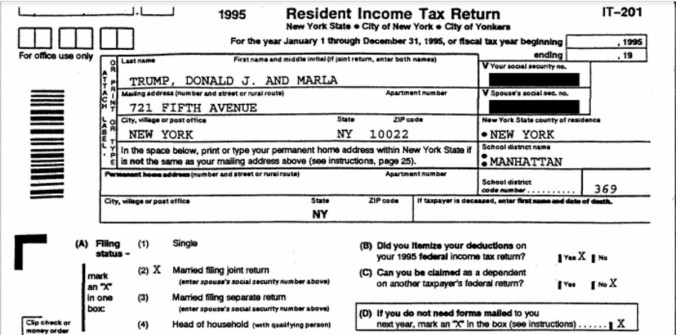
“The New York Times obtained records from 1995 showing that Donald J. Trump declared a $916 million loss. The figure is so substantial that it could have allowed him to legally avoid paying federal income tax for 18 years,” exclaimed the New York Times in today’s big “scoop.”

Observations:

1. The New York Times should not be publishing anyone’s tax returns who has not publicly released them. It’s unethical. They Times has the right to print just about anything, or course, but like all newspapers, it is obligated to exercise that right responsibly and fairly. This is neither. Tax returns are private. These tax returns reveal no crime, and nothing unethical on Trump’s part.

2. Nor does the public have a “right to know” Trump’s taxes. It has a right to trust Trump less than otherwise because he refuses to release his taxes, and has a right to think less of Trump for not following the recent accepted practice of candidates to release their tax returns. The public has no more right to see his tax returns without his consent, however, than it has a right to see mine.

3. What Trump’s taxes “could” have allowed him to do isn’t news. Nor is it responsible speculation.

4. This tax expert argues persuasively that it is highly unlikely that the returns mean what the Times says they do. Either way, it is all innuendo and speculation.

5. Federal law makes it illegal to publish an unauthorized tax return: Continue reading

OK, Voter ID Opponents, Here’s An Integrity Test: Is This A Smoking Gun Or An Amazing Coincidence?

Wow! Just a handful of fraudulent voters in the whole country for years, and one of them just happens to be captured for terrorism! What are the odds?

Wow! Just a handful of fraudulent voters in the whole country for years, and one of them just happens to be captured for terrorism! What are the odds?

Those opposing voter ID requirements as a thinly-veiled Republican effort to suppress black voting maintain that there is no need for identification at the polls because voter fraud doesn’t exist. Last week, discussing the controversy,  I flagged a New York Times editorial  titled, The Success of the Voter Fraud Myth.

It argued in part,

As study after study has shown, there is virtually no voter fraud anywhere in the country. The most comprehensive investigation to date found that out of one billion votes cast in all American elections between 2000 and 2014, there were 31 possible cases of impersonation fraud. Other violations — like absentee ballot fraud, multiple voting and registration fraud — are also exceedingly rare. So why do so many people continue to believe this falsehood?

Wendy Weiser, director of the Democracy Program at the Brennan Center for Justice, wrote in U.S. News & World Report in 2012  that voter fraud didn’t exist:

“Voter fraud would be a real problem if it actually happened. It’s a serious crime, and one that can undermine our democracy. Fortunately, it’s a crime we have largely figured out how to prevent.”

Huh.

Well then, what does this mean?

From King5 TV (NBC):

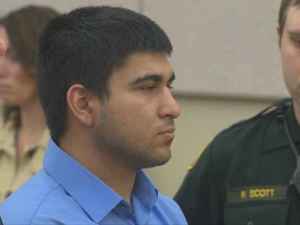
The Cascade Mall shooting suspect, Arcan Cetin, may face an additional investigation related to his voting record and citizenship status.

Federal sources confirm to KING 5 that Cetin was not a U.S. citizen, meaning legally he cannot vote. However, state records show Cetin registered to vote in 2014 and participated in three election cycles, including the May presidential primary.

Cetin, who immigrated to the United States from Turkey as a child, is considered a permanent resident or green card holder. While a permanent resident can apply for U.S. citizenship after a certain period of time, sources tell KING his status had not changed from green card holder to U.S. citizen.

While voters must attest to citizenship upon registering online or registering to vote at the Department of Licensing Office, Washington state doesn’t require proof of citizenship. Therefore elections officials say the state’s elections system operates, more or less, under an honor system.

“We don’t have a provision in state law that allows us either county elections officials or the Secretary of State’s office to verify someone’s citizenship,” explained Secretary of State Kim Wyman. “So, we’re in this place where we want to make sure we’re maintaining people’s confidence in the elections and the integrity of the process, but also that we’re giving this individual, like we would any voter, his due process. We’re moving forward, and that investigation is really coming out of the investigation from the shootings.”

The penalty for voting as a non U.S. citizen could result in five years of prison time or a $10,000, according to Secretary of State’s Office.

The options are: Continue reading

The New York Times Proves Why Journalists Can’t Be Trusted To “Fact-Check” Since They Don’t Know What A Lie Is

jaccuse2

Ugh.

I finally grabbed a barf bag and read the New York Times attack piece from the weekend titled “A Week of Whoppers.” Silly me: Donald Trump lies so often that I simply took it on faith that the Times would have no trouble finding real and substantive lies to expose from The Donald. Instead, what I found were a few genuine lies of no great significance lumpod with statements that were obviously not meant literally, off-the-cuff remarks that any objective listener would assume were just generalizations, self-evident hyperbole, or opinion. None rose to the level of outright attempts to deceive on the magnitude of “I never sent or received classified material,” or “wiped? Like with a cloth?”

Needless to say, but I’ll still say it, none came within a Washington mile of lies like “I did not have sex with that woman,”  which is one Hillary Clinton attempted to facilitate. It is depressing that any reporter, editor or reader would find the analysis that all 31 of these alleged “lies by Trump were “lies” fair, rational or convincing. Alexander Burns and Maggie Haberman prove themselves to be partisan hacks with this weak piece of anti-Trump hype. The statements flagged here are so clearly the result of a concerted anti-Trump bias that editors must have assumed that few would actually read them, and just take the headline and sheer size of the feature as proof that the Times had legitimately proven massive dishonesty.

And it had: its own.

Here are all 31 alleged Trump “lies,” with the Ethics Alarms verdicts on each. Continue reading

Collusion…But Then, As The Times Reminded Us, “These Are Not Ordinary Times,” So It’s OK

collusion

Over the weekend as the  2016 campaign’s first Presidential debate loomed, four news organizations published major stories pronouncing Donald Trump a liar, and essentially conferring on the Rationalization #22-ish Hillary “She’s not the Worst Liar” endorsement.

This was a new maneuver in the mainstream news medias full and open opposition of Trump that has left objectivity, neutrality and American journalism ethics in the dust. First came the The New York Times attack—the Times, as the flagship of U.S. journalism, had already given its blessing to biased coverage—with its “A Week of Whoppers“on Saturday. Politico, The Washington Post and The Los Angeles Times all followed the leader in short order. (Or followed orders in short…never mind, that doesn’t quite work.)

Contacted by a curious but gullible Brian Stelter, CNN’s biased but maybe a little less biased than he might be “media watchdog,” publication editors who were involved swore the timing was, as John Travolta says in “Face-Off,” “a  coinkydink!” Marty Baron, the executive editor of The Washington Post, told Stelter indignantly, “We don’t coordinate coverage with anyone else!”

“The four stories were welcomed by the Clinton campaign,” Stelter wrote.  “Aides cited the statistics in television interviews on Sunday.  However, there is no indication that the Clinton campaign was involved.” (That’s my emphasis, if you couldn’t tell.) Continue reading

Voter IDs And The “Don’t Lock The Barn Door Because The Horse Hasn’t Escaped Yet” Argument

horse-in-barn-door

There are some political and partisan controversies in which I just cannot comprehend, from an ethical perspective, why there is any serious disagreement. Illegal immigration is one of them. Of course we need to control immigration; of course it is madness to encourage illegal immigrants to enter the country; and of course we have to enforce our laws. The arguments against these obvious and undeniable facts are entirely based on rationalizations, emotion, cynical political strategies and group loyalties. The advocates for illegal immigrants have  one valid argument that only applies to those who currently live here: it’s too late and too difficult to get rid of them now. I agree, but that doesn’t mean it is responsible to keep adding to the problem.

Voter identification requirements is another one of those debates. Of course it makes sense to protect the integrity of elections by requiring valid IDs. The last time the Supreme Court visited the issue, an ideologically-mixed court found a voter ID requirement reasonable, necessary and constitutional. Writing for the 6-3 majority in 2008, Justice Stevens (who in retirement has become something of a progressive icon), wrote,

“The relevant burdens here are those imposed on eligible voters who lack photo identification cards that comply with [the Indiana law.] Because Indiana’s cards are free, the inconvenience of going to the Bureau of Motor Vehicles, gathering required documents, and posing for a photograph does not qualify as a substantial burden on most voters’ right to vote, or represent a significant increase over the usual burdens of voting. The severity of the somewhat heavier burden that may be placed on a limited number of persons—e.g., elderly persons born out-of-state, who may have difficulty obtaining a birth certificate—is mitigated by the fact that eligible voters without photo identification may cast provisional ballots that will be counted if they execute the required affidavit at the circuit court clerk’s office. Even assuming that the burden may not be justified as to a few voters, that conclusion is by no means sufficient to establish petitioners’ right to the relief they seek.”

Of course.  Our government is entirely dependent on elections. Nobody questions the reasonableness of requiring IDs to buy liquor, open a bank account, rent a car or check into a hotel, yet we’re going to rely on the honor system for our elections? The idea is madness, though, to be fair, two current members of the Court, Justice Ginsberg and Breyer,  argued that avoiding “disparate impact” justified allowing a gaping vulnerability in the integrity of elections to go unaddressed. Breyer wrote:

“Indiana’s statute requires registered voters to present photo identification at the polls. It imposes a burden upon some voters, but it does so in order to prevent fraud, to build confidence in the voting system, and thereby to maintain the integrity of the voting process. In determining whether this statute violates the Federal Constitution, I would balance the voting-related interests that the statute affects, asking “whether the statute burdens any one such interest in a manner out of proportion to the statute’s salutary effects upon the others (perhaps, but not necessarily, because of the existence of a clearly superior, less restrictive alternative)…”

Justice Breyer concluded that the alleged “burden” to some groups outweighed the integrity of the democratic system, thus embodying the current delusion of modern liberalism: race is more important that anything else, especially when that race is a reliable and uncritical source of power for Democrats.

It wasn’t until several political and judicial factors changed that the Ginsberg-Breyer rationale became politically weaponized, among them the increasing employment of the dubious “disparate impact” doctrine, the Democratic party strategists’ realization that painting Republicans as racists was an excellent way to get minorities to the polls; the growing tendency of African Americans to automatically vote a straight Democratic ticket regardless of who the candidates were and what they had accomplished; an aggressively political and partisan Justice Department and, yes, the realization that all those illegal immigrants here who are counting on keeping the borders as porous as possible might somehow find ways to vote, that requiring IDs became controversial.

Do some, even many, Republican legislators and conservative pundits promote state voter ID laws because they believe there would be a disparate impact on Democratic voting blocs? Absolutely; I have no doubts whatsoever. Does responsible and necessary legislation become magically irresponsible and unconstitutional because unethical motives merge with the ethical ones in passing it? Again, of course not. It is a principle of ethical analysis discussed here many times: many actions have both ethical and unethical motives, but the ethical nature of the conduct must be judged on its intended purpose, reasonably anticipated results, and effect on society as a whole. In the case of voter identification, the obvious and reasonable approach is to pass legislation to protect the integrity of the system and then seek to mitigate any inequities by separate means. In an ethical, reasonable system where one party didn’t see itself gaining power by allowing loose enforcement of voting requirements and the other party didn’t similarly see happy side-effect of enforcing them vigorously, this wouldn’t be a partisan issue at all. Of course we should have laws making sure that voters are who they say they are. Of course we should make sure that every citizen has access to such identification.

The current ascendant argument against voter ID laws is articulated by the New York Times in an editorial today titled, The Success of the Voter Fraud Myth.  Continue reading

This Just In: Journalism Ethics Is Still Dead…

An ad currently running on the New York Times website:

Drone footage that shows Greenland melting away. Long narratives about the plight of climate refugees, from Louisiana to Bolivia and beyond. A series on the California drought. Color-coded maps that show how hot it could be in 2060.

The New York Times is a leader in covering climate change. Now The Times is ramping up its coverage to make the most important story in the world even more relevant, urgent and accessible to a huge audience around the globe. We are looking for an editor to lead this dynamic new group. We want someone with an entrepreneurial streak who is obsessed with finding new ways to connect with readers and new ways to tell this vital story.

The coverage should encompass: the science of climate change; the politics of climate debates; the technological race to find solutions; the economic consequences of climate change; and profiles of fascinating characters enmeshed in the issues. The coverage should include journalism in a variety of formats: video, photography, newsletters, features, podcasts, conferences and more. The unit should make strategic decisions about which forms are top priorities and which are not.

The climate editor will collaborate with many others throughout the newsroom, but will operate apart from the current department structure, with no print obligations. (The Times is also searching for editors to lead similar teams exploring education and gender.)

This is, of course, smoking gun evidence of a political agenda, bias, and the intent of the Times to warp policy and public opinion according to what it has already determined is “the most important story in the world.”  Continue reading

Hillary Gets Caught In A (nother) Whopper

Why yes, this IS the thanks you get, General!

Why yes, this IS the thanks you get, General!

From the New York Times (Aug. 18):

Pressed by the F.B.I. about her email practices at the State Department, Hillary Clinton told investigators that former Secretary of State Colin L. Powell had advised her to use a personal email account.The account is included in the notes the Federal Bureau of Investigation handed over to Congress on Tuesday, relaying in detail the three-and-a-half-hour interview with Mrs. Clinton in early July that led to the decision by James B. Comey, the bureau’s director, not to pursue criminal charges against her.

From Page Six:

Colin Powell has broken his silence about his alleged involvement in the Hillary Clinton email scandal, saying her team is falsely trying to blame him.When asked by the FBI about her email use at the State Department, Clinton reportedly told investigators that former Secretary of State Powell had advised her to use a personal email account at a private dinner. But Powell, who had said last week in a statement that he had no recollection of the conversation, told Page Six at Saturday’s Apollo in the Hamptons event, “The truth is she was using it (her personal email) for a year before I sent her a memo telling her what I did [during my term as secretary of state]. “Her people have been trying to pin it on me.”

When asked why Clinton’s team were attempting to blame him, he responded, “Why do you think?”

Conclusion: Hillary Clinton lied to the F.B.I.

Ethics musings: Continue reading

Observations On The New York Times Column Rationalizing And Justifying Liberal News Media Bias

From the New York Times media columnist, Jim Rutenberg, in a piece called “Trump Is Testing the Norms of Objectivity in Journalism”:

If you’re a working journalist and you believe that Donald J. Trump is a demagogue playing to the nation’s worst racist and nationalistic tendencies, that he cozies up to anti-American dictators and that he would be dangerous with control of the United States nuclear codes, how the heck are you supposed to cover him? Because if you believe all of those things, you have to throw out the textbook American journalism has been using for the better part of the past half-century, if not longer, and approach it in a way you’ve never approached anything in your career. If you view a Trump presidency as something that’s potentially dangerous, then your reporting is going to reflect that. You would move closer than you’ve ever been to being oppositional. That’s uncomfortable and uncharted territory for every mainstream, nonopinion journalist I’ve ever known, and by normal standards, untenable….

…Mr. Trump’s candidacy is “extraordinary and precedent-shattering” and “to pretend otherwise is to be disingenuous with readers.” t would also be an abdication of political journalism’s most solemn duty: to ferret out what the candidates will be like in the most powerful office in the world.It may not always seem fair to Mr. Trump or his supporters. But journalism shouldn’t measure itself against any one campaign’s definition of fairness. It is journalism’s job to be true to the readers and viewers, and true to the facts, in a way that will stand up to history’s judgment. To do anything less would be untenable.

Observations:

1. The column disqualifies itself in the very first sentence. If you’re a working journalist and you believe that Donald J. Trump is a demagogue playing to the nation’s worst racist and nationalistic tendencies, that he cozies up to anti-American dictators and that he would be dangerous with control of the United States nuclear codes, how the heck are you supposed to cover him?”

How? Factually. Fairly. Objectively. Of course. What the journalist “believes” is irrelevant and inconsequential. The journalist’s job is to report facts, undistorted by what the journalist “believes” and “feels.” Doing otherwise is an abuse of position and a breach of ethics. That a Times journalist would have to ask the question reveals how arrogant and untrustworthy the field of journalism has become.

2. How is what Rutenberg describes regarding Trump any different from myriad previous examples when the news media decided it was appropriate to slant its reporting because its journalists felt their political views deserved to prevail? The mainstream media, decided to actively promote the candidacy of Barack Obama, with uncritical saturation coverage, soaring accolades, and a near total absence of skepticism. News sources, especially the Times, have minimized the significance of Obama fiascos, helped Administration cover-ups of misconduct in episodes like the IRS mistreatment of conservative groups, and blatantly lobbied for policies they “believed” in, like restricting gun ownership, same-sex marriage and the Affordable Care Act.

Is Rutenberg kidding? “Throw out the textbook American journalism has been using for the better part of the past half-century”…does he mean the textbook of journalism ethics from which the Times developed this, its standard of fairness in its Code of Standards and Ethics…

The goal of The New York Times is to cover the news as impartially as possible — “without fear or favor,” in the words of Adolph Ochs, our patriarch — and to treat readers, news sources, advertisers and others fairly and openly, and to be seen to be doing so…

that textbook? When was the last time any honest reader of sound mind could argue that the New York Times was “as impartially as possible”? How stupid and gullible does the Times think its readers are? Continue reading

The Times’ Timothy Egan Doesn’t Get It: Hillary Lies, Trump Just Has No Respect For Facts

polygraph

In a Sunday Times op-ed called Lord of the Lies, Timothy Egan argues that Donald Trump, and apparently only Donald Trump, should be fact-checked live in any Presidential debates. Egan is adopting the current fad among journalists, which is the argument that Trump is so bad, the media should apply a double standard, making sure his misrepresentations are immediately debunked, while presumably allowing Hillary to continue to issue whoppers every time she talks about Benghazi, her State e-mails, the Clinton Foundation, her record as a champion for victims of sexual assault, etc.

I already pointed out how unethical it was for CNN to employ an  on-screen fact-check of a Trump speech ( “Trump: I never said Japan should have nukes (he did).” ) especially since they will never do the same to Hillary (“Hillary:I never sent e-mails marked classified (She did…)”)  Egan thought CNN’s intrusion was just peachy, though, because the news media now believes their task isn’t to be fair to both candidates and treat them the same, but to employ any means necessary to defeat that one journalists have determined shouldn’t win.

A larger problem with Egan’s thesis—even more than his apparent belief that the notoriously biased PolitiFact is “non-partisan”)—is that he doesn’t know what a lie is. He adopts the flat-out wrong definition of lie used by most fact-checkers in fact: if they disagree with a statement or can show it is untrue, it’s a lie. That’s not what makes a statement a lie. For example, PolitiFact is demonstrably biased and Democratic-leaning, far more so than the Washington Post’s Factchecker or Fact Check.org. But I wouldn’t assume that Egan is lying when he says otherwise. Progressive journalists just assume PolitiFact is fair and non-partisan because they think they are fair and non-partisan. They are deluded, not lying. That’s an important distinction. Continue reading

MORE Gender Issues Confusion Monday, PART 3:The New York Times’ Hit Piece On Donald Trump And Women

Trump girls

The New York Times assigned six reporters to interview over fifty women who have dealt with The Donald, and the resulting story proved beyond a shadow of a doubt that he engages in routine sexual harassment, acts like a high school student, behaves like the archetypal male chauvinist pig, and habitually ogled women and made comments about their appearance. Of course, anyone who hadn’t been in suspended animation for the past decade or so would know or assume all this based on the Trump’s activities and words. This is the dilemma in trying to cover an obviously unfit and unqualified Presidential candidate like other Presidential candidates. For a traditional politician, the Times’s revelations would be devastating. In Trump’s case, we have learned so many worse things about his nature during the past six months that his misogyny is both old news and relatively trivial. It’s like a character “Jurassic World” warning  that the murderous Indominus Rex has bad breath.

It appears that the Times was also sloppy in its reporting, but never mind: the real mystery is how any Democrats thinks that what Trump has done can benefit Hillary Clinton in any way. Nothing Trump is accused of in the article approaches the conduct that women who  were involved with Bill Clinton claim he inflicted on them, only to have their claims dismissed or ignored by the news media and Democrats. That party went on record as believing that personal conduct, no matter how offensive or abusive to women, doesn’t matter, or at least didn’t matter in Bill’s case, because “Bill was on the right side of the issues, especially abortion. Indeed, one famous female journalist wrote that she would sleep with him anytime, just to thank him for supporting abortion.” Continue reading