If you know anyone from Minnesota or is unfortunate enough to have to live in that ethically-addled state today, pause in your appropriate contempt for the blight on the Republic the Land of Lakes has become in recent years. Express your gratitude for their state, whose brave soldiers in this day in 1863 may have quite literally saved the United States of America and made this 250th celebration possible.
I know, I know. Minnesota has gone completely nuts. It has an incompetent, silly, uber-woke governor; its Attorney General is an anti-white racist and probably a criminal, the Mayor of Minneapolis is an Ethics Villain, it has an anti-Semitic Congresswoman who has openly admitted that her first loyalty is to Somalia, its opposition to ICE operations represents more of a genuine insurrection than anything that occurred during the 2021 Capitol riot, and the state is in a tight race with California, Washington, Oregon, New York and Maryland for the booby-prize of “Most Embarrassing State .” But ’twas not always thus.
July 2 was the second day of the decisive Civil War battle at Gettysburg, Pennsylvania, and the most complicated and wide-ranging day in the conflict. So much of desperate significance was going on at Seminary Ridge and Cemetery Ridge, on Little Round Top, the Peach Orchard, Devil’s Den and a half dozen other key features on the battle field that whether an instance of heroism was recorded or forgotten is as much a matter of chance as anything else. Even determining what was the turning point in the day’s conflict, which ultimately was won by the forces of the North, is an exercise in searching for order in chaos.
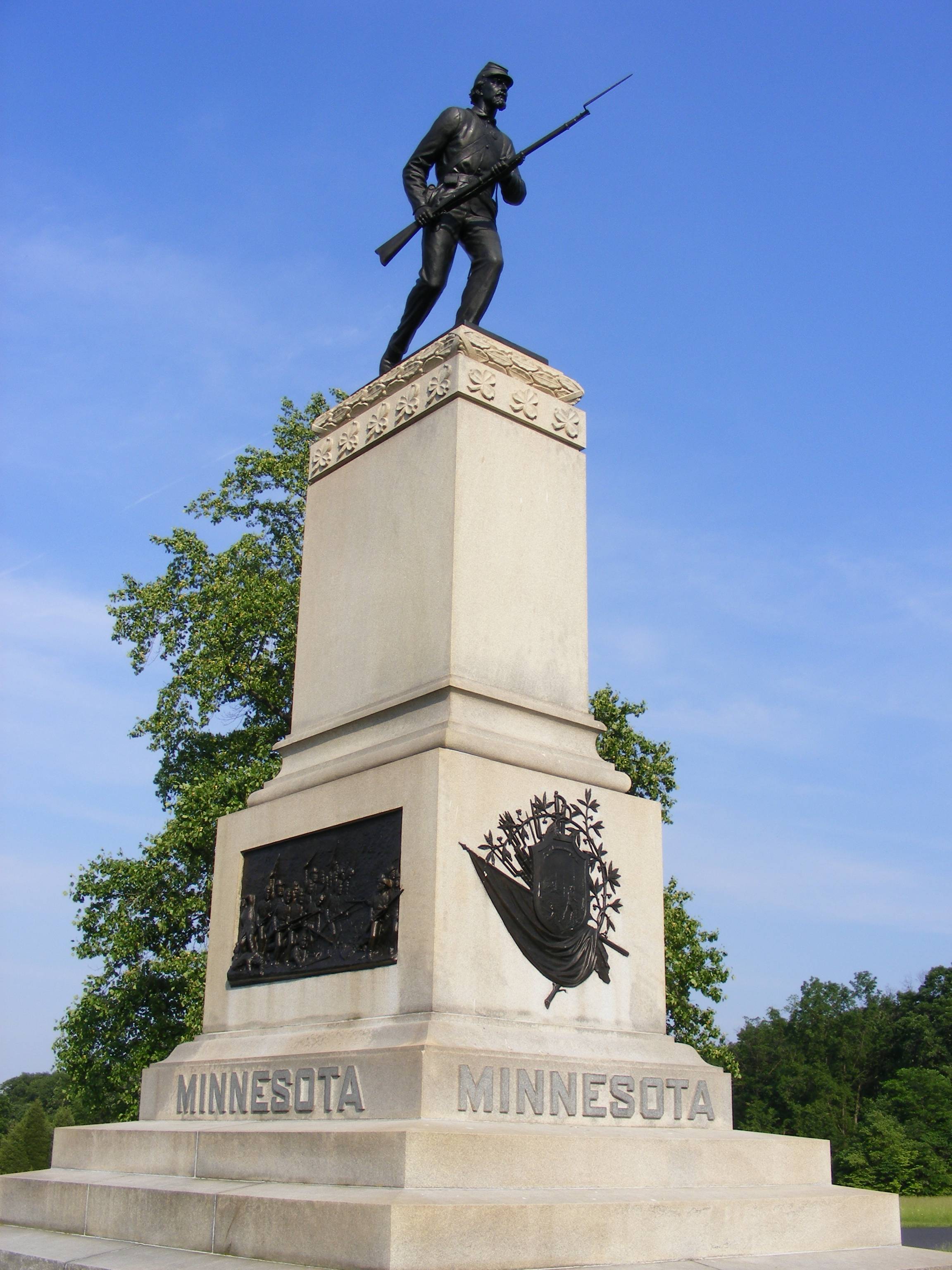
There is no question, however, that the First Minnesota Volunteer Regiment’s astonishing heroics stand out even among the many other examples of gallantry on that day. The battlefield monument to the First Minnesota is the largest erected to any Union regiment, and yet it has not guaranteed our cultural memory of the epic sacrifice those soldiers made. Other second day exploits, due to sometimes arbitrary choices made by historians and film makers, have taken up the limited space available in the public’s attention to the details of the Civil War.
This is a massive injustice. As the battle raged for Cemetery Ridge, crucial high ground occupied by Union forces but under siege by the Grays, General Winfield Hancock saw a serious breach in the Union line. He realize, in horror, that Wilcox’s Alabama Brigade was on the verge of breaking through, possible dooming Meade’s army to defeat. The attack had to be blunted and and its advance stalled until he could round up sufficient reinforcements to repel the rebels.
Hancock ordered the First Minnesota to charge the brigade and hold the position, even though its 262 men was outnumbered by a force of more than 1200. It wasn’t quite the hopeless odds face by the defenders of the Alamo, but the regiment’s prospects were grim enough.
Continue reading