Ethics Hero, Ghost Of Christmas Past Edition: Dwight Gooden

Dwight-Gooden

For me, Christmas triggers not only memories fond and bittersweet, but also regrets, realizations, and discovered clarity about where I have been and how I got where I am. This was really what Charles Dickens was expressing in “A Christmas Carol, and why it resonates even with the kinds of people who would be tempted to put a zombie Nativity on their front lawn.

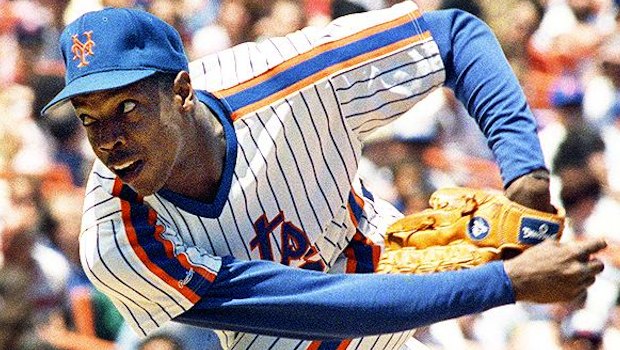
Last week, former New York Mets pitching ace Dwight Gooden, known in his prime as “Doctor K” (a “K” is a strikeout, and if you didn’t know that—wow) and eventually just “Doc,”penned a brave and inspiring piece for The Player’s Tribune, in which he addressed his younger self, warning the young, cocky kid with the world seemingly begging to be his playground and cheering section in 1984 about the traps and landmines lying in his path.

Gooden, for those of you who face life every day without the accumulated wisdom bestowed by the love of baseball, and who somehow live through cruel winter without the promise of Spring Training warming your nights, looked like he might become the greatest, coolest, most unhittable pitcher in baseball history when he arrived on the big league scene in ’84, winning 17 games with a deadly curve and a 98 mile per hour fastball at the tender age of 19. He became the youngest player ever to pitch in an All-Star Game that year (he struck out the side), and the next season, at 20, he won 24 games, lost only four, and led the National League with a miniscule 1.53 earned run average.

And he was never that good again. He began losing speed on his fastball the next year, and steadily declined thereafter. Eventually there were drug problems, alcoholism  and other embarrassments, and Doc Gooden, instead of being the lock for the Hall of Fame that he seemed at 20, was washed-up at 35, and an unofficial member of the Pantheon of Disappointing and Fallen Sports Heroes.

Today, as the former pitcher nears 50, Gooden is a dedicated father and grandfather to  his children and grandchildren. He is the president of Best of the Best Sports Management, where he works with his oldest son, Dwight Jr. and is also a spokesman for PinkTie.org , a Long Island-based charity dedicated to fighting breast cancer.

In his essay, titled, “Letter to my Younger Self,” Gooden is frank, uncompromising, wistful, self-critical, funny, and never indulges in self-pity. He ends it this way:

Drugs and alcohol are only a false sense of security. Neither thing will fill the void you feel. Unfortunately it might take you a few missed Christmas Days with your family to learn this.

You will want to try to fix your issues on your own. This is how you think a man handles his problems. It isn’t. Being a man is about reaching out for help when you need it. If your curveball isn’t working, you’ll know how to fix that. If the control on your pitches is off, you’ll know how to fix that. But you will face a lot of hardship because of your inability to realize that you can’t fix yourself.

Finally, please know this: I love you. It’s going to take you a long time and a lot of pain to realize this, but accepting it will go a long way towards healing. The journey will be trying, but it ends in a good place.

Keep getting those Ks,

You’re a hero after all, Doc.

Merry Christmas.

Comment of the Day: “Roshomon, Good Citizenship And Ethics: The Case Of The Concerned Stranger And The Indignant Father”

Poster - RashomonJeff Gates, the father, photographer and writer whose essay in the Washington Post prompted my post here and a lively discussion thereafter, has been kind enough to contribute additional thoughts and clarifications in response. This is one of the really good things about the internet, and his willingness to enhance the discussion with additional perspective reveals good things about Jeff as well. His original article is here.

At the outset, I want to clarify something about my post that I kept intending to do but obviously did not, at least not well. The fact that the man who was suspicious of his photo-session with his daughter said later that he worked for Homeland Security didn’t figure into my analysis at all, and still doesn’t. I am concerned with the original encounter, and the question of whether this was excessive Big Brotherism clouds the issue, which I see, and saw as this: we should applaud and encourage proactive fellow citizens who have the courage and the concern to step into developing situation that they believe might involve one individual harming another.  As the man needed no special authority to do that, I don’t care whether he was a federal agent or not; I thought it was pretty clear that this was not official action. Indeed, I think as official action, the man’s intervention was ham-handed and unprofessional.

Here is Jeff Gates’ Comment of the Day, on the post, “Roshomon, Good Citizenship And Ethics: The Case Of The Concerned Stranger And The Indignant Father.” Continue reading

Roshomon, Good Citizenship And Ethics: The Case Of The Concerned Stranger And The Indignant Father

“O wad some Power the giftie gie us To see oursels as ithers see us!”

—Robert Burns bystander-effectJeff Gates, a writer and adoptive father, contributed a thought-provoking column in the Washington Post’s Outlook section this weekend, describing what seemed to him to be a traumatic experience at Cape May. It begins…

“After my family arrives on the Cape May ferry for our annual vacation to the Jersey Shore, I take pictures of our two daughters on the ferry’s deck as we leave the harbor. I’ve been doing this since they were 3 and 4 years old. They are now 16 and 17. Each photo chronicles one year in the life of our family and our daughters’ growth into the beautiful young women they have become….On that first day of vacation, the sea was calm and the sky a brilliant blue. As I focused on the image in my camera’s viewfinder, the girls stood in their usual spot against the railing at the back of the boat. I was looking for just the right pose…Totally engaged with the scene in front of me, I jumped when a man came up beside me and said to my daughters: “I would be remiss if I didn’t ask if you were okay.”

He goes on:

“It took me a moment to figure out what he meant, but then it hit me: He thought I might be exploiting the girls, taking questionable photos for one of those “Exotic Beauties Want to Meet You!” Web sites or something just as unseemly. When I explained to my daughters what he was talking about, they were understandably confused. I told the man I was their father. He quickly apologized and turned away. But that perfect moment was ruined, and our annual photo shoot was over.”

Many of us might laugh off the experience as a funny anecdote, but not Gates, and not his daughters. He is Caucasian and they are both of Chinese heritage, having been adopted as infants in China by Gates and his wife. He obsessed about the incident for a while, and worked up sufficient indignation to track down the man and confront him, saying “Excuse me, sir, but you just embarrassed me in front of my children and strangers. And what you said was racist.” Continue reading

President Obama and the Peace Prize

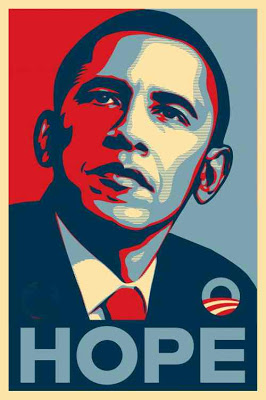
obama hope

I am going to be driving most of the day, and I wanted to have something worth reading (assuming anything here is worth reading, about which reasonable minds disagree) for you while I am prevented by life’s adventures from posting new commentary. I thought it might be instructive to re-post this, which was published at a time that few knew of Ethics Alarms’ existence. In light of all that has happened since, all we have learned, and all that I have written about the leadership of President Obama, it provides useful, and perhaps wistful perspective. I re-read it just now, wondering if I would write the same today, even knowing what I know now.

And I would.

Jack Marshall's avatarEthics Alarms

There are several ethical issues raised by the stunning announcement that President Barack Obama had won the Nobel Peace Prize. More, perhaps, were raised by the reactions to it.

Imagine, if you will, that you are a cast member in a Hollywood movie of dubious quality. Personally, you think the director is in over his head and that the movie is an empty, pompous failure. To your amazement, however, critics like the film. It is a surprise winner at an international film festival, and the director wins the “Master Film-maker” prize. Are you outraged, or pleasantly surprised? Do you congratulate the director for the honor, or do you tell him he is an undeserving fraud? Do you feel pride for your own connection to the award—you were in the cast, after all—or do you feel resentment? I would think the answers to all these questions are obvious. The civil, fair…

View original post 665 more words

The Cruelest Month And The Duty To Remember

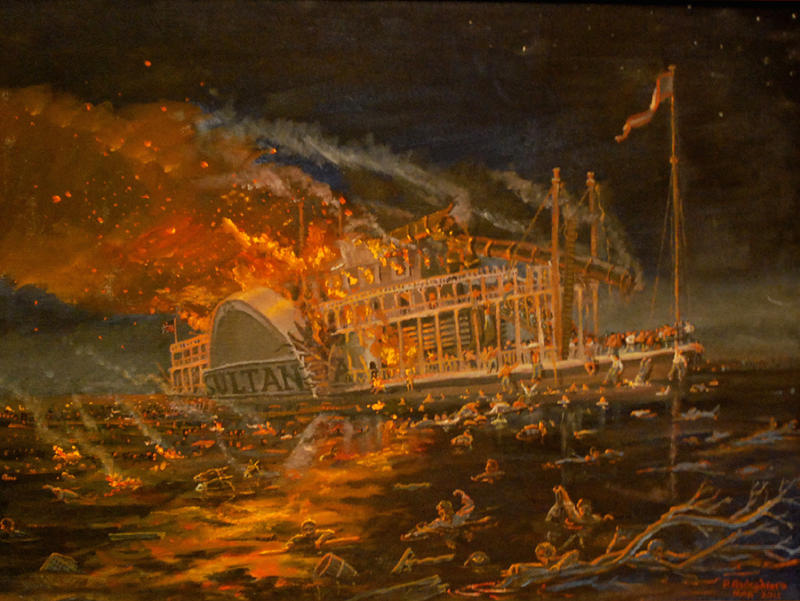
sultana-ablaze

If we have the education, curiosity, perspective and respect for our origins and those who have gone before us, the calendar is a source of constant reminders of what matters in life, and how we can be better citizens and human beings. It is a common belief among Millennials, and a lot of older Americans too, that history is irrelevant to their lives, and this is both a fallacy and a self-inflicted handicap. Not that keeping history in mind is easy: in this month, which T.S. Elliot dubbed “the cruelest,” paying appropriate respect by remembering is especially difficult.

Still, respecting history is our duty. It won’t be remembered, perhaps, but in April, 2012, a 23-year-old drunken fool named Daniel Athens was arrested for climbing over a barrier to urinate on a wall at the Alamo. Monday, a Texas judge threw the book at him, sentencing him to 18 months in state prison for vandalizing a National Monument and a shrine. The sentence seems extreme, and is a good example of how the law is a blunt weapon with which to enforce ethics. The Alamo has near religious significance in Texas, brave men died there, and the ruins serve as a symbol of critical virtues like loyalty, sacrifice, dedication, courage and patriotism. Athens, himself a Texan, defiled the memory of the fallen and symbolically rejected the values and heritage of his community and fellow citizens. Unfortunately, the harshness of the sentence will create sympathy for him: 18 months for peeing? But how else does a culture reinforce the importance of respect for the past? I don’t have an answer. Perhaps I would have sentenced him to take an exam on the lives of Travis, Crockett, Bowie, Seguin and the rest, as well as the siege itself, and imposed the jail term only if he flunked.

Yesterday, Major League Baseball celebrated the heroism and transformative life of Jackie Robinson, who broke baseball’s color barrier on April 15, 1947 by becoming baseball’s first black player, setting in motion powerful forces that propelled the cause of civil rights. Every player wore Robinson’s now retired uniform number 42, and there were commemorative ceremonies in the ball parks where it wasn’t too cold and wet to play ball. This remembrance had a difficult time competing with tax day, as history usually does when our immediate life concerns beckon.

Other important historical events deserving reflection, however, were more or less ignored entirely, for April 15 is a historically awful day: Continue reading

Ethics Quote Of The Day: Lou Gehrig, July 4, 1939

“Fans, for the past two weeks you have been reading about the bad break I got. Yet today I consider myself the luckiest man on the face of this earth.”

—-Baseball great Lou Gehrig, beginning his farewell speech to Yankee fans on July 4, 1939, as they filled Yankee stadium to say farewell to “the Iron Horse,” who was retiring from the game after being diagnosed with the incurable disease, amyotrophic lateral sclerosis (ALS), known forever after as “Lou Gehrig’s Disease.”

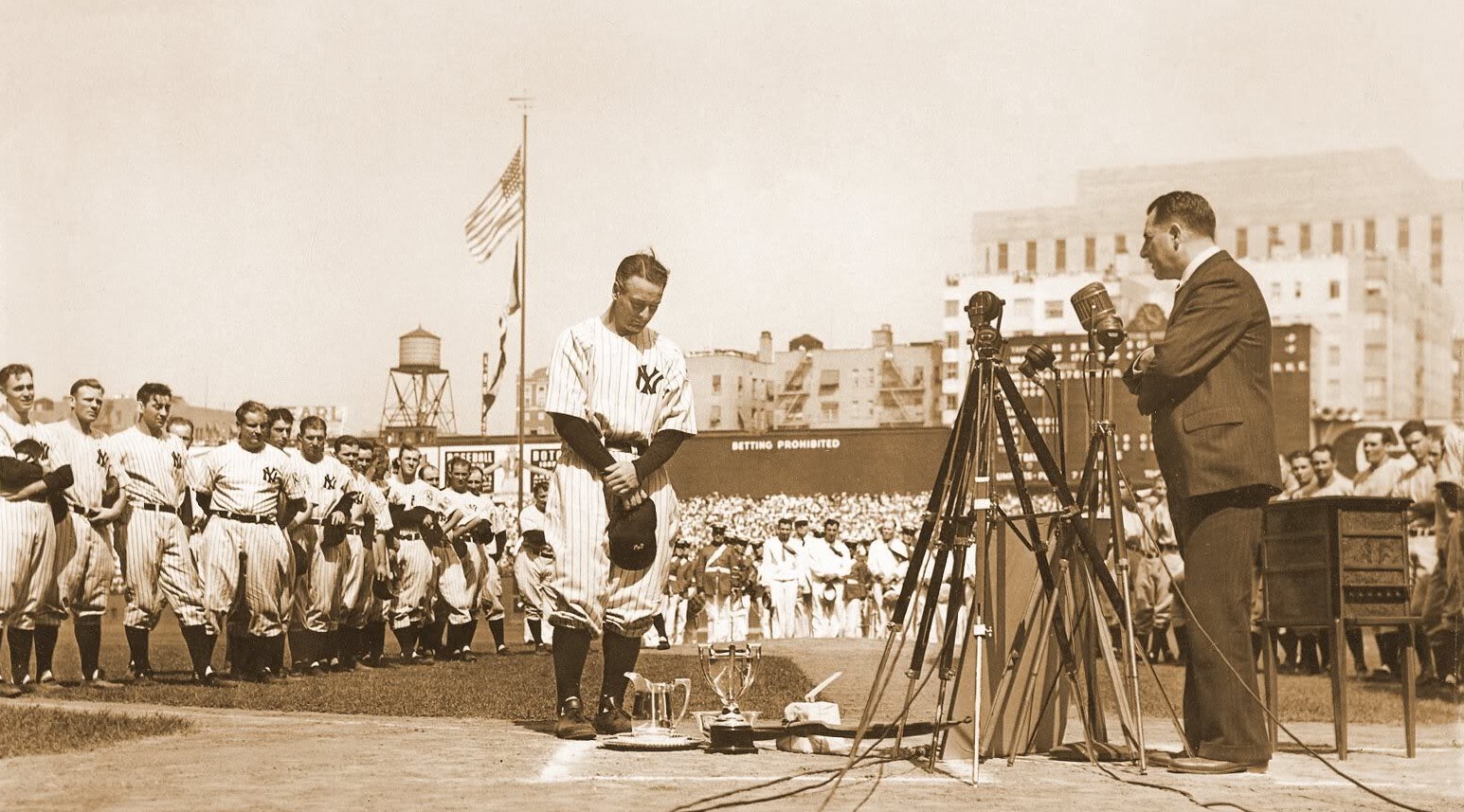
Lous Farewell

Lou Gehrig was only 36 years old when he learned that he was dying. ALS is a terrible wasting disease that has no cure, and in 1939 there was little treatment or assistance that could be offered to a victim as his body slowly ceased to function. It is an especially cruel disease for a professional athlete to face, and even more so one, like Gehrig, who was renowned for his endurance and seemingly indestructible body. When the progress of the illness, still then undiagnosed, caused Gehrig to remove himself from the New York Yankees line-up on May 1, 1939, it ended his amazing streak of 2,130 consecutive games, a baseball record that stood until broken by Cal Ripken, 56 years later.

Gehrig’s speech was from his heart. He was an educated and articulate man, but he had not planned on speaking at the moving ceremony to bid him farewell, as current former team mates, some of the greatest players ever to take the field, gathered to pay their respects. But the Yankee Stadium crowd of more than 60,000 began chanting his name, and after initially refusing, Gehrig moved to the microphone. Continue reading

Ethics Quote of the Week: James W.Hudson

Who ARE those guys?

“Tell the world about your guy in the rocking chair who was once gung ho, climbing mountains and dodging a ruthless enemy bent on his torture and destruction. Climb on his knee yourself, if you must, but get his story.”

—-James W. Hudson, as quoted by the Washington Post in his obituary today. Hudson, 93, was an OSS operative during World War II who was dropped behind German lines to set up an intelligence network and disrupt supply networks.

James Hudson was one of those guys for sure. Continue reading

Trump’s Lament

Can't you read the sign, Donald?

Was Donald Trump treated rudely and unfairly at the White House Correspondents Dinner, where he was made the target of sharp barbs by both President Obama and MC Seth Myers?

Trump thinks so, telling Fox and Friends, “Well, I really understood what I was getting into — I didn’t know that I’d be virtually the sole focus. I had no idea it would be to that extent, where you know, it was just joke after joke after joke. It was almost like, is there anyone else they could talk about?”

Trump is a poor sport, a whiner, a humorless fool, and deluded to boot. He spent the previous month accusing the President of the United States of being a liar, a fraud, a usurper, a poor student, and an illegal alien, appealing to the worst instincts of the most extreme Obama-haters and political foes. His conduct was most charitably and frequently defined as “a joke,” though it was worse than that. He comes to the Correspondent’s Dinner where the President has his one chance to skewer others the way comedians regularly skewer him, having provided by his own boorishness and hucksterism enough material to supply ten stand-up routines, not only claims to be surprised at the extent of his roasting, but is offended that he has to take his medicine. Continue reading

The Ignorant Citizen’s Ethical Duty Not To Make Others As Stupid As He Is

Here is the problem, of which the worst of the Tea Party movement is only the latest in a long line of examples.

We want typical citizens to participate in the democratic process. It is critical that they do. But the Framers recognized that participation in self-government needs to be responsible, and that responsible democratic government requires knowledge, common sense, and wisdom. They also recognized that the majority of any population doesn’t possess that; this is why they originally limited the right to vote.

Okay, that was a big mistake: if you are going to have free society, everyone should have a say in it. Still, a citizen has an obligation to be civically literate before he or she starts trying to tell everyone else the best way to run the town, the state or the country, and civic literacy, as anyone can tell by reading the comments on any news or public affairs website (except this one, of course), civic literacy, not to mention common sense, is in short supply. People either don’t value civic literacy, or more likely, don’t recognize when they don’t have it. Continue reading

Ethics Hero: John Green

Appearing on the Today Show, John Green and his wife Roxanna were asked about their feelings about the tragic death of their daughter Christina, age nine, at the hands of Tucson shooter Jared Loughner.

John Green, grieving father, replied:

“This shouldn’t happen in this country, or anywhere else, but in a free society, we’re going to be subject to people like this. I prefer this to the alternative.”

With his last six words, he established himself as superior in mind, principles and character to all of the unscrupulous commentators and devious politicians who have attempted to use this terrible tragedy to stifle dissent.

John Green leaves all of us wondering if we could summon such perspective, rationality and nobility under similar circumstances.