Baseball Ethics: On MLB’s Reinstatement of Pete Rose and the 8 Dirty 1919 White Sox

Today Pete Rose and other players “banned for life” by Major League Baseball were reinstated. This doesn’t mean they have been brought back to life, and it won’t get them into baseball’s Hall of Fame in Cooperstown. All it means is that a banning for life doesn’t extend past a banned player’s death.

I have to say, I thought this would bother me more than it does.

The decision by Commissioner Robert D. Manfred, whom I would regard as the Worst Commissioner Ever were it not for the fact that his predecessor, the revolting Bud Selig, should have that distinction forevermore, was clearly prompted by the death of baseball scumbag Pete Rose, President Trump’s meaningless promise to “pardon” him, whatever that means, and the Rose family’s renewed efforts to get baseball’s all-time hit leader into the Hall of Fame. From a lawyer’s perspective, I can’t quibble with Manfred’s logic that a lifetime ban, however deserved, should expire upon death, as most things do.

Continue reading

Trump’s Pete Rose Pardon: Not the Most Unethical Pardon, Just the Dumbest

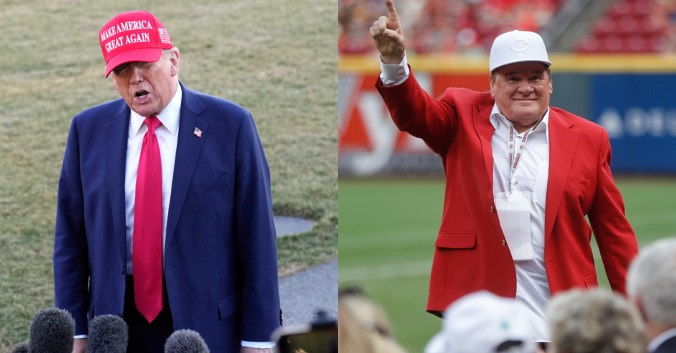
Above you see the President with a photo of the late, great, baseball slimeball doing the Nazi salute like Elon Musk, which I’m sure is what endears him to Trump.

Kidding!

Not kidding: between their various pardons, I’m pretty sure Presidents Biden and Trump have so degraded the status of the Presidential clemency power that it will never recover. Once, such pardons conveyed ethical values and legitimate justifications for a President’s compassion. This thobbingly stupid pardon should make the gesture an embarrassment forevermore.

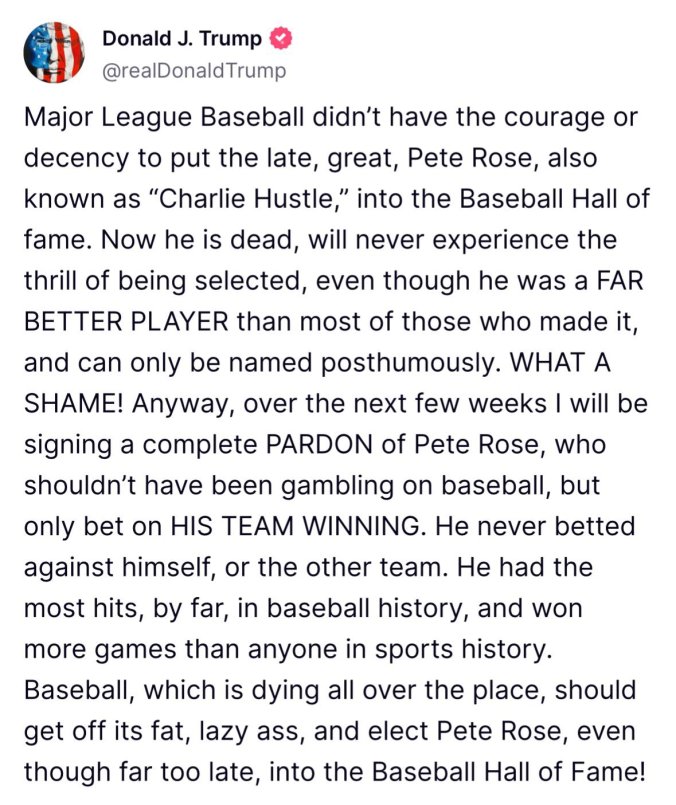
Here is the President’s asinine, even by his standards, Truth Social post:

Ugh. Fisking this crap is too easy but noxious, like shooting dead rats in a barrel…

Continue reading

On Pete Rose

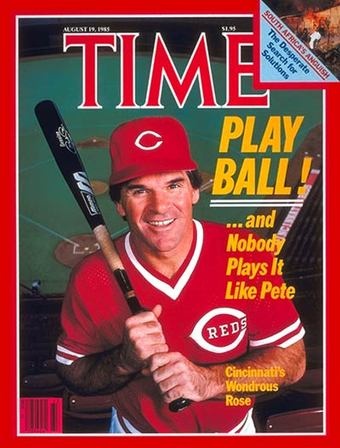
Pete Rose died yesterday: he was 83. A documentary on Rose came out this year, but there was nothing new in it except some more interviews with Pete in which he proved, again, that he just didn’t have functioning ethics alarms. Honesty, integrity, responsibility, trustworthiness, fairness, and a lot more on the list of ethical values, baseball’s all time hit leader didn’t understand at all. If you had any doubts that Rose was a sociopath, his own words in that documentary should have banished them.

Rose was the subject of my second ethics essay online, at the old, finally gone forever, Ethics Scoreboard. Here, I wrote about Pete for the first time shortly after launching Ethics Alarms in 2010. The topic: the discovery that Rose had used a corked bat (that’s illegal in baseball) as a player. I wrote in part, beginning by dismissing the theory that corked bats don’t actually help batters so using one shouldn’t count as cheating…

Continue reading

If It’s Any Consolation, Pete, If Ethics Alarms Had An Ethics Dunce Hall Of Fame, You’d Be The First One In…

Pete Rose, baseball’s all-time career hit leader, is also one of the most outrageous creeps ever to play the game, which is just as remarkable an accomplishment when one considers competition like Cap Anson, Hal Chase, Barry Bonds and Alex Rodriguez. The amazing thing is that Pistol Pete keeps adding to his jerk resume even now, and he’s 81 years old.

Rose was my very first American Ethics Dunce when the now inactive Ethics Scoreboard debuted in January of 2004. I wrote then,

Pete Rose now admits he bet on baseball (after ten years of lying about it) but says that his bets (always in favor of his team, never against it, he says) as manager of the Cincinnati Reds never effected his management decisions, and thus he did not harm the integrity of the game. He feels he should be let back into the game as a manager.

A couple of things, Pete:

1) Even if this were true, fans of the game cannot put their faith in the outcome of games when they know that those who help determine the outcome might be motivated by their wagers. This is the reason that we call “the appearance of impropriety” an ethical problem.

2) Presumably you did not bet on the Reds when a key player was sitting out, or when your starting pitcher wasn’t feeling good. Right? Or are we supposed to believe that you bet large amounts of money while already in debt to bookies in circumstances when you thought you would lose? So every time you didn’t bet on the Reds, you were sending information to the bookies, and it affected their odds on the game. Got it?

3) You say you never bet against the Reds. You used to say you never bet on baseball. You’re a liar. Why should anyone believe you now?

Later, the Scoreboard made Pete the first (and so far only) Ethics Dunce Emeritus after he admitted that in fact he did bet on every Reds game as a manager. (I really need to add Bill Clinton to the Ethics Dunce Emeritus ranks, among others. Remind me.) Continue reading

Stop Making Me Defend Pete Rose!

Pete Rose, baseball’s all-time hit leader who received a lifetime (and justified) ban from baseball for betting on games while a manager, was my very first Ethics Dunce, way back in January of 2004, on the old Ethics Scoreboard. Since then Pete has come up here often, with a thick and varied ethics dossier. The man is a slimeball; there is no disputing it. He knowingly violated baseball’s most inviolate rule; he lied about it in more than one way; he ended up in jail for defrauding the IRS; he has attempted multiple schemes to cash in on his own misconduct. Rose is the poster boy for the King’s Pass: he assumed that rules and laws didn’t apply to him because he was a Great and Beloved Player. Yes, he was a great, beloved, unique and entertaining player, but Pete Rose wouldn’t know an ethical value if it were nailed to his forehead.

And yet…the most recent attack on Rose’s character is contrived and unfair.

Continue reading

Ray Fosse And A Lesson In How Ethics Evolve

People who don’t read the baseball-related posts here miss the point: sports in general and baseball in particular create ethical problems that clarify ethics in all fields. The story of former catcher and broadcaster Ray Fosse is a prime example.

Fosse, was an All-Star catcher, a multiple Gold Glove-winner, a two-time World Series champ, and a long-time broadcaster who died yesterday, of cancer at the age of 74. His claim on immortality is the famous play above, which ended the 1970 All-Star Game, back when baseball’s “Mid-Season Classic” was more than just a chummy parade of stars playing baseball with the intensity of an office picnic softball game.

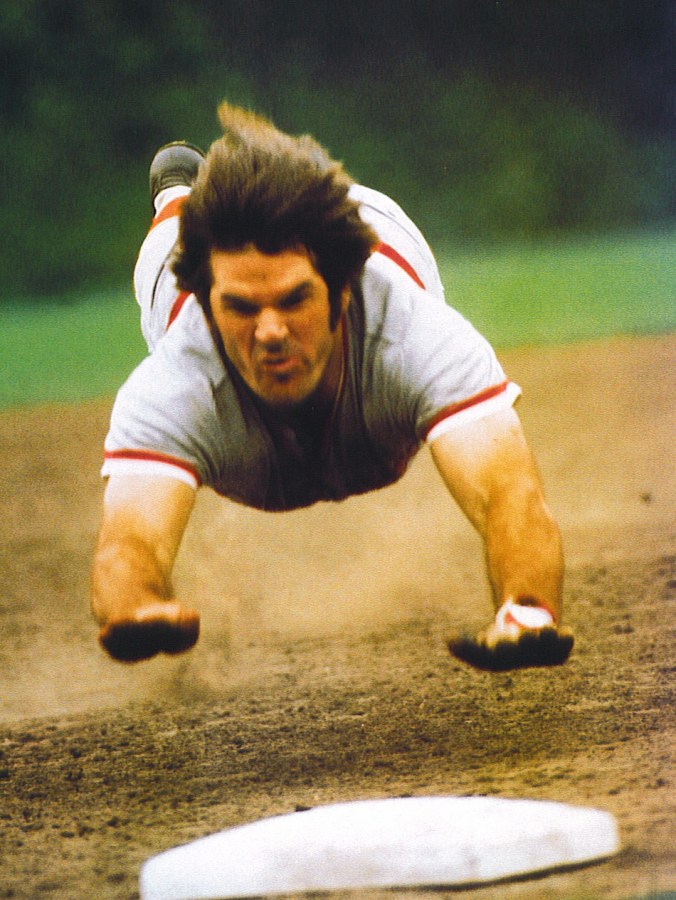
In 1970, Fosse was in his first full big league season with the Cleveland Indians, and signaled that he could be one of the all-time greats at his position. He won a Gold Glove, received some MVP votes, and had a 23-game hitting streak from early June into early July (That’s a lot. especially for a catcher). Fosse made the All-Star team that year and had his rendezvous with destiny when, in the bottom of 12th inning of a tense, tie game, the Reds’ Pete Rose, famous for his hustle and trying to score the winning run from second base, was beaten by the throw home but smashed into Fosse at home plate, causing the catcher to drop the ball and winning the game for the National league. It was a thrilling play, one of the most memorable in the nearly 90 years history of the exhibition, but Rose separated and fractured Fosse’s shoulder. Fosse continued to play for the rest of the 1970 season but because doctors didn’t discover the injuries until the following season his body never healed properly. Fosse would suffer lingering effects from play for the rest of his life. He also was never as good a player again.

Rose was unapologetic, and most conceded that his tactic was a clean play. Fosse was blocking the plate, and the only way Rose could score was to reach home while making him drop the ball. The controversy was over whether it was ethical for Rose to risk injuring another player in an exhibition game. Had Rose epitomized a sporting ideal by playing hard to win—after all, he could have been hurt too—or had he engaged in poor sportsmanship?

Continue reading

Morning Ethics Expectoration, 4/15/2021: I’m In A Really Bad Mood (And Ethics Is Just A Part Of It…)

Let’s see what revoltin’ developments we have accumulated, shall we? But first, some positive news…

1. Bernie Madoff has died in prison. Good. If there was ever a case for using capitol punishment for crimes other than murder and treason, Bernie is it. He was convicted of orchestrating the biggest Ponzi scheme in American history and was serving a 150-year sentence that he managed to escape by dying in prison of natural causes at age 82. He was a stone-cold sociopath who destroyed his family, foundations, charities and lives, all out of greed. On the plus side, his exploits did spawn two excellent dramatic portrayals, one by Robert De Niro and the other by Richard Dreyfuss. I liked Richard’s better, but after his disgusting conduct during the Trump years, Robert is permanently unwelcome to my eyeballs.

So much for the good news…

2. Don’t tell me again how poor Pete Rose deserves to be in the Hall of Fame. Pete was the second Ethics Dunce of them all, way back in 2004, here. Knowing well that baseball had an iron-clad, one strike and you’re out forever rule forbidding players, coaches and managers from betting on games, he did it anyway (as a manager) because, see, he is Pete Rose, and the rules don’t apply to him, but mostly because he’s an idiot. So he got banned from the game and the Hall of Fame despite being the all-time hit leader, ahead of Ty Cobb. He’s a walking, talking ethics corrupter, prompting fans and writers to resort to rationalizations to explain why he should be forgiven.

Now we have this:

Continue reading

Now THIS Is Moral Luck And Chaos Theory! How An Unethical Practical Joke Got Its Target a Plum Job, And Pete Rose Banned From Baseball

Yes, this one is about baseball. Trust me, I can find baseball ethics stories even when there’s no baseball. It is also about moral luck, how unethical conduct can have good results and vice-versa, and Chaos Theory, which posits that in complex systems, even insignificant changes can  set into motion unpredictable chain reactions, and where they stop, nobody knows.

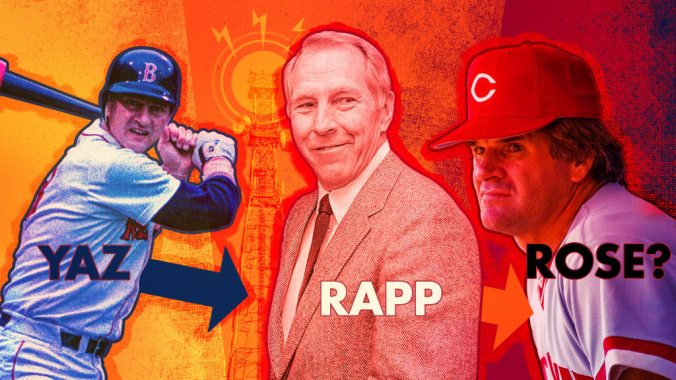
On Oct. 2, 1983, the Boston Red Sox said goodbye to Carl Yastrzemski at Fenway Park. I was there, along with my wife, thanks to the kindness of a good friend  (who eventually real-life de-friended me over a political disagreement in an episode I will never understand. I don’t like to think about it,) Yaz got a great send-off for his final game, with an hour-long pregame ceremony, the retirement of his No. 8 jersey and a letter, read aloud to the crowd, from President Reagan. Yaz, memorably, rounded the park, touching the hands of the fans, and dramatically ripped off his jersey as he went down the steps of the dugout for the last time as a player. I’ll never forget it.

Since the retirement of a Red Sox legend after 22 years was the biggest story in the city as well as in baseball,  the Boston sports talk radio show “The Sports Huddle” on WHDH decided to play a little joke. Let me interject here that “The Sports Huddle” was always a vile feature of the sports scene in Boston, uncivil, unfair, with loutish hosts and the kinds of callers who epitomized the worst stereotypes of Boston fans.  It’s gone now, and good riddance. But I digress….

The show decided it would be funny to ignore Carl Yastrzemski, who the show and its callers had been generally vicious about for a decade, and to devote its four-hours on Yaz’s day to a joke tribute to as unremarkable a baseball figure as they could find. The producers settled on the first-base coach of  the Montreal Expos,  55-year-old Vern Rapp, who had once managed the St. Louis Cardinals without distinction, and who had announced that he would end his baseball career at the end of the the 1983 season. Of course, only the most hard- core baseball fans in Boston would have any idea who Vern Rapp was.

The Sports Huddle jerks decided to play it all straight, presenting a solemn ,extended tribute to the mediocre, obsure,Expos coach. They tracked down former minor league teammates of Rapp’s,  friends  from his time in St. Louis, and  Cardinals broadcaster Mike Shannon, interviewing them all about Rapp’s fine qualities as a baseball man and human being, and how much baseball would miss him. Then they interviewed Rapp himself. Nobody suspected that it was all a put-on.

At least nobody dumped a bucket of blood on his head, like they did to Carrie White. Continue reading

Evening Ethics Reflections, 2/11/2020, While Waiting For Joe Biden To Go Down

Hi!

It looks like Joe Biden will end up fourth or worse in the New Hampshire primary, and if he does, it will all be over but for the shouting, or in Joe’s case, the blathering. This was pre-ordained from the second Joe entered the race: how anyone knowledgeable and paying minimal attention could see Joe was a shell of his former self, and his former self was never anything to get excited about in the first place. I have never believed that President Trump thought Biden was a threat to defeat him; if his determination to unravel the Biden’s influence peddling in the Ukraine had a personal component, it was that he just wanted to stick it to Joe and expose his hypocrisy. We will never know, I guess. But I assume trump knew he didn’t need to “cheat” to beat Biden.

It’s amusing and somehow fitting that Joe’s inexplicable “Lying dogfaced pony soldier” outburst is serving as a tipping point, with a lot of people suddenly smacking their heads “I could have had a V-8!” style and thinking, “Hey! This guy really is an idiot!” Yes, he really is. The fact that the bland Amy Klobuchar is surging as the new moderate (relatively) savior of the party shows just how bad Biden has been, and also just how unforgivably incompetent and unattractive a field the Democrats have offered America in 2020. On the hopeful side, at least Democratic voters have recognized Senator Warrren as the manipulative, untrustworthy demagogue she is. If a Massachusetts leftist Senator can’t beat Buttigieg and Sanders in New Hampshire, she’s not going to win anywhere.

All of this couldn’t happen to a more deserving party.

1. The President thinks Pete Rose belongs in the Hall of Fame. Of course he does. Our President has an unhealthy tolerance for liars and rogues. There has been a depressing outbreak of renewed sympathy for Rose, the game’s all-time hits leader who was banned from baseball for life after being proved guilty of betting on baseball games while a manager, betting on games his own team, the Reds, was playing, and lying about both over many years. The reason is the recent sign-stealing scandal, because, of course, one cheating scandal mitigates a completely different offense that didn’t have anything to do with cheating.

Naturally, there’s a tweet… Continue reading

Six Ethics Lessons As Bill James Falls Into His Own Research Trap

Baseball philosopher, iconoclast and analyst Bill James is one of my heroes for his amazing ability to look past conventional wisdom with an open mind. Beginning as essentially a self-published pamphleteer writing out of his basement, James’ counter-traditional explorations of baseball statistics eventually changed how baseball was watched, assessed, scouted and played, simply on the strength of Bill’s  ideas and his facility in explaining them.

His talents could be used in many other fields–James has recently branched out into examining famous unsolved murders—but it is also true that many of the ideas he has developed in relation to baseball have wider applications. For example, James was the source of the concept of “signature significance,” which is a staple here at Ethics Alarms.

His writing also taught me that bias makes us stupid, and about the insidious power of rationalizations.  Many of James’s observations seemed intrinsically obvious once he made and explained them, and the fact that  baseball executives, writers and players could have been so wrong about their own game for so long seemed incomprehensible. But the reasons were what they always are, in all fields. People are biased toward what they have always believed —confirmation bias–and the “It’s always been this way” variation on the most powerful rationalization of them all, “Everybody does it”  breeds blindness and  intellectual laziness. Continue reading