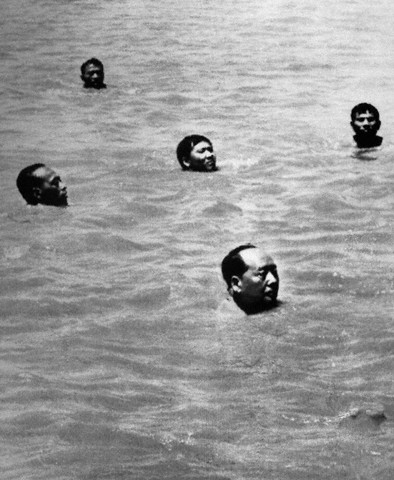
 In the early 1960s, as the Great Leap Forward led China into political, social and economic disasters, the opposition to Mao Zedong’s leadership grew; Chairman Mao’s reaction was to purge the party leadership of intellectuals and officials in what is now termed, “the Great Proletarian Cultural Revolution.”
Mao Zedong’s hold on the leadership of China was shaky as he passed 70; even slaughtering more of his enemies and rivals wasn’t working. On July 16th 1966, Mao sought to debunk rumors that he was frail and ill by staging photographs of him vigorously swimming in the Yangtze River. It was called, “The Swim Seen Round the World.” The Chinese press did its job, describing Mao’s cheeks as “glowing” and “ruddy,” his stroke steady and strong. “Our respected and beloved leader Chairman Mao is in such wonderful health!” one press report enthused.
In the West, however, there was more skepticism. Time reported that Mao swam “nearly 15 km in 65 minutes that day–a world-record pace, if true.” The photos of the swim, which showed an oddly solemn group of floating heads, were widely believed to have been doctored. As it turned out, the photos were real; Mao really did take a swim, though the event was staged, and nobody knows how long the swim lasted or how far Mao paddled. What are such photo ops? Are they deceptive? Are they ethical? Continue reading
 Ethics Alarms