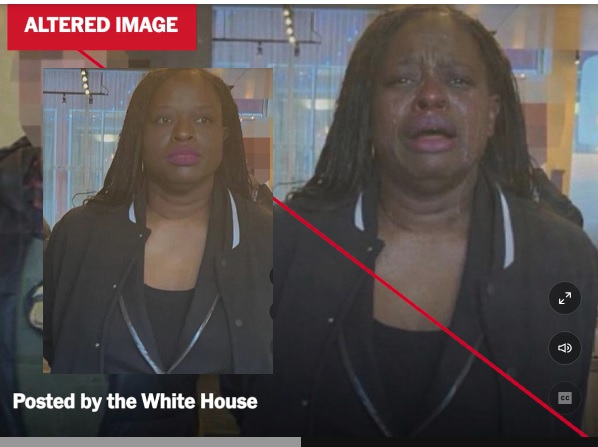
New York Magazine Is Caught Manufacturing Fake Evidence Of “White Supremacy”

Once upon a time, the news media would get away with this kind of blatant dishonesty.

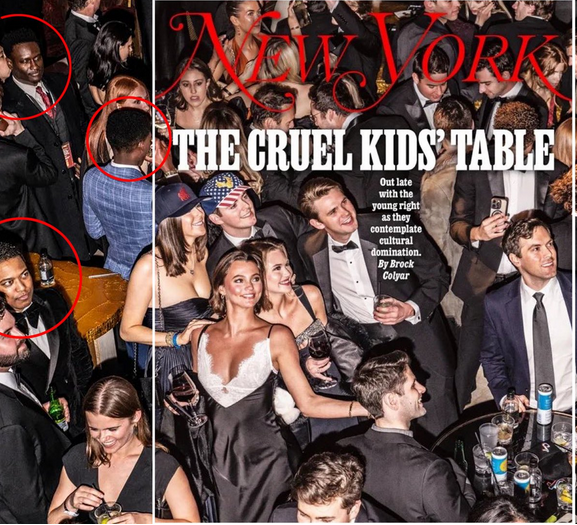
The story itself that New York Magazine used this deceptively cropped photo to introduce (The Cruel Kids Table: Out late with the young right as they cultivate cultural domination”) states that “Almost everyone is white” after beginning the story by quoting a party attendee as observing, “Have you noticed the entire room is white?” Promoting the piece, the NY Mag X account wrote that the story was about “the young, gleeful, confident, and casually cruel Trumpers who, after conquering Washington, have their sights set on the rest of America.” This was a hit piece about a supposedly all-white conservative influencers Trump inauguration party, yet the party’s host was black Gen Z Republican strategist CJ Pearson. Others pointed out, like black conservative pundit and “influencer” Rob Smith, also a guest at the party, that there were many Hispanics, blacks and Asians there. He posted this photo…

Continue reading

About That Most Dishonest, Cynical Presidential Campaign Ever…

One might be tempted to add “incompetent,” but we shall see.

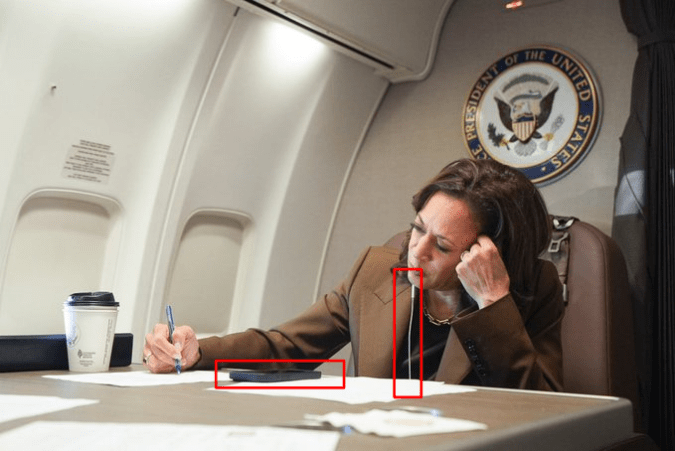
That ridiculous photo above of Harris supposedly on the FEMA briefing is signature significance. Witness the serious, troubled look on her face, the pen, the pad of paper, as she listens intently while flying over the hurricane destruction.

Except she isn’t listening, because the earbud dangling from her ear isn’t attached to the phone. Well, but maybe she has the phone on speaker….but what kind of inept staff allows a staged photo like this to be so messed up? And what kind of qualified national leader isn’t alert enough to know it’s going to make her look like a dufus?

“I was just briefed by @FEMA_Deanne Criswell on the latest developments about the ongoing impacts of Hurricane Helene, Harris captioned this photo. “We also discussed our Administration’s continued actions to support emergency response and recovery.   I also spoke with @NC_Governor Cooper about the ongoing rescue and recovery efforts in North Carolina.   Our Administration will continue to stay in constant contact with state and local officials to ensure communities have the support and resources they need.” Oh, I don’t doubt she had those conversations. But that’s not a photo of her doing so, and she’s telling the public that it is while the evidence that it isn’t is there for anyone alert to see.

Continue reading

More From The A.I. Ethics Files: The Suspicious Photograph Contest Entry

The photo above was entered into a photography competition but disqualified because the judges “suspected” that it was generated by artificial intelligence. As it turned out, the photograph was taken legitimately, but by the time the contest entrant learned about her disqualification, the competition had been settled. Suzi Dougherty used a high-level iPhone to createn the unsettling photo of her son standing near two mannequins while visiting a Gucci exhibition.

The photo competition was sponsored by Charing Cross Photo in Australia. Disqualifying Dougherty’s photo via Instagram post, the judges said they were “intrigued” by the photograph, but “suspicion set in.”

Oh. Well that’s OK then!

Continue reading

Add Switzerland To The List Of Supposedly Wise “First World” Nations That Don’t Comprehend The First Amendment Or The Ethical Importance Of It

…among others. But let’s concentrate on the First, shall we?

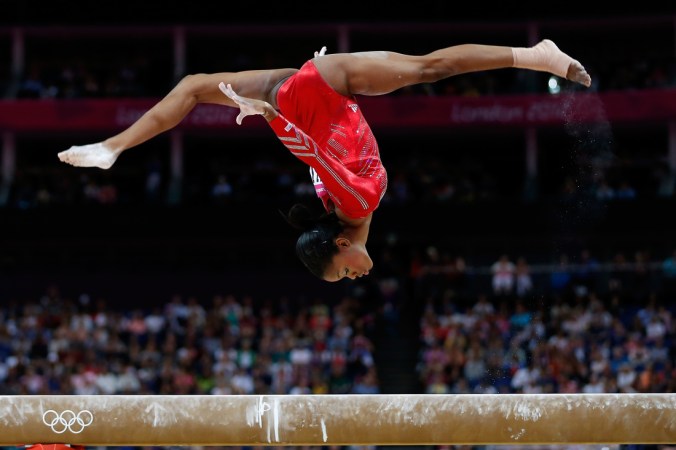
The Swiss Gymnastics Federation (STV) has now banned photographers from taking photos of female gymnasts like the one above of retired female gymnastics champ Gabrielle Douglas.

The association has imposed the ban on such “suggestive” photos to ensure that gymnasts can only be photographed in a way that focuses innocently on their poses and positions, not their bodies. “To protect gymnasts, the STV strives to ensure that no suggestive or otherwise ethically sensitive photos are published and passed on. Especially photos where gymnasts were photographed in the crotch,” STV states in its news guidelines. “The STV is aware that such photos can arise in action photography. However, publication should be avoided. The main concern of the STV is to sensitize the media professionals and to let common sense prevail.”

Continue reading

Ethics Dunce: Gov. Ron DeSantis

Yecchh.

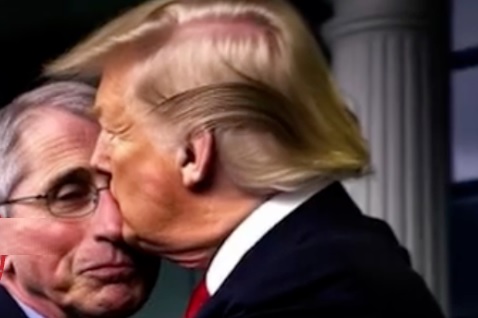
This hacky, dishonest attack ad undermines the one major advantage Gov. DeSantis should have over Donald Trump in their approaching battle for the GOP nomination: DeSantis doesn’t behave like he’s 10 years old. Allowing this photo to appear in the ad is particularly irresponsible…

…as it is a bad fake. If a candidate will allow fake photos to be used to mislead the public, what else will he lie about? This one is particularly stupid, because it shouldn’t be hard to legitimately criticize Donald Trump on myriad issues; creating false images to trigger junior high “Ew!” reactions is wildly unprofessional. Why is DeSantis relying on people who think this is legitimate advocacy?

Continue reading

Someone Explain The Kobe Bryant Photos Case To Me, Because I Don’t Understand It At All

It appears to be a triumph of “ick” over both law and ethics.

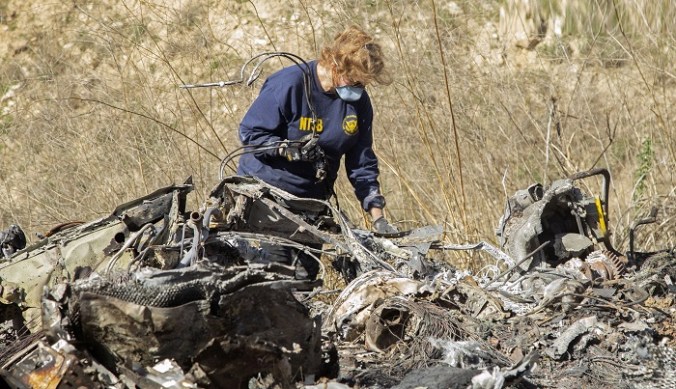
Kobe Bryant’s widow, Vanessa, was awarded $16 million as her part of a $31 million jury verdict Wednesday against Los Angeles County. Deputies and firefighters had shared gruesome photos of the NBA star; their 13-year-old daughter, Gianna; and other victims killed in a 2020 helicopter crash; the family of those other victims received the rest of $31 million. The nine jurors unanimously agreed with Vanessa Bryant and her attorneys’ argument that the photos invaded her privacy and caused emotional distress.

I’m sure they caused emotional distress. But how can an event that occurs in public be declared sufficiently private to have the protection of the right to privacy? If a journalist had taken the photos and published them, or shared them on a news website, presumably there would be no way Bryant’s widow would have a cause of action. I don’t see how a bystander with a cell phone could be blocked or sued either. These pictures were shared mostly among employees of the Los Angeles County sheriff’s and fire departments.They also were seen by some of their spouses and in one case by a bartender at a bar where a deputy was drinking. Well not to be unsympathetic, but so what? How does the right to privacy make reality a personal property protected by the law? If the bloody crash occurred where a crowd of a hundred people could see it, how would the law black them from taking photos and showing them to friends?

Continue reading

Ethics Quote Of The Month: Kim Phuc Phan Thi

“I thought to myself, “I am a little girl. I am naked. Why did he take that picture? Why didn’t my parents protect me? Why did he print that photo? Why was I the only kid naked while my brothers and cousins in the photo had their clothes on?” I felt ugly and ashamed.”

I always  uncomfortable with that photograph from the moment I saw it, and thought it was cruel and unethical. Would the AP have published a similar photograph of a white American girl? I don’t know, but I don’t trust the Associated Press (or any press, at this point). It won Ut a Pulitzer Prize and helped energize the anti-Vietnam war effort in the U.S., but the photo (shown in the underlined link above) fails two basic ethics systems: Reciprocity, as in the Golden Rule, and Kant’s Categorical Imperative, which forbids using another human being as a means to an end. Can it be justified under Utilitarian principles, as a balancing of outcomes? Was the benefit of publishing the photo sufficient to make it ethical conduct, despite the harm it would do to an innocent child?

 Not on my scorecard.

Continue reading

Unethcal Website Of The Month: The Post Millennial

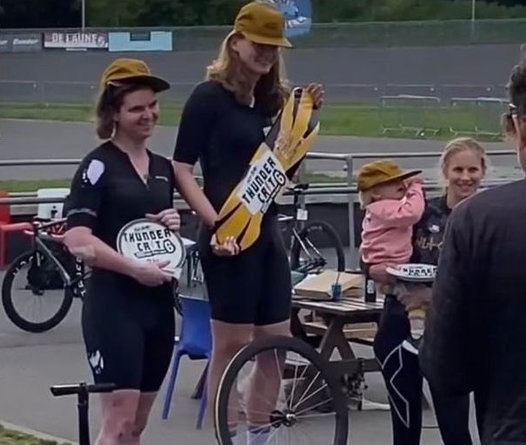
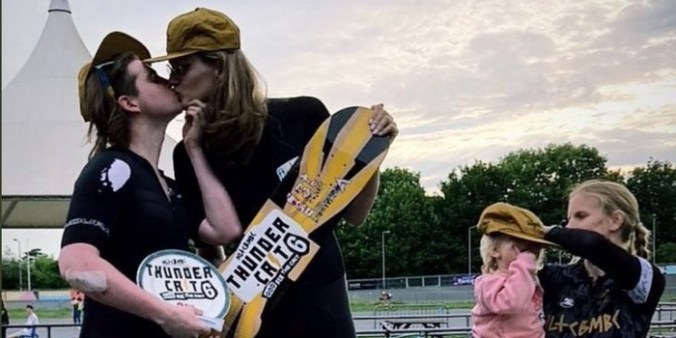
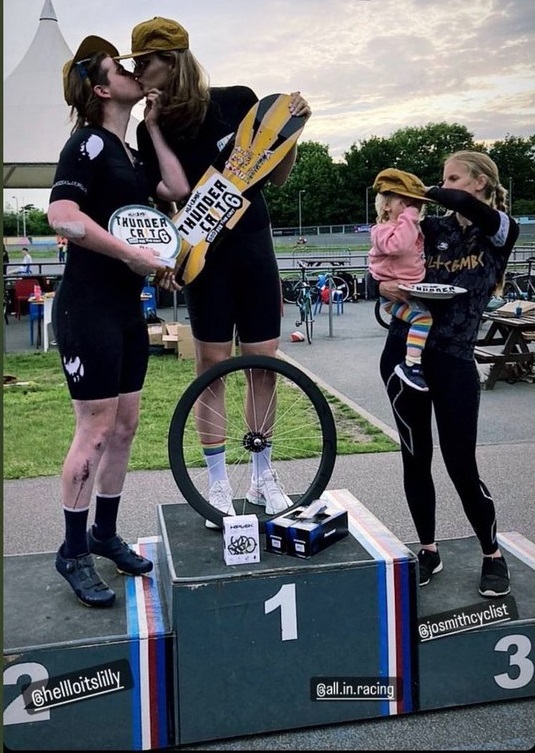
Emily Bridges and Lilly Chant, two biological men who “identify” as female, won the first and second place slots at London’s ThunderCrit cycling last week. That’s the third place finisher with her baby on the right. The Post Millennial, a conservative website, used the photo above and this one…

…to show how absurdly unfair the competition was, with the diminutive biological female dwarfed by her victorious trans competition. The headline was, “Biological males win women’s cycling event, kiss while third place female cares for child.”

And it almost fooled me. I was going to post the photos above as a “Res Ipsa Loquitur” stand-alone feature, but this time the pictures didn’t “speak for itself.” Here are the uncropped photos…

No wonder the trans-women dwarf the third place finisher! They are standing on higher platforms. Continue reading

Update On The Uvalde Massacre Extension Of The Sandy Hook Ethics Train Wreck, Part 5: The “Good Public Policy Comes From Creating Emotional Hysteria” Theory

“For a culture so steeped in violence, we spend a lot of time preventing anyone from actually seeing that violence,” says an Ethics Dunce quoted with reverence in the New York Times essay, “From Sandy Hook to Uvalde, the Violent Images Never Seen” “Something else is going on here, and I’m not sure it’s just that we’re trying to be sensitive.” Hmmm, what could that ‘something else’ be? It’s a mystery!

It’s ethics, you blithering fool. The Dunce is Nina Berman, a documentary photographer, filmmaker and Columbia journalism professor. See that least part? Is it any wonder that journalists are now our least ethical professionals? Jelani Cobb, incoming dean of the Columbia University School of Journalism, is also quoted as saying, “I’m not at all certain that it’s ethical or right to display these images in this way.”

Continue reading

Photography Ethics, Richard Prince And NFTs, Whatever The Hell They Are

NFT big

Since late last month, April 25 in fact, I have been periodically researching the topic of NFTs or “nonfungible tokens“. The damn things were back in the news yesterday when a digital-only photograph of supermodel Emily Ratajkowski standing in front of a photograph of herself with a smaller, different photograph of herself in the corner sold at auction at Christie’s for $140,000 ($175,000 after fees). Here’s Yahoo!’s description:

It’s not that the photo can be seen only by the buyer or even that the buyer can physically mount it in a frame (though one supposes the buyer could project it on a wall or screen and put a frame around the projection); it’s that the equivalent of the certificate verifying the authenticity of the digital file of the main photo is unique. It’s really the certificate that cannot be replaced exactly by a copy….NFTs have recently enjoyed a heyday. Nonfungible.com, which tracks such sales, shows massive spikes through the first quarter of 2021 over the last quarter of 2020, with sales volume reportedly in the range of $2 billion already this year.

Right. I can read that over and over, and it still makes no sense. As far as I can tell, these are like digital tulip bulbs from the Dutch tulip craze crossed with cyber-currency, and people who have so much money they don’t know what to do with it are buying what amounts to metadata as investments. But I may be completely wrong. I eventually gave up on trying to understand NFTs when my sock drawer started looking taking to me.

There is are underlying ethics issues, however. Ratajkowski created her NFT in part to troll Richard Prince, a photographer who has exploited the blurry ethics and copyright laws involving photography to make a lot of money and to infuriate many people, especially celebrities like Ratajkowski. Prince is the master of the digital age of Appropriation Art. When Andy Warhol essentially copied the design of a Campbell’s Tomato Soup can and made millions from it, that was the beginning of the trail of metaphorical bread crumbs that led to Prince. Thousands of photographs are placed online every day and appear all over the web, to be copied and re-used in on Pinterest, Instagram, Facebook and many other cyber-spaces. It is often impossible to track down the original photograph or its source even if one wants to give it attribution or ask permission to use it from the creator—this is something I do know something about, as I deal with it every day. Taking an individual’s image, however, treating it as one’s own and selling it is widely regarded a breach of photography ethics, and arguably a breach of law. “Fine Art,” however, creates a large loophole, and in the loophole dwells the much despised Richard Prince.

Continue reading