…do you know what the difference is between him and this Alabama cop?
Warning: This is difficult to watch. Unidentified Alabama police officer electrocutes man with Taser while he’s in handcuffs, and seems to enjoy doing it. The cop has been placed on leave. pic.twitter.com/DiBAq0BVnn
If the tasering killed the man, and it was possible, she’d be exactly as culpable as Chauvin. She might be more culpable, because her victim wasn’t actively resisting arrest when she used the weapon.
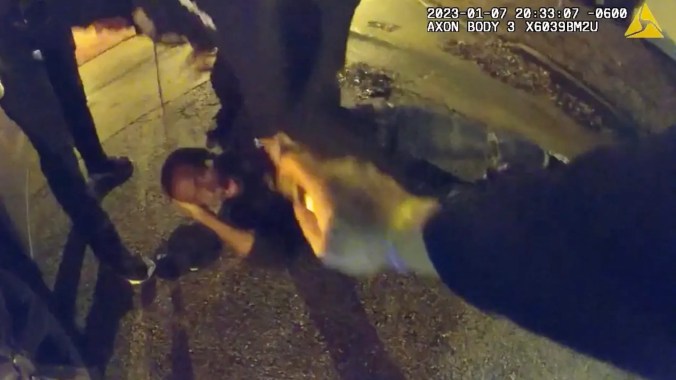
So far, the threshold ethics question that should begin any ethical analysis has not been answered regarding the horrific beating of young Tyre Nichols after a traffic stop. Five police officers were involved. That questions is, “What’s going on here?”
I’ve been thinking about this, and the ethical breakdown that led to it. Why did the ethics alarms not ring?
The tragic state of policing Jack mentioned is part of it. But what keeps coming to mind is something Jack has brought up many times regarding dog attacks: that when they’re part of a “pack,” even otherwise well-mannered dogs become dangerous as instincts take over.
Dogs are not the only animals that hunt or defend territory in packs. Continue reading →
I have now seen three gags online using that introduction above. All of them were really mean; one made me laugh out loud, and I was sorely tempted to use it. However to do so would be neither ethical nor in the spirit of the season, so I’ll just encourage readers to use their imaginations.
I was especially tempted after hearing President Biden and the First Lady call into the NBC broadcast of the Macy’s Thanksgiving Day Parade—I wasn’t watching at the time, but someone sent me the video yesterday. First, it was an intrusion into what is supposed to be a completely non-political holiday event for the President to try to exploit it. If Biden had even attempted to be the unifying leader he claimed to be while campaigning in 2020, I’d give it a pass, but at this point anything he does or says has to be taken as purely partisan, not to mention calculated and managed by his “handlers,” as in puppeteers. The phone call also went as you might expect: there were about 20 seconds of dead air time, which is an eternity on TV, as the Bidens could be faintly heard speaking incomprehensibly while NBC weather reporter Dylan Dreyer, smiling like a zany, went through a classic “Can you hear me? I can’t hear you…” routine. Finally, after Joe told Dreyer that she was doing a “good job” and giving credit to her for the good weather—she’s the weather girl, see; I think that bit was old by 1964—the First Couple replied to Dreyer’s invitation to say something of substance to the audience,
Mrs. Biden: “We just want to say we’re so grateful for the people, for this opportunity, for the health that we have now in America, and Joe, what do you want to say?”
Joe: “I want to say thanks to the firefighters and police officers, first responders. They never take a break.”
Mrs. Biden: “And God bless our troops for sure.”
Joe: “And by the way, we’re going to be talking to some of our troops later in the day, both here and abroad. I hope everybody remembers. We remember them every single day. God bless our troops for real.”
1. More Macy’s Thanksgiving Day Parade ethics.…On the one parade broadcast I did watch for a while, the commentators used the buzz-word “diversity” three times in less than fifteen minutes, explaining at one point that a marching band was wonderful because it was “diverse.” Bands are good when they look and sound good; it shouldn’t matter what colors it is or whether there is a nonbinary flute player. Then I remembered that Macy’s had just dropped the Salvation Army and will no longer allow its Santas and bell-ringers to solicit seasonal charity contributions, because the conservative religious organization isn’t sufficiently all-in with Macy’s political and social pandering mission to “grant funding to advance human rights, racial justice, workforce development and economic opportunity.” This despite last year’s embarrassing attempt by the Army to jump on the Critical Race Theory bandwagon. The government/media/corporate alliance to mandate beliefs and opinions and punish dissenters brooks no deviation.
The last metaphorical straw was when some female pop star I had never seen, heard or heard of before serenaded the viewers with the brain-numbing Christmas song, “What Christmas Means to Me”:
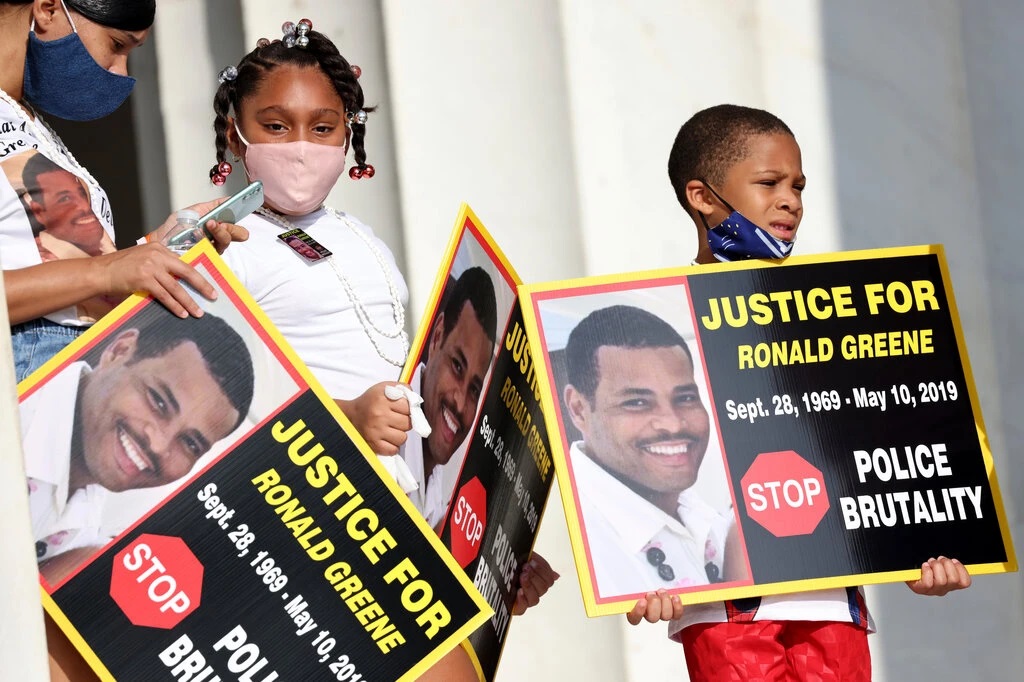
Another death of a black man in an encounter with the police has re-emerged from 2019, this time from Louisiana. It has even more of the unethical elements of past tragedies/botches/fiascos than usual, and the cast of characters are all playing their now familiar parts to maximize the likelihood of protests, riots, political grandstanding and confusion, not to mention more deaths and further damage to race relation and law enforcement. Good job, everyone!
This is a true ethics train wreck, because nobody, literally nobody, who has been involved with the episode so far has behaved ethically. At this point, I see no hope that the mess can be cleaned up, but maybe we can learn something from how thoroughly another Police Meet Black Lawbreaker disaster has been mishandled by everyone to ensure the worst conceivable outcome. In no particular order, here is a list of those responsible for the Ronald Greene Ethics Train Wreck.
She looks so smart and sure of herself! Surely we can trust what SHE writes…
The anti-police propaganda spreading the lie that most police are racist and brutal and therefore a greater threat to society than a benefit has become like the nine-headed Hydra of Greek mythology: nearly impossible to kill. Prime among the villains in this development are the news media, which has enthusiastically spread misinformation while refusing to do its job of clarifying facts rather than distorting them, and researchers and academics, who have become so cowed by the abusive hyper-ideological environment in which they work that they won’t even stand behind their own studies. As discussed here, after a peer-reviewed study showing that the race of the officer or the civilian could not predict fatal police shootings was used by defenders of police and critics of Black Lives Matte, the researchers were pressured into retracting their paper because it was being, they said, misused.
I know I’m sounding uncharacteristically frustrated this weekend, but I really don’t know how society fights deliberate disinformation in support of a destructive narrative when both the journalism sector and the academic establishment are in on the fix.
Here is a representative example from The New Yorker. The current edition includes a 5,000 word essay by Jill Lepore, who should be trustworthy: she is a professor of American history at Harvard as well as frequent writer at The New Yorker and for other presumably legitimate publications. Her topic is the history of policing in the United States, linking the early role of police in suppressing slave rebellions to police killings of blacks today. At one point she writes,
One study suggests that two-thirds of Americans between the ages of fifteen and thirty-four who were treated in emergency rooms suffered from injuries inflicted by police and security guards, about as many people as the number of pedestrians injured by motor vehicles.
“And when you see these towns and when you see these thugs being thrown into the back of a paddy wagon—you just see them thrown in, rough—I said, please don’t be too nice. Like when you guys put somebody in the car and you’re protecting their head, you know, the way you put their hand over? Like, don’t hit their head and they’ve just killed somebody—don’t hit their head. I said, you can take the hand away, okay?”
—The President of the United States of America, land of the free, home of the brave, and where no citizen is presumed guilty and is protected by the Bill of Rights, in a speech to Long Island law enforcement officials.
Ugh. What an idiot. Here we are in a societal racial schism with alleged police brutality at its core, and President Trump decides it’s the perfect time to publicly endorse beating up suspects on their way to jail.
Naturally, being professionals and having functioning ethics alarms, the International Association of Chiefs of Police as well as various police departments and chiefs released statements stressing the need for police to treat all people with respect. Darrel Stephens, the executive director of the Major Cities Chiefs Association, said that the President’s words were harmful to police departments that are trying to rebuild trust. He also added that the laughter and applause of those officers in attendance ” reinforces that there’s sort of a wink and a nod about these things, when that’s simply not the case,.”
Blue Lives Matter then tweeted that “Trump didn’t tell police to go out and brutalize people as the media would have you believe. It was a joke.”
Of course it was a joke—an irresponsible, reckless, inappropriate, harmful, stupid, stupid, stupid joke. That’s a rationalization, not an excuse.
I wonder if the new Chief of Staff could talk the Secret Service into allowing him to post an Amazonian blow-gun sniper with a tranquilizer dart at all Presidential speeches, with instructions to puff hard any time the President starts to go off script?
The ACLU of Colorado last week posted the above video of an Aurora, Colorado police encounter with two black citizens last February.
The sequence, drawn from one of the officers’ body camera, shows Darsean Kelley and another man being stopped by police after they had received a call about a man allegedly pointing a gun on a child, but with no description of the man. Kelley and his companion were standing on the sidewalk in the vicinity of the alleged incident. Police asked the men to sit down, which Kelley said was impossible to do because he had a groin injury. Officers then told both men to put their hands behind their heads and turn around. As his friend remained silent and apparently compliant, Kelley kept his hands raised and asked why he was being detained. Immediately after he said, “I know my rights!” one of the officers shot him in the back with a stun gun. He fell backwards into the street.
The police then arrested Kelley on a charge of disorderly conduct for failing to obey a lawful order. In his report, the officer wrote that he thought he might be reaching for a weapon. The ACLU of Colorado then filed a motion to dismiss the case arguing that Kelley was unlawfully detained and arrested without probable cause or reasonable suspicion.
Observations:
1. Kelley and the other man were unlawfully detained and arrested. Were they unlawfully stopped? No. The police could stop men in the vicinity of a complaint like the one they had received in order to investigate it. When people become belligerent or uncooperative during such legal stops, cops sometimes become suspicious, or decide to use their power to stick it to an individual who shows hostility when the officers feel they are just doing their jobs, or trying to. This is when such situations escalate.
I’m sure the officers regarded the “I can’t sit down” claim as suspicious and provocative. I would. Note that no harm befell the other man, who remained quiet and followed the officers’ instructions. This is the correct way to respond.
2. I’m sure Kelley felt that he was being “stopped for being black.” I would if I were him. How are police officers today supposed to allay this suspicion at the outset of a legitimate stop? (Or maybe they WERE stopped for being black…)
3. What is the policy for tasing? The typical hierarchy for the use of force in police departments used to be this:
Table 1: Use-of-Force Continuum
Suspect resistance
Officer use of force
1. No resistance
1. Officer presence
2. Verbal noncompliance
2. Verbal commands
3. Passive resistance
3. Hands-on tactics, chemical spray
4. Active resistance
4. Intermediate weapons: baton, Taser, strikes, nondeadly force
5. Aggressive resistance
5. Intermediate weapons, intensified techniques, nondeadly force
6. Deadly-force resistance
6. Deadly force
(Adapted from the Orlando, Florida Police Department’s Resistance and Response Continuum)
…
After the introduction of more powerful electronic control devices, many departments changed their use-of-force directives for handling suspects who were only passively resisting the lawful orders of the officer, and increased the required level of resistance by suspects to warrant use of stun guns or tasers from passive resistance to active, physical resistance.
Table 2: Levels of Resistance Defined
Passive Resistance
The subject fails to obey verbal direction, preventing the officer from taking lawful action.
Active Resistance
The subject’s actions are intended to facilitate an escape or prevent an arrest. The action is not likely to cause injury.
Aggressive Resistance
The subject has battered or is about to batter an officer, and the subject’s action is likely to cause injury.
Deadly-Force Resistance
The subject’s actions are likely to cause death or significant bodily harm to the officer or another person.
Adapted from the Orlando, Florida, Police Department’s Resistance and Response Continuum
I don’t know what the Aurora police policy is, but certainly under the kinder, gentler, saner revised standards above, stunning Kelley was excessive. Police brutality is not an unfair description of what he experienced. Continue reading →
The 8th Circuit Court of Appeals rejected the absurdly lenient prison sentence given to an Iowa police officer who brutally beat a man without cause, then filed a false police report accusing his victim of attacking him. Mersed Dautovic had been sentenced to just 20 months for the attack after a four-day trial in which a Des Moines jury found him guilty of using excessive force and obstructing justice.
Though the sentencing guidelines called for a range of 135 to 168 months, the trial judge sentenced sentenced Dautovic to only 20 months in prison. A three-judge panel on the 8th Circuit found this to be a “substantively unreasonable” punishment for Dautovic’s “egregious” conduct, which included savagely beating an innocent man, causing his victim serious and permanent bodily injury, then writing a false police report that caused the beaten man and his girl friend to have criminal charges filed against them, and offering perjured testimony against them at their trial.
“When the totality of the circumstances is considered, a variance from the guidelines range of 135 to 168 months’ imprisonment to a 20-month sentence is unreasonably lenient,” Judge Roger Wollman wrote for the court in his 14-page opinion.
Ya think?
Well what do you know…justice was done within the system!
In a case involving police misconduct!
When the cop was white,
And his victims were black!
And there were no demonstrations, riots, or looting involved!I guess that’s why you didn’t see this in the news.
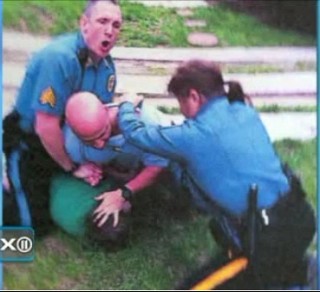
Police have a hard, crucial and dangerous job, so it is not surprising that the profession has developed a culture of rigidly enforced mutual support, the famous “blue line” that represents order against chaos, with police protecting society from the lawless and the predators, and making solidarity among the components of that line a key element in its strength. I understand why the culture has evolved to be what it is, and why an ethic of unconditional loyalty and trust thrives in police departments. There are times. however, when enforcing the integrity of the blue line serves to undermine it, and the saga of Officer Regina Tasca of the Bogota (New York) Police Department appears to be one of them. Continue reading →
"Yes, yes...journalism degree, experience at a local affiliate, blah, blah...but no rapes? Arrests? Scandals? Sexual abuse? Miss, you have NO credentials that make you valuable as a network reporter! Wait--what's your bra size?"
Good for media ethics pundit Howard Kurtz for blowing the whistle, however gently, on ABC News’s hiring of Elizabeth Smart as a contributing on-air expert on missing children cases. “Does that strike anyone as odd?” he writes.
Well, it depends what you mean by “odd,” Howard.
If you mean, does it surprise me that a broadcast media outlet, one of the journalistic mutations that hired Eliot Spitzer, fresh off his prostitution disgrace, to headline a current events show on CNN, that puts a giggly fold-out-come-to-life like Robin Meade in charge of Headline News’ morning, and that, like Fox News, chooses its female newsreaders and guest pundits according to their degree of resemblance to Mamie Van Doren or Raquel Welch, would hire a young, attractive blond woman with no credentials other than her role as the victim of kidnapping, sexual abuse and rape, as a correspondent, why no, I don’t find it odd at all.
If you mean, do I find it odd that a supposedly professional news network would so blatantly abandon professional standards just to cash in on the Casey Anthony uproar, however, then…wait, no, I don’t find that odd either. Revolting, but not odd. Continue reading →




 Ethics Alarms