I’m an ethicist who often writes on college controversies, and I make no secret about my double life in professional theater, so it figures that my inbox would include more than one query about Mt. Holyoke College’s decision to end its annual student performance of Eve Enlser’s “The Vagina Monologues” on the grounds that it is now admitting women without vaginas—I know, it’s confusing–who would feel excluded from what was supposed to be an inclusive experience and statement for the all-women’s school.
The annual production of the play is part of a country-wide tradition to perform Eve Ensler’s Vagina Monologues on Valentine’s Day to raise awareness about gender-based violence and usually coincides with the V-Day campaign. The proceeds are donated to sexual assault prevention organizations or women’s rights organizations. This year, however, Mount Holyoke’s Project Theatre Board is defying tradition by permanently retiring the play. In a school-wide email from the Theatre Board, a representative from the group, Erin Murphy, explained the problems with the play and the reasoning behind its discontinuation.
“At its core, the show offers an extremely narrow perspective on what it means to be a woman…Gender is a wide and varied experience, one that cannot simply be reduced to biological or anatomical distinctions, and many of us who have participated in the show have grown increasingly uncomfortable presenting material that is inherently reductionist and exclusive,” the email, obtained by Campus Reform, said.
Replacing the play will be Mount Holyoke’s own version that will be trans-inclusive and fix the “problems” supposedly perpetuated by Ensler. Murphy also claims that there are problems with race, class, and “other identities” within the play. The new production, comprised of students’ monologues, will be performed in a fashion reminiscent of the feminist classic. The program will be performed alongside the College’s Peer Health Educators, an on-campus student-led group that provides education and workshops for students, including a workshop on how to use sex toys properly.
The New York Times and CNN, among others, are ducking their responsibility as news organizations to run the current cover of “Charlie Hebdo.” Why is it their responsibility? Because the response of the devastated satirical publication is news, and as the Times laughably says on its front page, that news is fit to print: the Times and CNN are describing the cover, but don’t have the guts or integrity to show it. The disingenuous rationale, in CNN’s terms, is that they are respecting “the sensibilities” of Muslim viewers.
In a word: CRAP. The vast majority of readers and viewers should be kept in the dark to avoid offending Muslim readers and viewers who can easily avert their tender eyeballs? When have CNN and the Times applied that standard regarding any other religious group, or any group at all? [UPDATE: Over at Popehat, Ken White extravagantly exposes the intellectual bankruptcy of the Times’ rationalizations for not showing the cartoon with a series of well-formulated and pointed questions. This is admittedly more diagnostic than “CRAP,” but the message is the same.]
The translation of this craven self-censorship is “We are concerned about offending an anti-democratic and violent minority who are successfully using threats to constrain the free distribution of knowledge and information, because we are unworthy of the profession we presume to practice.”
Prof. Turley is a lawyer, of course, and trained to express himself with precision. Thus I have to ask: what the heck is he trying to say here?
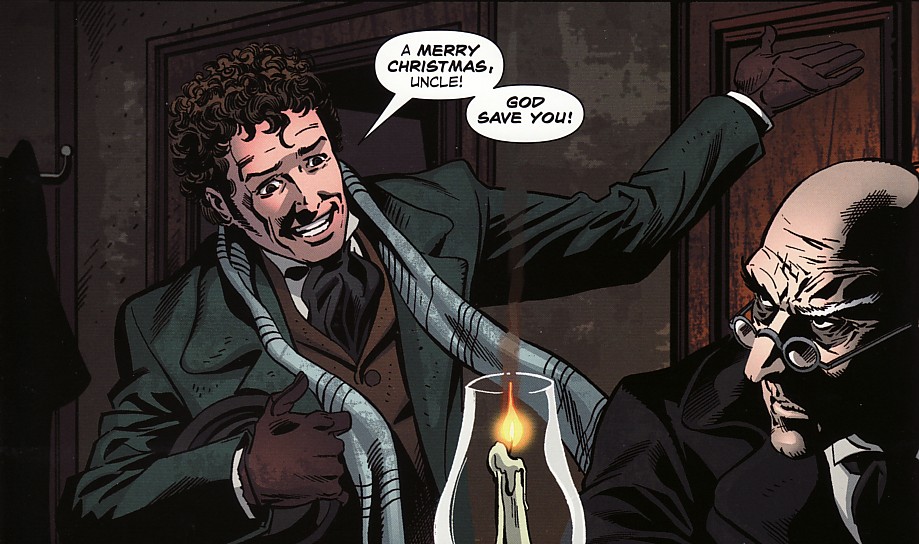
Is he wishing good tidings only those who, like his family, are celebrating Christmas, and rotten times to the rest? Is he editing the humanist message of Christmas to “Peace on Earth, and good will to those who are putting up Christmas trees and giving gifts, other wise you’re on your own”?
Or, as I fear greatly, given the fact that he is part of the U.S. education establishment and thus prone to have a spine of cream cheese, just observing the trendy political correctness that infects our times, and bowing to those who contrive to take offense when anyone smiles at them and offers a greeting that only says, at minimum, “We’re all in this together, so let’s try to be as good to each other as we can, OK?”Continue reading →
It is slowly dawning on me that Christmas music, one of the annual joys of my childhood and perhaps yours, is in a perilous state, both culturally and aesthetically. The best of the songs musically are religious in nature, which means that schools won’t pass them along to their charges as happened routinely when I was a child, and even playing them on the radio is likely to be regarded as a religious statement. I just loved the music, as I think most kids would if they ever got the chance before they were brainwashed into believing the ancient songs were subversive.
A full court cultural press is underway to make those songs as rarely heard outside of church as hymns, and I don’t see the trend as reversible. One obvious bar to a comeback: current pop stars don’t have the pipes to sing most of them without causing a sound pollution emergency. Or, if one of the few singers who could actually hit the notes dared to cover a carol like “O Holy Night,” he or she would feel required to apply flourishes of the sort that make every rendition of “The Star Spangled Banner” at a major sports event an invitation to PTSD.
Even for the more secular Christmas repertoire, the clock is running out. The most listenable versions, and the definitive ones in most cases, are by performers of the past who are not just dead, but also long forgotten by the current culture. An hour of classic Christmas recordings on the radio is now a reminder of how old I am and close to joining great singers like Bing Crosby, Judy Garland, Andy Williams, Nat King Cole, Jo Stafford, Burl Ives, Gene Autry, Frank Sinatra, Dean Martin, Elvis—dead, dead, dead. I guess Brenda Lee is still alive, so “Rockin’ Around The Christmas Tree” is a little less depressing, but it’s a minor classic at best. It’s gotten so bad that when I hear “The Little Drummer Boy,” I find myself wondering if the whole Harry Simeone Chorale is dead too—Harry died in 2005, and the recording is 56 years old, after all.
Meanwhile, our post-modern culture is sneering at the whole idea of Christmas songs, and Christmas itself. Most modern Christmas songs either are making fun of Christmas, about sex, or just lousy. The tradition is being undermined in more creative ways, too: this week I watched a 2012 straight-to-video movie called “12 Disasters of Christmas,” based on the loopy premise that “The Twelve Days of Christmas” was really a coded recipe for stopping the 2012 apocalypse predicted by the Mayan calendar. “The Mayans knew that the knowledge would have to be preserved for centuries, so they devised a song that would carry the secret and would be passed on and learned by children for generations,” explains the old codger who’s figured it all out. (But why would they choose such a monotonous and stupid song?) Come on, guess: How does the “Chosen One” stop the end of the world?[Answer below.]*
The movie is on to something, though. The Christmas songs that have the best chance of persevering though this age of cynicism and cultural illiteracy may be those that either tell a story or that have an interesting one related to their creation. The simple and beautiful tune of “Silent Night,” for example, as one of those films they used to show in school assemblies every year before some anti-religious hysteric sued, was composed for guitar in response to a Christmas Eve crisis for a small church in the Austrian alps in 1818: the church organ wasn’t working. I have found that Irving Berlin’s “White Christmas” affects me far more deeply since I learned that the Berlins’ infant son died on Christmas day, and that while his children celebrated Christmas as a cultural holiday, Berlin and his wife did not. They spent each Christmas after their son’s death in mourning. The song is a wistful remembrance of a happier time that the composer will never experience again.
Maybe another Christmas song will persevere if its origins are remembered; I was reminded of its history this week as a result of the thaw in U.S. relations with Cuba. Though my wife hates it, the song is one of my favorites, perhaps because it brings back warm memories: I watched the song’s first national broadcast with my sister and parents, and the Marshalls bought the recording the next day.
It was 1962. Noel Regney and Gloria Shayne were a husband and wife songwriting team of modest success. They were saddened by the lack of any spiritual content in popular Christmas songs then; imagine what they would think today.
Like all Americans, they were petrified during the thirteen days of the Cuban Missile Crisis, when the world stood on the brink of nuclear annihilation. As the crisis intensified, Regney found himself inspired to write down a simple poem with a Christmas theme. (Later, the couple would say that neither of them could ever sing the song through, because of the strong emotions it recalled.) When the nation could finally take a deep breath of relief as the threat ended, Gloria devised a melody for her husband’s words, though he had always been the composer when he and wife wrote songs together.
The result of this unique variation on their collaboration was recorded before the end of 1962, but it wasn’t until the following year, when Bing Crosby sang the team’s creation live on ABC’s “Hollywood Palace,” that it became widely known. The song written during the Cuban Missile Crisis became a best-seller, Crosby’s last hit Christmas record, and also the last popular Christmas song to have a religious theme.
It was, and remains, a prayer for peace.
____________________________
* By finding and wearing FIVE GOLDEN RINGS, of course!
Every now and then readers think I’m Ann Landers. Today I got a “Dear Ethics Alarms: What’s right?” e-mail from a friend, and I thought I’d answer it on the blog because it raises a classic ethics conundrum.
The inquirer belongs to a social group that meets weekly. It is a weekly joy, I am told; the writer has been attending for years. Everyone convenes, on the given day, right after work. Attendance varies, and membership is informal, though individuals have been told, on rare occasions, to come no more.
Of late an infrequent attendee, but a member of long standing, has begun to attend meetings with some regularity. My friend says this is not the happiest of developments, because the two do not get along. It is a breach of long-standing, I am told and is not going to be healed. “She is an asshole,” is how the letter delicately puts it.
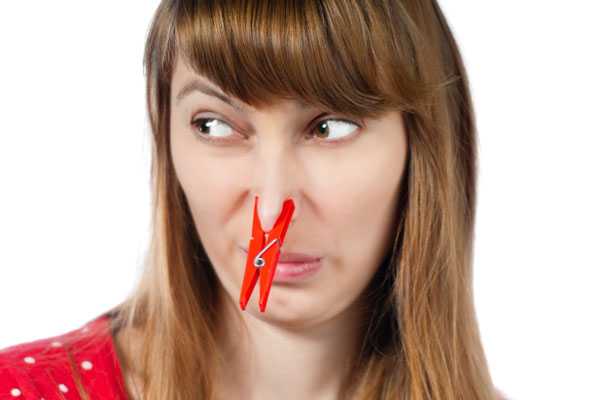
Last week, shortly before the end of the 90 minute gathering, the recent interloper stood up and declared that she had developed a serious allergy to colognes, perfumes, aftershave, and all chemical scents. Looking right at my friend, she declared that this allergy made exposure to any sort of commercial scent unbearable, and she asked that in the future no members should wear perfume of any kind.
“I have worn a favorite brand of cologne every day for over thirty years,” the from my acquaintance letter says. “I always get complimented on it; the scent is subtle and nobody would notice it unless they were right next to me. The asshole and I have been separated by the length of the room since she started coming. Personally, I think she made the demand just to make me miserable. She knows, from our previous relationship [NOTE: I think it was more than just a friendship], that I wear the cologne.”
The question:Is she ethically obligated to stop wearing cologne on the day of the meeting (she goes right from work) to accommodate this member’s special problem?
Add to this the broader ethics question that comes up often: Does a group member with special sensitivity have the ethical upper hand allowing such a member to demand that all other members avoid conduct that only bothers that member?Continue reading →
Cultural events earlier this month brought to light, on two continents, the problem of maintaining the integrity of art and literature under the onslaught of political correctness.
In Sweden, a controversy has erupted over the re-broadcast of a 1969 television adaptation of the Pippi Longstocking books, the children’s classics authored by Astrid Lindgren. The Swedish national TV station, SVT, announced that it is revising a scene from the 1969 television series about Pippi which she says her father is “king of the Negroes,”a direct quote from one of the stories. Believe it or not, this has set off a contentious national debate.
The family has approved the station’s desire to change the TV version, but is keeping the term in future editions of the books. In 2006, the family added a preface explaining that today, the word is considered “offensive,” but that when the books first appeared, “Negro was a common expression for people with black skin who lived in other parts of the world than ours.” That’s a sensible solution. Period and context is important in art and literature: the urge by some to constantly purge the world of any reference, word or attitude in past creations that seem out of place now leads to a form of cultural self-lobotomy. Erik Helmerson, a columnist at Dagens Nyheter, an influential Stockholm newspaper, called the changes a form of censorship. “I’m very sensitive to the fact that people are offended by the N word,” he said in an interview. “I’d never use it myself.” He even called revising the TV series “a huge interference into freedom of speech.” “Where do we draw the line? What do we cut and what do we keep? Who should decide? Who needs to be offended before we cut a word?” Continue reading →
Once again, we visit the ethically murky realm of jokes, near-jokes, misfired jokes, fake jokes, the ‘it was just a joke’ excuse and things the purveyor of non-jokes wish were jokes after the fact. Interestingly, by my estimation, the real and non-offending joke among our twin set today was the one delivered by a non-comedian, and the dishonest joke excuse was employed by a professional comic.
Case A: Jon Stewart
Appearing on CNN election day with Christiane Amanpour to talk about the midterm elections, the host asked Stewart if he voted. The comic/pundit/news anchor/progressive hit man responded “no” saying, “I just moved. I don’t know even where my thing is now.” Said Ann Althouse:
“The epitome of apathy. And this is the man who shows the young folks how to think!”
She was not alone. Later, as he hosted a special live election night edition of “The Daily Show,” Stewart apologized, saying:
“…to set the record straight, I did vote today… I was being flip, and it kind of took off, and you know what, I want to apologize. It sent a message that that I didn’t think voting was important. I shouldn’t have done that. That was stupid.”
This was flagged to me as a solid and ethical apology, and I agree, if that’s what it was. I don’t think that is what it was, though. I think it was damage control, and a lie. Maybe Stewart voted and maybe he didn’t, but he’s a professional comic. His “flip” dismissal of voting to Amanpour didn’t read a s a joke, and she didn’t seem to take it as one. He’s one of the highest paid and popular comedians in the country, and doesn’t know how to make it clear when he’s joking? Or can’t tell when a joke misfires, and he has to backtrack so people don’t think he’s serious? I am dubious. Continue reading →
I have not authored the usual number of unethical campaign tactics indictments this time around. One reason is that their desperation while facing an almost certain GOP wipe-out has led Democratic Party candidates into far more questionable devices than the confident Republicans as the Blues have increasingly defaulted to race-baiting, Koch brothers attacks, scare-mongering on everything from guns to contraception, and the “war on women” chorus. Combine that with the popular integrity breach of Democratic incumbants virtually pretending that they never heard of the Democratic President in the White House, and I was faced with giving more ammunition to those who accuse me of partisan bias. Looking at the poll projections, it appears that the worst offenders—Wendy Davis, Allison Grimes, Mark Udall, and Mary Landrieu among them—will get their just desserts from voters without additional alarms from me.
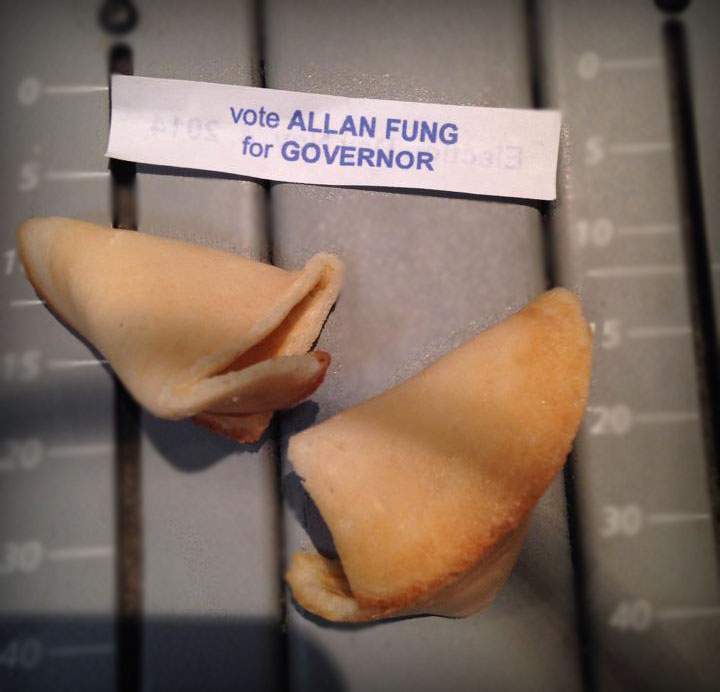
Speaking of desserts: this campaign tactic is worthy of note. A loyal Rhode Island reader inquires if I have any ethical problems with the campaign of Allen Fung, the Chinese-American GOP candidate in the closely contested Rhode Island governor’s race, delivering thousands of fortune cookies to Rhode Island Chinese restaurants that look like this when you open them
So your Ethics Alarms Pre-Election Ethics Quiz is the question asked of me:
The Bill Maher Ethics Conundrum is not what you probably think it is.
Maher, the alleged comic and anti-conservative scold who hosts an HBO program, was chosen by a student committee to be the commencement speaker for the University of California-Berkeley’s December graduation. This was a lazy, embarrassingly juvenile and politically-loaded selection, but Maher had also just recently used his show to join fellow atheist and neuroscientist Sam Harris in a condemnation of Islam, calling it “the only religion that acts like the mafia that will fucking kill you if you say the wrong thing, draw the wrong picture or write the wrong book.” Later on Maher nodded approvingly as Harris also called Islam”the mother lode of bad ideas.”
This caused Muslim students at Berkeley to prove Maher correct about their religion’s entrenched intolerance of opposition, and they have been joined by other political correctness censors in the student body—there are a lot of them—to demand that the university rescind Maher’s invitation because of his “hate speech.”A Change.org petition—-now THAT site is the real mother lode of bad ideas—now urges students to boycott the decision and asks the campus to stop him from speaking. It has gathered more than 1,400 signatures. The committee that chose Maher, naturally, backed down, but the University, so far at least, is sticking to its decision to invite him.
Yes, yes, universities ought to be marketplaces of ideas where all views are welcome, and yes, it is hypocritical and offends the traditions of liberal education to stop Maher from stating his views on Islam, or re-telling “The Aristocrats,” or making a fool of himself, or whatever he’s going to do because some students or all students disagree with him, just as it was for Rutgers students to force Condolezza Rice into withdrawing after she was invited to speak at Rutgers. The dilemma illustrated by this flap is a classic ethics problem, which I will henceforth call the Bill Maher Conundrum, which has been long debated and never decisively settled:
Is the ethical nature of an act defined by its intent, or by an objective assessment of the act alone without reference to motive?Continue reading →
Every now and then a comment out of the blue reminds me of a post that I had forgotten. That was the case here. Reading it again for the first time in five years, I was struck by how the crux of the post is still relevant today (that crux has nothing to do with baseball), and indeed how the intervening five years have made what I thought was a bad trend a genuine political and cultural malady.
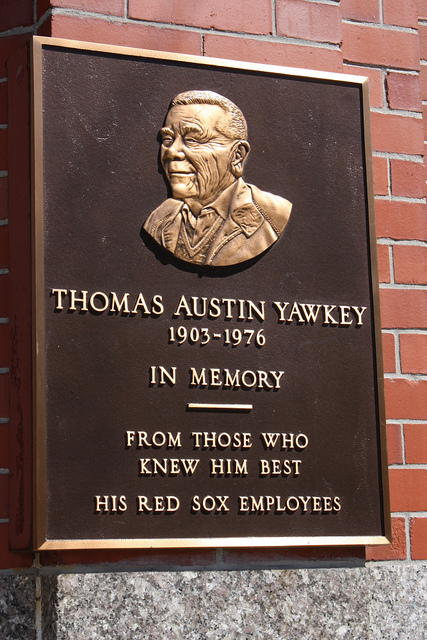
And the World Series is going on, and I feel badly about the Red Sox having such a miserable season. This post, which few read when it was first published as the blog was attracting (let’s see…) less than 200 views a day as opposed to nearly 4000 a day now, is a good one, and I enjoyed it. That “self-professed ethicist” has his moments….Continue reading →
 I’m an ethicist who often writes on college controversies, and I make no secret about my double life in professional theater, so it figures that my inbox would include more than one query about Mt. Holyoke College’s decision to end its annual student performance of Eve Enlser’s “The Vagina Monologues” on the grounds that it is now admitting women without vaginas—I know, it’s confusing–who would feel excluded from what was supposed to be an inclusive experience and statement for the all-women’s school.


 Ethics Alarms