The Most Ethical Christmas Carol

Well, unfortunately I started thinking that it’s beginning to look a lot like Christmas this week, so I’m depressed and miserable.

It’s my favorite time of the year because its the most ethical time of the year, but my wife, who was a Christmas fanatic, is dead; my son, who now insists that she’s my daughter, barely speaks to me though I have been nothing but supportive (because that’s my job); my sister is going to be across country for the holiday; and my mom, who was the center of every Christmas in my life as long as she was breathing, breathes no more. I have neither the time to decorate a tree properly (like I used to) nor the resources to  purchase one, and half-hearted decorations will only remind me of 2702 Westminster Place glories past. But I can’t avoid Christmas, just as I can’t avoid ““It’s a Wonderful Life”” as you know.  So I’ll be celebrating my favorite holiday here, on Ethics Alarms, with my five loyal readers and the other visitors who drop in, and pretty much nowhere else. That means, among other gifts, I will be bestowing various Christmas-related post from the Ethics Alarms Christmas attic. Like this one…

*** Continue reading

Mis-Remembering the Mutiny on the Bounty, a “Print the Legend” Classic

Today, April 28, is the anniversary of the famous mutiny on board the H.M.S. Bounty, when Fletcher Christian, the ship’s “master’s mate,” seized control of the ship and set its captain, William Bligh, adrift in the Pacific with a small group of sailors who refused to join Christian’s rebellion. The story of the mutiny and its aftermath has become a romantic cautionary tale that inspired three major Hollywood treatments, each with star-studded casts. If you ask the average American what happened on The Bounty, he or she will probably reply that a cruel captain who abused his crew was challenged by an honorable and courageous officer who took over the ship from a monster, and met with tragedy himself. Virtually no accounts of the event support that version of events, but that is the legend, and it persists to this day.

Why? It’s a better story, at least a clearer and more morally uplifting story than the truth, that’s why. Real life is messy and our heroes and villains tend to be more complicated than our emotions can handle, and this is especially true of the Bounty story. You see above the most famous moment from the great John Ford film, “The Man Who Shot Liberty Valence,” when the old newspaper editor refuses to report the shocking discovery that the heroic deed leading to the successful political career of a famous statesman and U.S. Senator never occurred. Ethics Alarms has discussed the “Print the legend” phenomenon so many times that it has its own tag. None of the examples that I have examined deserve that tag more than the mutiny on the Bounty.

Continue reading

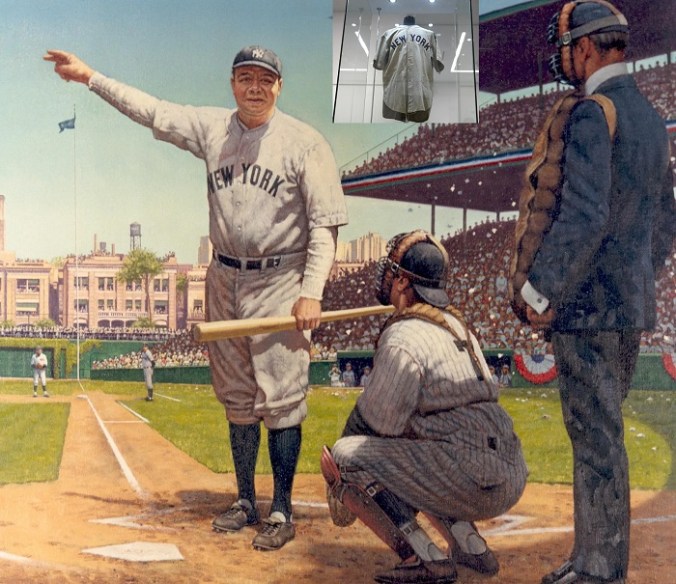
Ethics Observations On the Sale of Babe Ruth’s “Called Shot” Jersey for $24 Million

The jersey worn by baseball legend Babe Ruth when he “called his shot” in Game 3 of the 1932 World Series sold over the weekend for $24.12 million, setting the auction record for most expensive sports collectible. The previous record price for any sports collectible was the $12.6 million that a rare mint condition Topps 1952 Mickey Mantle card fetched in 2022. Babe’s jersey far eclipsed the $10.1 million a Michael Jordan Chicago Bulls jersey from Game 1 of the 1998 NBA Finals achived at auction that same year, the record for athletic attire until Babe broke it, like he shattered so many records when he was alive.

The sale raises many ethics issues, but the main one is that the exorbitant price is almost certainly based on a fabrication, a lie. It is similar to paying millions for the axe little George Washington used to cut down his father’s cherry tree.

Continue reading

The Snake Island Episode Is A Perfect Opportunity To Explain Moral Luck To Your Family And Friends

The legend was quick to take hold. The account was that as the Russian military pounded targets across Ukraine with bombs and missiles, a small team of Ukrainian border guards on rocky, desolate Zmiinyi Island, “Snake Island” to its friends, received a warning that the Alamo defenders would have recognized: Surrender or die. “I am a Russian warship,” the invaders said, according to a recording. “Lay down your arms and surrender to avoid bloodshed and unnecessary deaths. Otherwise, you will be bombed.”

Travis answered the equivalent message with a cannon shot. The defenders of Snake Island’s answer was more reminiscent of the famous reply of the 101st Airborne Division’s acting commander Anthony McAuliffe during the Battle of the Bulge. Defending Bastogne, McAuliffe gave a one-word reply to a German surrender ultimatum: “Nuts!” The Ukrainians’ version: “Russian warship, go fuck yourself.”

[Quick digression here: As I have mentioned before on EA, my WWII vet father, who fought in the Battle of the Bulge and got a Silver Star for his efforts, insisted that nobody in the Infantry believed for a second that “Nuts” was the actual reply. He said the consensus of those who knew McAuliffe as well as the way soldiers talked in the field were certain that he had really answered exactly like the Ukrainians. Meanwhile, how absurd is it for today’s media to celebrate the courage and defiance of the Snake Island defenders’ response, yet feel compelled to censor it by printing “f—“? ]

Digression over. The story reported in the news media was that the Russians opened fire, killing all 13 border guards. They became instant martyrs and their fate became inspiration for the brave Ukrainian refusal to accept Russian domination. Ukrainian President Volodymyr Zelensky later announced the deaths and said that the island’s defenders will be bestowed with the title “Hero of Ukraine,” the highest honor the Ukrainian leader can award.

Continue reading

Fake History Ethics, Baseball Division.

Yesterday was the anniversary of a famous day in baseball and American race relations history. From Nationalpastime.com:

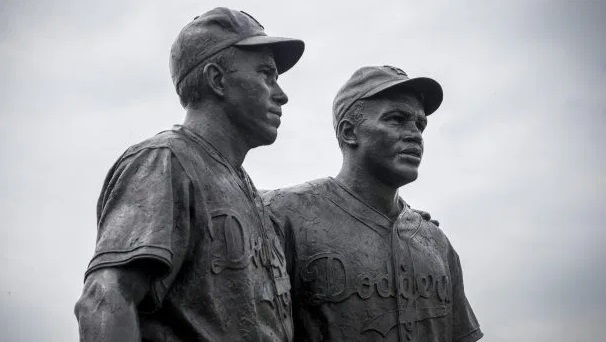
May 13, 1947: During the pregame infield practice, a barrage of racial slurs is directed at Jackie Robinson by the Cincinnati fans during the Dodgers’ first visit to Crosley Field this season. Brooklyn shortstop Pee Wee Reese, a Southerner from Kentucky with friends attending the game and captain of the team, engages the black infielder in conversation, and then put his arm around his teammate’s shoulder, a gesture that stuns and silences the crowd.

This  episode in the well-known saga of Jackie Robinson breaking the color line in baseball has taken on the status of legend. It is in the (excellent) biopic about Robinson, “42.” It was re-told in Ken Burns’ documentary “Baseball.” Most enduring of all, the moment is memorialized forever in the statue outside Dodger Stadium—well, forever until Robinson or Reese is cancelled because something unforgivable is unearthed in their past, whereupon UCLA students will pull the thing down as progressives cheer.

I’m preparing a program for the Smithsonian Associates on how baseball has influenced American values, culture, politics, language and society, so it is of special interest to me that there is considerable controversy over whether Reese’s mid-game gesture ever happened. Writes much-lauded baseball essayist Joe Posnanski,

“There is no mention at all of the embrace in the newspapers. Quite the opposite, in fact. The Cincinnati Enquirer wrote that very day that Robinson “was applauded every time he stepped to the plate.” Meanwhile, there is no mention of it in the black press either; Burns insists that the embrace had happened, the black papers “would have done 15 related articles.” There is no photo of it. Robinson’s 1948 book about his first season called “Jackie Robinson: My Own Story” does not mention any such incident….There isn’t a single contemporary account of the embrace in any of the newspapers or magazines.”

Theories abound. The episode happened on a different date. It happened, but not in view of the fans. It is a story that accurately describes what Reese’s support of Robinson—Reese was a white southerner and a team leader, and he and Robinson did become close friends—meant to the black rookie as he battled abuse and racism in that first season of 1947, but there was no literal arm around the shoulder.  Craig Calcaterra, recycling  the controversy yesterday on his NBC blog, theorized, Continue reading

Comment Of The Day: “Evening Ethics Update, 11/7/2019: Dr. King Is Un-honored…” (Item #4)

When I read the headline about the reversal of the name-change for the old boulevard in Kansas City, I was secretly hoping it would be because of recent credible revelations that Reverend Martin Luther King had facilitated a rape, and worse. In May, King biographer David Garrow unearthed previously classified FBI documents showing that King was a bad guy in private by any measure, even using a Donald Trump or a Bill Clinton standard. I had written at the time,

“I want to see the ignorant, doctrinaire college students, progressive history censors and pandering politicians face this crisis and either live up to their alleged virtues and censorious standards, or admit that they were dead wrong, as I and many others have been saying all along….

As a civilization, we must recognize and honor the many, many men and women of all races and origins who have made humanity better by their public deeds, intellectual advancements and accomplishments in civic life, war and peace. Few of them, if any, did not have serious flaws or engage during their lives in conduct that today, or even in their own times, would be considered reprehensible. Using these acts, and solely these acts, to assess which historical figures are worthy of being remembered by future generations leads to a societal suicide, embracing a culture without heroes or aspirations.”

I was thus hoping that the statue toppling side of the political spectrum was being forced to sample some of its’ own  medicine, and that King had lost an honor using the same, misguided principle that had the Democrats removing the names of their party’s founders, Jefferson and Jackson, from their annual dinners. Sauce for the goose, sauce for the gander, and perhaps when the gander realizes it’s bitter and stupid sauce, it will smarten up.

No such luck. It doesn’t seem as if King lost his street because he was a sexual predator, just because more Kansas City voters than not thought the old name shouldn’t have been changed in the first place

Steve-O-From NJ, however, does seem to be right about double standards where honors are concerned.

Here is his Comment of The Day on #4, the Kansas City Street Name Battle, in the post, “Evening Ethics Update, 11/7/2019: Dr. King Is Un-honored, Virginian Republicans Are Non-Functional, Fox News Is Pro-Darkness, And Joy Behar Is Still An Idiot”…

[Incidentally, has anyone read any hint of acknowledgment from the U.S. media, African-American groups or the NAACP that Garrow’s information raises a question about the propriety of honoring Dr. King? Neither have I….]

After two years of statue-toppling and other attempts to erase history, it should come as no surprise that eventually someone should suggest yanking something down dedicated to some darling of the left. The fact is that no city is REQUIRED to have a street named for King, nor is any citizen REQUIRED to honor him. In fact, as has been pointed out here, MLK was far from a saint in life, particularly with regard to his poor treatment of women. There is enough reason to criticize him to justify questioning why he should be honored at all, particularly in light of the current attacks on other (much more significant and influential) historical figures such as Columbus and Jefferson.

Of course the Left, and the black community in particular, doesn’t see it that way. If you’re lucky, they’ll just give you a non-answer, to the effect of the one is nothing like the other. If not, they’ll accuse you of being a racist, not because you said something affirmatively racist, but because you failed to give what they believe is proper deference to one of their icons. Continue reading

Morning Ethics Warm-Up, 5/31/19: Confirmation, Computers, Clinton, Cruz, And Comments

Good morning.

Trying to get used to my new computer, Microsoft 10, files I can’t find and many other things. Everything is going sloooooowly. Be merciful.

1. More on the Martin Luther King revelations. Yesterday I wrote about King biographer David Garrow’s article revealing the some disturbing and previously unrevealed results of the  FBI’s (illegal) surveillance of Martin Luther King. Predictably, Garrow is under fire for daring to sully an icon’s reputation, and because the source of the material is Hoover’s attempt to undermine King, that is the mode of attack. Garrow won a Pulitzer Prize for “Bearing the Cross,” his 1986 biography of King, and has said in the past  that FBI files should be treated with skepticism. However, he is obviously so disturbed at the new revelations that were inadvertently released that he is performing what he sees as his duty as a historian. He told the Washington Post that the summaries made by FBI agents who were spying on King are accurate, noting that different types of records warrant different levels of trust in their accuracy. The files claiming King was communist, he said,  “are coming literally third- or fourth-hand from a human informant,”so their accuracy is “highly dubious…But with the electronic surveillance records, those are very highly reliable, other than when the FBI can’t understand who’s talking.”

Confirmation bias is the key here. Garrow has none that I can see: his reputation is at risk if he is wrong, and he was an admirer of King, though not blind to his previously known flaws, like his epic infidelity. So far, the reflex deniers of Garrow’s conclusion all appear to be “keepers of the flame,” or at least invested in keeping King’s reputation intact.

It is encouraging to see the Post, which apparently refused to publish Garrow’s article,  covering the story. Most media sources are not, and that is signature significance. Many of the same sources have assumed that Donald Trump engaged in wilful sexual assault based solely on his recorded hyperbolic boasts to Billy Bush. The integrity of journalism in the U.S. could not be at lower tide.

In my case, I know enough about history and the important figures who stroll, dash and charge through it not to be surprised when any of them are revealed to have engaged in objectively horrible conduct at various points in their lives. Given King’s documented sexual appetites and epic infidelities, the likelihood that he was a sexual predator is strong. Again, my position is that King’s personal, even criminal conduct shouldn’t affect the assessment of or national gratitude for his public achievements at all. This isn’t the “personal conduct” dodge that Bill Clinton’s enablers used: his conduct with Lewinski and others was related to his job, his position, and in fact occurred in his office. That’s professional, workplace conduct, not personal.

I assume this will be another story inconvenient to the news media’s favorite causes,  that journalists and editors will attempt to bury, muddy, and minimize. Yes, and anyone who attempts to raise it, analyze it and verify it will be tarred as a racist. Perhaps I am naive and optimistic, but I don’t think that will work here. Just as eventually we had to face the truth about Thomas Jefferson and Bill Cosby, even those who want to deify King will have to deal with his private character, and decide whether they really want his statues and memorials, street signs and holiday, to come down.

Of course, there will be some good people on both sides of the argument. Continue reading

Martin Luther King Was A Depraved Sexual Predator. Now What, Statue-Topplers? [UPDATED]

I’m glad—thrilled may be a better word—that we now have strong evidence that Martin Luther King was not merely an unfaithful husband and compulsive dog (we already knew that, and so did J. Edgar Hoover), but that he was far, far worse. Of course, this doesn’t change in any way my assessment of King’s important contributions to civil rights, human rights, the culture and the nation. I just love to see people who have adopted an impossible and unethical standard for other important historical figures in order to preen, grandstand and mold history to their liking and purpose, to be hoisted—HARD–by their own petard.

King biographer David Garrow  unearthed previously classified FBI documents showing that King was a bad guy in private by any measure, even using a Donald Trump or a Bill Clinton standard.

For those whose view of candidate Trump was permanently lowered by his being caught on video crudely boosting about “grabbing women by the pussy,” William Sullivan, assistant director of the FBI, wrote in a 1964 memo among many recently released that King joked to his friends that “he had started the ‘International Association for the Advancement of Pussy-Eaters’.” There is  an incident recorded by FBI agents and held in a vault under court seal at the US National Archives showing that King  “looked on, laughed and offered advice” while a friend who was also a Baptist minister raped a woman described as one of his “parishioners”.

Believe it or not, that story gets worse. The FBI reported that King joined Logan Kearse, the pastor of Baltimore’s Cornerstone Baptist church, who had arrived in Washington with what the FBI summary describes as “several women ‘parishioners’ of his church” in an orgy in Kearse’s hotel room at the Willard Hotel. The FBI, having neen tipped off about the visit and that King would be involved, bugged the room.

The civil rights icon and his reverend friend  “discussed which women among the parishioners would be suitable for natural and unnatural sex acts.” One of the women protested, so Kearse  raped her as King watched. Continue reading

Comment Of The Day: “Morning Ethics Warm-Up, 4/15/2019: Patriots Day!…” [UPDATED]

P.M. Lawrence is a commenter from across the pond who revels in picking at various nits here, some of which are worth picking, some not so much. Always erudite and informative, his comments often open up some neglected ethics trap doors, and in this comment of the day in response to my post about Patriot’s Day, the regional holiday of my beloved Massachusetts that commemorated the Battles of Concord and Lexington. (The only “famous” incident that occurred that same day in 1775 in my home town Arlington, then Menotomy, Mass., was that Jason Russell and some fellow Minute Men were massacred by British soldiers as they retreated from Concord.)

P.M. took umbrage at my characterization of the day’s events as “the inspiring story of how ragtag groups of volunteers faced off against the trained soldiers of the most powerful country on Earth.” This is certainly how I was taught about the early days of the Revolution, and despite P.M’s objections, I’m not certain that it wasn’t accurate enough for regional history. The matter naturally raises the ethical conundrum at the end of “The Man Who Shot Liberty Valance”when the old newspaper editor says, “When the legend becomes fact, print the legend.”

I’m generally  in P.M.’s camp regarding fake history. As thrilling as it is to see Jim Bowie die fighting off multiple Mexican soldiers from his sickbed in the Alamo, it just plain didn’t happen, and his death shouldn’t be portrayed that way. I am not so certain that P.M. picked a valid historical nit to pick this time however, but he still earned a Comment of the Day (the last paragraph is from a follow-up comment) on the post, Morning Ethics Warm-Up, 4/15/2019: Patriots Day! Jackie Robinson Day!

I’ll be back at the end for a few comments.

“… the inspiring story of how ragtag groups of volunteers faced off against the trained soldiers of the most powerful country on Earth …”

Sigh. This fallacy keeps cropping up and should not be perpetuated. I will deal with it properly when I get the chance to write the fuller replies to some related matters, but for now I will point out the following more accurate material, leaving it up to readers to go into denial or go and check for themselves, as they prefer:-

They did no such thing, though what they did do was quite impressive enough as it was. They faced up against sizeable numbers of highly trained soldiers. There is absolutely no need or justification for mis-stating that those highly trained soldiers were from “the most powerful country on Earth”; they weren’t, they were British. The very real accomplishment would have been the same if they had faced as many Dutch or Danish regulars. Continue reading

You Know, Every Piece Of Sentimental Inspiration Doesn’t Have To Be Debunked: Of Dogs, Death, And “The Man Who Shot Liberty Valance”

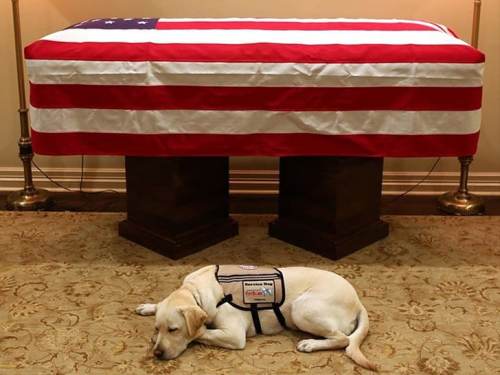
There was a nice, heartwarming photo yesterday of George H.W. Bush’s service dog lying by his casket.  This was accorded the usual sniffling interpretation, which is fine: the image is moving. Nonetheless, Slate felt it necessary to publish “Don’t Spend Your Emotional Energy on Sully H.W. Bush/He’s a service dog who had been with the president for six months, not his lifelong companion.”

“It’s wonderful for Bush that he had a trained service animal like Sully available to him [for 6] months. It’s a good thing that the dog is moving on to another gig where he can be helpful to other people (rather than becoming another Bush family pet). But it’s a bit demented to project soul-wrenching grief onto a dog’s decision to lie down in front of a casket. Is Sully “heroic” for learning to obey the human beings who taught him to perform certain tasks? Does the photo say anything special about this dog’s particular loyalty or judgment, or is he just … there? Also, if dogs are subject to praise for obeying their masters, what do we do about the pets who eat their owners’ dead (or even just passed-out) bodies?…”

Oh, thank you, thank you SO much for that lovely image.

Of course the dog doesn’t understand that Bush is dead, or that he’s in the casket, or anything. So what? Anyone who knows anything about dogs can figure that out. Why was this snark necessary? Continue reading