Observations On The Obscene Trump Audio Scandal

4217128-caveman

A leaked audio  obtained and released by the Washington Post has Donald Trump commenting to media personality Billy Bush about his attempts to bed a married woman, a few months months after he married Melania Trump, his third wife. When he sees a beautiful woman, the GOP standard-bearer said, he  kisses her without consent.  “When you’re a star, they let you do it. You can do anything,” he explains. He describes a married woman who wouldn’t sleep with him by making fun of her as having“phony tits.” Then he advises Bush, “Grab them by the pussy.”

Nice.

But not surprising. Not even a little bit.

Observations:

1. CNN’s senior White House correspondent Jim Acosta believes this may finish Trump’s presidential campaign. Utter incompetence and confirmation bias: why does anyone listen to “experts” this dense? Acosta, and I’m sure he has lots of company, apparently has learned nothing over the past year. What kind of person who currently supports Trump despite his constant vulgarity, misogyny, meanness, dishonesty, irresponsible statements and foolishness would regard this unremarkable male jerkishness as a last straw? Of course he talks like that. I never had any doubt that he talked like that, just as I never doubted that Hillary Clinton regarded Bernie’s supporters as gullible children, as a recent leak of her candid comments revealed. Did you think Trump talked about women differently than this when he was with other guys? Continue reading

Comment of the Day: “A Daughter Sues Her Parents For Being Assholes. Good.”

growth-sequence

Having just returned from an eight-day (and partially laptop-less) speaking tour  that has me about ten posts behind, it was nice to have Steve-O-in-NJ deliver a textbook Comment of the Day, expanding on the original post with relevant and useful observations about photography -obsessed parents and photography ethics.

I do object from an ethical standpoint to his tit-for-tat endorsing last line.

Here is his good and thoughtful work in response to the post, “A Daughter Sues Her Parents For Being Assholes. Good.”

What are the ethics of taking 500 pictures of your child? I wish that I could say that the ethics of taking large numbers of pictures are always the same but they are not. I am in the middle of a two-week vacation and I have been taking a large number of pictures. I see absolutely nothing wrong with shooting a large number of pictures during an air show, particularly where the opportunity to get a particular shot is very limited. I see absolutely nothing wrong with taking a large number of pictures at a place like Colonial Williamsburg, where the actors are deliberately dressed up in costumes designed to attract attention. The same ethics generally applies to any event where there are costumed individuals who are seeking attention. The same ethics probably apply to sporting events. Of course the shooting of inanimate objects like in a museum is perfectly all right, subject to whatever policies the institution puts in place and makes known. Continue reading

A Daughter Sues Her Parents For Being Assholes. Good.

photo

An 18-year-old Austrian woman is suing her parents for continually posting embarrassing childhood photos of her on Facebook without her consent. Since 2009, she alleges, they have willfully humiliated her by constantly posting intimate images from her childhood—about 500 to date. Among them are potty training photos and pictures of her having her diapers changed.

The abused daughter told reporters, “They knew no shame and no limit – and didn’t care whether it was a picture of me sitting on the toilet or lying naked in my cot – every stage was photographed and then made public.” Her parents have  700 Facebook friends.

The technical term for them is “cruel and merciless assholes.”

They have refused to delete the photos, with her father arguing that since he took the photos he has the right to publish them to the world.

Oh, what does the law have to do with this? If the parents had any decency, and sense of fairness, respect and caring, the law wouldn’t have to be involved in any way.  Their daughter feels humiliated, as most of us would be, by having such photos published. There is no ethical principle under which publishing photographs (or videos) of anyone that were taken without consent when the subject objects or one knows or should know that he or should would object can be justified. This controversy, if ethical parents were involved, would be settled with a simple exchange:

Her: “Please don’t put anymore of those photos on Facebook, and take down the ones that are up now. They are embarrassing.”

Them: “OK!”

How hard is that? I know it’s hard for parents to resist posting photos of their adorable infants and toddlers while they are too young to protest, but the protest should be presumed. The Golden Rule rules, and I go further: this is an absolute. Children should not have their lifetime privacy scarred by parents selfishly indulging themselves by treating their children like pets. Children should be able to trust their parents to respect their sensibilities and vulnerabilities, and not to sacrifice them for cheap Facebook “likes.”  Obviously, many of them can’t.

Continue reading

Ethics Alarms Presents A New Category: “Trump Of The Month” And Congratulates The First Recipient, Kelly Osbourne

From this day on, “Trump of the Month” will recognize those individuals who are accorded the benefits of celebrity, public attention, trust and credibility despite  demonstrating beyond any shadow of a doubt their lack of  the character, judgment or acumen to justify such status.

With that important announcement, Ethics Alarms now designates its first Trump of the Month, the daughter of elderly British rock star Ozzie Osbourne, Kelly Osbourne. She is described these days as a “television personality,” the rocking-chair career also occupied, at a slightly higher level, by Osbourne’s opinionated wife, Sharon. Both Osbournes owe their millions in dollars and fans to the fact that they are related to Ozzie, and nothing else—and Ozzie was a drug-addled, half-forgotten has-been when some bright TV executive, inspired by his name and the idea of doing a reality show parody of “The Adventures of Ozzie and Harriet,” the sine qua non of unfunny whitebread Fifties family sitcoms, gave him a second bite at fame.

Kelly’s got nothing, and I am being generous. She is not especially attractive, has no talent, has never uttered a perceptive comment in her life, and should fall down on her knees and thank providence that she is not living in a two room apartment in Gary trying to make ends meet as a temp. Because, however, she acquired that most important of all assets, at least to star-struck Americans, fame, by appearing weekly in a long-past reality show about the dysfunctional family of a mumbling boob with a lot of money (that would be Ozzie), she has been tapped to deliver verdicts on everything from fashion (Kelly herself likes to dye her hair lavender) to the administration of Barack Obama. Why are so many citizens ill-informed and eagerly embracing the dubious leadership abilities of Trump, Clinton or Sanders? Paying attention to “authorities” like Kelly are part of the reason. Compared to Kelly Osbourne, the Kardashians look like the Algonquin Roundtable.

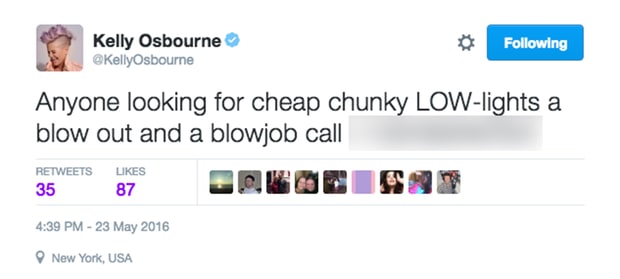
Kelly Osbourne earned the initial Trump of the Month by engaging in the kind of slimy conduct that in a sane culture would ensure permanent obscurity and antipathy. Her parents recently announced that they were getting a divorce because Sharon found incriminating e-mails that proved Ozzie had been fooling around with  Sharon’s hairdresser. In response, pundit Kelly tweeted this classy tweet to her FOUR MILLION followers on Twitter:

kelly-osbourne-tweet-

Continue reading

Celebrity vs Fan: The Amy Schumer Affair

Schumer Fan

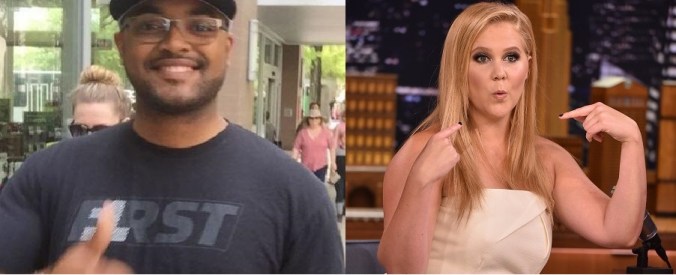
Trendy comedienne Amy Schumer posted this tale of a recent encounter with a selfie-seeking fan on Instagram:

“This guy in front of his family just ran up next to me scared the shit out of me. Put a camera in my face. I asked him to stop and he said ” no it’s America and we paid for you” this was in front of his daughter. I was saying stop and no. Great message to your kid. Yes legally you are allowed to take a picture of me. But I was asking you to stop and saying no. I will not take picture with people anymore and it’s because of this dude in Greenville.”

She included the resulting photo of him above, which

a.) Made him an instant celebrity

b.) Made him an instant target,or

c.) Both.

Later, she “walked the statement back,” as they say in politics, and tweeted,

“I’ll still take pictures with nice people when I choose if it’s a good time for that. But I don’t owe you anything. So don’t take if I say no.”

The smiling young man with the blurry thumb  is named Leslie Brewer. This weekend, he contacted the Fox affiliate in Greenville–apparently everything will be happening in North Carolina from now on—to defend himself, and since conservatives hate Amy Schumer, Fox was eager to give him a forum.  The resulting story, in part: Continue reading

Apology Ethics 2: Is This A Legitimate Excuse? Does It Matter?

Skydiving

Tom Angel was chief of staff for the Los Angeles County sheriff until emails he had sent to friends four years ago, prior to becoming the sheriff’s top aide, denigrating several different groups of minorities including Muslims, Catholics and Latinos surfaced in the media. Now Angel  has resigned.

His boss, Sheriff Jim McDonnell,  announced the departure  in a statement posted to Facebook that called the messages “inappropriate and unprofessional.”  That was fair.

Originally, the department defended Angel, saying in part,

“Although his judgment in this situation is of concern to members of the Sheriff’s Department, no one is more distressed about it than Chief Angel himself.  His apologies for this uncharacteristic act have been profuse and sincere. Chief Angel’s decision-making and actions in his long prior career with the Sheriff’s Department and since his return in 2015 reveal more about his actual character and typical good judgment than the instances from four years prior currently reported in the media.”

It didn’t work, especially after Angel’s apology, quoted in the LA Times, was this:

“Anybody in the workplace unfortunately forwards emails from time to time that they probably shouldn’t have forwarded. I apologize if I offended anybody, but the intent was not for the public to have seen these jokes.”

Should that have been sufficient? Continue reading

The Case Of The Involuntary Naked Teacher

This isn't a picture of Leigh Anne Arthur; this is 2014 Naked Teacher Principle victim Kaitlin Pearson. But even if this had been the picture on Arthur's cell phone, she wouldn't have deserve to be fired...

This isn’t a picture of Leigh Anne Arthur; this is 2014 Naked Teacher Principle victim Kaitlin Pearson. But even if this had been the picture on Arthur’s cell phone, she wouldn’t have deserved to be fired…

The Ethics Alarms Naked Teacher Principle (NTP) states:

A secondary school teacher or administrator (or other role model for children) who allows pictures of himself or herself to be widely publicized, as on the web, showing the teacher naked or engaging in sexually provocative poses, cannot complain when he or she is dismissed by the school as a result. The first formulation of the NTP can be found here.

I suppose I need to circulate this more widely, because some schools apparently are confused, such as Union County High School in South Carolina. In a completely warped and unfair application of the NTP, school district officials in Union County demanded and received the resignation of engineering teacher Leigh Anne Arthur after a student stole her phone, examined its contents and found a semi-nude selfie (intended for her husband’s enjoyment only), which he shared with his classmates.

 The district’s David Eubanks said that the district’s position was that the 13-year teaching veteran was at fault for leaving her phone unlocked on her desk when she went out of the room, and that she had, in effect made the pictures available to her students. He also said that the engineering teacher’s actions may have contributed to the delinquency of a minor.

The technical terms for Eubanks are unethical, unjust and illogical. The kid stole the phone before he knew what was on it. He would have stolen it even if it had been locked. Arthur didn’t make him a delinquent; he was already a delinquent. How far would the school board take their absurd logic? If the kid stole her purse, found a key in an envelope with a bank account number on it, and the student took it to a bank and got into her locked storage box, and in there was the combination to a warehouse storage locker that contained a nude oil painting of her that was painted when she was an artist’s model, and he stole the painting and held an exhibit of it in his garage, charging admission, would the school system fire the teacher, or expel the student for an outrageous invasion of privacy, as well as theft? Continue reading

More Photography Ethics: A Federal Court Rules That There Is No Right To Photograph Police

photographing_police

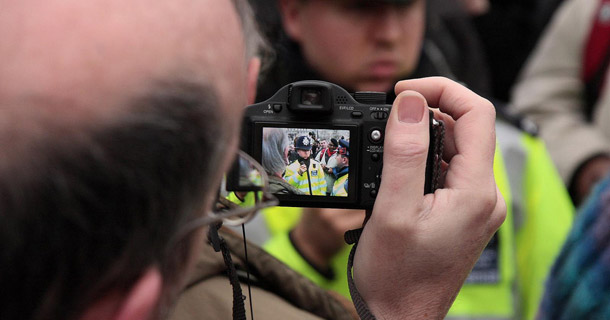
U.S. District Judge Mark Kearney has ruled that citizens don’t have a First Amendment right to take cellphone videos and photos of police unless they are challenging or criticizing the police conduct.

This opinion makes no sense, and is dead wrong.

Richard Fields, a Temple University student, took a cellphone photo of about 20 police officers standing outside a house party because, he testified, he thought it would be an interesting picture. Amanda Geraci, who says she is “a trained legal observer,” whatever that is, tried to video an arrest during a an anti-fracking  protest.

Fields had his cellphone seized and was cuffed, as an officer searched his cellphone before returning it and cited him for obstructing the highway and public passages while taking the photo.  Geraci said an officer physically restrained her to prevent her from recording the arrest. The two both sued for alleged First and Fourth Amendment violations, and their cases were consolidated before the court, as the same Constitutional issues were involved.

Judge Kearney argued that Fields and Geraci would have to show their behavior was “expressive conduct” to support a First Amendment claim. Neither plaintiff met that burden, because neither told the police why they wanted to capture the images, Kearney wrote. “The conduct must be direct and expressive; we cannot be left guessing as to the ‘expression’ intended by the conduct.”

“Applying this standard, we conclude Fields and Geraci cannot meet the burden of demonstrating their taking, or attempting to take, pictures with no further comments or conduct is ‘sufficiently imbued with elements of communication’ to be deemed expressive conduct. Neither Fields nor Geraci direct us to facts showing at the time they took or wanted to take pictures, they asserted anything to anyone. There is also no evidence any of the officers understood them as communicating any idea or message.”

What astounding nonsense! Would Kearney argue that an oil painting was similarly ambiguous as “expressive” without the painter saying, “I am painting the picture so that I have a painting that I can show others”? Continue reading

I Found It! Presenting The Lost Rationalization, #57: The Golden Rule Mutation, or “I’m all right with it!”

sleeping woman

Every time I come across a rationalization for the Ethics Alarms list, I metaphorically, and sometimes literally, slap myself on the forehead. How could I have missed it? Thus I have been long convinced that there was a huge, obvious, missing rationalization that somehow got lost in the search for others. Jimmy Durante did a piano routine called “I’m the Guy Who Found the Lost Chord!” (“The Lost Chord” is a previously famous composition by Sir Arthur Sullivan) in which he celebrated finding the chord, then lost it again mid-song. (Jimmy later found it again when he sat on the keyboard in disgust, and the magic chord issued forth. “Strange” he said, “I usually play by ear!”) This is how frustrated I was until today, when  veteran commenter Tim LeVier led me to the Lost Rationalization, #57, “The Golden Rule Mutation,” or “I’m all right with it!” It’s a major one:

57. The Golden Rule Mutation, or “I’m all right with it!” Continue reading

Celebrity Ethics: Sir Paul And Bill

Pual rejcected

Two recent ethics stories involving the famous, accomplished and popular:

1. Bill Murray The aging bad boy of SNL and “Groundhog Day,” found himself in some trouble recently when he was trying to chill at the Vesuvio rooftop lounge in Carmel, California, convenient to the annual Pebble Beach Pro-Am golf tourney in which Bill was playing. A few patrons started flashing cameras at him from close range—without asking, of course–and true to his on-screen character (and off-screen, where he is known as an impulsive jerk), Murray got up and chucked their phones off the 2nd story rooftop. Obviously, whatever the provocation, you can’t do that.

Bill paid for the phones, and the owners didn’t press charges. The problem for me were the typical reactions of commenters on the story, proving once again that the average, even above average member of the public can’t solve a simple ethics problem. Continue reading