From the Res Ipsa Loquitur Files: A Democratic House Member Says White Children Should Be Taught To Feel Guilty About Their Skin Color

What this says about her party and its ideological moorings is obvious. So is what it tells us about anyone who would vote for someone like this to have any power or influence over our society. We have had the “gotcha!” privilege debate here extensively in the 20-teens, and it was insufficiently slapped down to prevent the DEI and “presumed racism” pathogens.

The ethics mystery is why anyone white swallows this crap? I can see the advantages to minorities, since they can, by accepting it, absolve themselves of all failures, misdeeds and shortcomings. However, whites (and men) who fall for this argument are agreeing to be metaphorically hobbled, like Kunta Kinte in “Roots.” Worse, they are endorsing the hobbling of their children too.

I get why extreme, ruthless, unethical progressives push such garbage: it’s a means to an end, and the end is power. I do not understand why anyone privileged with a functioning brain and critical thinking skills tolerates officials like Stalker, never mind actually voting for her.

No, Dr. Gelman, Just Because You Think Your Toaster Is A Lawyer Doesn’t Mean What You Say To It Is Privileged

Its continues to amaze me whom the New York Times will give a platform to. Take Dr. Nils Gilman (please!), a historian who “works at the intersection of technology and public policy,” whatever that means.

He has written a supposedly learned column for the Times [gift link] claiming that human beings should have something akin to attorney-client privilege when they shoot off their mouths to their chatbots. His cautionary tale:

On New Year’s Day, Jonathan Rinderknecht purportedly asked ChatGPT: “Are you at fault if a fire is [lit]because of your cigarettes?”… “Yes,” ChatGPT replied…. Rinderknecht…had previously told the chatbot how “amazing” it had felt to burn a Bible months prior….and had also asked it to create a “dystopian” painting of a crowd of poor people fleeing a forest fire while a crowd of rich people mocked them behind a gate.

Somehow the bot squealed to federal authorities. Those conversations were considered sufficient evidence of Rinderknecht’s mind, motives and intent to start a fire that, along with GPS data that put him at the scene of the initial blaze, the feds arrested and chargeed him with several criminal counts, including destruction of property by means of fire, alleging that he was responsible for a small blaze that reignited a week later to start the horrific Palisades fire.

To the author, “this disturbing development is a warning for our legal system.” You see, lonely, stupid people are using A.I. chatbots as confidants, therapists and advisers now, and the damn things cannot be trusted. “We urgently need a new form of legal protection that would safeguard most private communications between people and A.I. chatbots. I call it A.I. interaction privilege,” he pleads.

Continue reading

Today’s Spectacular Ethics Attraction: SEE “The Ethicist” Whirl Like a Dervish To Rationalize Racial Discrimination!!!

Like the freaks at an old time carnival and the live eel-eating geek, this is a pretty disgusting display. The manager of an intern program for a “major global institution” asks permission from the New York Times Magazine’s advice columnist “The Ethicist” to offer full time positions based on race rather than performance. Of course, the manager never says “race,” what he says is that although the “more privileged” interns “appear to be” performing at a higher level than those “who come from less privileged backgrounds,” he wants ethical leave to make the final hiring decisions by “taking personal life circumstances” into consideration. In other words, he wants to discriminate against the white interns.

The euphemisms are so thick you best use a trowel to read the query, but NYU ethics professor Kwame Anthony Appiah not only follows his lead but also (predictably) goes to great lengths to rationalize what is an obvious appeal to DEI ideology. Permit me to dissect The Ethicist’s intellectual dishonest double-talk; this time I’ll have The Ethicist’s words in italics and mine in regular text:

We live in a class society.

Objection! “Class society” suggests that this is a formal, enforced system like India or Great Britain. The only classless societies, theoretically, are ideally-functioning communist societies, which don’t exist. The Ethicist exposes his bias immediately.

People who are rich in financial terms tend to be rich in cultural and social capital too: They have social assets, resources and connections. All these forms of advantage can contribute to an employee’s actual performance.

Appiah is assuming cause and effect when the distinction is unknowable. Families that make an effort to create social assets, cultural awareness and beneficial connections for their children tend to raise more successful children. Rich people don’t all become rich because riches have been providentially bestowed on them, but this is how The Ethicist frames the issue. After all, Karl Marx says it is so.

But they can also contribute to the employee’s perceived performance. People often make judgments about the intelligence of speakers on the basis of their accents, for example, and one form of cultural capital is having the accent of the white, educated, Northern-coastal, middle classes. So you can ask yourself whether your judgment about which of these interns is doing best has been shaped by features that don’t reflect the contribution they’re likely to make. You’re obviously alert to this possibility, because you write that the more privileged interns “appear” to be performing better; it’s worth thinking about whether you can identify evaluative measures that are less subject to this kind of bias.

Nice try. Because the inquirer used the equivocal “appear,” The Ethicist leaps to the conclusion that the real meaning was “the whte interns may not be as good as their performance indicates.” His bias is palpable. In jobs requiring communication, for example, clear and understandable speech is a significant asset, and legitimately so. Anyone seeking to rise in business who hasn’t dealt with the problem of an accent handicap has demonstrated a significant lack of industry and responsibility. Appiah just brushes away the importance of being able to be understood as a mirage. Baloney! Learn to speak clearly and well. If speaking clearly and well means learning to sound like a white, educated, Northern-coastal, middle classes individual, then do it. If you want to keep sounding like Snoop Dogg on principle, swell, but don’t come around whining about prejudice when you can’t get the jobs you want.

Continue reading

Comment of the Day: “Oops! A Chief Diversity Officer Reveals The Real Biases Corrupting Her Field”

It is going to be interesting to see if the currently metastasizing DEI mania eventually collapses as its illiberal and destructive features become impossible to excuse or ignore. I assume it will eventually end up in history’s junk yard, and the sooner the better, but equally bad ideas have survived to cause decades of societal chaos.

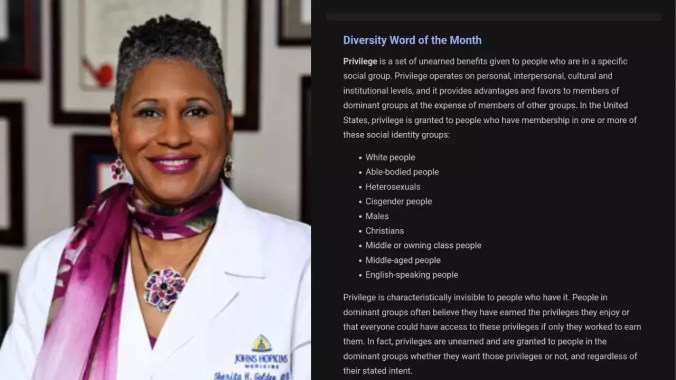
The post about the diversity officer declaring “White people,” “Able-bodied people,” “Heterosexuals,” “Cisgender people,” “Males,” “Christians,” “Middle or owning class people,” “Middle-aged people,” and “English-speaking people” to be blights on efforts to build a just society (and then quickly disavowing her language as soon as she was called on it) provoked—is still provoking–many excellent comments, including the Comment of the Day by Extradimensional Cephalopod below. He (It? I don’t know EC’s preferred pronouns) shamed me by pointing out that the woke concept of “privilege” is a manifestation of the fundamental attribution error, which I haven’t discussed here for a long time. His Comment of the Day also provoked the Comment of the Day on a Comment Destined to Become a Comment of the Day by JutGory, who wrote,

Extradimensional Cephalopod: “(I keep unsuccessfully searching for a quote I remember where someone describes their “privilege” as a right that they want everyone to have, e.g. the right to have no reason to fear the police.)Attribute it to me if you like; that is one of my critiques of the notion of privilege. In some instances, privilege is not part of an unearned advantage; it is part of an unwarranted disadvantage. I am not privileged by being treated the way everyone should be treated; someone else is “under-privileged” by not being treated the way one should be.

“Under-privileged”?

“Unprivileged”?

“Demoted”?

“Debased”?

We don’t really have a commensurate term to describe that.So, people use privilege to describe any advantage that one person may have over another. Actually, common with leftists, we talk about groups, not individuals, and then ascribe a quality of the group to the individual. This is kind of an example of the logical fallacy of division. But, the problem is that individuals have, as comments above have noted, many qualities, some of which are more advantageous or disadvantageous than others (almost as if individuals are somehow unique). It is because of this that they had to come up with notions of “intersectionality” because it turns out that “privilege” is a concept that is inadequate when it comes to describing the world. (But, hey, Ptolemy needed epicycles and the equant to make sense of the universe.)

“Privilege” does not exist. “Privilege” is an attempt to describe phenomena and create a generalization about it.

Here is EC’s Comment of the Day on the post, “Comment of the Day: “Oops! A Chief Diversity Officer Reveals The Real Biases Corrupting Her Field”:

Continue reading

Oops! A Chief Diversity Officer Reveals The Real Biases Corrupting Her Field

Attention should be paid.

In the latest issue of the “Monthly Diversity Digest,”  Dr. Sherita Hill Golden defined as her “Diversity Word of the Month” privilege as “a set of unearned benefits given to people who are in a specific social group.” “Given”? She went on to write that

“Privilege is characteristically invisible to people who have it. People in dominant groups often believe they have earned the privileges they enjoy or that everyone could have access to these privileges if only they worked to earn them. In fact, privileges are unearned and are granted to people in the dominant groups whether they want those privileges or not, and regardless of their stated intent.”

Golden then named these unfairly and unethically favored groups: “White people,” “Able-bodied people,” “Heterosexuals,” “Cisgender people,” “Males,” “Christians,” “Middle or owning class people,” “Middle-aged people,” and “English-speaking people.”

Continue reading

SCOTUS Punts An Important Legal Ethics Controversy

In the Supreme Court case In Re Grand Jury, the government had been trying to obtain  documents from an unnamed law firm specializing in international tax law. The documents were needed to investigate the law firm’s client. A judge held the law firm in contempt for failing to turn over disputed documents, and the 9th U.S. Circuit Court of Appeals at San Francisco affirmed in 2021. The issue was what test courts should apply when considering whether to protect “dual-purpose” documents that contain both legal and nonlegal advice.  The 9th Circuit ruled that courts should look to the “primary purpose” of a communication when it involves both legal and nonlegal analysis. Documents may be privileged when the primary purpose is to provide a client with legal advice. The firm argued that the entire document, along with any non-legal advice and material in it, should be considered privileged if legal advice was one of the “significant purposes” of the communication.

The legal ethics traditions argue for the more expansive standard. ABA Model Rule of Professional Conduct 2.1, “Advisor,states in part,

“In rendering advice, a lawyer may refer not only to law but to other considerations such as moral, economic, social and political factors, that may be relevant to the client’s situation….Advice couched in narrow legal terms may be of little value to a client, especially where practical considerations, such as cost or effects on other people, are predominant. Purely technical legal advice, therefore, can sometimes be inadequate. It is proper for a lawyer to refer to relevant moral and ethical considerations in giving advice. Although a lawyer is not a moral advisor as such, moral and ethical considerations impinge upon most legal questions and may decisively influence how the law will be applied.”

I agree with this approach. Requiring a client or an attorney to parse a letter or oral discussion to separate the legal, privileged content from the rest would chill effective lawyer client communication. Continue reading

Not Everyone Can Use Obnoxious Rationalization 11B, “The Royal Rationalization”

Eric 14 of Sweden

[Reminder to Humble Talent, whose useful addition to the Rationalization List was recently explained here. I still need your choice of a name before I can add it!]

You find new rationalizations—well, ones you hadn’t thought of before— in the strangest places.

This one is hardly new: it hails from the 16th century at least. It ambushed me on a 2018 Smithsonian special about the discovery of the “Mars,” a sunken Swedish warship that was built between 1563 and 1564. It was the pride and joy of Sweden’s King Eric XIV’s fleet, and one of the largest warships of the time. “Even larger than the famous Swedish ship Vasa,” Wikipedia tells us. I’ll take ‘Famous Swedish Warships’ for $100, Alex!”  

The discovery was announced in August, 2011, and in November it was announced that the shipwreck’s identity had been confirmed by its unique cannons along with “other findings.”  The Smithsonian channel’s 2018 production describing further investigations added that the “Mars” identity was confirmed by the discovery of silver coins minted by Eric XIV the year before the battle that sunk her in 1563.

The coins bore what historians say was Eric’s official motto: “God Gives to Whoever He Chooses.”

Continue reading

KABOOM! (This Is What President Trump Will be Running Against, Make No Mistake…)

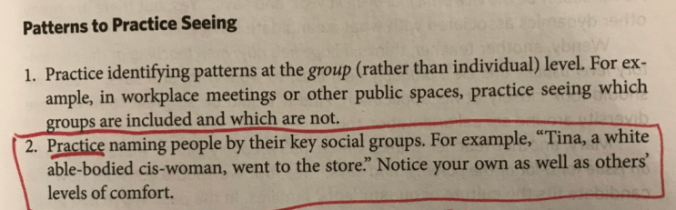
The above excerpt  is from “Is Everyone Really Equal? An Introduction to Key Concepts in Social Justice Education” by Özlem Sensoy and Robin DiAngelo. Apparently it has won awards, though I suspect not for what I would give it an award for. Here’s the description:

This is the new edition of the award-winning guide to social justice education. Based on the authors’ extensive experience in a range of settings in the United States and Canada, the book addresses the most common stumbling blocks to understanding social justice. This comprehensive resource includes new features such as a chapter on intersectionality and classism; discussion of contemporary activism (Black Lives Matter, Occupy, and Idle No More); material on White Settler societies and colonialism; pedagogical supports related to “common social patterns” and “vocabulary to practice using”; and extensive updates throughout. Accessible to students from high school through graduate school, Is Everyone Really Equal? is a detailed and engaging textbook and professional development resource presenting the key concepts in social justice education. The text includes many user-friendly features, examples, and vignettes to not just define but illustrate the concepts. Book Features: Definition Boxes that define key terms. Stop Boxes to remind readers of previously explained ideas. Perspective Check Boxes to draw attention to alternative standpoints. Discussion Questions and Extension Activities for using the book in a class, workshop, or study group. A Glossary of terms and guide to language use.

Continue reading

Regarding Felicity Huffman’s Slap-On-The-Wrist

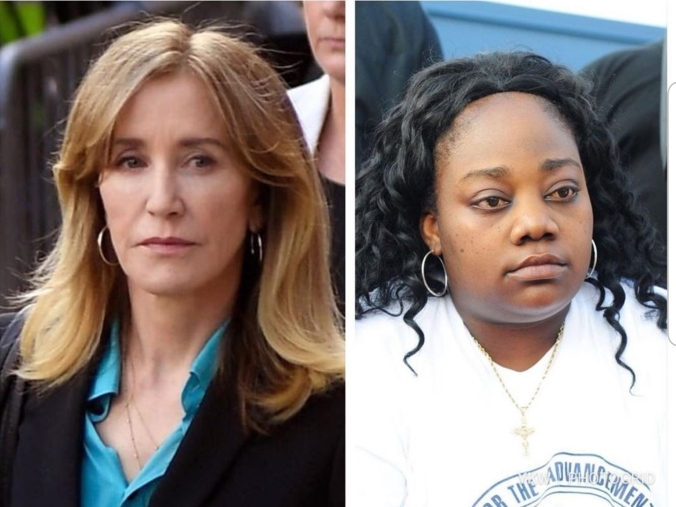
Before actress Felicity Huffman was sentenced for her participation in the rigged college admissions scandal, also known as “Varsity Blues”, the leftist website Salon had already pronounced her treatment by the justice system as racist. It said in part,

Back in 2011 Tanya McDowell was homeless and living in her van. She wanted her five-year-old son to receive a quality education, so she enrolled him in Brookside Elementary of the Norwalk School District. He was later kicked out due to a residency issue, so he transferred to Bridgeport schools.

Police investigated McDowell and charged her with fraud. A year later she pleaded guilty to first-degree larceny and conspiracy to commit first-degree larceny; for these offenses, she received a five-year sentence. Before McDowell started serving it out, she was charged with selling narcotics to an undercover police officer, an offense that killed her community support. McDowell was ultimately given 12 years, to be suspended after she served five, and followed by five years of probation; the narcotic sentence to run concurrently with a five-year sentence she had already received in the Norwalk school case. All of this story, from the over-policing of this mother to the severity of her sentence, along with everything she did, was obviously driven by poverty, which remains synonymous with “guilty” in our lopsided system of so-called justice.

On the other hand, you have a person like Felicity Huffman, who enjoys the many privileges that come with being a rich “Desperate Housewives” star…and having the resources to expose her daughter to educational advantages that McDowell may not have even been able to dream of: tutoring, unlimited books, technology, a safe learning environment, and even an SAT specialist who helps struggling kids obtain high scores. …[T]he actress was arrested in March on mail fraud and conspiracy charges as an outcome of the FBI’s Operation Varsity Blues investigation, and pleaded guilty to mail fraud, after paying $15,000 to allegedly rig her daughter’s SAT scores. Huffman is scheduled to be sentenced in Boston on Friday — for one month in prison, if the federal prosecutors’ recommendation is followed. Huffman’s attorneys have instead asked for a year’s probation, plus community service and a $20,000 fine.

Let’s begin with the fact that this is unethical and dishonest advocacy. Searching for an admittedly terrible prosecution from eight years ago  to contrast with Huffman’s case is contrived racism. The fact that the mother was later legitimately charged with selling narcotics renders the comparison a stretch at best.  In the absence of sufficient numbers of cases across the country to make a valid generalization, Salon’s assumptions are just cheap muckraking.

Stipulated: charging McDowell with larceny for trying to sneak her child into a better school district was a cruel and unethical prosecution; charging her with fraud and seeking a significant punishment was not. The idea was to discourage similar deceptions, no matter how well-intentioned they were.  That is a valid law enforcement objective, and an important one.

What Huffman’s attorneys proposed as appropriate punishment was irrelevant to Salon’s thesis. Their job is to get the actress as light a sentence as possible, and if possible, no sentence at all. We are not told what McDowell’s attorney’s argued on her behalf, because it is also irrelevant, but, I suspect, it was omitted because their recommendations were not that different from those of Huffman’s case. Continue reading

Let’s Play “Desperate, Gallant, Or Offensive!” Today’s Contestant: Actor William H. Macy

Welcome, Ethics Alarms readers! It’s time for that exciting game show, “Desperate, Gallant, Or Offensive!,” where the audience judges whether its celebrity contestants have stayed within ethical boundaries!

Today’s contestant is celebrated actor William H. Macy, not to be confused with Bill Macy, who played Bea Arthur’s long-suffering husband on “Maude.” William H is one of the most honored and respected, not to mention versatile American actors. He has won two Emmy Awards, four Screen Actors Guild Awards, and an Academy Award nomination for Best Supporting Actor for his memorable performance in Fargo.” Since 2011, he has played Frank Gallagher, the main character in the Showtime adaptation of the British television series “Shameless.”  Most relevant now, however, is his 22 year marriage to actress Felicity Huffman, who is about to be sentenced for her participation in the so-called “Varsity Blues” college admission scandal.

Ready to play? All right! Here is what loving husband William wrote to the judge preparing to sentence Huffman: Continue reading