Ethics Quiz: Pronouns Again

The New York Times says that reporters who contact Trump Administration officials to request statements or quotes on significant events or policies do not get a response to their emails if their signature includes their “preferred pronouns.” This has not been officially confirmed as administration policy, but Trump press spokesperson Karoline Leavitt told the paper that policy it is, saying, “As a matter of policy, we do not respond to reporters with pronouns in their bios. Any reporter who chooses to put their preferred pronouns in their bio clearly does not care about biological reality or truth and therefore cannot be trusted to write an honest story.” Katie Miller, wife of White House deputy chief of staff Stephen Miller and spokeswoman for the Department of Government Efficiency, answered an inquiry on the topic, “As a matter of policy, I don’t respond to people who use pronouns in their signatures as it shows they ignore scientific realities and therefore ignore facts.” Trump’s presidential campaign account on X also claimed, “It is official White House policy to IGNORE reporters’ emails with pronouns in the signature.”

Your Ethics Alarms Ethics Quiz of the Day is…

Is that policy, if that is the policy, fair and ethical?

Continue reading

Unsolicited Virtue Signaling and Grandstanding Like This Should Be Slapped Down, and Hard

Anderson Cooper, as we all know, is a weenie, and he proved it in this exchange.

Ms. Thomas may be an activist, but she’s also an asshole. Cooper should have said, “Excuse me, but did you inform me of your favored pronouns? Did I ask what they were? Do they have any relevance to the matter we are discussing? Since the answer to those questions are all “no,” your making a point to correct me on live TV is rude, obnoxious, and uncalled for. Sit down, please.

Next questioner!

Wait, This Was A Gang Rape? [Expanded]

From “The Ethicist” column: A perfect example of why capitulating to preferred-pronoun bullying is madness, sending human communication back to grunts and squeaks. Here’s the inquirer’s story:

I went on a date with someone, and we went back to their apartment. In the middle of sex, I caught this person, who uses they/them pronouns, recording me on their phone. For my safety, I chose to pretend I did not notice, as I did not want to be stranded in the middle of the night. In the morning, I confronted them, and they apologized and deleted the video. They said that was their first time recording someone during sex and a spur-of-the-moment decision, albeit a bad one.

When I arrived home I felt more dehumanized than angry, as if I were a sex toy. I told my friends what happened, and they were very upset, and urged me to file a police report. I dismissed this at first, but I looked online and found that capturing imagery of a person’s private parts without their consent, when there is a reasonable expectation of privacy, is a violation of state and federal laws.

I decided to contact my date and inform them of the gravity of their actions and told them never to do it again. I also decided that I didn’t want to press charges. I do not want to subject myself to a lengthy legal process, repeating and reliving this story over and over, as well as having to tell my family or put my life on hold. My friends are concerned that I don’t feel upset enough, and they assume that this was not my date’s first time recording someone, and will not be the last. They think I should file a police report to prevent my date from recording others in the future. I chose to assume that my date is a normal human being who made a stupid decision and does not necessarily deserve a criminal record because of it. By informing my date of the severity of their actions, they now know to never make that mistake again.

My friends don’t agree with my decision, despite understanding why I would not want to press charges. We all agree that it should not be my responsibility to prevent my date from committing future crimes, but they think I should do it anyway because it’s the right thing to do. I fear that they think less of me now because I am ‘‘protecting’’ my date by giving them the benefit of the doubt, and that I’m being selfish because I do not want to sacrifice myself to the legal system on the chance that my date is a morally reprehensible person who will continue to record people without their consent. — Name Withheld, San Diego

Continue reading

Ethics Hero: Non-Weenie Chard Scharf

Pronouns again.

A reader flagged this story and it almost got lost in the swirl of ethics chaos this month, so I want to get it up quickly today. Chad Scharf was the vice president of software engineering at the Jacksonville, Florida, location of Bitwarden, which is a cybersecurity firm based in California. I suspect that headquarters locale is at fault for the fact that Bitwarden decided that all employees should include “their “preferred pronouns” in their personal profiles on Slack, an online messaging platform. This was, of course, part of its diversity/equity/inclusion embrace.

DEI is a cover for government, corporate and other sinister educational efforts to engage in discrimination, progressive virtue signalling and indoctrination, and the only way to slow it down until the courts step in is to show some backbone and say, “No.” That’s what Scharf did. He declined to list any preferred pronouns, and that should have been the end of the issue. There is a clear and reasonable presumption that an employee with a male name who doesn’t specify pronouns is content with being identified by male pronouns.

Continue reading

Ethics Alarms Archives Encore: “If ‘A Boy Named Sue’ Had Problems, What’s Chance Does An ‘It’ Named Searyl Have?”

Introduction (March 31, 2023)

When I was preparing for yesterday’s final post about the French family fighting to overcome France’s paternalistic government bureaucrats from inflicting the name “Hades” on their infant son, I considered introducing the tale with Johnny Cash’s famous rendition of Shel Silverstein’s “A Boy Named Sue.” But I suspected that I had used the song before, and sure enough I had, in the post that follows, from six years ago.

The main thrust of the essay is the ethical issue touched on in the Hades story as well as others here through the years: the unethical act of giving children weird names. I was surprised, however, to see the post’s prescient and remarkably currently relevant commentary about the transgender insanity that was then no more than a twinkle in the Woke-Deranged mob’s metaphorical eye.

Wow, I nailed it. (Hence my doppleganger Fredo’s appearance in the clip from the Ethics Alarms clip collection.)Too bad only a small cadre of the ethically enlightened and intellectually curious read this blog: forewarned, maybe the current madness that has teachers encouraging fifth grade girls to cut off their breasts and large swathes of society urging momentarily confused boys to call themselves by plural pronouns and “identify” as “non-binary” could have been avoided, or at least minimized. This is my fault, of course; I’m the one who hasn’t figured out how to be an “influencer,” while 21-year-old Kardashians can. I get my self blackballed by NPR by daring to defend Donald Trump on a flaming progressive’s show.

Fredo.

But I digress—sorry. The quote below that struck me was this one:

This is what happens when you let the nose of a flatulent and rude camel into your tent. Those with gender issues should not be abused, beaten, or discriminated against. Agreed. They should have access to medical treatment connected to their condition. Absolutely. They should be able to openly declare their status without fear of reprisals, and people with compassion, manners and ethics shouldn’t teat them like freaks. Got it.

But they do not have leave to re-make the world in their image, and cry foul if the majority draws reasonable lines and says: No. Behave.

Here is the post, from July 10, 2017:

Continue reading

Exhibit A On Why “They/Them” Preferred Pronouns Must Be Mocked And Rejected Rather Than Respected

Here is a really weird question posed to “The Ethicist,” offered not for the issue raised (which is not exactly a tough one) but for the manner in which it is presented. The bolding is mine:

When my father died, my family took photos of his body before he was cremated. The photos were of him at home, peaceful in bed; my mother wanted to tenderly remember him both in life and in his death. My partner at the time uploaded these photos to their computer, storing these and other images in their cloud server as we archived memories from the trip home to say goodbye to my father.

One evening later that year, my then-partner pulled up the photos and did a slide show of our trip for their family. When my partner got to the images of my father’s dead body, they went through every image instead of skipping over them. It was immensely painful, compounded by the fact that my father is a Black man and these images were being shown to an affluent white family. The race and class dynamics here were staggering — it felt as if this white family was viewing these images as entertainment. This was among the incidents that triggered my ending the relationship; my ex didn’t quite understand why this was inappropriate or painful.

As we were breaking up, I asked that they erase the images from their drive. Since that time, they’ve made a million excuses as to why they can’t erase the images — the drive is in storage, they’ve moved, etc. It’s now been nearly six years. Still, I am deeply disturbed by the lack of control I have over these images. Currently my ex lives in the U.K., and I live in the U.S. What is the correct course of action here? Do I let it go? Seek legal action? My great fear is that these images will circulate into the future without my or my family’s consent. — Name Withheld

Language is supposed to communicate, not be distorted to satisfy narcissistic eccentricities and grandstanding. Who or what “moved,” the ex-, her family, or the photos? The account is absurdly ambiguous, although if you pause long enough along the way and think hard, you probably can figure it out—except that human communication is not supposed to be like Rubik’s Cube.

Continue reading

The Revealing Resume

Business.com performed an experiment by sending two identical fake resumes to “180 unique job postings that were explicitly open to entry-level candidates.” Both featured a gender-ambiguous name, “Taylor Williams.” The only difference between two resumes was the presence of preferred gender pronouns on the test version. The test resume included “they/them” pronouns under the name in the header.

The fake resume including preferred pronouns received 8% less interest than the one without them, and fewer interview and phone screening invitations.

The researchers found this “worrisome.”Ryan McGonagill, director of industry research at Business.com, told NBC,

The law makes it clear that you cannot base any employment decision (hiring, terminating, or otherwise) based on their gender identity. It’s incredibly disappointing and unethical that many of the hiring managers in our study would disqualify a candidate for being authentic.”

Continue reading

Pre-Independence Day Ethics Warm-Up, July 3, 2022: What Might Have Been [Broken Link Fixed]

Typically, Ethics Alarms has highlighted July 3 with reflections on the Battle of Gettysburg in 1863, for which the 3rd was the dramatic last and decisive day. I know it must be hard to believe, but I do get tired of writing the same things over and over again, an occupational hazard of being an ethicist during a mass ethics breakdown in our democracy and among the increasingly corrupt people we have put in power to protect it. I still can’t ignore Pickett’s futile charge and Custer’s charge as well, so I direct you to last year’s post on both events and their ethics implications.

However, this year I am introducing the July 3 warm-up with another crucial anniversary, one that may have had even more impact on the history of the United States, its prospects and its values than Gettysburg. July 2, 1776 is when the Continental Congress finally agreed to take the leap and forge a new nation (John Adams thought the 2nd would be the day we celebrated) and July 4, 1776 was the date the document was signed. But in-between those more noted dates the Continental Congress began debating and editing Jefferson’s draft Declaration, eventually making 86 edits that cut the length by about a fourth. 

Because the Declaration of Independence is the mission statement of America, framing and sometimes compelling what followed, especially the Constitution, the editing decisions of July 3, 1776 affected our laws and culture in many ways that are unimaginable after more than 200 years. You can read the original here. It is this deleted paragraph, however, that most inspires reflections on what might have been (and what might not):

“He has waged cruel war against human nature itself, violating its most sacred rights of life and liberty in the persons of a distant people who never offended him, captivating & carrying them into slavery in another hemisphere or to incur miserable death in their transportation thither. This piratical warfare, the opprobrium of infidel powers, is the warfare of the Christian King of Great Britain. Determined to keep open a market where Men should be bought & sold, he has prostituted his negative for suppressing every legislative attempt to prohibit or restrain this execrable commerce. And that this assemblage of horrors might want no fact of distinguished die, he is now exciting those very people to rise in arms among us, and to purchase that liberty of which he has deprived them, by murdering the people on whom he has obtruded them: thus paying off former crimes committed again the Liberties of one people, with crimes which he urges them to commit against the lives of another.”

Now on to the present day’s ethics concerns...

Continue reading

On “Correct Pronouns,” Part 2

I began this inquiry two days ago, intending to complete it forthwith, but then a sick, broken, psychopathic teen in Texas murdered his grandmother, children and teachers with an AR-15 with the predictable Ethics Train Wreck gathering steam once again. Let’s finish up before something else goes wrong.

Ann Althouse is at fault: she flagged Roxane Gay’s New York Times advice column “Work Friend,” focusing on this question from the ubiquitous “Anonymous”:

In the past six months, my organization approved the optional inclusion of pronouns in email signatures. I learned that one of my team members uses nonbinary pronouns. In my written communication and conversation about that team member, I now use those pronouns, but I notice that no one else has made the adjustment. As the supervisor of this team, how can I fix this situation?I feel like the longer I wait to address it, the more disrespectful and complicit I’m being. I can’t police people’s language, but I would call someone out for other kinds of behavior I interpreted as disrespectful. (For what it’s worth, I don’t suspect anyone of being intentionally disrespectful by not using their colleague’s preferred pronouns.) The nonbinary colleague has not said anything to me about this being a problem, but I have to assume it feels dismissive. I feel I owe them an apology, but what I really owe them is better leadership. What would you do?

The advice columnist whose record of often obnoxious woke certitude ended up eating the issue sufficiently to require two parts to the intended post, responded,

“Thank you for asking this question. Everyone deserves to be treated with respect and part of that is using people’s correct pronouns.”

“Correct pronouns?” Doesn’t correct mean “factual and true”? The requirement that individuals and groups get to demand and enforce what is correct is, I think, one more manifestation of the Left’s slide into a totalitarian mindset, and the tendency of the easily subjugated, weenies and the “oh. well, if they care so much, why fight it?” crowd to let societal freedom die a death of a thousand cuts. Ann quoted one of Gay’s commenters, who wrote,

I am really curious about this pronoun business in business communication. Who decided that the new law of the land is that everybody gets to pick their pronouns however misaligned they may be to their publicly visibly persona, and everybody else needs to learn this and memorize? Who has time for this?

Of course, it is not a matter of time, but a matter of ethics. It is an ethics conflict, in fact, one that involves a clash of manners, consideration, principles, respect, fairness, responsibility, and the abuse of power. It is ethical—fair, respectful, caring—to agree to call a friend, colleague or acquaintance by whatever name they wish to be called, within reason. Not all names are appropriate in all settings, however: a boss that asked to be called “Love Bug” or “Sex Machine” in the workplace is engaging in sexual harassment. Unethical. Would one have to call someone by her “correct” name if she insisted on the title, “Your Majesty”? That’s getting closer to the issue here. Such demands (a request is a demand if one will encounter negative consequences for rejecting it) are a power play; one relevant ethics question is whether the conduct is justifiable. I object to jumping through hoops on command: Ethics Alarms will capitalize the “b” in Black when the stars turn cold, just as I rejected the abomination “of color” the first time it raised its colorful head.

Writing about the pronouns issue a year ago, Althouse, who has raised the question a lot, ended one post, “Personally, I feel that anyone who feels the need to announce their pronouns is childish and rude, and I treat them as such.” That discussion covered whether requiring/demanding/requesting that someone adopt one’s counter-factual, eccentric or debatable choice of pronouns is forcing others to adopt an ideology they do not share.

Of course it is. That’s the whole point. Continue reading

Ethics Signs And Portents, 5/10/2022: Langella’s Lament, Kellogg’s Indoctrination, Lightfoot’s Incitement, And Yellen’s idiocy.

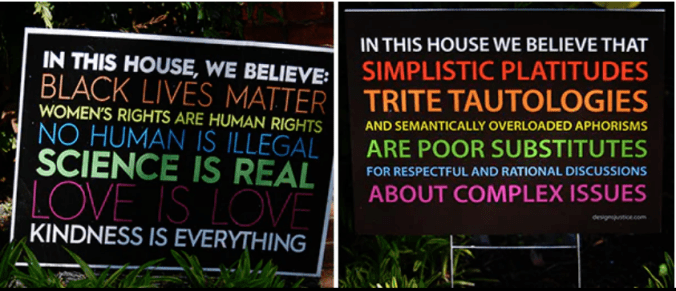
That photo of the dueling signs in my neighborhood (Alexandria, VA) is from the Washington Post last week. Ethics Alarms first noted this obnoxious phenomenon here in 2016, with several updates since.

That’s some scoop there, Lois Lane!

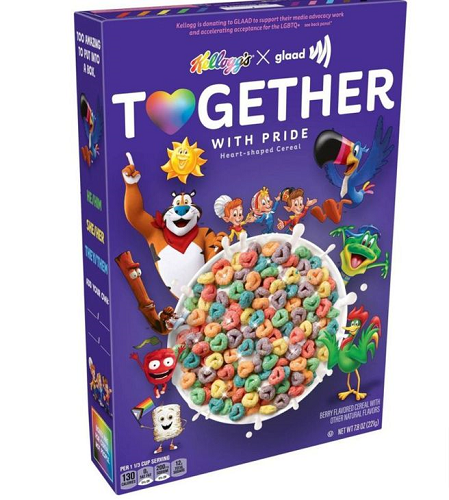
1. Now here’s an even more obnoxious sign of the times: cereal boxes presuming to indoctrinate kids. What possible excuse is there for this, on the side of this Kellogg’s box:

I don’t care about the box design or the cereal: it’s a product, and if a parent wants to buy it, swell. It’s a marketing gimmick. Yuck, but so what? However, this, on the side panel, steps over the line into the culture wars and indoctrination. Not on my breakfast table…

2. Oh, fine: the Treasury Secretary is an idiot as well as an Ethics Dunce. Janet Yellen is now on record as endorsing one of the more offensive and cretinous arguments in favor of Roe v. Wade: snuffing out more children in the womb is good for the economy! “I believe that eliminating the right of women to make decisions about when and whether to have children would have very damaging effects on the economy and would set women back decades,” she said in response to a question at a Senate Banking Committee hearing. Continue reading