Ten Inconvenient Truths Of The George Floyd Ethics Train Wreck

1. George Floyd was not an admirable man. That shouldn’t and doesn’t matter, of course. What happened to him at the hands of four police officers shouldn’t happen to a dog. However, cognitive dissonance makes it difficult for emotion and anger-soaked people to accept that their martyrs are imperfect, so we are always forced to endure this process. In fact, the argument against police brutality would be cleaer and more persuasive if it were based on the fact that even the worst criminals should never be abused. Instead, the message conveyed is that what happened to Floyd is especially wrong because he was the salt of the earth. It wasn’t, and he wasn’t.

2. The officer was not trying to kill Floyd. He knew he was being recorded; he had to know that if Floyd died, he would be in terrible trouble.

3. Minnesota has already botched the prosecution. The first inept act was the governor and others widely publicizing the claim that Chauvin “murdered” Floyd. This will make a fair trial difficult, and if he is convicted, will automatically support an appeal. Then the radical, race-obsessed Attorney General, Keith Ellison, made it easier for Chauvin’s defense lawyers by over-charging, and worse, set out a precedent that may make policing impossible.  Former prosecutor Andrew McCarthy explains:

The second-degree murder charge is now the main charge against all four officers. Essentially, the theory is that they committed a felony assault when they subdued a suspect who was resisting arrest. During the course of carrying out that “crime,” prosecutors allege, Floyd’s death resulted. 

While the point may be subtle, this is saliently different from the theory of third-degree murder — i.e., depraved-indifference murder. In the latter, prosecutors would concede that it was lawful in principle for the police to subdue Floyd, but argue (correctly) that their manner of doing so was recklessly indifferent to human life, causing his death. By contrast, the new “felony murder” count, spearheaded by Keith Ellison, the radical leftist state attorney general, puts police on notice that they can be charged with a crime — felony assault — for doing their job, which routinely involves physically restraining suspects who resist lawful commands.

Any experienced law-enforcement officer will tell you that it is common for suspects to resist arrest by lying on the ground, claiming to be ill, waving arms to avoid being cuffed, and refusing to be placed in a squad car. Cops, of course, may not use excessive force when that happens. They must, however, be permitted to use sufficiently superior force to detain and transport uncooperative arrestees. In Minnesota, thanks to its election of the new breed of progressive prosecutor who rails against the justice system’s purported institutional racism, police officers who use force in arresting dangerous criminals now run the risk that they will be the ones who face criminal charges.

4. If, due to Ellison’s unethical zeal, the officers are acquitted, there will be more riots, because the vast majority of the public doesn’t understand the justice system, and the vast majority of the protesters don’t care about due process and the presumption of innocence.

5.  The attacks by the Left on police could (and should) lead to the elimination of police unions, which, in turn, could and should lead to the abolishment of public employee unions generally. That’s a conservative agenda item, because public unions have been a mainstay of big city Democratic support. Continue reading
Ethics Quote Of The Week: Michael Kinsley

“As the news media struggles to expose government secrets and the government struggles to keep them secret, there is no invisible hand to assure that the right balance is struck. So what do we do about leaks of government information? Lock up the perpetrators or give them the Pulitzer Prize? (The Pulitzer people chose the second option.) This is not a straightforward or easy question. But I can’t see how we can have a policy that authorizes newspapers and reporters to chase down and publish any national security leaks they can find. This isn’t Easter and these are not eggs.”

—-Pundit and former editor of Slate Michael Kinsley, reviewing the book by Edward Snowden co-conspirator Glenn Greenwald’s book, “No Place to Hide.”

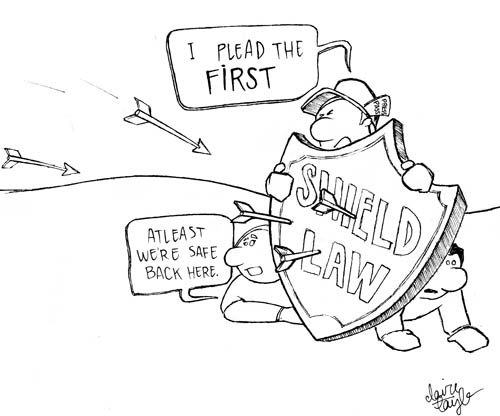
This is the heroic image the press has of itself, as it protects useful criminals and traitors. Unfortunately, it's a self-serving fantasy.

This is the heroic image the press has of itself, as it protects useful criminals and traitors. Unfortunately, it’s a self-serving fantasy.

I lost much of my respect for Kinsley (full disclosure: we’re college classmates; he’s a celebrity journalist, I’m not) when he was shouting liberal talking points at Robert Novak every week on “Crossfire.” I knew Mike was more nuanced than that, and later he admitted as much in various essays: it was all for show. He later admitted that he sometimes endorsed books without reading them completely, and began writing these odd op-eds that appeared to mock the very position he seemed to be taking. Kinsley is suffering from Parkinson’s Disease*, and perhaps that’s a factor in his self-conscious sense of remove from his own writings, but the impression he has given for decades now is of a detached intellectual who looks down his nose at the very profession that feeds him, and who finds it amusing that the rubes still hang on his words, when he doesn’t give them much thought himself.

This quote from his review of Greenwald’s book (hmmm…did Kinsley actually read this one?) fits the bill. It is sloppy, but sufficiently specific to be unethical. He is essentially suggesting censorship of the press, which is an irresponsible position. The publishing of leaks should not be infringed. Chasing them down, however, is another matter. Current laws, if Democrats would leave them alone, are currently sufficient to discourage criminal acquisition of national security documents: just throw journalists who won’t reveal their criminal—that’s what they are you know, like Snowden—sources in jail until they crack, rot, or both, for obstructing justice When journalists actively aid and abet the theft of documents and data, like Greenwald did, before they are acquired and published, prosecute them too, along with their souces. Publishing such documents or using them for investigations are legitimate and First Amendment-protected activities, but nothing in the Constitution protects the leakers, traitors and thieves, or journalists who conspire to help them break the law—which is the stealing, not the publishing.

I have called what the press does with stolen material “information laundering.” That function, unfortunately, is too important to the role of the press in our democracy to regulate or constrain it, no matter how often it is abused. Still,  this should not make those who aren’t journalists immune from prosecution, or journalists who cross the line that divides reporting the news from making it.

* This is a correction; the original post said MS. I apologize for the error; I shouldn’t have relied on memory.

__________________________

Sources: New York Times

Cartoon: Doyle, Baylor

The Ethics of “No-Body” Murder Prosecutions.

Oh! THERE's the body!!!

Texas lawyer Robert Guest has opined that a Texas jury would have convicted Casey Anthony in a heartbeat, and cites as proof the February conviction of Charles Stobaugh in Denton County. He was accused of killing his  estranged wife, though no body has ever been found at all.

Maybe.  There are a lot of differences in the circumstances of the two cases, not the least is that finding a badly decomposed body with a piece of electrical tape across her mouth has a big advantage over never finding any body at all: at least you are certain that the victim is dead.  Stobuagh, like Anthony, engaged in a pattern of lies and strange statements; for example, he suggested that his wife, who suddenly vanished and stopped using her bank account, credit cards and cell phone, was “playing a prank.”  He also began seeing a new girl friend more or less the moment his wife vanished. I’d say the biggest difference is the presumption of a motive: husbands killing their wives, especially their estranged wives, is a common and well-recognized form of homicide, with a motive that any married person immediately understands. A mother killing her young child, in contrast, is very unusual, and the presumption is that no mother would do it. The Anthony prosecution was more difficult than the prosecution of Stobuagh, even with Caylee’s body. Continue reading

Outrageous Prosecution: The Eric Rinehart Story

Asst. U.S. Attorney DeBrotas predecessors

Eric Rinehart, a 34-year-old police officer in  Middletown, Indiana, began consensual sexual relationships with two young women, ages 16 and 17. Rinehart was going through a divorce at the time, and in Indiana, he was doing nothing illegal, for 16 is the age of consent in the Hoosier state? Unethical? I tend to think so, but that isn’t part of the story.

One of the girls told Rinehart that she had posed for erotic photos for an earlier, presumably younger boyfriend, and suggested that she do the same for him. So Rinehart gave her his camera, with which she took the lascivious photos. This inspired Rinehart to take some more sexy photos and at least one video of both girls, which he downloaded to his computer.

For this, Rinehart was convicted on two federal charges of producing child pornography. Continue reading