Comment of the Day: Prosecutor Ethics, “What The Hell Were You Thinking?” Dept: Dog-Whistling “Dixie” To The Jury

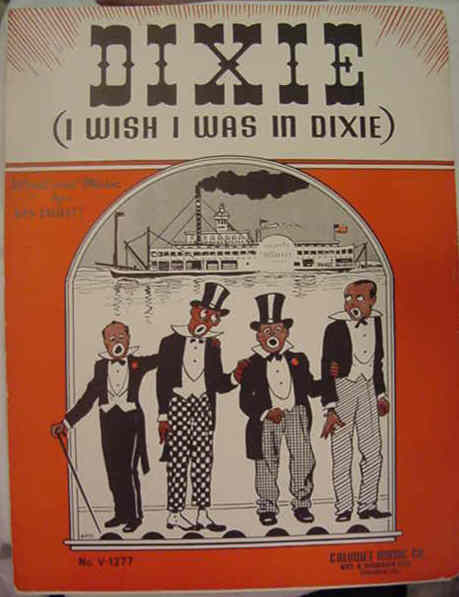
Dixie

I will introduce this fascinating Comment of the Day by one of the blog’s masters of the long form comment, Chris Marschner,  by saying that I think it is only tangentially related to the post, though he would disagree. Chris is writing about the history of “Dixie” and why it should not be associated with racism. Whether I agree with that analysis or not, the fact is that the public does overwhelmingly associate the song with a longing for the simplicities of the Old South, when the darkies were singing in the cotton fields and those Northern folks weren’t sticking in their noses where they don’t belong. This is the basis of an Idaho court’s decision to overturn the conviction of a black defendant after the prosecutor gratuitously and needlessly quoted the lyrics of the song in her closing argument.  That decision was correct, because the issue is whether the comment could reasonably have been an appeal, or seemed like an appeal, or have had the effect of an appeal, to racial bias. I don’t think that conclusion is arguable.

Here is Chris’s Comment of the Day on the post, Prosecutor Ethics, “What The Hell Were You Thinking?” Dept: Dog-Whistling “Dixie” To The Jury:

The prosecutor failed her client – the people- not because she used the words of an 19th century song but because she failed to come to understand that history and culture of the US has been so bastardized that even an appellate court has no understanding and context of the origins of the song and the history and culture of the south. And, because of its misunderstanding believes the lyrics to be racially prejudicial.

“Maybe Erica is so young, color blind and historically ignorant that she had no idea that “Dixie” has been played at Klan rallies and used as the campaign theme for states rights, segregationist, white supremacy candidates since the Civil War. Maybe she didn’t recognize the cotton reference as racial.”

This song was written by a northerner named Daniel Decatur Emmett and performed in New York in an 1859 minstrel show by Emmitt in blackface. The reference to cotton is geographic in nature because cotton represented the primary agricultural commodity and wealth creator of the southern states – nothing more unless one is predisposed to finding anything related to the antebellum south as racist

Many songs have been coopted by various groups but to suggest that lyrics of Dixie are inherently racial because they are used by White supremacists is faulty logic. If a white supremacist adopted the image of Leonardo D’Vinci’s David or Venus d’ Milo or other classical work of art on their flag that would not mean that any such depiction suggests racial superiority. Continue reading


Prosecutor Ethics, “What The Hell Were You Thinking?” Dept: Dog-Whistling “Dixie” To The Jury

"Wait...WHAT did you just say??"

“Wait…WHAT did you just say??”

Canyon County Deputy Prosecutor Erica Kallin wanted to make the point that the defense attorney for the African American defendant, James D. Kirk, was trying to lead the jury to ignore the evidence that pointed to his guilt in his trial for lewd conduct with a 17-year-old girl and sexual battery of a 13-year-old girl—making them, in effect,”look away” from the truth. How could she make that argument in a vivid way? Clarence Darrow used to use poems in his famous closing arguments; was there a memorable poem that used the phrase, “look away”?

“Eureka!” Erica thought. She found it! So she said to jury deliberating on the case:

“‘Oh I wish I was in the land of cotton. Good times not forgotten. Look away. Look away. Look away,’ And isn’t that really what you’ve kind of been asked to do? Look away from the two eyewitnesses. Look away from the two victims. Look away from the nurse and her medical opinion. Look away. Look away.”

The jury convicted Kirk, on both counts; the evidence against him was indeed strong. He was sentenced to 20 years in prison. Continue reading

A British KABOOM! The Man In The Tiger Suit

Tony, Tony, Tony. We're so disapointed.

Tony, Tony, Tony. We’re so disappointed.

Pieces of my head are on the ceiling, thanks to the violent cranial explosion caused by this story, a KABOOM! from across the pond. Usually my head isn’t so sensitive to non-American unethical conduct, but this, as you shall soon see, is special.

Andrew Holland, 51, a Welsh bus driver, was accused of owning an extreme porn video featuring a woman having sex with a tiger. He had been arrested and charged over the video, which he claimed friends gave him as a joke. Holland lost his job, was targeted with hate mail from vigilantes, and he suffered a heart attack that he says was caused by the stress of the case.

Then, after inflicting all of this on Holland,  prosecutors  looked at the video closely, and, for the first time, with the sound turned on. Oops. That was no tiger—that was a man in a tiger suit. The big clue was when they they heard the randy tiger,  in the throes of sexual ecstasy, growl out,

“That’s grrrrrrrrrreat!

Yes, just like Tony the Tiger, the Frosted Flakes icon, except that in Great Britain they are called “Frosties.” Continue reading

No “Stand Your Ground” For Domestic Abuse Victims? Law vs. Ethics Strikes Again!

Domestic violenceA hoary statutory destruction debate that hails from the Fifties centered on the simple prohibition, “No Vehicles in the Park.” The question is whether the reasonable and proper interpretation of such a prohibition should rest on the clear meaning of the words alone, or whether the underlying purpose and reasoning behind the rule or law must be taken into account. A tank is a vehicle: does the rule mean that a WW I tank can’t be placed in the park as a memorial? Is a baby stroller a vehicle (the dictionary says yes)? If we accept the literal approach—the school of jurisprudence championed by scholar L.A. Hart that is called legal positivism—we take legal interpretation out the realm of ethics and morality, and give judges only the power to apply laws as written, results be damned. The other approach, more popular with non-lawyers and many judges but not necessarily correct, is identified with Hart’s contemporary Lon Fuller, and called the natural law approach.

This conflict has arisen in intriguing fashion in a South Carolina dispute over the application of that state’s Stand Your Ground law in domestic abuse cases. In 2012, an abusive boyfriend, Eric Lee, dragged Whitlee Jones down a street by her hair. She got away, and Lee returned to the apartment they shared. A 911 call prompted by the hair-dragging spectacle brought a policeman to visit, and Lee put him at ease, saying that all was well.

It wasn’t. Jones, having retrieved her hair weave that didn’t survive the drag through downtown Charleston, returned to the apartment to pack her belongings and move out. As Jones began to leave the apartment, Lee blocked her way, and according to Jones, began to shake her. She pulled out a knife and stabbed him once, and once was enough. Lee died. Jones was arrested for murder. Continue reading

Curse You, Steven Bochco!

Uh-uh-uh! Love and forensics don't mix!

Uh-uh-uh! Love and forensics don’t mix!

TV writer and producer Steven Bochco, in “Hill Street Blues” and subsequent creations, liked to show the justice system flourishing despite every segment of it having romances and sex with every other segment: judges sleeping with lawyers, associates sleeping with partners, police officers having sex with defense attorneys, paralegals boinking supervising attorneys…oh, the combinations were endless. David Kelley, he of “The Practice,” “Boston Legal” and “Ally McBeal,” took the theme to new heights and depths, and “The Good Wife” has ploughed some new ground—sex with investigators!—too.

It doesn’t work, you know. None of it. These all create conflicts of interest, and are either ethical breaches or the doorway to them. Mustn’t have sex where you have a duty to seek justice rather than nookie.

Now from California comes news of another unfortunate coupling. The Santa Clara County District Attorney’s Office has moved to dismiss a 1989 cold case homicide of Cathy Zimmer, filed earlier this year against her husband and his brother. It seems that the prosecutor originally assigned to the case had “an undisclosed and improper relationship” with the case’s forensic lab technician. This is the kind of thing you would see if Steven Bochco wrote “CSI.”

District Attorney Jeff Rosen explained: “We have an absolute and ethical duty to enforce the laws in a just and objective manner and without regard to sympathy, bias or prejudice for or against any particular party. We offer our deepest apologies to the family of the victim, but based on the totality of the circumstances, we simply cannot proceed without taking the time to reexamine and reevaluate the case in order to ensure we have not violated the rights of the accused, nor compromised the integrity of the criminal justice system.”

I assume—I hope—that there isn’t as much cross-pollinating in the labs, law firms, courtrooms and police precincts as Hollywood seems to think.

__________________________

Pointer and Source: ABA Journal

In Massachusetts, The Unethical Kind Of Prosecutorial Discretion

The DA explains why he's glad the law was broken. Wait...WHAT?

The DA explains why he’s glad the law was broken. Wait…WHAT?

Prosecutorial discretion is a critical aspect of the prosecutorial function. There are many good reasons for a prosecutor  to charge an individual with a crime in a particular case, and among the factors a prosecutor may legitimately consider in making this decision are, according to the American Bar Association’s ethical guidelines:

  • whether there is evidence of the existence of criminal conduct;
  • the nature and seriousness of the problem or alleged offense, including the risk or degree of harm from ongoing criminal conduct;
  • a history of prior violations of the same or similar laws and whether those violations have previously been addressed through law enforcement or other means;
  • the motive, interest, bias or other improper factors that may influence those seeking to initiate or cause the initiation of a criminal investigation;
  • the need for, and expected impact of, criminal enforcement to punish blameworthy behavior; provide specific and/or general deterrence;
  • provide protection to the community; reinforce norms embodied in the criminal law; prevent unauthorized private action to enforce the law;
  • preserve the credibility of the criminal justice system; and other legitimate public interests.
  • whether the costs and benefits of the investigation and of particular investigative tools and techniques are justified in consideration of, among other things, the nature of the criminal activity as well as the impact of conducting the investigation on other enforcement priorities and resources
  • the collateral effects of the investigation on witnesses, subjects, targets and non-culpable third parties, including financial damage and harm to reputation
  • the probability of obtaining sufficient evidence for a successful prosecution of the matter in question, including, if there is a trial, the probability of obtaining a conviction and having the conviction upheld upon appellate review; and
  • whether society’s interest in the matter might be better or equally vindicated by available civil, regulatory, administrative, or private remedies.

None of these suggest that the prosecutor’s personal sympathy with the motives of the lawbreaker is a sufficient or ethical reason not to charge when a serious crime has been committed. That, however, appears to be how Bristol County (Massachusetts) District Attorney Sam Sutter sees his role: arbiter and enabler of righteous criminal activity. Continue reading

When Does A Prosecutor’s Personal Life Become Relevant To Professional Performance? I Believe This Would Be An Example…

Love is blind.

Love is blind.

In Washington State, a Spokane County deputy prosecutor named Marriya Wright has resigned her position following the discovery of a photograph of her in a bikini (posing in a bodybuilding competition) in the possession of  Matthew Baumrucker, an inmate in the Spokane County Jail notable for having the word “criminal” tattooed on his forehead.

Police have determined that Baumrucker and Wright corresponded via text or phone calls 1,280 times between February 6 and March 5, during the time that the inmate was being investigated for his alleged role in an assault. On March 3, police were trying to find Baumrucker in connection with the assault charge, and found him in an apartment with a woman who later told police that Baumrucker had received legal advice from a woman he called  “Marriya.” Baumrucker told the woman that “Marriya told him she didn’t have to let the police in to search if they did not have a search warrant.” Another witness told police that they saw Baumrucker meet Wright in a car at a nearby gas station, and “overheard Marriya telling Baumrucker he needed to get his warrants taken care of.”   Surveillance video obtained by police confirms Baumrucker got into Wright’s vehicle at that gas station. Continue reading

Monday Morning Lessons in News Media Bias, Incompetence, and Manipulation of Public Opinion

Side profile of a journalist typing on a typewriter

It took all of 15 minutes this morning to see the incompetence and bias of the new media in action regarding two politically charged events currently unfolding:

1. The Washington Post: The Rick Perry Indictment

On page A3 of the Washington Post front section, this report by Post reporter Sean Sullivan was sub-headlined like this:

Texas governor denies any impropriety in feud with district attorney

Continue reading

More On The Perry Indictment: The Mark Of Hack Partisan Journalism

H

The unethical indictment of Republican Texas Governor Rick Perry in Travis County (Austin) for the “crime” of trying to force a drunk, power abusing, ethically corrupt district attorney from continuing to head the Public Integrity Unit—quick, now, Democrats…why is this a bad thing?—is a rare opportunity for otherwise incorrigibly biased journalists to show some token integrity and fairness. What is forfeited, after all, by admitting the obvious, that Perry is being railroaded by an abuse of prosecutorial power to derail him politically? Perry is no real threat to win the Presidency, no matter how high his stock is now. We all saw why in 2012.

So the liberal media has no need to play gotcha, and could, for a change, actually do its job: show the public why the indictment is nothing but a political hit job; why it’s a breach of legal ethics, how disgracefully Travis County DA Rosemary Lehmberg has conducted herself; why she is obligated to resign after breaking the law, trying to use her position to intimidate police officers on video, having her law license suspended, and apparently doing nothing about the fact that she is a raging drunk; why having such an individual heading up the agency responsible for public integrity is a threat to the public well-being and the public trust; and why a Governor of any political affiliation doing everything he can to pressure such a miserable and incompetent DA to resign as she had a professional obligation to do is, not merely not criminal, but admirable.

But most of them just can’t bring themselves to do it. So here is the Daily Beast partisan hack news commentary website, the yin on the left to the yang of Tucker Carlson’s partisan hack Daily Caller on the right, which wouldn’t be necessary if there weren’t a Daily Beast,  publishing this piece by its partisan hack staffer Mark McKinnon, implying that there may be validity to the indictment, suggesting that Perry did something wrong, and glossing over how disgusting it is that Lehmberg  still holds office. Continue reading

Ethics Dunces: ABC News, Jonathan Karl and the Sunday Morning “Roundtable”

Republican Texas Governor Rick Perry is being threatened with prison by a per se unethical and illegal grand jury indictment, obtained by special prosecutor Michael McCrum, that attempts to criminalize not merely political tactics, which is how critics are describing it, but the essential and obligatory efforts of a state’s elected leader  to remove a corrupt and unqualified district attorney who is unfit to serve, corrupt,defiant….and drunk as a skunk.

You can read various eviscerations of the indictment here, here and here; there are many more. So far, I can’t find a respectable legal source that finds the indictment anything better than jaw-droppingly absurd and an abuse of prosecution. Jonathan Chait, a left-ish pundit and far from a Perry fan (much like me, except for the left-ish part), nicely expresses his contempt of the charge here. A short hand version would be that Perry has been threatened with jail based on what he said about vetoing a bill, which seems like a First Amendment violation to me.

The reason for the Ethics Dunce call on ABC is that this morning, the network reported on the indictment of Perry and its effect on his Presidential prospects in 2016 without explaining the reason for the Governor’s actions that the prosecutor is straining to call illegal. A simple, thorough, clear explanation would be sufficient to cause any reasonable reader or listener to cry “What? You’re kidding! That’s not possible!” That explanation, however, was not forthcoming on ABC, and has been missing from other reporting as well. Continue reading