Public Art Ethics Again

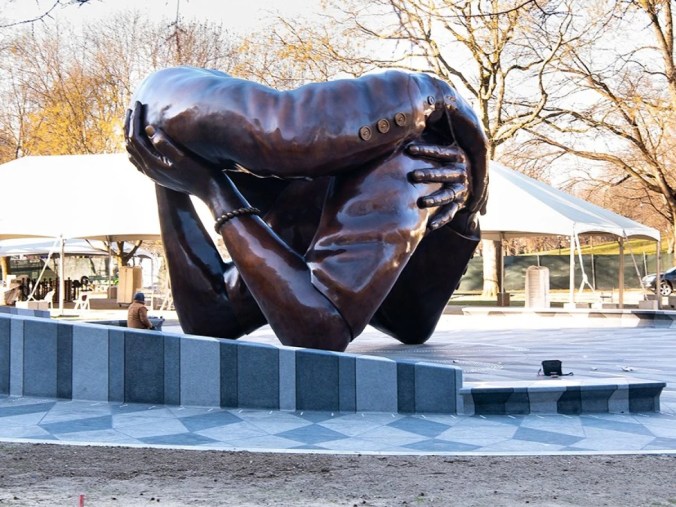
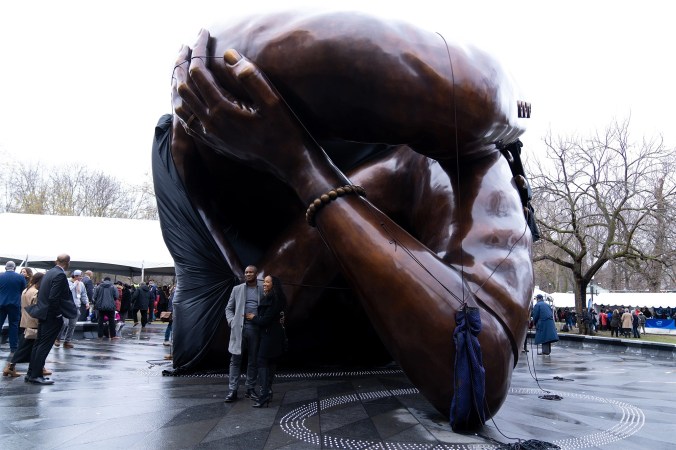
Guess what American icon this newly unveiled, giant sculpture on the  Boston Common memorializes? Here are several angles…

Of course, it’s Dr. Martin Luther King! Didn’t you recognize him? Titled “The Embrace,” the artwork, which cost an estimated $10 million dollars, is supposed to represent King and his wife hugging each other in Boston when he learned of his Nobel Peace Prize in 1964.

Many seem to think the thing is not only an eyesore, but an arguably pornographic one. I know, I know, most public art is controversial, but that doesn’t mean, or shouldn’t, that anything goes. Who approved that? There are no better ways to spend ten million bucks? If an artwork is supposed to honor a person or an event, is it too much to ask that someone of reasonable intelligence should be able to discern what the hell a sculpture means without an explanation?

One virtue of the MLK memorial is that it makes the pretty awful one on the Washington Mall—

— seem like a Michelangelo by comparison.

In 2020, Boston removed its “Emancipation” sculpture, the Freedman’s Memorial
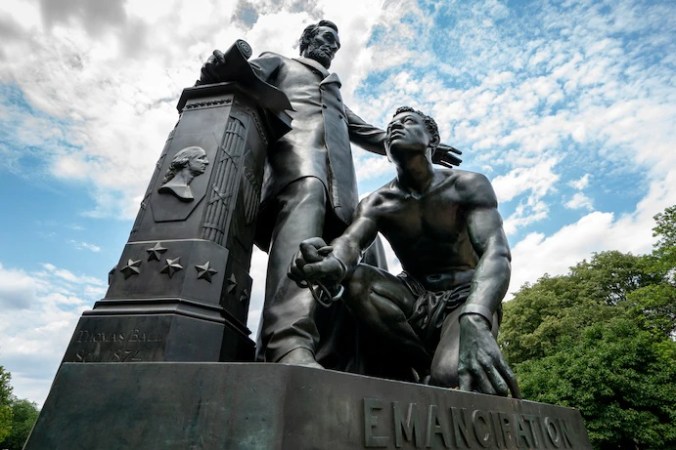
…which had been on display since 1879. It was considered by some to be politically incorrect, with the symbolic image of Abraham Lincoln freeing a kneeling former slave from his chains made some residents and visitors “uncomfortable,” 12,000 people signed a petition demanding the statue’s removal. So down it went.

I bet Boston can find at least 12,000 people who are made uncomfortable by “The Embrace.” Personally, it reminds me of the sandworms in “Beetlejuice.”

Ethics Quiz: Public Art Ethics

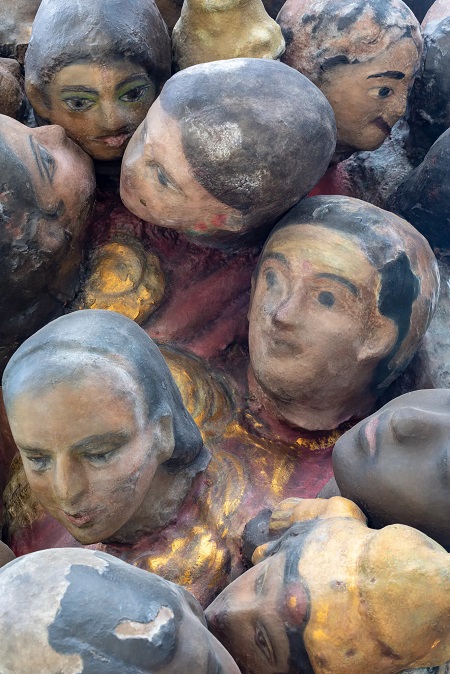
“Ancestor,” a new sculpture by Bharti Kher,  has been chosen to reside at the Fifth Avenue and 60th Street entrance to Central Park in New York City for the next year. It’s 18 feet tall, has 24 heads (detail below)….

…and is made to look old and weathered, though it was cast in bronze and is fresh out of the oven, or whatever. The Times says,
“Ancestor” is, at its core, an Indian goddess form, the kind found in Hindu popular iconography, with hair that rises in a bun yet somehow also hangs in a braid. But protruding in clumps pell-mell from her upper body are 23 extra heads, each with its own expression, peering this way and that.

You can read about what the artist thinks this mess means here. I don’t even have a coherent quiz question to pose, just a group of puzzled queries that follow my immediate, “What the hell?” Continue reading

Remembering Arturo Di Modica, The Artistic Ethics Train Wreck

Talented and bold artist? Shameless self-promoter? Hypocrite? Unethical jerk? Arturo Di Modica, the Sicilian-born sculptor who died earlier this year was all of these. He was also a one-man ethics train wreck.

In mid-December of 1989, the artist illegally dropped his “Charging Bull,” a 3.5 ton bronze sculpture (that’s a similar model he had mounted in China above), in Lower Manhattan one night in 1989. He claimed it was a gift to his adopted country, the United States, urging courage and defiance after its 1988 financial collapse. Maybe. Or he just wanted to grandstand and get publicity. Either way, you cannot put a giant statue in a public place without permission, permits, owning the property involved, little things like that.

This was a planned crime. Di Modica spent weeks prowling the Wall Street area after midnight, noting when and where police officers walked by. He had about forty accomplices waiting at around 1 a.m. when he loaded his sculpture onto a flatbed truck and drove to Broad Street, next to the Stock Exchange. But it was nearing Christmas, and the Stock Exchange had put up a huge Christmas tree where he had planned to drop “Charging Bull.”

So he put it under the tree.

Continue reading

Pre-Thanksgiving Day Ethics Wrap-Up, 11/27/2019

Be thankful tomorrow, everybody.

There’s always something…

1. On unethical misleading language, Part A: Today’s “Nah, there’s no mainstream media bias” note: I was suddenly struck after reading one, two, three, four impeachment-related stories in a row in four separate news sources that they all used the phrase “dirt on Joe Biden.” Isn’t that strange? “Dirt” isn’t a description, it’s a characterization, and a deliberately  pejorative one that assumes that Biden is a victim of a dastardly action. It’s widespread use is one more smoking gun that demonstrates mainstream media bias aimed at smearing President Trump. The term “dirt” presupposes that if the President sought to persuade the Ukraine to aid the U.S. in an investigation, something it is obligated by treaty to do, it was only to assist his re-election chances. When the term “dirt” has been used in conjunction with a politition seeking damning information on Bill Clinton, either George Bush, or Trump himslef, it was always in the context of an election campaign. Few wrote that the Mueller investigation was a “dirt” seeking operation (though in truth it was). But it’s always “dirt on Joe Biden” that the Ukraine was allegedly asked/forced/extorted into looking for. When Jeffrey Epstein was being investigated, nobody said the FBI was seeking to smear him with “dirt,” because news sources accepted that an investigation was appropriate.

Yet there are many reasons and strong evidence suggesting that an investigation of Joe Biden’s alleged machinations to benefit his son by abusing his office and misusing his influence was (and is) also appropriate. The United States should not just shrug off corruption in its highest offices because a complicit individual is running for President, but that is the thrust of the current impeachment push by House Democrats. For the media to intentionally choose terminology—and slang, which is usually not in a newspaper style-book— to lead readers away from the argument that an investigation of Joe Biden was necessary and valid whether he was running for President or not shows a disturbing disinterest in fair reporting, and a preference for anti-Trump propaganda. Continue reading

Ethics Hero: Artist Shepard Fairey

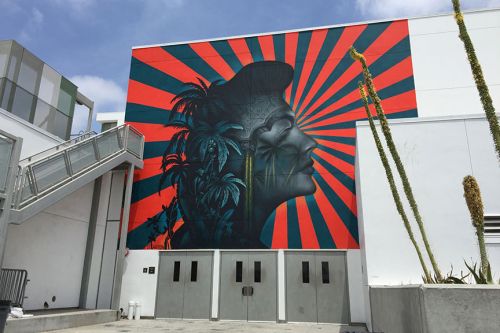
Wait a minute…doesn’t Ava look a bit like Tojo?

I’m so tempted to post this story as a late response to my virtue-signaling Facebook friend who fatuously argued that political correctness was just about “not being an asshole.” this is, of course, another example of partisans using denial to avoid facing inconvenient facts.

Because some delicate flowers complained that the mural above, by artist Beau Stanton, offended them and made them feel unsafe because the rays emanating from the head—of actress Ava Gardner, for God’s sake— reminded them of the Japanese imperial battle flag, the L.A. school district agreed to paint over it. The mural is located at the Robert F. Kennedy Community Schools in Koreatown, which is part of the Los Angeles Unified School District. Koreans have not forgiven Japan for its atrocities during World War II, which is understandable. Projecting that on a mural portraying Ava Garder is not.

The school district’s senior regional administrator, Roberto Martinez, compared the Stanton mural to Confederate statues and argues that the value of the art doesn’t outweigh the “offense” to people. Pssst…Facebook friend! He’s the asshole! He’s also too dumb and biased to be a trustworthy educator!

Now artist Shepard Fairey, who painted THIS mural… Continue reading

Statue Ethics Stand-Off: “Charging Bull” vs. “Fearless Girl”

The Wall Street art ethics controversy pitting a nearly 30-year-old sculpture of an angry bull against the upstart statue of a defiant little girl has fascinating cultural implications. The ethical solution to the confrontation are simple and undeniable, however, though the legal issues a bit less so. “Fearless Girl” has got to go.

Arturo Di Modica created “Charging Bull” in response to stock market travails during the late 1980s. The three-and-a-half-ton sculpture was placed near Wall Street in the dead of night,  and was embraced by the financial ditrict and New Yorkers as iconic public art. The artist copyrighted and trademarked his work, which he has said was meant to symbolize “freedom in the world, peace, strength, power and love.”

I don’t get the love part, but okay: the point is that the bull is a positive metaphor, not a sinister one.

The “Fearless Girl” statue was positioned this year, the night before International Women’s Day, in a direct stand-off with the bull. It had been commissioned by State Street Global Advisors, a financial firm based in Boston, as a public relations and advertising move and classic virtue signalling. State Street Global’s home page trumpets the new statue’s message of “the power of women in leadership” and uses it to urge “greater gender diversity on corporate boards.” The metal girl’s  cynical and self-serving origins don’t seem to bother the work’s fans though.

The problem is that the message of “Fearless Girl” requires the participation of the bull to make any sense and to have any power at all. Otherwise, it might as well be Pippi Longstocking.  In essence, the new statue appropriates Di Modica’s work, and violently alters it. The artist is a furious as a charging bull that what he intended as a symbol of capitalist power and national vigor has been transformed into a sexist representation of male domination. Di Modica and his lawyers demand that the statue be moved away from its bull-baiting position, arguing that State Street Global commissioned “Fearless Girl” as a site-specific work conceived with “Charging Bull” in mind. It thus illegally commercialized  Di Modica’s statue in violation of the artist’s intent and copyright. They also claim that the city  violated the artist’s  legal rights by issuing permits allowing the four-foot-tall tyke to face off with the bronze bull without the artist’s permission. Letters to the Mayor DiBlasio, Ronald P. O’Hanley, the president and chief executive of State Street Global; and Harris Diamond, the chairman and chief executive of McCann Worldgroup, State Street Global’s marketing agency demand the removal of “Fearless Girl” forthwith.

Ethically, “Fearless Girl” doesn’t have a leg to stand on. Continue reading