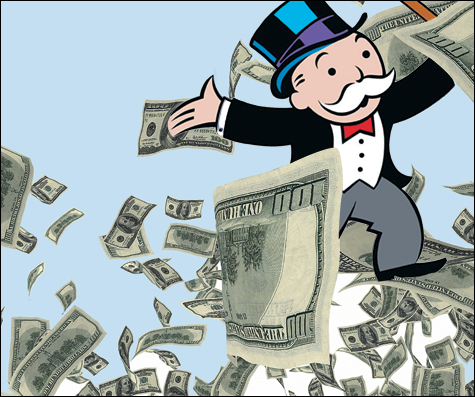
Is Corporate Philanthropy Unethical? No, But It’s Important to Ask the Question

I gather not very many readers sample the links on Ethics Alarms, which is a shame. They contain a lot of different approaches to ethical issues, from many philosophical approaches. Well, heck…I use them , which is really what they are here for. One of the more original thinkers represented among the various sites is Jason Christopher Cockrell, author of The Worst-Case Scenario. It appears that he has abandoned blogging, which is a shame, but his last post, at the end of 2010, was full of surprises. In it, he offered an argument against corporate charity, something I have never heard anyone criticize on any level, except to say that there isn’t enough of it.



The theory behind corporate philanthropy is that it is a win-win for everyone involved. The corporation enhances its public reputation and visibility, improving employee moral and making investors proud to hold stock. Society benefits from substantial contributions that support everything from cancer research to Sesame Street to regional theater. It is hard to imagine what the charitable landscape would look like without corporate philanthropy, but the thought of eliminating it is sufficient to give any professional fundraiser hives. I know—both I and my wife were development officers for many years. Continue reading

Kobe Bryant’s Two-Word Ethics Train Wreck

"Fucking" + "faggot"= ?

In the heat of an NBA game, Los Angeles Laker star Kobe Bryant shouted a two-word epithet at a NBA ref, estimated to be the 9,675,987, 555, 321,005, 349,674, 021st time a player has insulted a ref in hoops since they started keeping count in 1973. Unfortunately, the two words were “fucking faggot.”

And it was picked up by the TV microphones.

In rapid succession, the Gay Lesbian Transgendered advocates were all over the NBA,  calling a foul; Bryant was apologizing, and the NBA was fining Bryant $100,000.

Ethics train wreck. It’s a train wreck because whatever happens at this point, the result has ethical problems, and the lesson is ethically muddled. There is no question at all that if the remark by Bryant hadn’t been picked up by the mics, there would be no issue, no controversy. But it was, which means that a comment intended for one individual (if that) became a national display of incivility (or worse.) Continue reading

Ethics Quiz: The Candies’ Foundation and Bristol Palin

" Hi! I'm Kim Kardashian, here to tell you that making a sex tape is a terrible mistake, even though my own sex tape made me and my two equally shallow sisters rich celebrities. Don't make the same mistake I did. Really. Trust me."

The Candie’s Foundation is a non-profit organization that, according to its website,

“…works to shape the way youth in America think about teen pregnancy and parenthood. We are an operating foundation rather than a grant-making foundation. The foundation develops and runs communication campaigns to raise awareness about, and motivate teens to prevent, teen pregnancy.”

The main source of its message to teens right now is that “Dancing With The Stars” icon, Bristol Palin. Palin, now 20, qualified herself for the assignment of speaking to teens about the importance of avoiding getting pregnant by getting pregnant when she was 16, and doing it center stage, while her mother was the Governor of Alaska. Thus using her position in Alaska’s first family to add prestige to the role of unwed teenage mother in that state, Bristol went on to national prominence as Sarah Palin campaigned for Vice President on the GOP ticket, with Bristol demonstrating during and after that jaunt that marrying the father of your child might not be such a good idea either, since he might be, as in the case of Bristol’s short-term fiancee, Levi Johnston, an immature, selfish, publicity-seeking dimwit.

Having done maximum damage to everyone but herself by becoming pregnant (with significant help from Levi, naturally), unwed mother Bristol Palin parlayed her own irresponsible behavior into the job of spokeswoman for The Candie’s Foundation. Well, her mother, I think it is fair to say, did the parlaying. It never hurts to help a prominent and rising cult political figure’s wayward offspring. Who knows when you might need a favor…or have an unemployable offspring of your own?

Bristol goes around the country talking with students and other teenagers, reminding them that they are too young to have kids, and that they should wait because it will screw up their lives. Of course, all of these teenagers know that the unwed, former teen mother telling them this has absolutely no credibility, and in fact represents the much more optimistic ( and completely unrealistic for anyone whose family isn’t rich and/or famous) position  that you can have a baby in your teens, get on lots of magazine covers, have your mother get you a job traveling around the country talking about it while someone else takes care of the baby, and become a celebrity in the bargain. Neat-o! Continue reading

To Wisconsin Unions, a Depressed Woman’s Suicide Is Just Another PR Weapon

"Oh, no. Poor ..hey, wait a minute! We just might be able to use this!"

“The ends justify the means,” for better or worse, has always been the modus operandi of the American union movement. Back at the beginning of the 20th Century, this often translated into violence, as union leaders used bombs and murder to counter equally vile tactics—or worse—by their industry foes. Union violence is more common today in the threatening than in the actual execution, but the public unions battling Governor Scott Walker in Wisconsin have made it increasingly clear that ethics, fairness and truth are not going to stand in the way of their objectives, particularly the objective of winning the battle for public support.

A new low may have been reached with the effort to blame Walker for the suicide of Jeri-Lyn Betts, a 57-year-old teacher suffering from chronic depression, who apparently committed suicide last week.  Continue reading

Update: Derek Jeter Is Now A Full-Fledged Ethics Dunce

In an earlier post, I noted that Yankee legend Derek Jeter could do the right thing and accept the New York Yankee’s generous offer to pay him about twice what he’s worth, or become an Ethics Dunce (qualifications: greed, ingratitude, selfishness, unfairness, abuse of power ) by trying to extort the team for millions of dollars he neither needs nor deserves.

He has chosen the latter. Sorry, Yankee fans. Derek’s a Dunce after all.

I really thought he was better than this.

False Redemption and the Michael Vick Fallacy

Michael Vick was once a star quarterback for NFL’s Atlanta Falcons. Then it was discovered that he was secretly in the illegal dog-fighting business, breaking the law and being brutally cruel to dogs in the process. This lost him his job, his contract, his freedom, and many millions of dollars. Now he’s a star quarterback again, leading the Philadelphia Eagles. Last Monday night, he had what some have called the best game any quarterback has had in the NFL in forty years. Many are celebrating his return to stardom as an inspiring example of rehabilitation and redemption. After all, he’s a hero again.

Not to me, he isn’t.

It well may be that Michael Vick is a changed man, but the jury is out on that; it’s just taking longer to get a verdict than it did for his dog-fighting charges. There is absolutely no nexus between Vick’s resurgence on the football field and his character. Continue reading

One Word Removed From Ethics Dunce-hood: Yankee Shortstop Derek Jeter

Derek Jeter is not an Ethics Dunce yet, and all those who admire the career of the great Yankee shortstop—even grudging Red Sox fans like myself–have to hope and wish that he does nor become on. He is perilously close, however—one word away, in fact. The word is “no,” and if he utters it in response to the reported contract being offered to him by the New York Yankees, it is time to replace his NY cap with a tall, pointy one. Continue reading

Chevron, Environmentalists, Hoaxes, and the Ethics of Dialogue

Chevron, the oil giant, rolled out a new ad campaign this week. It announced that Chevron agrees with critics and environmentally concerned Americans that it has critical responsibilities, such as reinvesting profits into socially responsible projects, seeking renewable energy sources, and taking extra steps to protect the environment. “We hear what people say about oil companies – that they should develop renewables, support communities, create jobs and protect the environment – and the fact is, we agree,” says Rhonda Zygocki, Chevron’s vice president of Policy, Government and Public Affairs, in the company’s press release. “This campaign demonstrates our values as a company and the greater value we provide in meeting the world’s demand for energy.  There is a lot of common ground on energy issues if we take the time to find it.” Continue reading

CNN’s Rick Sanchez Firing Statement: Fair or a Missed Opportunity?

CNN promptly fired “Rick’s List” host Rick Sanchez after a bizarre satellite radio rant in which he accused “The Daily Show” host John Stewart of being a “bigot” (presumably because he often picks on Sanchez, who is a Cuban-American) and insinuated that both Stewart and bigwigs at CNN were not inclined to give Sanchez a fair shake because they are Jews.Of course he had to go.

The question is, how should the network have handled the firing? It opted for traditional: a straightforward statement that Sanchez wasn’t a CNN employee any more, and a gracious note of thanks and good wishes:

“Rick Sanchez is no longer with the company. We thank Rick for his years of service and we wish him well.“

Blogger Sam Rubin, however, feels that CNN “blew it.” Here is the statement Rubin feels CNN should have made, taking a stand and being aggressively critical while showing Sanchez the door: Continue reading

Revisiting the Obligation vs. Charity Issue in Baseball Retirement Benfits

In a recent post, Ethics Alarms discussed that demands of a group of former Major League baseball who receive inferior retirement benefits, because the changes made to the game’s pension and health insurance qualifications in 1980 were not made retroactive. The group has argued that it was unfair for the baseball clubs and players union to have voluntarily extended benefits to  pre-1947 players—players who played before there were any retirement benefits at all—and not them. The post argued…

“…The inclusion of the older players, from before 1947, was not the same: the group included many of the game’s greatest players, who could legitimately say that they were essential in building the industry that had made the current players so wealthy.  Leaving all the older players without any pensions or medical plans from Major League Baseball looked like ingratitude toward the men who, quite literally, helped make the teams and players rich. The sport owed them, and it was right for them to help the veteran group…[The 1948-1979 group], by definition, were not stars; for the most part, they were…journeyman spare-part players who barely held on to their jobs…The fact that players with one day of service in the big leagues today qualify for a health insurance no more entitles the Moonlight Grahams of the Seventies to the same than the million dollar salaries of today’s second-string catchers entitles retired catchers who made $30,000 a year to insist on retroactive pay at today’s pay scales. Baseball players are paid what their rarified talents are worth, and those who create today’s multi-billion dollar industry are worth much more than the players who toiled before the big cable contracts and merchandising kicked in…The fair thing is for people to live with the deals they freely agreed to as conditions of their employment, and when a future employee negotiates a better deal for the work you once did, the fair thing is to say to him, “Good for you!” It would be generous and kind for the Major League teams and players to close some of the disparity in benefits; I hope they do it. Nevertheless, they have no obligation to do it, and it is not a breach of fairness if they don’t.” [You can read the entire essay here.]

The post attracted a strong comment from Craig Skok, one of the players in the 1948-1979 group. He is an excellent representative of the plight of this group, because he just barely missed the cut-off for full benefits. He wrote… Continue reading