
I’m Curious: Do Women—Any Women, A Lot Of Women, Adult Women, Rational Women—Think This Times Column Makes Sense? (Because It Doesn’t)

Jerry Richardson (above), the 81-year-old original owner of the Carolina Panthers in the NFL,  has decided that rather than ride out the sexual harassment allegations  recently reported  by Sports Illustrated, the wisest (and most lucrative course) will be to sell the team after this season. His profit will be somewhere in the billions, not that he isn’t a billionaire already.

New York Times sportswriter Juliet Macur is grievously offended by this, writing,

“Here’s what would make more sense: For Richardson to announce that the proceeds of the sale — or even just a couple hundred million? — would be donated to the women he harassed…[Many men] have been chased from the top of their professions for disgusting behavior involving women they worked with. They are suddenly pariahs, their reputations destroyed. But they remain very rich men, and their families, for generations, will be able to live off the financial rewards they collected while perpetuating these offenses….Richardson, who made his fortune in the fast-food industry, might be the richest of all the men accused in the #MeToo movement so far. Perhaps it’s appropriate, in a legal sense, that he is able to sell his company and walk off the stage. But it doesn’t seem morally fair that he should benefit so richly from it.”

This is pure, unadulterated emotionalism and indignation unfiltered by thought or coherent societal values. If these are the kinds of ethical arguments—and it is an ethical argument–major information sources are going to publish as worthy of being injected into public discourse, we might as well tear up the laws, forswear ethical systems, embrace passion, anger, vengeance and the rest as our sole tools to govern human affairs, and resign ourselves to chaos. Continue reading

Franken’s Accuser Presents: A Perfect Rationalization #42, The Hillary Inoculation, or “If he/she doesn’t care, why should anyone else?”

I haven’t seen such a perfect example of Rationalization #43 since Bill Clinton was caught with his pants down, a blue dress within range and a good cigar.

In case you haven’t perused the Ethics Alarms Rationalization List lately, and if so, shame on you, Al Franken’s accuser’s interview today on “Good Morning America” (if you don’t watch “Good Morning America,” good for you) laid the foundation for a virtual #43 orgy.

This rationalization description one is fun to read now, written as it was long before Hillary’s two candidacies for President, and the current Washington, D.C. leg of the Harvey Weinstein Ethics Train Wreck.

42. The Hillary Inoculation, or “If he/she doesn’t care, why should anyone else?”

This is a complex, hybrid rationalization that draws upon the warped and corrupting logic of “Everybody does it,” the Biblical rationalizations, Comparative Virtue (“there are worse things!”) and a few others to reach an absurd argument that nevertheless sometimes carries the day.

One example that will live in infamy, and the inspiration for #42’s title, was Bill Clinton’s Monica Lewinsky scandal, which exposed him beyond all doubt as a liar, a power abuser, a hypocrite and, incidentally, an adulterer, not that anyone was surprised at that. His wife, First Lady Hillary Clinton, prominently defended her husband, somehow keeping her feminist creds at the same time, a neat trick. She knew which side of the bread her butter was on, as the saying goes: her loyalty was going to pay off more than righteous indignation. Thus she obfuscated, spun and lied for Bill, and gave his defenders this jaw-dropping argument, which they used liberally:

“If Hillary is willing to forgive him, why shouldn’t we?”

Let us count the ways. Why?

1. Because her relationship to him is as a wife to a husband, and ours is as citizens to a national leader. The standards are different, the stakes are different, and the consequences of the betrayal of trust are different.

2. Because the seriousness of an ethical or legal violation is not defined by who chooses to tolerate or forgive it.

3. Because her decision to ignore, forgive or tolerate may be the product of bias, self-interest, or other non-ethical considerations that make the decision unreliable, untrustworthy, and a poor template for the response of others, as well as societal standards.

4. Because she may be wrong, mistaken, or a fool.

5. Because we each are responsible for making our own ethical judgments, and to delegate those judgments to a third party, especially to a third party who is not objective or likely to be affected by conflicts of interest, makes neither logical nor ethical sense.

[Hmmmm. Caught two typos there, and also needed to make an edit. I guess I haven’t read the list lately. Shame on me.] Continue reading

Great…Now I Have To Defend ANOTHER Complete And Utter Jerk [Updated]

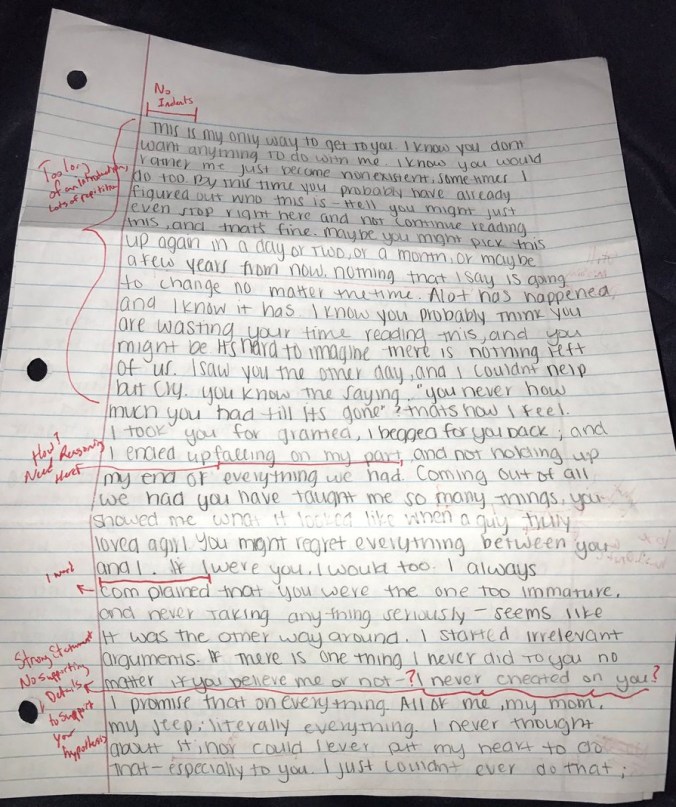
University of Central Florida student Nick Lutz set out to humiliate his ex-girlfriend after she sent him a letter (above)  apologizing after their breakup, so he graded it like a school paper, and instead of keeping the exchange private and between them as a responsible, decent, fair adult would, he tweeted it to the world, where predictably, since the Twitterverse is populated by a lot of people like Nick, it went viral, with hundreds of thousands of like-minded jerks “liking” it.

Nick is, at this stage of his life, a toxic creep without properly functioning ethics alarms. However, his school had no legitimate interest in this matter. Yet it placed him on two semesters of suspension and probation as punishment for this entirely non-school related conduct. (No, the badly treated ex- is not a student.) UCF sent Nick two letters, the first stating that he may have violated the law (no, he didn’t), while the second stated that he had violated the university’s student rules of conduct regarding disruption and cyber-bullying.

Baloney. Read the rules; I did.  Even though the rules are unenforceably broad, they wouldn’t apply to his conduct: Continue reading

From “The Pazuzu Excuse” Files: The Justly-Fired TV Reporter’s Lament

http://www.youtube.com/watch?v=npWFv6rYmjU

Colleen Campbell, a local  Philadelphia television reporter, got herself fired for an obscenity-packed rant berating a cop  outside a Philadelphia comedy club. What she didn’t know was that the whole, ugly thing was filmed. You know that rule that says “ethics is what you do when nobody’s looking except your embarrassed companion and a policeman who you have no respect for anyway because he’s just a cop? That’s the one Colleen whiffed on.

Campbell ae was kicked out of the club for “loud whispering” throughout the show. Once outside, she denied being disruptive to an officer who removed her. The officer replied that Campbell and her male friend needed to just leave the scene. The reporter replied, charmingly,

Or what? Or what, motherfucker? Lick my asshole. How about that? Fucking piece of shit. That’s why nobody likes fucking police … idiots in this fucking town.”

Campbell, 28, didn’t know her act was caught on camera and posted to Facebook until after she received word from the station that she had been fired. Now she says…

“That’s not me or how I talk or act or anything at all…I don’t know what to do. I feel ruined and embarrassed for me and my family….I feel awful…That’s not me or how I speak or how I talk or how I was raised. I had to delete all my social media, because I’m getting threats….I wanna apologize to the officer. I don’t remember the whole altercation at all. I remember feeling attacked. I would never talk like that. It was like watching a whole different me.”

The Kathy Griffin episode sparked several of those currently popular blog posts and web essays about how social media destroys people who make “one mistake” and if it could happen to them, it can happen to you. Ethics Alarms has had several of these posts in the past, always about regular citizens who had an ugly e-mail distributed to the universe by an angry girl friend, or a tasteless or misunderstood tweet to a friend gone viral. No question: these web lynchings are out of proportion to the offense. Continue reading

Ethics Quiz: The Boston Red Sox And “Hate Speech”

SHHHHHHHH!

I don’t know why it is that the Boston Red Sox are leading all of baseball in ethics controversies, but here’s the story:

The Red Sox have been playing the Orioles the last four days, in a series marked by rancor arising from an incident last week that has metastasized into an exchange of words, accusations and attempted beanballs.  After the first game in this series,  Orioles’ outfielder Adam Jones claimed that he had heard racial epithets from the stands, and a bag of peanuts had been thrown at him.  Boston  and the Red Sox in particular have a dubious racial history (the team was the last in baseball ito have a black player), so this immediately became a big story, with the Sox, MLB, the city, and even the governor expressing horror, regret, and outrage. No fan or Orioles player has stepped  forward to substantiate Jones’ accusations. I don’t doubt him, but that is relevant, because in the entire episode as it unfolded, conclusive evidence has been deemed unnecessary. Accusations alone confer guilt. In the next game, Fenway gave Jones a long standing ovation on his first trip to the plate, saying, in essence, “We’re sorry you were treated this way, and we reject that disgusting conduct.” Good. That is the Fenway Park I know.

Then it was reported that another fan who was in the crowd at Fenway  the next night has been banned for life by the Red Sox. Team president Sam Kennedy said that the fan received the lifetime ban for using a racial slur to to describe a Kenyan woman who sang the National Anthem before the game, in a conversation with another fan.

Calvin Hennick, a Boston resident bringing his son to his first Red Sox game as a present for his sixth birthday, wrote on Facebook and confirmed to the Associated Press  that a  fan sitting near him used “nigger” when referring to the National  Anthem singer that night. Hennick asked the man to repeat what he had said, and when he did,Hennick summoned security. The Fenway security ejected the offending fan, who denied using a racial slur….you know, like Giles Corey denied being a witch.

Kennedy thanked Hennick, who is white, for coming forward. Says NBC baseball writer Craig Calcaterra, who once was a lawyer and presumably understood basic principles of justice, process, and fairness, “Kudos to the Red Sox for acting so swiftly.”

The Red Sox acted swiftly, all right.

Your Ethics Alarms Ethics Quiz of the Day is this...

Is it fair, proportionate, reasonable and just to ban a baseball spectator for life under these circumstances?

Continue reading

Comments Of The Day (3): “An Especially Ugly Ethics Quiz: Cam Betrayed”

There have been many excellent posts on the Ethics Quiz about the couple that executed their apparently loving therapy dog, a Staffordshire Bull Terrier named Cam. Three comments stand out (I could easily have selected twice this many, however) , one by Paul W. Schlecht, another by slickwilly, and a third by Elizabeth II. They cover some common ground, and together show the complexity and breadth of this issue, which goes beyond mere animal cruelty to our society’s emotional connection, confusion and hypocrisy about animals generally. I decided that they complement each other, and am posting them as a set.

First, here is slickwilly’s Comment of the Day on the post, “An Especially Ugly Ethics Quiz: Cam Betrayed”:

Growing up rural, animal management is a way of life. You care for ‘commercial’ animals and you care for ‘pets.’ Confusing the two causes problems with regards to ‘final disposition.’ You never torture the animal (as this was considered a lack of character and a sign of a dangerous person) but attempt to make the act as painless as possible. (Note this is why you never hunt deer with an insufficient caliber, or take low probability shots that may wound but not quickly lower the target’s blood pressure to induce unconsciousness. Not only is is more humane, but also prevents the meat from being tainted or lost.)

A good working definition of a commercial animal versus a pet is driven by what type of profits are earned on the animal. We (generally) keep and pay for pets for emotional reasons (a type of profit), and do not expect monetary profit. Commercial animals are for food and profit. The line can blur, as in the case of military bomb dogs or ‘barn’ cats, but this generally is the case. It is a pet if you cannot bear to think of eating it. Cows can be pets. Dogs can be junk yard guard animals. The owner’s feelings make the difference.

I remember some folks who were unable to kill their show chickens, pigs, sheep, (or whatever) for delivery to the buyer (who did not bid on a live animal, and paid well over market value to support the college aspirations of the seller.) The Ag teacher’s advice was to never name a meat production animal, if you intend to sell it. Reluctance to complete the life cycle of such animals indicated the person was not suited to that sort of rural agricultural activity. Go grow corn if you like, but don’t raise beef. There was no shame in this: find what you like to do and do it. But make no mistake: anyone who has cared for 20 pigs knows they are NOT pets, and they EAT a lot, which has to be paid for.

Continue reading

An Especially Ugly Ethics Quiz: Cam Betrayed

This story is too disturbing to describe, so I’m going to just give you the link.  Briefly, it involves a couple, she a veteran, he a soldier, killing their therapy dog, laughing as they did it, and filming the event. They were arrested on charges of animal cruelty. Read the story, here, and then consider the Ethics Alarms Ethics Quiz of the Day, which is…

What is the fair, proportionate, and reasonable punishment for this conduct?

Continue reading

A Facebook Case Study In How People Cripple Their Ability, And Ours, To Make Ethical Distinctions

I inadvertently stumbled over a provocative Facebook post by a friend of a friend of a friend. My friend is a principled and intelligent liberal: apparently I stumbled on to a chain where each link was a little more detached from reality and reason.

The stranger’s post involved the story from two weeks ago, in the aftermath of the collapse of a crucial  highway bridge in Atlanta. Investigators found the the collapse was caused by a fire.There were no deaths or injuries caused by the fire and the explosion it sparked , but i  severed the vital roadway that runs north-south through downtown Atlanta and carries 250,000 vehicles daily, City Fire Department investigators arrested three homeless people on suspicion of involvement in the fire. Eventually only one was charged:  Basil Eleby, a homeless man, was arraigned on charges of first-degree arson and criminal damage to property. He had many previous drug and assault arrests, according to Fulton County jail records.

To this my friend’s friend’s friend—his name doesn’t matter—responded,

Three people are now under arrest for the fire that led to the freeway collapse in Atlanta – 3 homeless people. I predicted this. But rather than seek out revenge on these 3 for the tremendous inconvenience they’ve caused, can we take a moment to realize that no person reading this has ever known the reality of sleeping under a bridge. None of us have been compelled to light a fire under that same bridge in order to keep our bodies warm.

And can we please have a conversation about funding mental health for the homeless? And can we please have a conversation, not based in shame, not based in revenge, about getting homeless people off the street?

Yes, these 3 folks have done something that has inconvenienced many people. Lighting that fire is something they have probably done countless times before. Can we take this as an opportunity to deal with the real problem? It gives me no satisfaction that the person charged with the worst of this situation will have his homelessness solved by a jail sentence.

Now, I’m sure this individual is a really kind, compassionate individual. I’m also sure he’s the kind of person who is always saying things like “Why is anyone going hungry in the richest country in the world?” to the vigorous head-nodding of his friends, and his friends’ friends. (I am willing to bet money that he was a passionate Bernie Sanders supporter; probably Occupy Wall Street too.) This kind of statement, however, is policy and ethics static. It literally makes people stupid, and leads them away from useful, objective, dispassionate analysis, not towards it.  It is an irresponsible Facebook post.

Of course, it is also flagrant virtue-signalling and grandstanding. Now everyone knows that this guy is oh so compassionate and such a good Christian, who rejects revenge, and wants us to apply the Golden Rule to the poor and the weak. Applause, please. Yes, you’re a wonderful human being. Unfortunately, thinking like this impedes policy solutions to problems, by simplifying them and dumbing them down into their most emotionally distracting components, while pretending that hard truths don’t exist. Continue reading

Ethics Quiz: Punishing The 12-Year-Old Killer

debrow

Texas Monthly this month has a troubling profile of Edwin Debrow, who is 37 years old,  has been behind bars since he was 12, and may have to stay there until he is 52. On September 21, 1991, Debrow shot a San Antonio school teacher named Curtis Edwards in the back of the head. Edwards’ body was found sprawled across the front seat of a taxi that he drove part-time at night. Edwin, police determined, had shot Edwards during an attempted robbery. Above is the photo of the 12-year-old in custody.

Texas law, you will not be surprised to learn, allows very harsh punishment for  juvenile offenders.Other states will sometimes try 12-year-olds as adults. Last year’s documentary “Beware the Slenderman” tells the strange story of Anissa Weier and Morgan Geyser, two 12-year-old Wisconsin girls who attempted to stab another 12-year old girl to death in 2014. Under Wisconsin law, Weier and Geyser will be tried as adults for attempted first-degree intentional homicide, and if convicted, they could be sentenced to up to 65 years in state prison.

Your Ethics Alarms Ethics Quiz of the Day is this:

Is it ethical for society to punish children with such long prison sentences, no matter how serious the crime?

Continue reading

From The “When Ethics Alarms Don’t Ring” Files: The Non-Sexual Coat-Hanger Rape

coat-hanger

What’s going on here? We may not  know enough to be sure, but one thing is certain: Deputy Attorney General Casey Hammer’s brain and mouth are not connected to his ethics alarms. Maybe the whole Idaho Attorney General’s office has the same problem.

In 2015, charges were brought against  three white Dietrich, Idaho high school football players alleging that they attacked and sexually assaulted a black, mentally disabled teammate. John R.K. Howard, then 18, was charged as an adult and accused of thrusting a coat-hanger into the anus of the boy while the others held him.

Now 19,  Howard was allowed last week to avoid jail time in exchange for an Alford plea, a device allowed in some states, in which he acknowledges that he would have likely been found guilty in trial but doesn’t admit his guilt.  He pleaded to a single felony count of injury to a child, for which he will be sentenced to only two to three years of probation and 300 hours of community service. In my state, serious traffic violations can get harsher punishment than that.

Deputy Attorney General Casey Hammer “explained” that while Howard’s behavior was “egregious” and caused the victim “a lot of suffering,” it was not a really a sex crime, and so his office agreed to dropping the charge to the lesser felony. This means that in Idaho, apparently, kicking a hanger into a male victim’s rectum doesn’t qualify as rape. I wonder if any object being kicked into someone’s rectum is similarly immune from the charge. Would someone who kicked a hanger into a woman’s vagina be called rape? How about if the assailant was black and the victim was white?

Incredibly, Hemmer’s commentary got worse. “We don’t believe it’s appropriate for Mr. Howard to suffer the consequences of a sex offender,” Hemmer said. “But he still needs to be held accountable.”

Heaven forbid that that a student who does this to a disabled team mate while he is being held by two other students should suffer. We can’t have that.

Continue reading