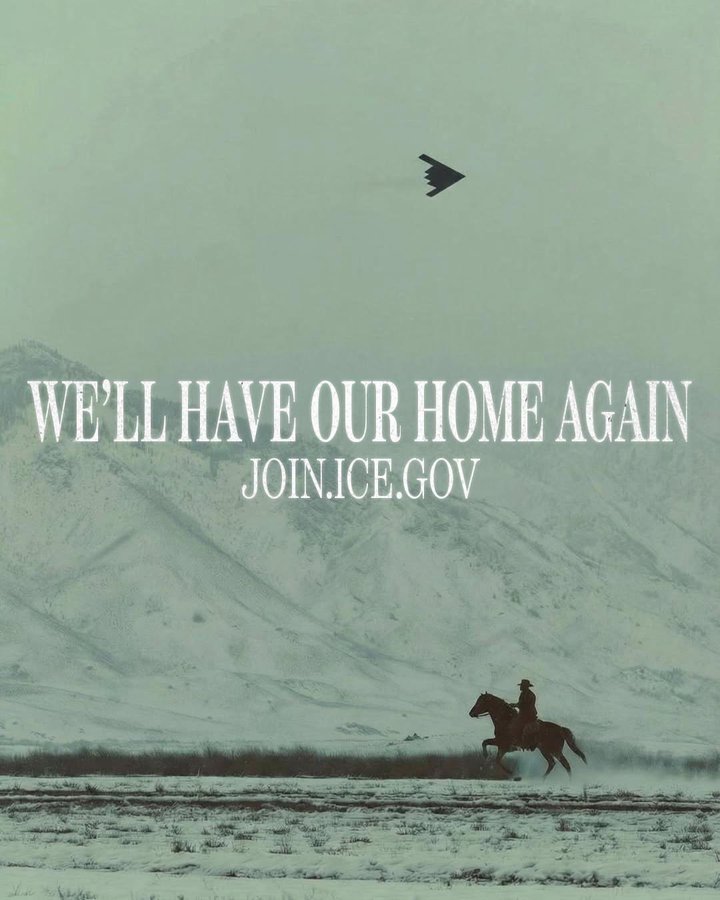
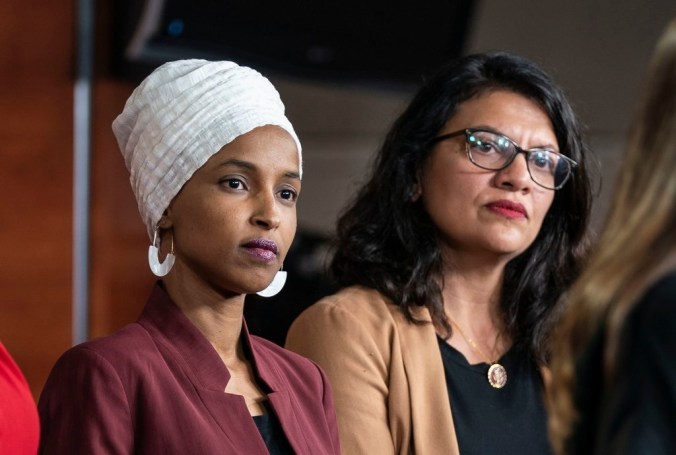
We will know that the nation is recuperating from The Great Stupid when voters no longer elect anti-American members of Congress like Tlaib and her fellow infiltrator, Rep. Omar. This week Omar and similarly corrupt Democratic Washington Rep. Pramila Jayapal chaired a so-called hearing, completely partisan and without balance or dissent, regarding lawful activities of Immigration and Customs Enforcement (ICE) operations in Minnesota and the death of activist Renee Good when she interfered with their efforts, almost running over an agent with her car. Tlaib decided it would be an ideal time to pitch a hissy fit over the image above, Department of Homeland Security recruitment post.
“We will have our home again!” the Congresswoman said as she displayed the photo. “What does that evoke in you when you see this? It literally, when I see it, as a Muslima, as a Palestinian, as a child of immigrants, I see that this is something that is evoking like I’m not welcome here.”
Apparently President Trump lobbied Prime Minister Benjamin Netanyahu’s government to bar two of the President’s least favorite members of Congress, Representatives Tlaib of Michigan and Ilhan Omar of Minnesota, from entering Israel for official visits. Israel then reversed an earlier decision to admit the two Muslim Democrats, both supporters of the international Israel boycott movement.
From the Times:
An Israeli official close to the prime minister’s office said on Thursday that a call came from the Trump administration as recently as this week pressing Mr. Netanyahu to bar the congresswomen. The official, who spoke on the condition of anonymity to discuss delicate information, said the prime minister found himself in a “lose lose” situation, having to choose between upsetting Mr. Trump or the Democrats.
Of interest but irrelevant to the ethics issue is this morning’s news that Tlaib is now being allowed to enter Israel on humanitarian grounds in order to visit her 90-year-old grandmother, provided the Congresswoman pledges “not to promote boycotts” while in the country. That’s nice. But it doesn’t change the analysis of what Trump did.
One of the “Big Lie” attacks (I haven’t yet added this one to the Ethics Alarms Big Lie Directory, but it will be #6) on President Trump, spurred by partisan academics and gullibly swallowed whole by history-challenged members of the public, has been that this President uniquely ignores or violates so-called “democratic norms,” meaning that he frequently takes actions that may be within his power, but that traditions, precedent and the practices of his predecessors have established as un-Presidential or even taboo. For the most part, this is contrived criticism representing a double standard and requiring historical amnesia. Presidents break norms, and the stronger ones break them frequently. Democrats attempting to equate breaking precedents as the equivalent of “high crimes and misdemeanors” are showing their hand: this complaint is just one more unethical justification for a “resistance” coup.
The fact that there is nothing automatically wrong with breaking norms does not mean that all norms should be breached, or that breaching a particular norm is wise, responsible, or ethical. A President enlisting a foreign ally to take negative action against a member of Congress is one norm that shouldn’t be violated.
The action is unethical by any ethical standards. From a Golden Rule standpoint, no President would tolerate members of Congress lobbying foreign governments to take adverse action against him, though I have little doubt that this has been attempted by legislators in the past. Kant’s Rule of Universality would reject the practice as a new norm, and from a utilitarian standpoint, it’s hard to see how such conduct by a President would result on balance in more beneficial consequences than negative ones. Continue reading →
CNN called them racist yesterday (so did Huffpo, but you know—Huffpo.). That’s not journalism. You tell the public about a statement, and you let others of note or credibility characterize it. It is particularly unethical journalism to cross the line into characterizing a statement and to characterize it falsely to conform to a false narrative or “big lie,” which the “Trump is a racist” assertion is.
Ann Althouse, bless her, saved me the time of explaining why yesterday’s stupid tweets, which I posted about here, are not racist in her first blog post this morning. No one should have to explain that the tweets weren’t racist, since they weren’t, and have no characteristic of racism whatsoever. Critics who choose that cheap route should have to explain why the tweets are racist, using the actual definition, which the accusation defies. Here is Althouse, after repeating the original set of tweets:Continue reading →
1 What a shock: A standard, typical, Oval Office speech. The monster! Ann Althouse has nicely covered the expected biased media reaction to President Trump’s speech last night, noting in part…
“Given the hype, it was disconcerting to hear a speech that, at least for the opening minutes, could have been delivered by any normal politician….Those very gestures of presidential normalcy revealed how futile it was for anyone to wish that Trump would start talking like that all the time. Trump may have told more blatant falsehoods about immigrants and crime over the course of his speech, but to watch him mouth these platitudes is to witness a more insidious and disorienting kind of lying….Watching Trump’s flat delivery of sentiments that he can’t possibly believe was the inverse of comforting. Instead, the address had the queasy effect of a serial killer’s mask in a horror movie: It was a failed attempt to look normal that concealed something even more terrifying underneath….”
But the WaPo readers probably love this sort of thing…
I’m sure they do. Isn’t that great journalism? “We know he doesn’t believe what he’s saying.” The presumption of dishonesty and racism.
I’ve now watched the Pelosi/Schumer response. I observed my emotional reaction, and I can tell you for sure that the line that reached me was “The fact is: the women and children at the border are not a security threat, they are a humanitarian challenge – a challenge that President Trump’s own cruel and counterproductive policies have only deepened” (spoken by Pelosi).
The word with emotional resonance for me was “humanitarian.” So I went back to the text of Trump’s speech, and I see that he used the word in his first sentence:
“My fellow Americans: Tonight, I am speaking to you because there is a growing humanitarian and security crisis at our southern border.”
And, to skip ahead to the 6th paragraph:
“This is a humanitarian crisis — a crisis of the heart and a crisis of the soul….”
It is not the job, obligation or responsibility of the United States to solve the humanitarian problems caused by citizens of other nations trying to enter our country illegally while imperiling children in the process. It does have an obligation to make it crystal clear that trying to make the problem ours will be futile.
Pelosi’s argument boils down to “Think of the Children!”
2. And speaking of rationalizations:This dumb blog attempted to defend US congresswoman Rashida Tlaib uncivil and unprofessional vulgarity (“We’re gonna go in there and we’re going to impeach the motherfucker!”) by listing celebrities who have used the same insult: rappers, comedians, non-Americans, incorrigible left-wing Hollywood jerks like Spike Lee, and actors like Robert De Niro and Samuel L. Jackson, who in his movies calls everyone and everything a motherfucker, so he really shouldn’t count. this doesn’t even work as an “Everybody Does It” excuse. The issue isn’t the vulgarity, it’s the speaker, a member of Congress, and the ethical standards one accepts when entering that institution. Continue reading →
 Ethics Alarms