We Are All Dan Snyder Now

Washington-Redskins

…and isn’t that a revolting development?

Few things infuriate me more than when unethical conduct by an individual or organization force me to side with the supporters of a position or a cause that I oppose myself. Last year, to cite the most egregious example, I found myself in the same camp with the National Rifle Association, Ted Nugent and worse when anti-gun zealots, uncritically backed by the news media, used dishonest, misleading, irrational and emotional appeals to try to pass more stringent gun ownership regulations on the wave of national horror over the Sandy Hook shooting. Indeed, the more fake statistics and shameless slippery slope arguments (“If we can save the life of only one child…”) that were aimed at guns and  law-abiding gun owners, the more I saw the wisdom of Second Amendment absolutism.

Thanks to the exorbitant and irresponsible rhetoric by the likes of Diane Feinstein, Joe Biden, Andrew Cuomo, Piers Morgan, Jim Carrey and others—Don’t tell ME what I “need” to protect my family and home; there’s a possible serial killer on the loose in my Alexandria, Virginia neighborhood at this very moment who has been randomly knocking on doors and shooting people—I no longer trust the government to make rational decisions that affect my options as a potential gun owner. Good work, guys. Before you started using kids as props, lying about the number of shootings, and sounding for all the world like a nation trying to make sure only the government could own legal weapons, I was a supporter of more stringent firearms regulations. You lost me. I am officially convinced that we may need  guns to protect ourselves against power-abusing people like you.

Now members of  Congress are trying to strong-arm Washington Redskins owner Dan Snyder into changing the name of his football team, using the power of the government to pressure him, through the National Football League, into bending to their will on a matter that is absolutely none of their business. Great. Now I have to stand shoulder to shoulder with Snyder, whom we in the Washington area know as a spoiled rich kid, a bully, an egomaniac and a meddling fool who has progressively reduced the region’s beloved football team to tragic joke.

And you should stand with him too, if you think our Bill of Rights is worth preserving. Continue reading

Unethical Quote of the Week: Sen. Claire McCaskill

“I think most women understand that they should not be held accountable for the behaviors of their husbands. And you know, frankly, it was a long time ago, and our country did very well under the leadership of Bill Clinton.” 

—-Sen. Claire McCaskill (D-Mo),  on MSNBC, doing a lousy job rebutting Sen. Rand Paul’s recent statements accusing Democrats of hypocrisy by pursuing their lucrative and politically successful “war on women” attacks on Republicans while continuing to embrace the Clintons, ignoring Bill Clinton’s treatment of his wife, Monica Lewinsky, and women.

Sen McCaskill pulls me back in, damn her.

Sen McCaskill pulls me back in, damn her.

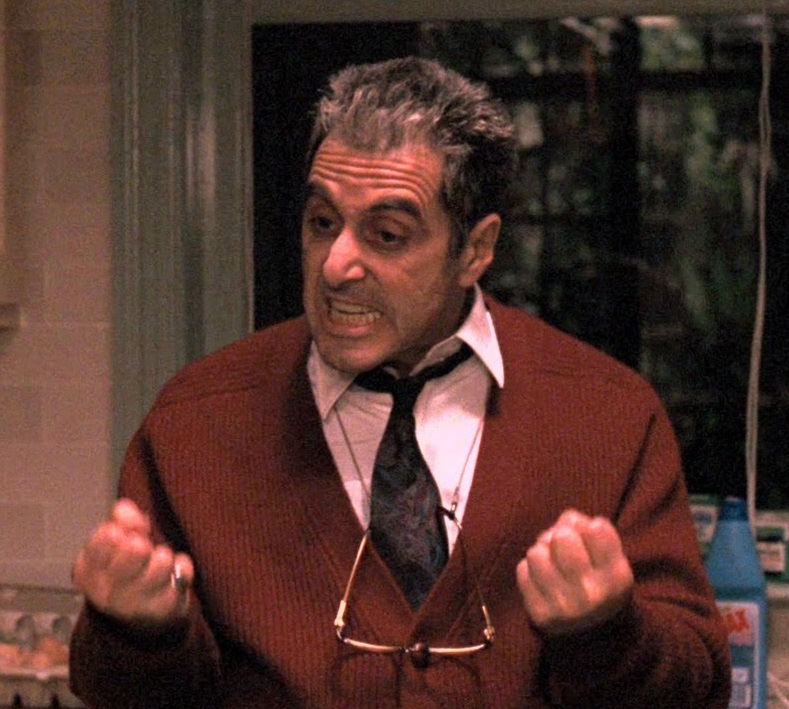
Curse anyone who reminds me of anything related to Godfather III, but there was Claire, turning me into Michael: “Just when I think I’m out, they puuull me back in!” I know I write about Bill Clinton too much; I have promised multiple times to enshrine him in the Ethics Alarms Ethics Hall of Eternal Contempt, but haven’t had time to build the damn thing. His sly, shameless, smirking, dishonesty and manipulations drive me crazy, almost as crazy as the way so many otherwise rational ethical people, especially women (oh, that Bill’s a charmer, like so many sociopaths), keep giving him pass after pass to keep on doing it.

When Sen. Rand Paul, whom I generally do not admire but who has his moments, recently turned a “Meet the Press” question about the “war on women” around and attacked the Democratic hypocrisy for making such a claim while defending and cheering on the likes of Bill Clinton, I enjoyed the jiu-jitsu, as Paul was right….but I didn’t mention it! I resisted! I was even about to write a post today criticizing Senator Paul, who has  apparently embarked on a long-term anti-Clinton jihad (fine with me!), for saying that Clinton’s settlement with Paula Jones in 1999, in which he paid $850,000 to settle her claims of sexual harassment, was an admission of guilt, which is an unfair, legally ignorant statement embarrassing for a Senator. I even wrote the headline: Ethics Dunce: Sen Rand Paul. Then Sen. McCaskill has to respond with her display of virtuoso unethical nonsense, and—I’m Michael Corleone.

Her quote really is one for the ages…dishonest, insulting, loaded with rationalizations: Continue reading

Ethics Dunce (Again): Washington Post Columnist Richard Cohen

No danger of an innocent being unjustly executed here...

No danger of an innocent being unjustly executed here, Richard…Now what?

Most Ethics Dunces named on Ethics Alarms are being chided for one, possibly anomalous, instance of ethics cluelessness, but not Richard Cohen. He is a lifetime, career-long ethics dunce. It is noteworthy when he writes something that doesn’t reek of ethics confusion.

Today he is blogging about the death penalty. There are coherent, powerful arguments that have been and can be made against the death penalty, but Cohen doesn’t bother with any of them, which, as a reflex old-school liberal, he should at least know by heart. No, he attacks the decision of Eric Holder to approve his Massachusetts U.S. Attorney’s request to seek the death penalty for Dzhokhar Tsarnaev, the surviving Boston Marathon bomber as “political cowardice using one invalid argument after another, and by the way, curse you, Richard Cohen, for forcing me to defend Attorney General Holder.

Here are Cohen’s “arguments”:

  • The death penalty is a horrible crime on par with Tsarnaev and his brother intentionally killing and maiming innocent spectators of the Boston Marathon. Such an absurd statement carries a high burden of proof, which Cohen doesn’t even attempt to meet.
  • “[The death penalty] is the sine qua non of lack of thought, a medieval tick of the political right, a murder in the name of murder that does absolutely no good, unless it is to validate the killers’ belief in killing.” Ironically, Cohen’s post is the sine qua non of lack of thought. Since the death penalty has been around continuously since well before Medieval times, calling it a medieval tick is about as fair and accurate as calling religion, warfare, and property laws  medieval tics. Of course it does good: the fact that a vicious anti-social murderer is permanently removed from society and no longer uses up resources, space and oxygen that can be better employed in the furtherance of humanity is an absolute good, and that those contemplating similarly heinous acts are on notice that the same fate awaits them is also good. Continue reading

Two and a Half More Rationalizations: “The Hillary Inoculation,” “The Unethical Tree in the Forest,” and a Sub-Category of “The King’s Pass”

42-hitchhikers-guide-to-the-galaxy-5139489-1024-768

“There are more rationalizations in heaven and earth, Horatio, than are dreamt of in your philosophy.”

It certainly seems so, Hamlet.

And stop calling me “Horatio”!

While writing about the McDonnells, I found myself citing some obvious and common rationalizations that I discovered (to me shame and embarrassment)  had never been added to the Ethics Alarms Rationalizations List, which two days ago stood at an even 40. I wrote them up and added then, placing “The Unethical Tree in the Forest” at #10, since it is so common, and designating the other, “I deserve this,” as a sub-category under “The King’s Pass,”at #11 (a). Then, in today’s comments to yesterday’s post about the perfect Naked Teacher (if only all those who clicked on that post were just slightly interested in ethics!), came a ridiculous argument that I immediately recognized as particularly infuriating rationalization I had heard before, too often, in the days when Democrats were churning out rationalizations like the chocolates on Lucy’s conveyor belt. I have dubbed it “The Hillary Inoculation.” These put the current count of rationalizations at forty-two, and a half. Here are the new additions.

Learn to recognize them, but don’t use them.

10. The Unethical Tree in the Forest, or “What they don’t know won’t hurt them.” Continue reading

Virginia’s McDonnells, Masters Of Rationalization

Former_Governor_Indicted

The only question regarding the multiple count federal corruption indictment of Virginia’s most recent ex-Governor Bob McDonnell (R) and his wife is whether or not the relevant laws are so porous that they can’t be convicted on the evidence. Did they use McDonnell’s high office for personal enrichment? Yes. Did they go to great lengths to disguise the fact? Yes. Did the Governor betray the public trust? Yes. Were the gifts, loans and cash, totaling at least $165,000, received from a dietary supplements company CEO essentially bribes? Of course they were. This is another excellent example of why the admonition that the accused are innocent until proven guilty is often technical rather than true. Based on irrefutable facts, the Virginia’s former First Couple is guilty as hell—of dishonesty, greed, corruption, obstruction of justice, bribery, betrayal of trust, the appearance of impropriety and outrageously unethical conduct. They just may not have broken any of the laws regulating those actions.

The legal case will ultimately rest on whether there was a specific, provable quid pro quo, which is to say, were the gifts and loans from Jonnie Williams Sr., former CEO of Star Scientific, expressly made in exchange for the governor’s assistance in helping his company in the state? Williams, who has made a deal, will testify that this was his understanding; why else would he allow himself to be used as a piggy bank by McDonnell and his wife? But in politics, as we all know, the myth is otherwise. Big companies give lawmakers big campaign contributions out of the goodness of their hearts and patriotic fervor, and it’s just a coincidence that those same lawmakers subsequently support laws that make those same companies millions, or block laws that would get in their way. It’s a coincidence! The Feds are going to have to show that what McDonnell did was significantly more sleazy than what virtually the entire population of Congress does by reflex, and also a clear violation of law. Continue reading

The Alex Rodriguez Suspension, Barry Bonds, And The Slippery Slope

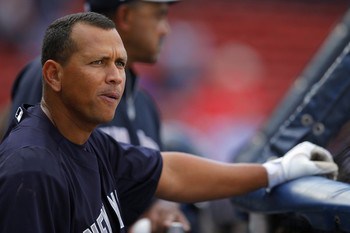
New York Yankees' Alex Rodriguez stretches before American League baseball game at Fenway Park in Boston

In a decision that further defines major league baseball’s cultural standards regarding performance enhancing drugs and the players who use them, New York Yankee Alex Rodriguez was suspended for the entire 2014 season and post-season by an arbitrator yesterday. Rodriguez, a long-time superstar who was once considered a lock to break baseball’s career home run record, and who is the highest paid player in the game, was suspended for illicit drug use without testing positive under the game’s union-negotiated testing system. He was, instead, suspended for a violation of the player’s Basic Agreement under baseball management’s right to police the game and do what is in its best interests.

The evidence that Rodriguez was a flagrant and long-time steroid abuser came from documents obtained from Biogenesis, a lab that developed drugs for athletes and others, as well as convincing testimony. Rodriguez had challenged the suspension in a grievance procedure after MLB handed down a 211 game suspension during the 2013 season. The arbitrator’s ruling, which is confidential, apparently concluded that the player not only cheated, but obstructed efforts to enforce baseball’s intensified anti-drug measures in the wake of the wide-spread use of PEDs in the 90’s and thereafter.

As expected, the result produced the usual complaints and rationalizations from the disturbingly large contingent of baseball fans and writers who remain obdurate regarding the offensiveness of steroid cheating, claiming that it was “a part of the game,” that the objections to it are inconsistent, and that baseball’s vilification of users is hypocritical. They had been practicing these and related arguments for months as they waited for the baseball Hall of Fame voting results announced last week, in which about 65% of the voters showed that they regarded steroid use as a disqualification for the honor, even when a player-user had excelled on the field. Rodriquez’s defeat deeply undermines the cause of the steroid defenders, and the likelihood that their argument will ever prevail. Continue reading

Ethics Observations On Sticks, Leadership, And Chris Christie’s Vindictive Bridge Closing Scandal

Christie apologizes

Before we delve into the starting point for most ethics inquiries—What’s going on here?— a summary…

Last September, the Port Authority of New York and New Jersey closed all but one lane of the George Washington Bridge , horrifically tangling commuter transportation in Fort Lee, New Jersey, just across bridge from Manhattan. The lane closures  delayed emergency responders to four calls, and may have resulted in at least one death. New Jersey Governor Chris Christie’s office had attributed the lane closures to a traffic study.  But smoking gun e-mails emerged proving beyond the shadow of a doubt that the bridge closing was far more sinister: top Christie aides engineered the gridlock specifically to cause problems for Fort Lee, whose mayor had angered the Governor by refusing to endorse him for re-election. It was political payback of a particularly brutal and Machiavellian sort.

“Time for some traffic problems in Fort Lee,” wrote Bridget Anne Kelly, a deputy chief of staff to Christie, in an email on Aug. 13 to David Wildstein, Christie’s appointee at the Port Authority. Wildstein resigned in December after news of the scandal first broke; he has since refused to answer questions in a hearing on the matter, citing the Fifth Amendment. Christie fired Kelly yesterday, and in a long and emotional press conference, profusely apologized while insisting that he knew nothing of the plot, but accepted responsibility for the actions of his staff. The incident is attracting national interest because Christie, a Republican,  is an intriguing and controversial  potential candidate for a 2016 Presidential run.

Observations:

  • This is bad, and there is no defense for it. Government power should never be abused like this, by anyone. Distorting one’s duties to the public to harm members of the public out of such motives as spite, revenge, retribution, intimidation or personal and political gain is the moral equivalent of a crime.
  • In fact, it should be a crime. It can’t be, because the problem is that some degree of such distortions of the duty to act in the public’s best interest are essential political tools that cannot be jettisoned without undermining effective leadership as well. Politics works through the carrot and the stick, and the stick virtually always causes collateral damage. At every level of government, refusing to do what a powerful leader wants must have negative consequences, or nobody will do what the leader wants, and he or she will no longer be effective. That, in the end, hurts the public too–presumably more seriously than the short-term harm from political payback. Continue reading

Here’s The Ethics Lesson From The Hall Of Fame Voting Results Tomorrow…

HOF

And that lesson is: sportswriters have no clue when it comes to ethical analysis, or any other kind of analysis, really.

Tomorrow the results of the Major League Baseball Hall of Fame voting will be announced, and those former stars receiving at least 75% of the vote will be officially enshrined as immortals. Every year before the steroid era, the voting was preceded by weird arguments that made no sense, like the one about whether a former player should be a “first time electee.” Some writers would concede that a given player was great enough for the Hall, but not vote for him because “he wasn’t good enough to get in on the first ballot.” This was, and is, ridiculous, and unfair. The question is, “Was this player great enough to deserve enshrinement, when the standards are unchanging?” It’s a yes or no question. “Maybe next year” is not a valid answer.

Thus I suppose that it should be no surprise that these same clods, faced with some really difficult ethical lines to draw in the wake of the so-called steroid era, show themselves to be not merely dunces, but ethics dunces as well. I just heard a sportswriter, Marty Noble, tell a baseball talk show that he won’t vote for any player about whom there is any question whatsoever regarding whether he cheated with steroids, including doubts based on rumors, whispering campaigns, looks, suspicions and drug tests. But he still voted for some players, he says. Well, that’s just wrong, by his own standards—he can’t be 100% sure about anyone. He also said that while he can vote for up to ten players, and agreed that there are more than ten players this year who have strong Hall credentials, he’s only voting for three. Why? Because, he says, the induction ceremony is too long.

Yes, he’s an idiot. Continue reading

Fun With Rationalizations: Considering Salon’s Attack On The New York Post

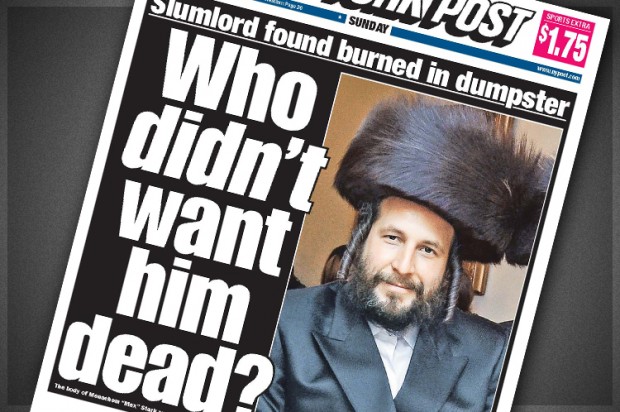
post_cover-620x412

Let me dispense with the outrage over The New York Post’s brilliant (from their perspective, which is selling newspapers) and tasteless front page covering the death of Menachem Stark, a Hasidic real estate developer ( a.k.a. “slumlord”) who was found murdered and burned in a dumpster last Friday in Long Island.

The operative principle is not, as the reader who flagged the issue suggested, the Golden Rule. The Golden Rule does not often apply to the press, which is supposed to be truthful, not kind and diplomatic. There are provisions of most journalistic codes about avoiding unnecessary harm to third parties, which is pretty much a universal ethics rule in every field, from law to the military. When, however, you operate a tabloid, and not just any tabloid but a tabloid whose brand is defined by intentionally shocking, outrageous, assaultive and controversial headlines and photos, “Unnecessary harm to third parties” is almost an impossible principle to apply.

The headline is a perfect example of the Julie Principle, which I explained back in May. The Julie Principle comes into play when an undesirable or annoying  characteristic or behavior pattern in a person or organization appears to be hard-wired and part of their essence.  In judging such a person or entity, it is useful to keep the lyrics of Julie’s song from “Show Boat” (lyrics by Oscar Hammerstein Jr., music by Jerome Kern) firmly in mind, when she sings…

Fish gotta swim, birds gotta fly…

I’ve gotta love that man til I die

Can’t help lovin’ that man of mine!  Continue reading

Ethics Dunce: ESPN Blogger David Schoenfield

...reason is emotion, and emotion is reason...

…reason is emotion, and emotion is reason…

Every year about this time, a large group of baseball writers, not to mention fans, expose their ethics and analytical deficiencies by making terrible arguments for admitting steroid-using stars of note into baseball’s Hall of Fame. The voting for the Hall is going on now, you see, and this year a bumper crop of candidates were either proven steroid users or reasonably suspected of being so.

Also every year at this time, I pick one of those ethically-challenged writers as an Ethics Dunce. This year, the winner is ESPN’s David Schoenfield, by virtue of a sentence near the end of a recent post in support of Frank Thomas and Edgar Martinez, neither of whom are on the Performance Enhancing Drug suspicion list, as Hall of Fame candidates. Schoenfield wrote,

“The PED disagreements are all about emotion (“Cheaters!”) versus reason (“It was part of the game in that era, we don’t know who did what, etc.”).

Talk about a big, fat, hanging curveball over the heart of the plate! Continue reading