Comments Of The Day: “Open Forum…Again!” (Reparations Thread)

This week’s Open Forum was epic. All four major topics raised—children allowed to attempt dangerous challenges, Southern Democrats, Artificial Intelligence, and reparations for slavery, led to excellent, varied and provocative debates. I feel a bit guilty for co-opting the child exploitation thread with a full post; several of the comments in that thread were COTD quality, especially A.M. Golden’s at 8:12 am on the 20th.

The A.I. thread was one of the very best on any topic in the history of the blog. I started out  trying to choose a Comment of the Day from that discussion, and after realizing that there was one  great comment after another, considered re-publishing the whole sequence, but it is too long. I urge anyone who hasn’t done so already to read it all. The participants were adimagejim (who gets credit for opening  the topic), Michael R, Steve Witherspoon, Alex, johnburger2013, and Bad Bob.

I chose the reparations thread to highlight the comments because the topic was recently the subject of a hearing on the Hill, and because I think the “debate” is and has always been intellectually dishonest on the part of “reparations” advocates, who, I suspect, know exactly how impossible their demands and proposals are. Nonetheless the news media treats the arguments with reverence, and are happy to assist when naysayers are accused of insensitivity and bigotry. The Comments of the Day that follow  effectively show just how absurd—and unethical—the reparations case is.

Steve Witherspoon: Continue reading

Comment Of The Day: “Reparations Again”

Reparations for slavery are 1) impossible 2) unaffordable  3) offensive, and 4) guaranteed to worsen race relations rather than repair them, but as long as progressives feel the need to pander to a victim mentality among blacks and think they can prosper by professing to support what they must know is a cynical fantasy, we will continue to hear about them. Ethics Alarms, in turn, will have to keep noting the proposal is unethical.

We got a classic example of the kind of “logic” applied by reparations-mongers when one of the more obscure and unqualified contenders for the Democratic Presidential nomination—you can imagine how obscure and unqualified that must be—announced her support for taking the money from other races to enrich anyone who identifies as the offspring of slaves. Marianne Williams—quick, now, who is she?—told CNN over the weekend,

“It’s simply a debt we owe. This country will not heal until we take a serious moral inventory. A nation must undergo the same level of deep moral inventory [and] admission of our character defects. Racism is a character defect. Let’s end this. Let’s fix this. Let’s solve this. Reparations won’t end everything but it will be a profound gift. It implies a mea culpa. It implies a recognition of a debt owed and therefore, it carries not only economic power but spiritual force — whatever it costs, it’s time to do this.”

Sure.

Here is A.M. Golden’s Comment of the Day on the post, Reprations Again.

I’ll be back with a brief comment after A.M. has his say.

I oppose reparations. It’s no better than the lottery or a medical settlement.

In the Black Community, the concept of “Giving Back to the Community” is huge. It’s expected that, if you run a business in the neighborhood, you will use your largess to help your neighbors. This is, in part, why Asian-owned businesses that tend to be family run get flack because they don’t hire within the community. A wealthy resident or a business owner is made to feel obligated to fund a community center or food pantry (though this is really just making the lottery winner a forced charitable organization or even an extension of government). But, in many cases, “Giving Back to Community” means that you just hand over money to people as loans that are, in actuality, gifts.

I remember attending a sci-fi convention a few years ago with a notable black actor who spent many years working at his trade before becoming famous. At his Q&A session, he talked about a charitable organization he is involved with that sends minority children out into a type of summer camp in open places like Montana so they can be exposed to nature and a different environment. Halfway through the panel, an African-American fellow walked in, sat down, raised his hand and asked what the actor had done to “Give back to the community”. The actor then repeated his earlier description of his charitable work. After that, the newcomer left…probably to go into other Q&A sessions to determine if other black actors were pulling their weight. Continue reading

Reparations Again.

Almost all of the Democratic Presidential wannabes are claiming that they support reparations for slavery. This is signature significance for shameless pandering and dishonesty, of course, and pretty redolent, in my assessment, of buying black votes. There are many, many things coming out of the mouths of the various demagogues, empty suits and crypto-socialists aspiring to unseat Donald Trump that are impossible–banning combustion engines, free college for all, ending the Electoral College, and many more—but reparations is a special species of fantasy, wrong in every way.

I have been periodically reading scholarly and not so scholarly debates about the feasibility  and justification for reparations for decades, and I have come to see this as less of a policy debate than a confession of defeat. Of course, every year that the timeline retreats from the end of slavery, the more logically untenable the mass hand-out of massive amounts of money that the nation cannot afford  to the descendants of slaves becomes. Ethically it was always untenable, and guaranteed, if such an irresponsible thing actually happened, to exacerbate racial divisions while creating endless demands for similar programs to benefit other groups, especially Native Americans. And why shouldn’t women receive reparations for all those centuries of forced labor and childbearing without civil rights, if the United States is going into the retroactive damages business?

Polling is a bad way to conduct a nation’s business, but sometimes the public can detect a true stinker when it sees one:. Reparations are unpopular with about 80% of the population, and I sense that even progressives just pretend to tolerate politicians who blather on about it because they know it’s all for show, and designed to harvest naive votes for more practical crazy leftist proposals.

Many of these proposals involve trying to somehow solve the gaps between black and white success and achievement in America, and mostly consist of rigging the system in various ways, especially now that Affirmative Action’s days are numbered, (and didn’t work that well anyway). Are a disproportionate number of blacks getting tossed out of school? Stop holding blacks to disciplinary standards—better yet, stop holding any students to disciplinary standards. Bad test scores making it more difficult to justify discriminating against Asian-Americans with better test scores? Eliminate testing as part of the college admission process!  Are too many African-Americans incarcerated? Legalize as many of the crimes as possible, and then  stop sending non-violent law-breakers to prison. These and other measures are no more fair of logical than reparations, just cheaper and easier to con or guilt Americans into accepting.

Back in March of 2016, I temporarily lost my mind in the wake of our first black President’s utter failure to address our race problems, despite his soaring rhetoric.  Charts from the Brookings Institution’s Social Mobility Memos blog were posted to the web, and starkly indicated that the  apparently intractable problems of American blacks that I studied in college had failed to improve in 50 years. I wrote this post, in which I  concluded, after a number of depressing observations, Continue reading

Cutting The Racial Gordian Knot: What Are The Ethical Implications Of The Terrible Economic Disparity Between Black And White In America?

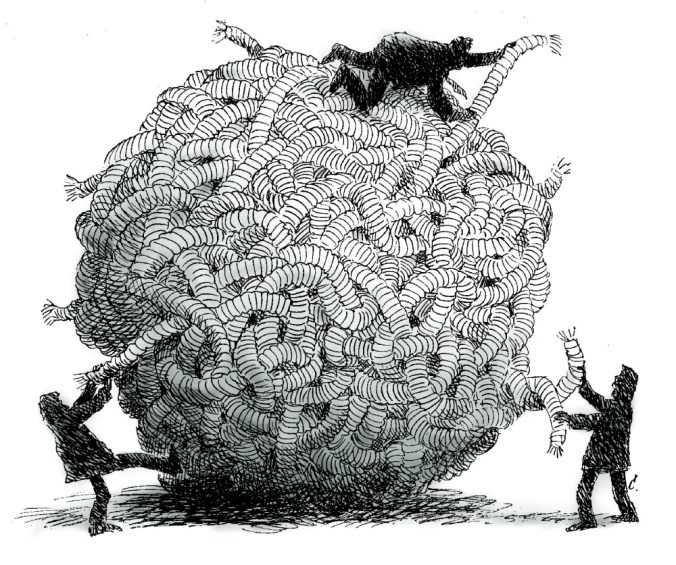
Gordian Knot

The question raises the ethical implications to all American citizens and our shared obligation to our nation and its society of a disastrous, crippling problem that poisons our culture. and society: the persistent plight of Black America.

Back when I was a senior in college majoring in American Government and the U.S. Presidency, I took a course  from Professor Thomas Pettigrew, then as now one of the foremost scholars on race, prejudice and public policy. It was about the challenges facing blacks as they tried then to benefit from new legislation and opportunities created by the Civil Rights Act and other policies, such as school busing. I was very impressed by Pettigrew’s even-handed, objective and non-political approach, even though, at my college, political teaching was the rule, not the exception.

I have never left a course so discouraged. Pettigrew, himself a pretty optimistic man, led us into one dead-end after another: black families, education, neighborhoods, political behavior, crime and more, all dysfunctional or suffering. All areas of black society interfered with or blocked improvements, progress, remedies and policy initiatives that showed promise to address racial inequality in other areas.

Late in the course I asked him if he saw any hope that in 50 years, black America would be approaching parity with white America. “I have hope,” he said. “But I honestly don’t see how we get there from here. There is a path, but we haven’t found it.”

It appears that my discouragement then was an accurate reading of the problems ahead.

Last week, these charts from the Brookings Institution’s Social Mobility Memos blog were posted to the web by other sources. They show how deeply the problems I was warned about have failed to improve in 50 years. Here is what they show:

1. Upward mobility is much more unlikely  for black than white Americans. 51% of the black Americans born into the lowest fifth of the earnings distribution remain there at age 40:

Ethics Quiz: Japan’s Official Apology To The Korean “Comfort Women”

comfort-women

Before and during World War II, the Imperial Japanese Army forced an estimated 400,000 women and girls from occupied territories, primarily Korea, China, and the Philippines, into sexual slavery for the convenience and “comfort” of Japanese soldiers. That the women were kidnapped, raped, and in many cases murdered is not in dispute, but for cultural and political reasons the Japanese government has never accepted full responsibility for the nation’s mass crime, or acknowledged its true nature. To the contrary, Japan has protested memorials to the Comfort women in various locales, including the United States. Japan officially maintains that the women were ordinary prostitutes, and that no crimes were committed toward them. This is a long, bitter controversy between South Korea and Japan particularly.

Pressure from the United States on both Japan and South Korea to resolve the issue had been building, and on December 29, 2015, the two nations reached an agreement by which the Comfort Women issue was considered “finally and irreversibly” resolved. Under the agreement, the Japanese government issued this negotiated statement:

The issue of comfort women, with an involvement of the Japanese military authorities at that time, was a grave affront to the honor and dignity of large numbers of women, and the Government of Japan is painfully aware of responsibilities from this perspective. 

As Prime Minister of Japan, Prime Minister Abe expresses anew his most sincere apologies and remorse to all the women who underwent immeasurable and painful experiences and suffered incurable physical and psychological wounds as comfort women.

As part of the resolution, the Japanese government pledged to contribute one billion yen (about $8.3 million), out of the Japanese government’s budget to a foundation established by the Korean government dedicated to assisting the surviving Korean Comfort Women. Forty six survive. They had no part in the agreement discussions.

The deal is unpopular in South Korea. Critics immediately complained that the agreement is inadequate. Of course it is. $8.3 million would be moderate damages in the U.S. for a single woman who was kidnapped and forced into sexual slavery. Japan is not going to accept full responsibility for the war crimes, and that should be obvious after so many decades and such stubborn denial.

The ethics question that is a bit more challenging is whether the apology is worth the paper it is printed on, or even a true apology. After the agreement, Prime Minister Shinzo Abe  stated: “there will be no future reference at all to this issue [the Comfort Women issue]. We will not raise it in the next Japan-Korea summit meeting. This is the end. There will be no more apology.” Many Koreans feel that an official apology followed immediately by a statement that says, in essence, “There, that should shut them up!” is cynical and worthless. As a Korean issues website put it, “If an apology is not followed by contrition and self-reflection, but instead by gloating—-does that apology mean anything?”

Good question! Let me rephrase that as the Ethics Alarms Ethics Quiz of the Day:

Is the official Japanese apology for the crimes against the Korean Comfort Women ethical?

Continue reading

Unethical Op-Ed Of The Month, Or Maybe All Time: Theodore R. Johnson In The Washington Post

Well, at least that would explain it...

Well, at least that would explain it…

The essay is titled, “We used to count black Americans as 3/5 of a person. For reparations, give them 5/3 of a vote.” Yes, it’s serious. There is so much wrong with it logically, ethically, historically, legally, and Constitutionally, that it would take more words, time and effort to fully rebut all the nonsense in the article than this oddity is worth. Go ahead, read it. If your first reaction is, “Hey! What a brilliant idea!,” it’s time to seek professional help, and I don’t care what color you are.

Rather than give this perverted, anti-democratic fantasy the dignity of a rebuttal, I’ll just offer a few observations: Continue reading

Ethics Quiz: “12 Years A Slave” Plays The Racial Guilt Card On Oscar Voters

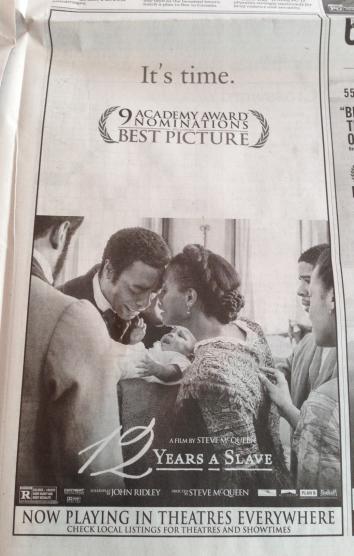
12_years_ad_2.jpeg

“It’s time.”

This is the  tag line in the post-Oscar nomination ads being prominently run in New York and California for  “12 Years A Slave,” a strong Academy Award contender (nine nominations, including best film).

Although there is room for disagreement, and the ad has the virtue of all clever advertising that it conveys different messages to different markets—Haven’t seen the film yet? “It’s time!”  Desperate to see the best movie you saw in 2013 finally get its due? “It’s time!”  When will the question of whether the most honored film of the last 12 months will win the biggest honor of them all be answered? “It’s time!”…or almost time, as the Oscar ceremonies are coming up on March 2—the consensus is that “It’s time” is mainly aimed at Oscar voters, and the message it conveys is, as Slate puts it, “it’s time for a movie about slavery, and with a significantly black cast and crew, to be recognized by the Academy of Motion Picture Arts and Sciences.” Film critic Phil Hammond puts it slightly differently:

“The ad not only can be interpreted as shining a light on a very dark period in American history, it also shines a light on the Academy’s fairly dismal record of awarding its top honor to any movie about the black experience. In fact there has been only one Best Picture winner in the 85 years the Academy of Motion Picture Arts and Sciences has been handing out Oscars that even remotely qualifies in this regard. In 1968, In The Heat Of The Night, a murder mystery set against the racial divide in a small Southern town, won Best Picture and four other Oscars just a few days after the assassination of Martin Luther King (the ceremony was even postponed two days out of respect). The votes were in before the King assassination, but it seemed then that “It’s Time” would have been an appropriate way to describe that victory. However, outside of lead actor Sidney Poitier — who also co-starred in another racially themed Best Pic nominee that year, Guess Who’s Coming To Dinner —  this movie  featured a largely white cast, white producer, screenwriter and director (Norman Jewison).”

If so many in the industry are interpreting the ad this way, it is fair to assume that this was at least one of the ad’s objectives, and on the assumption that it was an objective, your Ethics Alarms Ethics Quiz today is this:

“Is appealing to Oscar voters on this basis fair and ethical?”

I can see strong arguments for each position. Continue reading

Ethics Quote of the Week

“For many African-Americans, these facts can be difficult to accept. Excuses run the gamut, from ‘Africans didn’t know how harsh slavery in America was’ and ‘Slavery in Africa was, by comparison, humane’ or, in a bizarre version of ‘The devil made me do it,’ “Africans were driven to this only by the unprecedented profits offered by greedy European countries.”

Henry Louis Gates, in his New York Times op-ed, “Ending the Slavery Blame-Game,” confronting the complicity of Africans in American slavery by selling their own people to slave-traders.

Harvard professor Gates, a respected authority on race in America despite his problems with the Cambridge police, has made an admirable effort to take the issue of reparations out of the context of racial guilt-mongering and forcing advocates to deal with facts rather than emotion. The fair starting point for discussions, Gates points out, is that the ancestors of white and black Americans profited from slavery.

Does this rule out any fair and coherent allocation of slave reparations, which were conceptually problematical already? Probably, and if so, we should move on to more productive debates. Gates is brave and responsible for shining light on a genuinely “inconvenient truth.”