Missouri’s Unethical Food Stamps Bill

Sometimes you just need a good lobster. I'm from Boston. Trust me on this.

Sometimes you just need a good lobster. I’m from Boston. Trust me on this.

Years ago, my wise and wonderful first year Contracts professor at Georgetown Law Center, the late Richard Alan Gordon, made a permanent impact on my conscience with a spontaneous rant. He was discussing a case involving a welfare recipient who had been sued by a Washington department store for failing to keep up with installment payments on a Hi-Fi system. The court voided the contract, saying that it was unconscionable for the store to intentionally create incentives for poor people to spend public assistance money on “non-essentials” like music systems. (I wish I remembered the name of the case, but then I only got a C+ in the course.)

As the students nodded their heads in agreement with the opinion, Professor Gordon cut them short and thundered (I am copying from faded old notes: Dick’s rants were always eloquent and memorable, and I began reconstructing them after class for posterity):

“Outrageous! Who are you, or a court, or a government, or any authority to tell another human being that feeding his body is more important than feeding his soul? Music is “non-essential”? I suppose that means that literature, culture, inspiration, wisdom, knowledge…or a moment of joy, the thrill of discovery, experiencing a concert, admiring a great work of art, or sharing an intimate and timeless moment with the love of your life is “non-essential” too! Neither the law nor any court nor a government authority has a right to dictate what is essential to any human being, whether he is receiving public assistance or not. Being poor imposes its own cruel restrictions on liberty and autonomy. Imposing more still is both an abuse of power and a violation of basic human rights. This is an assault on human dignity.”

Continue reading

Tales of the Indiana State Legislature: “Your Baby Is A Racist!”

Indiana State Rep. Vanessa Summers. (All right, not really, but I couldn't resist. Read the story and you'll get it.)

Indiana State Rep. Vanessa Summers. (All right, not really, but I couldn’t resist. Read the story and you’ll get it.)

Can it get worse than this? During the debate  in the Indiana House  over the Religious Freedom and Restoration Act,  state Rep. Vanessa Summers, (D-Indianapolis) rose to set a new record in outrageous race-baiting.

“I told [Republican colleague] Jud McMillin I love his son, but he’s scared of me because of my color.”

Responding to a rumble of protest from her assembled colleagues, Summers insisted, “It’s true.” When challenged on the assertion later. she defended her accusation, saying:

“He (the eighteen-month-old child) looked at me like I was a monster and turned around and cried. And I told him (McMillin) you need to introduce your child to some people that are dark-skinned so he will not be scared.”

There are so many take-aways from this episode that it’s difficult to know where to begin, or where to stop.

Continue reading

Jerks, Liars, Hypocrites, Fools and Hoosiers: 10 Ethics Observations On Indiana’s Religious Freedom Restoration Act Controversy

Indiana5

1. The law was passed to make discrimination against gays, trans individuals and especially same-sex couples seeking marriage if not easier, to at least seem easier. Anyone claiming otherwise is lying, or being intentionally obtuse. Would Indiana be passing this law without the Hobby Lobby decision or the various court rulings requiring photographers, bakers, and other businesses to provide the same products and services to gay couples that they do to heterosexuals? Yes, you say? Tell me another.

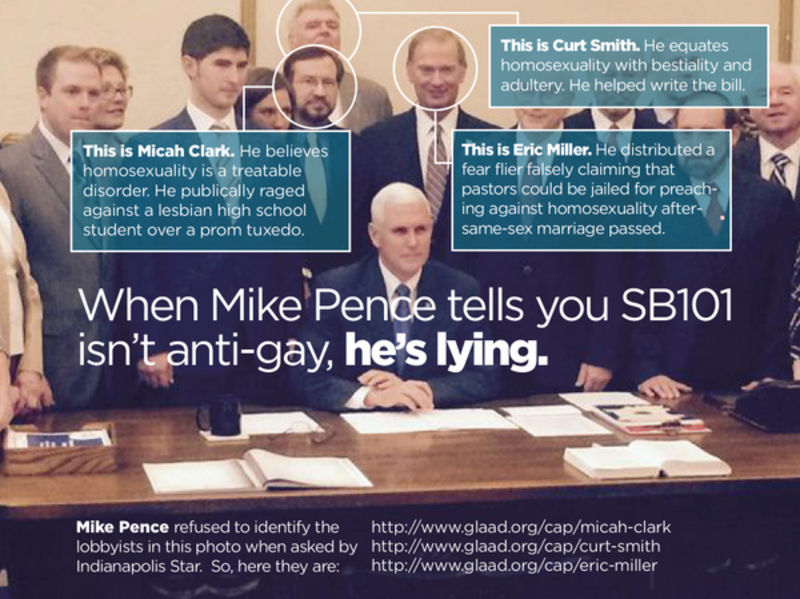
As GLAAD alertly pointed out, Governor Pence was surrounded by anti-gay activists when he signed the bill:

GLAAD Pence

This is res ipsa loquitur, and doesn’t speak well for the Governor’s candor or intelligence.

2. Context matters. The original laws of this sort (the Federal law signed by President Clinton is also called the Religious Freedom Restoration Act) were part of the left’s long range pro-drug strategy, like medical marijuana. It was essentially a hippie law designed to create a slippery slope to recreational drug legalization by allowing fringe religious groups, specifically Native American tribes, to use peyote in tribal ceremonies. Now you understand why Clinton signed the bill.

Oops. Excuse me if I enjoy the spectacle of the clever members of the Church of the Perpetually Stoned—including the ACLU, which once supported such laws as long as they pointed the way to their young lawyers being able to have their Saturday night joints legally but now opposes them—being hoisted on their own petard.

“When the federal government adopted a religious protection act in 1993, same-sex marriage was not on the horizon,” whines the New York Times. Well, competent, well-considered, properly drafted, responsibly passed laws don’t suddenly become unbearable, then fine, then unbearable again with every shift of the cultural winds. The intent of the law was never to protect mainstream religions, but cloaked itself in language that did. It backfired.

3. That being stipulated, the good states need to read their own laws before they start grandstanding. Connecticut Governor Dan Malloy just announced on Twitter that he plans to sign an executive order banning state travel to Indiana in response to its Religious Freedom Restoration Act. Yet Connecticut, hippie enclave and bedroom community of rich, white, liberal New Yorkers that it is, happily jumped on the religious freedom train with a law of its own, one that, as the Federalist points out, makes discrimination on the basis of religion easier than the Hoosier version, which only prohibits the government from substantially burdening religion. Connecticut’s law does not include the word “substantially,” meaning that all government-enacted burdens on religion are theoretically illegal.

I wonder how Malloy is going to ban government travel to Connecticut? Is the theory that the same law can be good when liberal states pass it and evil when those bad conservative states pass it? It is more likely that the governor hasn’t looked at his own state’s law.

4. The hysteria being stirred up over the supposed horribles Indiana’s law will lead to is irresponsible. Jonathan Adler explains on The Volokh Conspiracy: Continue reading

Unethical Quote of the Week: Sen. John McCain, and also “WHAT????”

U.S. Senator John McCain gestures as he arrives to address the third session of the Republican National Convention in Tampa

“It was kind of a very rapid process. Everybody was looking forward to getting out of town because of the snowstorm. I think we probably should have had more discussion about it, given the blowback that there is.”

—- Sen. John McCain (R-Az) to Politico, explaining and making excuses for 47 Republican Senators injecting themselves into sensitive U.S. negotiations with Iran over nuclear weapon development..

1. I am speechless. Luckily, I can type.

Well, sort of.

2. The silver lining: at least the Senator just made those regretting President Obama’s election in 2008 feel better. We were spared embarrassing moments like that of President McCain, asked why he sent missiles to destroy Toronto, explaining, “Yeah, I was watching “Family Feud,” had to run to the can, and was distracted. Hey, it happens.” Continue reading

Iran Letter Ethics Q and A: Senate Heroes, Blame, Trust And Captain Queeg

Question:  Are the seven GOP Senators who did not sign the Iran letter Ethics Heroes?

Answer: I almost designated them as such, but that would have been a mistake. There are too many non-heroic and even unethical reasons Sen. Lamar Alexander (R-Tenn.), Sen. Lisa Murkowski (R-Alaska), Sen. Dan Coats (R-Ind.) and Sen. Thad Cochran (R-Miss.), Sen. Susan Collins (R-Maine), Sen. Jeff Flake (R-Ariz.), and Sen. Bob Corker (R-Tenn.), Senate Foreign Relations Chairman might have chosen to refuse to go along with their colleagues. Based on the explanations I’ve read, that seems to be the case. Collins, for example, says that she didn’t think the letter would work. Wrong answer: the reason to reject the letter is because it’s a flat-out violation of legislative limits imposed on the Constitution. Similarly, Flake says that he didn’t think the letter was necessary, whatever that means. It is also likely that some of the seven felt they could have their cake and eat it too: they want the letter to undermine U.S. diplomacy, but don’t want to take the criticism that goes with signing it.

Question: Do I blame President Obama for the letter?

Answer: A friend who is such a knee-jerking Obama enabler and excuser that it’s a miracle he can walk posted yesterday’s  Thirteen Ethics Observations On The GOP’s Letter To Iran on his Facebook page, and one of his knee-jerking friends wrote, “Typical: blame Obama.” I did not and do not blame Obama for the fact that the Republican Senators engaged in a foolish, dangerous and bright-line violation of the separation of powers, and anyone who could read the post otherwise is so deranged by bias that their faculties are impaired…or they just aren’t very bright.

I did write, and it is true, that the President shares significant responsibility for the poisonous and dysfunctional relations with the Congress that led to this fiasco. He is at the top of the government; it’s ultimately his job to make the government and the system work. Obama and his enablers reject accountability at every turn, but the unavoidable facts are that he is in charge, he took the job voluntarily, and whatever doesn’t work, including the government itself, is on his record. He never made a good faith, sincere, dedicated effort to work with the Republicans in Congress; he never worked to develop the negotiation, compromise, horse-trading, cajoling, quid pro quo skills that successful, competent Presidents have used to deal with the same levels of political opposition that he has found impossible to cope with. He took no steps to build trust in Congress, and engaged in serial conduct that was guaranteed to destroy trust, and has.

Finally, his illegal immigration executive order (the illegal accurately modifies both “immigration” and “order”) and his unilateral alterations to his own, incompetent and sloppy, health care law showed exactly the same contempt for constitutional limits as the Senate letter.

Obama is not to blame for the letter. He is absolutely and ultimately accountable for the conditions that prompted the letter and the decision to send it.

Question: Is there an ethical justification for sending the letter? Continue reading

Thirteen Ethics Observations On The GOP’s Letter To Iran

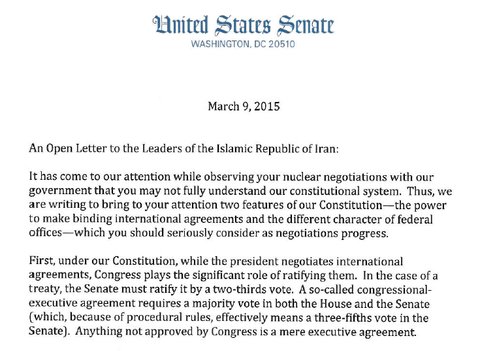
Letter to IranFrom the Washington Post:

“An already heated battle between the White House and Republicans over negotiations to curtail Iran’s nuclear program grew more tense Monday when 47 Republican senators sent a letter to Iran designed to kill any potential deal.

The White House responded by accusing the Republicans of conspiring with Iranian hard-liners, who oppose the delicate negotiations, and suggesting that their goal was to push the United States into a military conflict.”

Observations:

1. The letter cannot be defended as anything other than an effort to sabotage sensitive international negotiations. As such, it is direct interference with the President’s ability to do his job. The fact that Republicans, like Israel, have abundant evidence that President Obama is likely to do that job, in this case, badly and even dangerously is no justification for this unethical, unconstitutional, arrogant and offensive act. The American people elected Obama president, and with that came the authority to conduct foreign affairs and oversee negotiations with foreign governments. The letter is wrong in every way.

2. It does not matter, and should not matter, to any American whether or not they believe that a breakdown in negotiations with Iran would be preferable and safer than the kind of deal this President is likely to produce. It does not matter. The letter is per se a breach of the separation of powers, and as precedent, endangers the nation’s entire governance structure.

3. Anyone who defends this atrocious, reckless and unprofessional conduct is fully embracing “the ends justifies the means” as a principle of democratic government.

4. If he was not aware of it and did not approve it, Republican Senate leader Mitch McConnell is obligated to condemn this action, and punish all signatories,  stripping them of committee assignments related to foreign affairs.

5. He won’t. Continue reading

Ethics Observations On The Selma Celebration “Gotcha’s!”

Selma redux

1. The big controversy as of this morning involved the New York Times front page photo, which managed to be cropped exactly at the point where former President Bush could have been seen. Given the Times’ proclivities, conservative blogs and Fox News presumed the snub was intentional. If it had been intentional, that would have indeed been disrespectful and unethical photojournalism. The Times explanation, however, seems reasonable. It tells us something, though, that nobody at the Times saw this coming. I think it’s incompetence born of bias. “Where’s Bush?” “He was too far down the line, so the photo looks lousy if he’s included.” “Damn. Well, put a note in explaining that.” Bias makes us stupid, and the fact that no Times editor had this conversation is, in fact, stupid.

2. If the NAACP was setting the place cards, and I assume they were, then Bush should have been second row center, and not an MSNBC demagogue and race-hustler who owes the U.S. back taxes. Talk about biased and stupid. The NAACP claims it wants to be a unifying force in the country, but it doesn’t. It promotes divisiveness,and intentionally. It’s good for business.

3. A graceful, fair, respectful and competent President of the United States would have insisted that his immediate predecessor be in a position of prominence, as part of the message that this event was an important part of the history of America and all Americans. It would have been the right thing to do. Bush would have done the same for him. But we do not have a graceful, fair, respectful and competent President. We have an arrogant, petty, self-absorbed and divisive one.

4. …who can, on occasion, rise to give an excellent speech, which he did. Continue reading

Ethics Tales: How Julia Sand Saved A President And Changed The Nation

open book on concrete background

In my recent overview of the U.S. presidency (the four parts are now combined on a single page under “Rule Book” above), I noted that our 21st President, Chester A. Arthur, was one of my personal favorites and an Ethics Hero. He confounded all predictions and his previous undistinguished background, not to mention a career marked  by political hackery and toadying to corrupt Republican power broker Roscoe Conkling, to rise to the challenge of the office and to effectively fight the corrupt practices that had elevated him to power. Most significantly, he established the Civil Service system, which crippled the spoils and patronage practices that made the Federal government both incompetent and a breeding ground for scandal.

I did not mention, because I did not then know, the unlikely catalyst for his conversion. Recently a good friend, knowing of my interest in Arthur, his tragic predecessor, James Garfield, and presidential assassinations sent me a copy of Destiny of the Republic, the acclaimed history of the Garfield assassination and its aftermath by Candace Millard. It’s a wonderful book, and while I knew much of the history already, I definitely did not know about Julia Sand. Her tale is amazing, and it gives me hope. If you do not know about Julia and Chester, and it is not a well-known episode, you should.

Allow me to tell it to you?

James Garfield, an Ohio Congressman, had been the dark horse nominee of the Republican Party in 1880, foiling the ambitions of many powerful politicians, the most powerful among them being Sen. Roscoe Conkling of New York. In order to cement New York’s electoral votes, the convention gave the Vice Presidential nomination to Conkling’s lackey, the dignified-looking but otherwise unimpressive Chester A. Arthur, who may have been the least qualified individual ever to run for that office. The highest position he had ever held was Collector of Customs of the Port of New York, which had been handed to him by Conkling, and he was later removed from that post for incompetence and corruption.  He’d never been elected to significant office or been any kind of executive. Arthur’s career before becoming Vice President makes Sarah Palin look like Winston Churchill.

After the election, Arthur got to work being a disloyal Vice-President, acting as Conklin’s agent in the White House. (Arthur, a widower, even lived as a guest in Conkling’s Washington mansion.) He actively undermined Garfield’s efforts at government reform, at one point going so far as signing a petition supporting Conkling when Garfield refused to appoint only Cabinet members with the Conkling stamp of approval. Then,  on July 2, 1881, less than six months after taking office, the impressive Garfield was shot in Washington D.C.’s Union Station by Charles Guiteau, easily the craziest of the various crazies who have taken a shot at our leaders. (He was also the only lawyer in that group.)

Everybody was horrified, initially at the crime, but also at the prospect of Arthur becoming President. Some even suspected him of being complicit in the act; Guiteau didn’t help by writing Arthur a letter prior to his attack telling him what he needed to do as President.  Most, however, were just aghast at the prospect of the brilliant, courageous, skilled and honorable Garfield being replaced by this utter non-entity under Conkling’s thumb.

None were more aghast than Chester A. Arthur. He may have been a hack, but he was no fool, and he knew he wasn’t up to the job. It was reported that when he learned of Garfield’s shooting, Arthur began weeping like a child. During the nearly three months it took the hardy Garfield to die—he was killed by sepsis induced by the unsanitary prodding of his doctors as they searched for Guiteau’s bullet: the wound itself was probably survivable—Arthur descended into panic, shock, and depression.  For nearly two months, he stayed at home with the blinds drawn, fearing his own assassination. So invisible was he that there were  rumors that Arthur had poisoned himself.

Then Arthur received a letter, dated August 27, 1881, from a woman he did not know, Julia Sands. It immediately got his attention, for she addressed him in a manner he had never been spoken or written to before. The remarkable letter said in part… Continue reading

The Ethics Of Netanyahu’s Speech and the Consequences Of Lost Trust

netanyahu

One of my knee-jerk progressive Facebook friends is addicted to terrible analogies. Here is his recent attempt to frame the controversial appearance by Benjamin Netanyahu before Congress today:

“At the invitation of Speaker Yuli Edelstein, President Barak Obama will appear before the Israeli Knesset on Thursday to give a major speech on the Netanyahu adminstration’s bungling of the Palestinian conflict, territorial abuse to build settlements, and allocation of US foreign aide…”

What’s wrong with that? You have three seconds.

Time’s up. That is a lousy analogy, because the positions of the U.S. and Israel are not accurately reversed as a good analogy would demand. If Netanyahu was appearing before Congress to lecture it on U.S. policies regarding illegal immigration over the Mexican border, that would justify my friend’s hypothetical. What Netanyahu is here to talk about, however, is the future of his people and his nation, not ours.

As I wrote here about a month ago, there is no question that this is a breach of diplomatic protocol, nor is there any doubt that Congress is defying tradition, separation of powers and probably the Constitution to invite the Israel Prime Minister to, in essence, lobby the public regarding the President’s conduct of foreign policy. Congress’s actions are objectively unethical, a calculated tit for the President’s equally unethical tat of using executive orders to circumvent the lawmaking process. This episode is ethically more complicated than that, however, and when the criticism is doled out, other ethical considerations and principles are relevant.

Here is the chief one: Netanyahu does not trust the judgment, motives, negotiating skill and competence of the Obama Administration. Continue reading

Ethics Dunces: The Republican “Base”

National religion

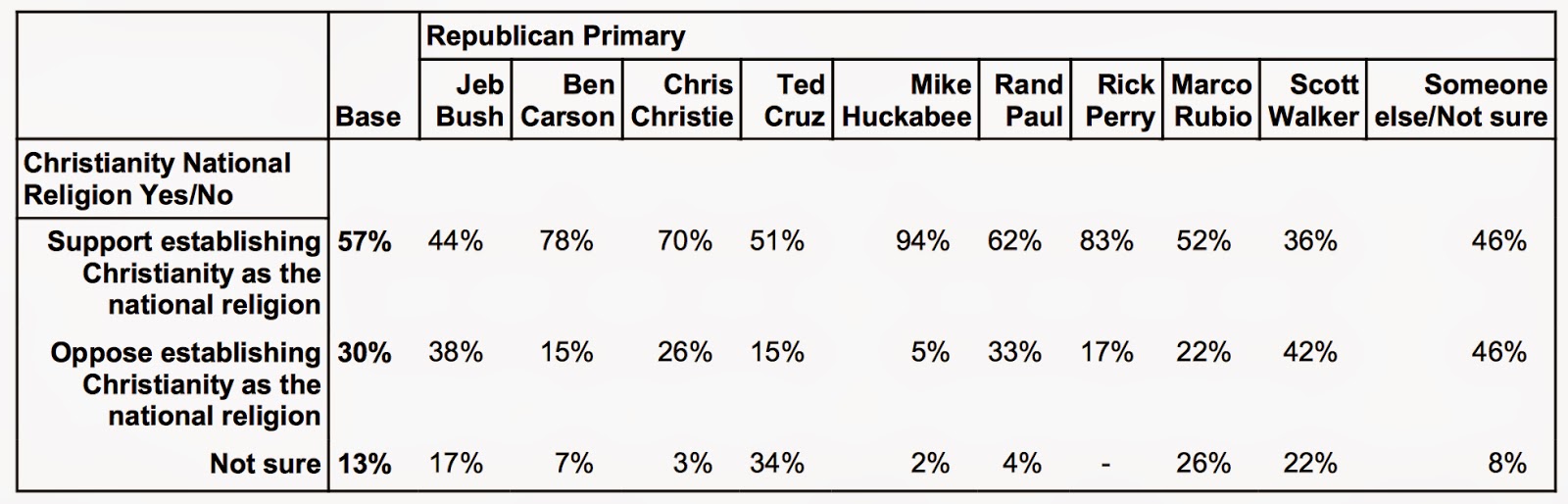
Public Polling Policy surveyed 316 Republican primary voters—the hard core— from February 20th to 22nd to measure their attitudes and policy views, as well as their current preferences for President. The margin of error for the survey is +/- 5.5%. The results are here.

The headlines will be about the candidate rankings, which are meaningless at this point. The valuable revelation, especially for Democrats who want to mercilessly mock their Republican friends, if they have any, and Republicans who want to drown themselves out of hopelessness and shame are…

A. The graphic above, showing that 57% of the Republicans polled want to establish a national religion, Christianity, and

B. The fact that only 37% believe in evolution. Continue reading