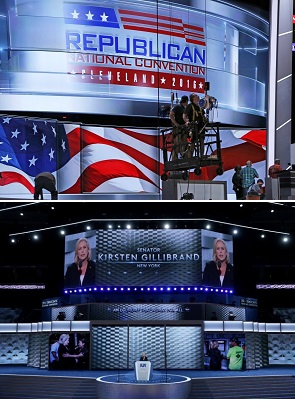
Is It Fair To Question The Democratic Party’s Values When It Has No American Flags Visible During Its National Convention?

Yes.

Of course yes.

One of these things, is not like the others...

One of these things, is not like the others…

Opening night of the Democratic National Convention—that gathering of the historic institution created by Thomas Jefferson and Andrew Jackson to facilitate democracy by fulfilling the idealistic vision of the Founders, who bravely led the original colonies, represented by thirteen red and white stripes, to rise up against a hereditary monarchy and through courage, sacrifice and enterprise create the most successful and humanist nation ever seen on earth…you know, that Democratic National Convention?—showed no American flags on the stage, no red, white and blue symbolism, and an apparently flagless crowd.

Was the American flag actually banned from the convention? That can’t be…but it certainly looked like it.  The absence of any flags can’t be an accident, or unintentional.

What’s going on here?

Nothing good.

Nothing healthy.

In the eight years since Barack Obama was nominated…by the way, here is the scene of his second nomination, just four years ago…

Obama Accepts Nomination On Final Day Of Democratic National Convention

…the Democratic Party has morphed into an organization that is increasingly dependent on the pleasure and approval of anti-American groups. The supporters of illegal immigration, some of whom advocate returning the Southwest to Mexico; angry black liberation movement activists, who regard the United States as a racist nation and culture; radical internationalists, who believe the United States should not only behave like “other first world nations,” but allow itself to be governed by them; progressives whose view of the United States, nourished by indoctrination in the public schools and colleges dominated by far left faculties, is relentlessly negative; growing numbers of socialists, anti-capitalists, anti-law enforcement activists and fans of soft totalitarianism—-these are increasingly the voting blocs that the professional politicians who  run the Democratic Party feel they must pander to and satisfy. Continue reading

“Bewitched” Ethics: A Startling Lesson In How Increased Sensitivity To Other Cultures Constitutes Progress

http://www.youtube.com/watch?v=oOOFdNWPP04

The Sixties witchery sitcom “Bewitched” is a guilty pleasure, mostly because of the superb cast and unabashed silliness of the enterprise. (I do avoid the episodes with Darrin 2, Dick Sergeant, who took over the role of Samantha’s befuddled mortal husband—without any explanation in the series—after the Definitive Darrin, Dick York, became unable to perform.) A new cable channel is running the series in the morning, and today I saw an episode that delivered a series of shocks that never would have registered in 1968, when it first aired. Some of them should have, though.

The episode, “A Majority of Two” (the title evokes the stage and film comedy “A Majority of One,” about a romance between a middle-aged Japanese man and a Jewish widow from Brooklyn)  involves Darrin’s boss, the weaselly Larry Tate, conning Samantha into hosting a dinner for important advertising client Kensu Mishimoto, who is flying in from Japan. Sam agrees—after all, a nose twitch or two is all it takes—but asks Larry what to serve, Japanese or Western cuisine. Larry is prepared: he gives Samantha a note with the name of what Mishimoto’s secretary told Tate was the businessman’s favorite  dish: Hung Ai Wan Goo Rash. There being no internet, Sam worries about how she will get the recipe.

Let’s count the insensitivity jolts here: Continue reading

The Black Lives Matters Effect, Part I: The Tenor And The Blogger

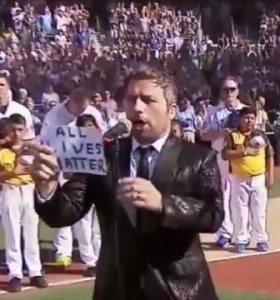
Singing the right lyrics also matters, you boob...

Singing the right lyrics also matters, you boob…

One thing you have to say for Black Lives Matters: it is good at making people make asses of themselves. “Late Night” host Seth Myers was yesterday’s example, but there are oh-so-many-more, and much worse.

For example, in the pre-game ceremonies of the Major League Baseball 2016 All-Star Game in San Diego, a Canadian tenor, apparently driven to distraction by the reverential treatment given to a group that promotes race hatred and a color-based standard for law-enforcement, snapped while performing the Canadian national anthem. Remigio Pereira, a member of  the vocal group The Tenors tapped to sing the anthem, held up a handwritten sign that read “All Lives Matter” altered the lyrics in the line “With glowing hearts we see thee rise. The True North strong and free” to “We’re all brothers and sisters, all lives matter to the great.”

This doesn’t fit the music, and is even worse than the real lyrics, which is quite a feat. Of course, Remigio was unethical to do this, expropriating an event that had nothing to do with Black Lives Matter, nor race, nor politics to make his own grandstanding statement (come to think of it, baseball does have something to do with grandstands. The stunt was disrespectful of everyone—his hosts, Major League Baseball; San Diego; the captive audience in the stadium, the TV audience, Canada. It was also a breach of trust that directly and perhaps fatally wounded his group, which immediately suspended him (Can we say F-I-R-E-D, Tenors? Sure we can) and issued an abject apology.

The statement was not unduly disrespectful to Black Lives Matter, however, which has shown itself to be unworthy of respect, as all divisive hate groups are.

The Black Lives Matters effect is wide-ranging, however, as this episode shows. It not only makes Canadian tenors irresponsible, but sportswriters too. Over at NBC Sports online, baseball blogger Craig Calcaterra couldn’t perceive the unethical nature of a performer hijacking a paid gig for his own purposes, but lectured his readers on the sin of using the term “All Lives Matter,” writing,

This may not seem terribly controversial to some, but in the context of the Black Lives Matter movement that has risen over the past few years, “All Lives Matter” has come to be seen as a reactionary response which fundamentally misunderstands — often intentionally — the purpose of the Black Lives Matter movement. And is used to belittle and marginalize the Black Lives Matter Movement. The phrase “black lives matter” does not mean that “black lives matter more than any other lives.” If it did, sure, maybe “All Lives Matter” would be a reasonable response. But “Black Lives Matter” is a response to a society and, particularly, police, which treat blacks as lesser persons and who do not face repercussions for harming and in some cases killing black people through excessive force. It’s “black lives matter too” — a necessary statement, sadly — not “black lives matter more.”

Sigh. Continue reading

McAfee And Me: An Ethics Rant

I have written here before about my theory that the needless complexity of life, especially involving daily interactions with technology, are driving normal people crazy, and sometimes homicidally crazy. While activists and justly alarmed citizens point to guns and mental health policies to explain murderous rampages by citizens previously regarded as quite and law abiding, insufficient attention is being paid to the ratcheting-up of daily stresses caused by the private and public sectors gratuitously making  daily life unbearably frustrating to navigate, particularly for the less skilled navigators among us.

I don’t expect to snap, but you never know. It is said, I assume apocryphally, that there was a sick drawing New Yorker black humor cartoonist Charles Addams would send to his editor when he was about to have one of his periodic breakdowns, and the magazine would see that he was deposited in his favorite sanitarium in a timely fashion. If you read the message  “AGGGGGGGGGGGGGGGGGGGGGGGGZZZZZKKKKKAAAAARHHHHHYY!”-and nothing else--in a future post, you will know that I have gone full Sweeney Todd (Sweeney in his fury and grief determined that half the human race were so cruel and corrupt that they deserved to die, and that they made the other half so miserable that it was merciful to murder them too) and my immediate neighborhood is in mortal danger. Call the police. I don’t have a gun, but I don’t need one: I’m pretty good with a baseball bat.

If and when that happens, something like my experience yesterday will be the cause.

I have a new netbook, and it included a free 30 day trial subscription to McAfee’s virus protection service. For a week I had been getting obtrusive pop-up ads from McAfee telling me that my protection was about to lapse and my opportunity to purchase a special discounted continuation of the service (Just $39.99, marked down from $89.99!) would soon evaporate. Yesterday was the expiration date, so I decided to accept the offer and sign up online.

I checked the appropriate boxes and filled in all the information, including the credit card data. The attempt to pay was rejected, the screen told me, for my security code, that little three digit number on the back of the card, was incorrect. So I reentered it, after checking it carefully. After much churning and two “preparing your order” screens, I again got the error message. Huh. I tried again. Same thing.

This provoked a mature explosion quite familiar to my wife and dog (the dog hid under the bed), in which I cursed all online purchase, subscription and registration procedures, which inevitably take far longer than they are supposed to, are so complicated that they invite human error, and appear to have been designed by Joseph Mengele as some kind of sadistic experiment. My wife sagely suggested that I try another credit card, since the one I was using had recently been the object of a bank screw-up that ate another several hours of my rapidly dwindling life span. This I did…four times. Every time, the security code was flagged as entered wrongly, which it was not. Finally, I used a third card. Again, no dice, “incorrect data.”

The attempt to pay McAfee $39.99 had now taken about a half an hour. Continue reading

Hey Uber: Shut Up And Drive.

Ubergunviolence3.sized-770x415xt

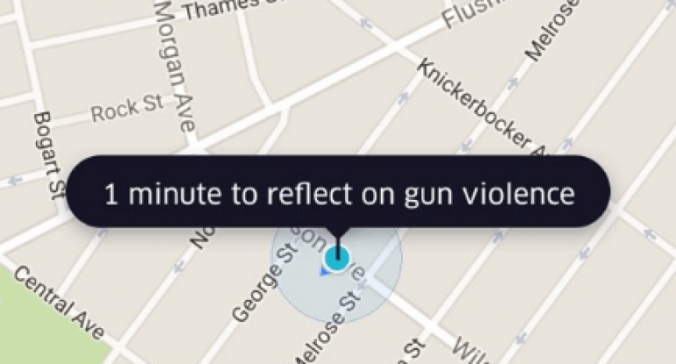
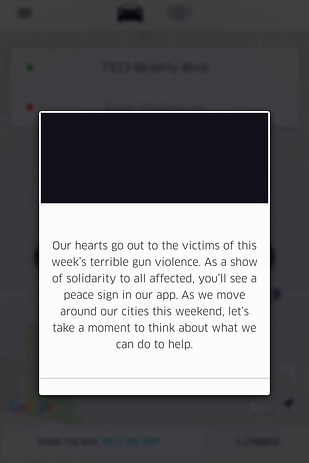
Uber, the transportation networking company, now subjects customers seeking to book a ride to a directive calling on them to think about gun violence before they continue the process. When users open the Uber app, they see a message reading, “Our hearts go out to the victims of this week’s terrible gun violence….As we move around our cities this weekend, let’s take a moment to think about what we can do to help.”  Thusly:

Ubergunviolence2

Okay, here’s what Uber can do to help. Stop referring to law enforcement action, even if it’s excessive, as “gun violence.” Stop referring to racially motivated hits, like the murder of the Dallas police officers, as “gun violence,” as if in some alternate universe where there are no guns, Micah Johnson would have hurled spitballs at the officers to show his contempt. In fact, Uber can shut up entirely.

And stop suggesting that the shooting of two individuals in a police confrontation is equivilent to the assassination of five police officers. How despicable.

We saw this kind of arrogant, obnoxious abuse of the customer/service relationship when Starbucks decided it was appropriate to challenge its customers to have dialogue with 20-something barristas about race. Uber knows how to get me to my destination, supposedly. It has no more expertise regarding social and law enforcement policies than my mail carrier, and if he tells me to take a minute to think about gun violence before I can get my mail, I’m telling him to go to hell.

Uber is showing disrespect for its customers and its customers’ time. The company has no right to rob me of a single moment to force-feed me its anti-gun chairman’s political views, and I would say the same if they were pro-gun sentiments. It’s unethical to make me a captive audience for ten minutes, five minutes, a minute or a second. I’m calling for a ride, not indoctrination, not presumptuous attempted enlightenment, not to be told to save the whales, reduce my carbon foot print, vote for Hillary, or think about gun violence.  Continue reading

Unethical Manager Writes Advice Columnist For Affirmation, Gets Head Handed To Him.

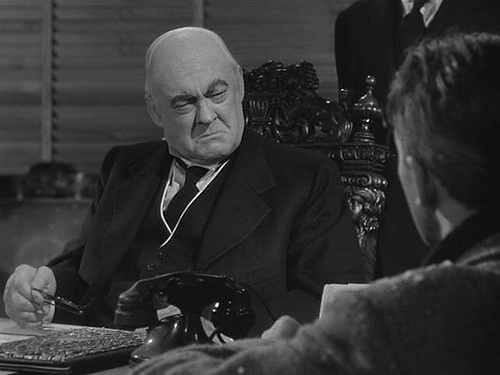
mr-potter

Well and rightly done, Allison Green!

Allison Green, a management advice blogger, received this jaw-dropping question from a relative of Mr Potter:

I manage a team, and part of their jobs is to provide customer support over the phone. …One employee asked to come in two hours after the start time due to her college graduation ceremony being that same day (she was taking night classes part-time in order to earn her degree). I was unable to grant her request because she was the employee with the lowest seniority and we need coverage for that day….I told this team member that she could not start two hours late and that she would have to skip the ceremony. An hour later, she handed me her work ID and a list of all the times she had worked late/come in early/worked overtime for each and every one of her coworkers. Then she quit on the spot.

I’m a bit upset because she was my best employee by far. Her work was excellent, she never missed a day of work in the six years she worked here, and she was my go-to person for weekends and holidays.

…I want to reach out and tell her that quitting without notice because she didn’t get her way isn’t exactly professional. I only want to do this because she was an otherwise great employee, and I don’t want her to derail her career by doing this again and thinking it is okay. She was raised in a few dozen different foster homes and has no living family. She was homeless for a bit after she turned 18 and besides us she doesn’t have anyone in her life that has ever had professional employment. This is the only job she has had. Since she’s never had anyone to teach her professional norms, I want to help her so she doesn’t make the same mistake again. What do you think is the best way for me to do this?

He also said that on one occasion he had granted a similar request “because they had concert tickets that they had already paid for, but this was a special circumstance because there was cost involved.”

!!!!!

Before showing you Allison’s response, here’s mine: Continue reading

From The Man Who Would Be President, And Who Thinks That Rationalizations Are Cogent Arguments, A Perfect #22

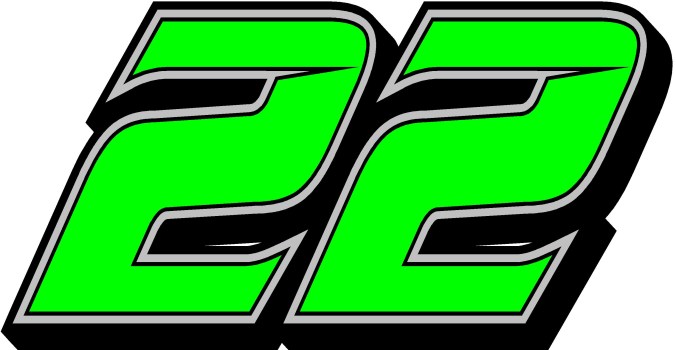
22

Just two weeks ago, I breathlessly announced that Former Secretary of State Madeleine Albright, against all odds. had pulled into a lead over Donald Trump for the 2016 Unethical Rationalizations Championship by giving us a perfect #22, the worst rationalization of them all. That’s this one:

22. The Comparative Virtue Excuse: “There are worse things.”

If “Everybody does it” is the Golden Rationalization, this is the bottom of the barrel. … It is true that for most ethical misconduct, there are indeed “worse things.” Lying to your boss in order to goof off at the golf course isn’t as bad as stealing a ham, and stealing a ham is nothing compared selling military secrets to North Korea. So what? We judge human conduct against ideals of good behavior that we aspire to, not by the bad behavior of others. One’s objective is to be the best human being that we can be, not to just avoid being the worst rotter anyone has ever met.

Behavior has to be assessed on its own terms, not according to some imaginary comparative scale. The fact that someone’s act is more or less ethical than yours has no effect on the ethical nature of your conduct. “There are worse things” is not an argument; it’s the desperate cry of someone who has run out of rationalizations.

Now, Donald Trump never runs out of rationalizations; as I wrote in the Albright post, “Trump is capable of hitting the entire list of rationalizations, all 68 of them (including the sub-rationalizations) given the opportunity.” He also rose to the challenge posed by Albright quickly, for he not only gave America a Full 22, he did so in the context of arguing for an unconstitutional government breach of First, Second, and Fifth Amendment rights on a massive scale! Bravo!

On Face the Nation  yesterday, talking about the Orlando shooting,  this idiot—sorry, sorry!—Mr. Trump said..

“Well I think profiling is something that we’re going to have to start thinking about as a country.Other countries do it, you look at Israel and you look at others, they do it and they do it successfully. [DINDINGDINGDINGDING! There are two more rationalizations right there:#1, Everybody Does It, and  #3, Consequentialism, or  “It Worked Out for the Best”! I mean,this guy is a rationalization machine! ] And I hate the concept of profiling but we have to start using common sense and we have to use our heads. It’s not the worst thing to do.” Continue reading

Remembering Bob Hope

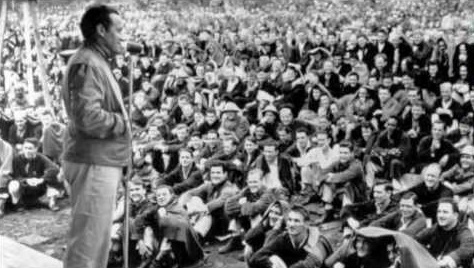
hope and troops

I can’t blame the airport officials who voted 8 to 1 last month to eliminate Bob Hope’s name and change the airfield’s label to “Hollywood Burbank Airport.”  It was a business decision based on hard data. Hope’s name wasn’t resonating with passengers outside of Southern California, especially those east of the Colorado Rockies.

The airfield had been  rechristened to honor Hope in 2003, not long after his death at the age of 100. Yet just a bit more than a decade later, the entertainment icon whose theme song was “Thanks for the Memory” is fading from ours at record speed.  The comments on various news reports on the airport’s decision range from stunningly ignorant to disrespectful. Bob Hope deserves better. The culture will be stronger if it remembers him, and so will the nation.

I must admit, I didn’t see this coming, but I should have. The survival or disappearance of once famous figures from our cultural memory fascinates and often horrifies me. One of the definitions of culture is what a society chooses to remember and chooses to forget: these seemingly random decisions have significant long-term consequences. Occasionally there is a last-minute rescue:  just as the Treasury was preparing to remove Alexander Hamilton from the ten-dollar bill, a Broadway musical, of all things, rescued his image and re-established his cultural presence. Usually, however, once a figure drops down the memory hole, he and the public appreciation of his importance is gone, gone, gone. Forever.

The mechanics of this process are chaotic. A single movie that enters classic territory and is featured regularly on television can rescue the memory of a whole career for generations. Ray Bolger, an eccentric dancer who was never regarded as close to Fred Astaire or Gene Kelly in the hierarchy of Hollywood hoofers nonetheless remains a recognizable figure today purely on the basis of “The Wizard of Oz.” Edward G. Robinson was a famous and respected actor mostly on the strength of his gangster films, but his memory survives almost entirely due to his strange ( and strangely miscast)  role as the Hebrew villain in “The Ten Commandments.” Meanwhile, who remembers George Raft?

Hope, I now realize, despite one of the longest and most successful careers in show business history and epic stardom on radio, films, theater and T, despite being the most frequent and most successful MC for the Oscars telecast and while he was alive and regarded for 50 years as the undisputed champion of stand-up comics, has no such marker to keep his image and memory alive. Humor is famously dependent on the times and culture, and Hope’s humor and style were more so than most. He was not a physical or slapstick comedian, and his movies, with the exception of the best of his “Road” movies with Bing Crosby, were at best mildly funny. The later ones, like his films with Phyllis Diller and Lucille Ball, weren’t even that. By the 1960’s, Bob Hope’s reputation as an entertainment icon was so well-established that he didn’t really need to be funny; the fact that he was Bob Hope was enough. He was a living relic of vaudeville, radio comedy and traditional TV skits who never changed his delivery or mildly self-deprecatory yet cocky demeanor. But what was special about him? There’s little available on TV or elsewhere to let new generations in on the secret. Continue reading

Dress Code Ethics: The Jet Blue Affair

Maggie flying (above) and performing (below)

Maggie flying (above) and performing (below)

JetBlue has a line in its contract of carriage that gives its employees the power to refuse to fly passengers who try to board a plane wearing clothing that is “lewd, obscene, or patently offensive.” Based on that vague standard, Seattle-based burlesque performer Maggie McMuffin was refused seating on a JetBlue flight from Boston’s Logan International Airport last month when the airline’s gate agents refused to let her board  until she changed her shorts. Maggie told a local CBS affiliate that an airline employee said her outfit was “not appropriate” according to the flight crew and pilot. Now Maggie is taking advantage of the situation to get some cheap publicity and maybe an interview or two, while embarrassing JetBlue. You can read more details in Slate’s story here.

Ah, dress codes! They are conduct rules put in place by businesses and institutions because some people have no manners, sense of place, consideration for others or respect, and these codes never, ever, work in the long run, because some people have no manners, sense of place, consideration for others or respect.

Once upon a time, children, adults going out into public dressed with taste and modesty as an expression of respect to others, including strangers, that they might meet. The Sixties destroyed this cultural consensus by questioning manners, decorum, conformity, dignity, and respect for others, especially anybody over thirty. Do your own thing! Let it all hang out! Today, a half century later,  people nonchalantly wear flip-flops to the opera and church, while the obese passenger sitting next to you on an airplane may be wearing a tank-top, and hasn’t  bathed in a week.

Of course Maggie McMuffin—I’m sure that’s her real name—wasn’t dressed appropriately to fly. (That’s her outfit above to the left–I assume she was wearing her head…) She was definitely dressed appropriately to draw attention to herself as burlesque performers (a.k.a “strippers”) are wont to do, and that was her intent. The JetBlue agreement, however, doesn’t say its employees can kick you off the plane for dressing inappropriately—like in a scuba suit, a bunny costume, or as Dracula. It says “lewd, obscene, or patently offensive.”  Whatever you can say about Maggie’s travel garb, it isn’t “lewd, obscene, or patently offensive.” JetBlue was wrong: unfair, incompetent, foolish. Unethical. Continue reading

From The Signature Significance Files: Trump And The Teleprompter. Seriously, How Can You Even Consider Voting For A Guy Like This?

"He loves me,...he loves me not...he loves me..."

He loves me,…he loves me not…he loves me…

I know, I have exceeded my Donald Trump quota for the week, but I can’t let this pass.

From the Washington Post’s Rebecca Sinderbrand, who follows the campaign’s twists and turns in an on-line column, comes a useful report on The Donald’s statements about teleprompters and his use of them between April 27 and May 27:

—April 27: Uses a teleprompter while delivering a foreign policy speech.

—May 2:  “I don’t have any teleprompters…I’m up here all by myself.”

—May 20:  “I’ve started to use [teleprompters] a little bit. They’re not bad. You never get yourself in trouble when you use a teleprompter.”

—May 22:  Attacks Clinton because she “reads off a teleprompter, you notice. She’s reading off a teleprompter, she always does.”

—May 24: “We should have a law that when you run for president, you shouldn’t be allowed to use a teleprompter.”

—May 26:  Uses a teleprompter while delivering an energy policy speech in North Dakota.

—May 27: “Isn’t it great when you don’t use teleprompters? …we oughta have a law that if you’re running for president, you can’t use teleprompters.”

Questions: Continue reading