Here’s What Was REALLY Wrong With Bill Cosby’s Sweater…

Cosby sweater

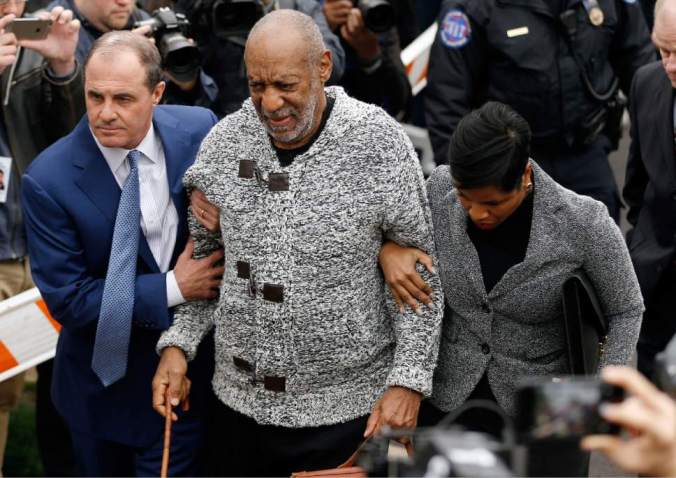
Washington Post fashion editor Robin Givhan set off a lively controversy by alleging that the “grandpa” sweater Bill Cosby wore to court was a calculated and manipulative ploy to gain public sympathy. “Bill Cosby’s perp walk was striking for its overwhelming lack of grace and power. It was an exploitation of our assumptions of fragile old age,” she wrote.  “It was the explicit manipulation of a studiously unattractive sweater.”

Was it? Lawyers often micro-manage a clients’ appearance in court; when it amounts to deception, I have written that it is unethical. Cosby’s attire seems hardly deceptive; after all, he is famous for his sweaters. There is even a pop song called Cosby’s Sweater. Ann Althouse agrees with Givhan that it was “a con,” but suggests that it’s an ethical con because “everybody does it.”

I don’t understand either Givhan’s logic or Althouse’s, and if Cosby’s lawyers talked him into this costume, they did him no favors. Cosby’s best armor against the verdict of public opinion is that Cliff Huxtable would never do the horrible things he’s being accused of.  There is no better, more benign, more appealing image of Bill Cosby than “TV Bill Cosby” as we fondly remember him. In court, he looked like a dirty old man, which is what he apparently is. Cliff Huxtable wouldn’t be caught dead wearing a sweater like that to court. (Bill would have also been well-advised to shave.) Continue reading

Ethics Dunce And Unethical Column Of The Month: Univision Anchor Jorge Ramos

Who is the traitor, Jorge?

Who is the traitor, Jorge?

There are some positions in some controversies that I really cannot manage to respect, because no matter how much I try to understand the points of view, they seem so obviously wrong and ethically indefensible. On “The View” yesterday, for example, alleged comedian Joy Behar, in discussing the character of Bill and Hillary Clinton, stated without joking that she would vote for a proven rapist for President, as long as he or she was a Democrat. This is the kind of position I’m talking about.

Yesterday, the Hall of Fame voting results were announced. Mike Piazza and Ken Griffey, Jr. were elected to the Hall by the baseball writers, and equally welcome to this ethicist-baseball fan was the fact that Barry Bonds and Roger Clemens, both unrepentant steroid cheats, were not elected, and their still paltry vote totals suggest that they may never be. Yet several baseball pundits, reporting on the voting results, preceded this aspect of the news with “Unfortunately.”

I don’t understand that attitude toward cheating at all. I have written about as much about Barry Bonds as any ethics topic on Ethics, and  the case against him is air-tight, with the only defenses ever put forth being invalid rationalizations, easily rebutted. Nevertheless, otherwise intelligent people keep repeating them, hoping to outlast reason and reality by perseverance and repetition. (Sadly, this often works, as “77 cents on the dollar,” “Bush lied” and “Hands Up! Don’t Shoot!” tragically prove.) In the last 24 hours, I have heard Clemens and Bonds called “great players” so many times that my teeth have been ground down perceptibly. Cheaters are never great, as I explained in one of my favorite posts of 2015.

I was preparing to once again swat down the cultural poison being peddled by the Bonds and Clemens defenders when another of the issues that I believe has no respectable “other side” again raised its uglier than ugly head, so I changed course. That issue is illegal immigration, as in “immigration that occurs in direct violation of U.S. law, making it illegal.” Those who engage in illegal immigration are immigrants, and because their manner of immigration is illegal, they are illegal immigrants. Those who insist on calling them merely immigrants are lying; those who favor euphemisms like “undocumented workers” are engaging in intentional deceit. No, I have no respect for their rhetorical dishonesty–their smug and falsely sanctimonious rhetorical dishonesty—and it should not be tolerated by any U.S. citizen who wants transparent debate on a crucial national policy issue.

The ethics violator in the immediate case is serial offender Jorge Ramos, who uses his position as a broadcast journalist—unethically, since his duty is to report the news accurately, not to spout propaganda—to advocate  unrestricted immigration by Hispanics and Latinos into the United States. It is a logically, historically, demographically, economically, politically and legally irresponsible, outrageous position, but he managed to exceed previously established depths in promoting it by writing, in a column for Fusion, that GOP candidates Ted Cruz and Marco Rubio are engaging in betrayal by “turning their backs on immigrants,” who, he says, just got here a little later than they did. Continue reading

“The Affair” Smears An American War Hero

The General and friend.

                             The General and friend.

“The Affair,” Showtime’s much lauded soap opera, wrapped up its season yesterday, without me. There are some things I won’t forgive, and sliming the legacy and reputation of long dead individuals of character and accomplishment is one of them.”The Affair” was guilty of that the previous week. It is dead to me.

The background: General Omar Bradley is increasingly accorded credit for planning D-Day, and thus is owed a large share of the world’s gratitude for winning World War II. He was not flamboyant like Patton or MacArthur, and had no political aspirations, so despite his remarkable life in service of the United States, Omar Bradley is an undeservedly obscure historical figure. He is, also, beyond any controversy, an American hero.

He also was an especially ethical one, as indicated by three of his better known quotes:

“It is time that we steered by the stars, not by the lights of each passing ship.”

“We have grasped the mystery of the atom and rejected the Sermon on the Mount. The world has achieved brilliance without conscience. Ours is a world of nuclear giants and ethical infants. We know more about war than we know about peace, more about killing than we know about living.”

“Dependability, integrity, the characteristic of never knowingly doing anything wrong, that you would never cheat anyone, that you would give everybody a fair deal. Character is a sort of an all-inclusive thing. If a man has character, everyone has confidence in him. Soldiers must have confidence in their leader.”

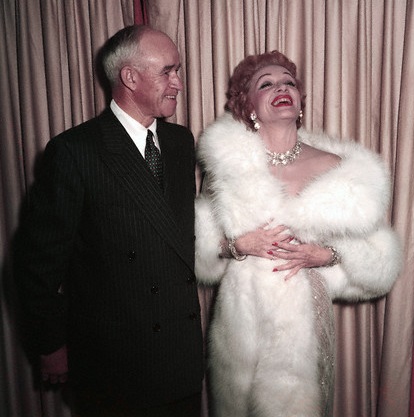
Why the writers of “The Affair” decided smear Bradley, I cannot fathom. Nonetheless, any viewers of the show that watched the penultimate episode and who didn’t know who Bradley was, and many who did, left it with the belief that Bradley, a who by all accounts was faithfully and lovingly married to the his first wife throughout the war and until her death, had an affair with actress Marlene Dietrich, who traveled with the U.S. Army for nearly two years at the end of the war. “The Affair’s” self-obsessed and perpetually horny protagonist, a successful novelist, told his therapist—and boy, does he need one–that his new book would be a historical novel about Omar Bradley. Then he said that he was tempted to skip the affair with Marlene Dietrich, but then that was the most interesting thing about Bradley to him. Continue reading

Trivial Ethics Dunce That Is Driving Me Crazy Anyway So I Have To Mention It: GEICO

http://www.youtube.com/watch?v=r9qcWljsT7s

The current GEICO ad campaign, “It’s what you do,” has already scored an ethics foul; the latest one is less substantive. Nonetheless, it is in the increasingly common category of “They just didn’t care,” which is a subset of disrespect and lack of diligence. Besides, it involves a great American song.

In the GEICO ad featuring Peter Pan annoying former classmates at a high school reunion ( the kid playing Peter is terrific), the spot concludes with Peter entertaining the class while flying over their heads with a mike and singing, “You Make Me Feel So Young,” a 1946 classic composed by Josef Myrow, with lyrics written by Mack Gordon. It begins,

You make me feel so young.
You make me feel as though (alt. “like”) spring has sprung.
And every time I see you grin,
I’m such a happy individual.

But for some damn reason, Peter sings,

You make me feel so young.
You make me feel so spring has sprung..

..which isn’t even English, and definitely isn’t the lyric. How hard would it have been to fix this? GEICO just couldn’t be bothered, so the song is misrepresented in its first widespread media us in decades.

Here’s the song sung the right way, Peter, you little snot:

UPDATE: See here.

Sign Language Interpreter Ethics Epilogue: “A Christmas Carol”

Gavin Alvedy rehearses a scene from the Downriver Youth Performing Arts Center's "Miracle on 34th Street" as DYPAC alum Emily Zaleski signs alongside him. Zaleski, who grew up performing on DYPAC’s stage, now is a certified American Sign Language interpreter with Synergy on Stage and will interpret during the Dec. 8 performance.

Sign language interpreters and their advocates descended on Ethics Alarms in indignation aftert  my March post about “showboating sign language interpreters for deaf audience members.” It took until December for my commentary to reach this passionate interest group, but when it did, I was called many names, including “ablist,” and had to put up with comments like this one from the ironically named “Danny Who Knows About Stuff”:

I would take this “ethics” person seriously if he/she seemed to know anything about the ethics that guide sign language interpreting. And, I suppose it would be helpful if the person understood anything about linguistics, sign language, Deaf culture, or audience response theory. This article is more about the individual than than the issue. In short, this person is no more an ethicist that is Donald Trump.

How I love the quote around “ethics.”

Danny was pretty typical. See, I don’t need to know about any of Danny’s “stuff” as a director of a play or musical. All I need to know is whether a feature of the performance detracts from it by foiling the focus that the staging was designed to facilitate. Every competent director knows that. The needs of the signer and the signer’s much, much smaller audience cannot be permitted to wag the dog, or make the dog trip on its tongue.  or perish of neglect.

“Danny Who Knows About Stuff” became “Danny Who Is Banned From Ethics Alarms,” in case you didn’t guess.

If I had already experienced what I experienced yesterday with a “professional” signer, that March post would have been much tougher. I directed an staged reading of “A Christmas Carol” with a cast of 30 terrific actors for a single free performance for D.C.’s Martin Luther King Library, and was told that the library would be sending a signer. Now, a signer for your usual staged reading is like having a signer for an oil painting. It makes no sense. In readings, the actors mostly read. Presumably the deaf can read “A Christmas Carol” themselves. You could say they would want to see the performers, but  in readings the performers’ acting mostly consists of vocal expression, which the deaf audience can’t hear, and facial expressions, which they won’t see if they are watching the signer. As it happens, I don’t do staged readings like that; there is a lot of movement and staging, so a signer makes some sense.

But they didn’t know how I would stage it.

By the time we got to the final rehearsal, I had forgotten about the alleged signer, who was supposed to at least attend one rehearsal so I could fit her onto the stage where she would be seen and not get in the way. She arrived, for the first time, 15 minutes before the performance, and immediately announced that she didn’t know whether she would be signing or not.  That’s helpful. She also complained that the script was very well adapted for signing (Why, thank-you!) and that the show, at 90 minutes, was impossibly long for a single signer to do: she was waiting to see if a second signer was coming, as she had assumed. Now, nobody warned me that I had to make room for two signers in the small performing space, neither of whom would deign to attend a rehearsal. ( Her complaint about length was also nonsense. I have had single signers for many shows longer than 90 minutes, and they didn’t collapse from exhaustion or finger cramps.) Continue reading

Comment of the Day: “Comment of the Day: ‘On the Importance Of Christmas To The Culture And Our Nation : An Ethics Alarms Guide'”

Scrooge9

Nesting Comments of the Day again, as Belle’s reflections on how the cultural celebrations of Christmas made her feel “othered” as a child was met with many excellent responses and a lively thread. Pennagain’s (that is to say, the Commenter Previously Known As Penn) comment, however, surpassed tough competition, and thus we have the Comment of the Day on the post, Comment of the Day: “On the Importance Of Christmas To The Culture And Our Nation : An Ethics Alarms Guide”:

First impressions aren’t that easy to shrug off. Belle’s comment that she “was always sure that Ebenezer Scrooge was a commentary on the Jews” reawakened a long dormant spectre of mine. So, Google to the rescue, I went searching for the 65-year-old source and damned if I didn’t find it: My oldest Scrooge image is not from Dickens; it’s from the Rackham illustration of Shylock from Charles and Mary Lamb’s incomparable childrens’ (anyone’s!) introduction to Tales from Shakespeare:

ShylockFiction abounds with misers, a sub-category of villains (often semi-comical: to jeer at), a stock character from Medieval times, especially in children’s stories, who are often more memorable — and way more fun to act out — than are heroes. Miserly villains tend to have the same features and characteristics: mean, suspicious, hoarding good will as well as gold, stooped, narrow-shouldered, and “clay-faced” life-denying penny-pinchers … as is another “Ebenezer” in Stevenson’s “Kidnapped” whose miserliness is ethically and morally beyond villainhood (he changes sides in the middle of a battle), or a father-and-son pair of Chuzzlewits in another Dicken’s classic, or Shylock himself — who has by the end of Scene 1, before he lends the money and (jokingly) adds the “interest” that is the basis of the tragedy, chosen love of money over love of his daughter.

Continue reading

Remembering The President Whose Dedication To Ethics Made The U.S. Possible

george_washington_death

We no longer honor George Washington on his birthday to the extent his importance to our nation warrants. George Washington died on this date, in his Mount Vernon Home, at the age of 67. Let’s think about him now, specifically his character.

Washington is still something of a mysterious man, but there is no question that he was one who was possessed of natural and remarkable leadership abilities, unusual instincts of common sense and justice, astounding courage, striking charisma and most of all, the rare ability, especially in one so celebrated and successful, to change his attitudes and beliefs over time. He was chosen, among the most outstanding collection of leaders this nation ever had at a single point in history, to lead them  all, and the primary reason was that while few of our Founding Fathers trusted each other, they all trusted him. George Will calls him “the indispensable man,” and the assessment is apt.

One formative experience that created that indispensable man was his lifetime dedication to civility, respect, conscience, kindness and ethics as they were taught to him by his father. The elder Washington made young George copy a list 110 rules of civility and deportment into his school notebook when the President-to-be was about sixteen-years old. Scholars have determined that the list originated in the late sixteenth century in France, and had been in use there and in England before the elder Washington ever imbued his son with them. Biographers of George have been struck by the extent to which these maxims accurately describe his behavior, habits and ethical conduct throughout his life. He was quick to quote them;  it has been said that if you awoke George from his slumber prior to breathing his last on that December 14, and asked him, “What’s Rule #7?,” he would have recited it on the spot. (“Put not off your clothes in the presence of others, nor go out of your chamber half dressed.”) The Library of Congress owns the original manuscript for the Rules of Civility.

Washington’s 110 Rules have been on the Ethics Alarms home page in the left margin under “Rule Book” almost from the beginning of the blog, and I posted them back in 2009. It’s time to look at them again, as we remember, and are properly grateful for, this special man. Many are funny, in retrospect, in their dated reflection on earlier times, but the ethics principles sounded still resonate, especially the last:

110. Labor to keep alive in your breast that little spark of celestial fire called conscience.

That one alone is worth a lifetime.

George Washington’s 110 Rules

The Rules of Civility & Decent Behavior in Company and Conversation
(As memorized by George Washington as a youth. Authorship unknown)

Continue reading

Comment of the Day: “On the Importance Of Christmas To The Culture And Our Nation : An Ethics Alarms Guide”


Belle is a Jewish reader of the recent Ethics Alarms Christmas post who sent  her comment to me off-site, then agreed to have it posted as the Comment of the Day after I requested permission.

She describes a real dilemma that I am very aware of, and thus am grateful for her raising it clearly and directly. I’ll be back with a bit more at the end, but here is Belle’s Comment of the Day on the post, On the Importance Of Christmas To The Culture And Our Nation : An Ethics Alarms Guide

I would like to try to make you understand at least a little why I am SO heartened that my children are growing up with “Happy Holidays” and Chanukah menorahs along with Christmas trees in public places, and how difficult it was for those of us non-Christians who didn’t. I sense that you were so antagonized by your colleague’s aggressiveness and different world view that you couldn’t hear what might have been behind the aggressiveness. You write that “Jews, Muslims, atheists and Mayans who take part in a secular Christmas and all of its traditions—including the Christmas carols and the Christian traditions of the star, the manger and the rest, lose nothing, and gain a great deal. Christmas is supposed to bring everyone in a society together after the conflicts of the past years have pulled them apart, What could possibly be objectionable to that? What could be more important than that, especially in these especially divisive times? How could it possibly be responsible, sensible or ethical to try to sabotage such a benign, healing, joyful tradition and weaken it in our culture, when we need it most?” Continue reading

Ethics Heroes: The Community of Middlesborough, England.

COX_funeral_3524163b

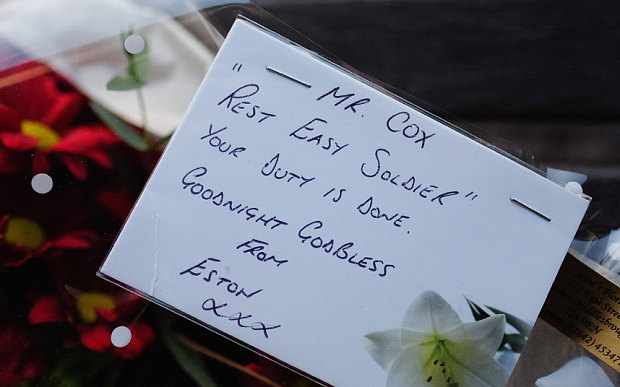
Thomas Cox, a British World War Two vet who served in the Royal Pioneer Corps, died at the age of 90 with no known surviving relatives.

Hoping to give Cox the final salute he deserved, the Royal Pioneer Corps Association  posted an appeal on its Facebook page asking for people to attend his funeral. The plea was shared among veteran groups, military groups and others, and when the day came, hundreds of strangers to Cox were on hand to say farewell and thanks to the old soldier. Many of the mourners at the service in Middelborough, Teaside sent flowers and wreaths as well.

They didn’t do this for the family, for there was none, and Cox was beyond caring. They came out of respect for a generation, a pivotal moment in human history, and to assert that we are all part of a larger family, though we usually don’t behave that way.

There’s not a lot more to say, is there?

Mission accomplished.

Heroes, Villains And Fools In The Latest “Donald Trump Candidacy Ethics Train Wreck” Disaster

Circus Train wreck

In a single post I can’t possibly cover all of the heroes, villains and fools who have emerged in the aftermath of the explosion of Trump’s latest hand-grenade tossed into the Presidential campaign. I have to start somewhere, though.

At the outset, I want to officially designate Trump’s campaign as an ethics train wreck, neatly paired with the Hillary Clinton Campaign Ethics Train Wreck (more from that later.) Do you sense that the number of Ethics Train Wrecks are proliferating? You are correct, and it is both a direct result and an indirect result of the Obama Administration Ethics Train Wreck. When leadership is feckless, weak, dishonest, unethical and ineffective, a society’s ethical standards start to unravel.

Now on to the initial designations regarding Trump’s declaration that Muslims should be banned from entering the country.

Hero, Villain, AND Fool: Donald Trump. Trump is a hero in his own mind; in ethics terms, the status is accidental, an example of doing a good and courageous thing for all the wrong reasons. In his typical, bully-in-a china-shop  way, Trump has forced the national debate to focus on nasty realities rather than operate from President Obama’s fantasy world, where radical Islamic terrorists somehow are not Islamic, and Hillary Clinton’s delusion/lie that terrorism has “nothing to do with Muslims, whatsoever” even after two Muslims, because they were Muslims, killed 14 citizens in a terrorist attack. Muslims who have been radicalized or who have ties to terror groups are a real and existential problem that requires a coherent policy addressed at the problem. Chanted nostrums like “This isn’t who we are” don’t get the job done. A frank debate is mandatory, and sometimes only a boor, a maniac or a boob with less than acute intellectual skills will have the guts to force such a debate. Clarence Darrow regarded nut-case John Brown as such a hero, arguing that some problems require someone whose disregard for conventional societal standards to “cut the Gordian Knot.” By Darrow’s definition, then, Trump is a hero. Continue reading