responsibility
Obama, Trump, And The Avoidable “Two Presidents” Ethical Dilemma
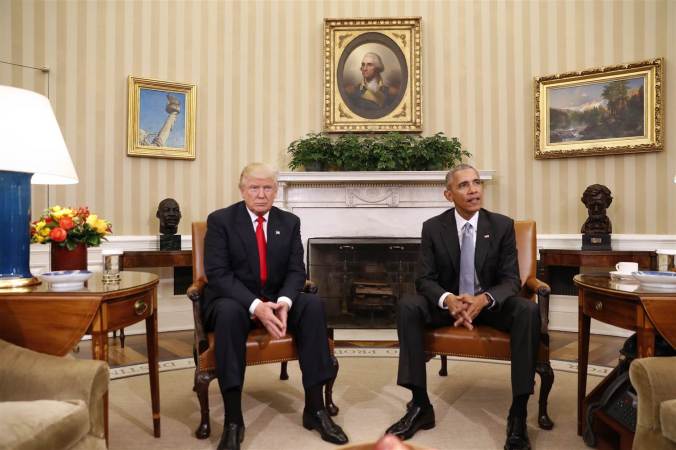
Yesterday, Donald Trump sent out not just one but three tweets that directly interfered with current U.S. policy efforts, involving the costs of a new jet fighter plane, nuclear weapons, and a U.N. resolution criticizing Israel. This understandably is causing consternation in the Obama administration, because Trump is exercising influence without authority. Until January 20, 2017, Donald Trump has no official position or authority in the government at all. He does have power and influence, however, because everyone knows that he will have authority very soon.
What constitutes abuse of the power and influence? Should a President Elect be a mute and invisible presence until he is officially sworn in, so as not to interfere with the current President’s discharge of his duties?
For the lame duck Chief Executive, with slightly more than two months left in office and vastly diminished influence, the ethical problem is different. How much should he defer to the incoming President, and not take actions that will seriously interfere with the policy directions the new President may choose to take? Once the will of the people has been made clear at the ballot box, is it fair and responsible for current President to actively work against the likely agenda of the incoming President?
Finally, if a lame duck President is attempting to undermine the objectives of the incoming President before that President Elect takes office, is it unethical for the President Elect to use his influence and power to stop him, or at least mitigate the damage? Continue reading
Are No Professions Safe From The 2016 Post Election Ethics Train Wreck? Now Even Restaurant Critics Have Gotten On Board!
As a professional ethics specialist, I find the enthusiasm with which alleged professionals have used the election of Donald Trump to excuse their abandonment of such ethical values as fairness, responsibility, respect and citizenship deeply discouraging, and I am seriously considering becoming a beachcomber. I already knew that the journalism profession no longer could distinguish ethics from a hairy crab, so this wasn’t too surprising, nor was it too much of a shock that the New York Times has become a non-stop anti-Trump fear-fest and rant machine. Let’s see, in today’s edition alone there is a hit piece on Trump advisor Steve Bannon called “Bannon’s Coriolanus Rewrite,” then “Donald Trump’s Racial Ignorance,” “Where the Right Went Wrong,” (an amazing title, given the current balance of political power after Hillary’s botched campaign), “How the Truth Got Hacked,” “Is Democracy in Danger?” “Trump, the Russian Poodle,” and “Is This Collective Trauma?” The last, I guess, explains why mass trauma is inevitable for progressives, moderates and “Never Trump” Republicans when “the political order they long took for granted — defined by polarization, yes, but also by a commitment to basic principles of democracy and decency — is suddenly gone.” One would almost wonder from that sentence which side of the political spectrum is calling for armed insurrection, pre-inaugural impeachment, and the overturning of the election results. The Times is also a showcase for columnists whose minds have snapped like dry branches in the wind, causing them to leap manically onto the Trump Hysteria Express. Economist Paul Krugman has long been a hyper-partisan scold for whom fairness is alien territory, but this tweet was spectacularly vicious even for him:
“Thought: There was (rightly) a cloud of illegitimacy over Bush, dispelled (wrongly) by 9/11. Creates some interesting incentives for Trump.”
An ethical newspaper wouldn’t want someone capable of such a comment working for it.
Many broadcast journalists were stunningly unprofessional, indeed amateurish, on election night. Martha Raddatz choked up with emotion reporting Clinton’s loss; now there’s an objective reporter. Rachel Maddow described the evening as a “nightmare.”
Education has been racing journalism to the ethics barrel bottom for years, but I did not expect universities to send such intimidating messages to their students that they were expected to either be in mourning or on the verge of emotional breakdowns because the Democrats lost. Once, higher institutions of learning aimed to teach students critical thinking skills so they could make up their own minds regarding civic affairs. High school administrators and teachers also forgot their duties, and allowed students to skip school because, you know, TRUMP!!!!, and “ARRRGHHHHH!!!!”
Lawyers have lost their ethical bearings, of course, as have law professors, with perhaps the best example of the latter being the Georgetown Law Center adjunct who claims that the Constitution is unconstitutional, because following it will elect Donald Trump. My law alma mater isn’t faring too well in the train wreck: another professor, Paul Butler, argued that Supreme Court justices shouldn’t normally attack a President Elect, except when it’s Donald Trump.
Other academics have disgraced themselves. A prominent historian, for example, even resorted to making up history to provide an excuse for Democrats losing to such a horrible creature. Professor Larry Lessig of Harvard Law, who heads an ethics institute there, is encouraging electors to be “faithless,” as in “double-cross the voters who elected them.” Some ethics institute you have there, Harvard!
Artist, actors and show business professionals have debased themselves even more than usual, beginning with the Broadway cast of “Hamilton’s” breach of the Performer’s First Commandment: DON’T ABUSE THE AUDIENCE. They have even started turning on each other: Jon Voight, whose sin was that he expressed support for the man elected President, was booed at recent awards show by his fellow actors. Nice.
But as bad as this has been, I didn’t expect food critics to be corrupted. Continue reading
“White Christmas” Ethics Addendum: Battlefield Incompetence, Insubordination And More In The Holiday Classic
A Special Guest Post by Texagg04
Ethics Alarms commenters who are honored with the annual “Commenter of the Year” title in the yearly Ethics Alarms awards have the option of joining the elite ranks of guest bloggers here. Texagg04 got the honor a couple years ago but never exercised his option. His recently posted, meticulously-researched and fascinating multi-comment addition to my 2012 post about the holiday film “White Christmas” seemed too extensive for a mere Comment of the Day, and I asked tex to edit it into a single post. He agreed, and what follows is the result. I recommend seeing the film (it’s on Netflix) either before of after reading his analysis. The 2015 update to the 2012 Ethics alarms “White Christmas” post is here.
—Jack
***
As the kids were watching “White Christmas” and I walked by, in passing, I noticed something amiss about the “military” feel of the opening scenes that seemed off ethically. So I copied and pasted the first website that claimed to be a script of White Christmas. I’m not sure what it was…if it was a working copy or a first draft, but it has significant differences from the actual filmed scenes. So, I’m forced to modify some of my assessment from the original three posts.
All the dialogue is transcribed *directly* from the listening to the movie, so I think I’m pretty close to word for word. The scene descriptions and action statements are modified versions of the script I got from the original website (which can be found here).
Before I go into commentary, I’ll insert the entire dialogue for perusal and familiarity. There are numbers to reference particular dialogue in my analysis at the end. Here are the opening scenes—General Waverly is played by Dean Jagger; Captain Bob Wallace is Bing Crosby, and Private Phil Davis is Danny Kaye:
Continue reading
14 Ethics Musings On The Death Of Francisco Serna

Scott and Serna.
Slightly after midnight on Monday, police in Bakersfield, Calif., received a call concerning a man thought to be brandishing a weapon in a residential neighborhood.
Shortly after police arrived, 73-year-old Francisco Serna — who family members said was suffering from the early stages of dementia — walked out of his home and into his driveway. When Serna, who was unarmed, did not comply with officers’ orders to remove his hands from his jacket pocket, one officer fired seven shots at him, killing him.
During a canvass of the premises that lasted at least until the following afternoon, police did not find a firearm on or near Serna. Instead, they found a crucifix.
Questions and Observations:
1. The shooting occurred two days ago, on December 12. There have been no organized protests, or community groups, family lawyers or anyone else suggesting that the shooting was murder, or an example of police animus toward the community. Why not?
2. The circumstances of the shooting were notably similar to the police involved shooting of Keith Scott in Charlotte, North Carolina, except that in the case of Scott, the officer believed the victim had a gun, and he did have a gun. Nonetheless, that shooting triggered two days of rioting. Why?
3. In the Scott shooting, both officer and victim were black. In the recent shooting in Bakersfield, officer and victim were white. Why did one shooting become a racial incident and the other not, when the conduct of the police officers were essentially identical, and the provocation for the shootings were similar as well?
4. One difference in the two episodes is that in Charlotte, a false narrative was launched by a family member to make the shooting appear to be a case of excessive force with a police cover-up. Is it just felicitous that this did not occur in Bakersfield, or was the Charlotte episode different in some way that caused events to resemble the aftermath in the Ferguson and Freddie Gray police-involved deaths?
5. If Francisco Serna had been black and all other facts the same, is there any reason to believe that the aftermath, including recriminations, accusations and attacks on police, the justice system and the nation’s culture, would have been any different than they have been every time an unarmed black man, or a black man who was reported as being unarmed, has been shot by police? If there is not, what does that tell us? Continue reading
Warning From Great Britain: The “Lawscam” Excuse Is Coming To Colleges
It was all the fault of imperial Indian history….
The controversy died down a bit in 2016, but it is still out there: unemployed young lawyers are still blaming their law schools for the fact that their degrees didn’t deliver riches and success in a competitive field. When a ballyhooed lawsuit by one such lawyer failed last April, it briefly muted the howling, but the central misconception is still virulent. From the Ethics Alarms post about that law suit:
The rejection of Alaburda’s law suit sends a message that young lawyers need to hear, and heed. If they thought a law degree was going to guarantee their success, they have been tragically confused by the culture’s hucksters and politicians, not the law schools. For too long, education has been sold as the key to income and jobs, when it is nothing but a process designed to make more competent, able, creative and responsible human beings. By itself, a degree proves nothing. It only signifies that its owner has had access to useful knowledge and the chance to develop useful skills. It is up to graduates to use that knowledge and those skills to make a life for themselves. If they fail to achieve their goals, they cannot blame the law school because they perceived a promise that was never made.
One failed suit, however, couldn’t undo the destructive false message society and its leaders have been issuing for decades: “the purpose of earning a diploma is to get a good job.” As more and more young men and women are steered into college and a college degree becomes symbolic of nothing, there will be more law suits by college graduates like the one currently being fought in Great Britain, where Faiz Siddiqui, an Oxford graduate, is suing his alma mater for not giving him a first-class degree 16 years ago. (In British universities, graduating with a “first class degree” is roughly similar to graduating “with honors” in an American college. Based on a student’s grades, Oxford gives out three classes of degrees, first-class being the highest.)
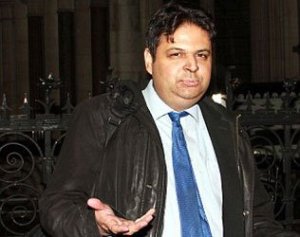
Siddiqui is now 38 years old, angry and disillusioned. In his suit, he alleges that his life and career were stunted because he didn’t earn “a first,” as the degree is called, when he studied modern history at Brasenose College and graduated from Oxford University in June 2000. “Negligent teaching” in a course on Indian imperial history, he says, pulled down his overall grade and ruined his life. Now he’s asking for a million British pounds in damages for his lack of lifetime earnings in a legal action against the Oxford chancellor, masters and scholars. His barrister, Roger Mallalieu, also claims that Oxford is responsible for Siddiqui’s insomnia and depression.
Apparently the history module was less than optimum while Siddiqui was a student, because half of the teaching staff responsible for Asian history were on sabbatical. Mallalieu told the British high court that the inferior teaching resulted in his client’s lesser grade and thus “denied him the chance of becoming a high-flying commercial barrister.” Continue reading
Ugh! Here’s One More Unethical Practice (Of Many) Trump Needs To Eliminate From His Repertoire, And Quickly
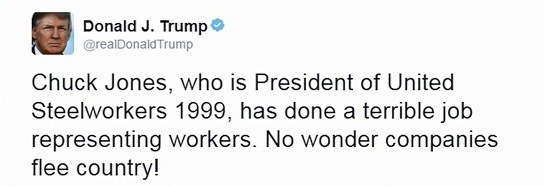
It’s pretty simple, though President Obama hasn’t figured it out in in eight years:
The President of the United States must not attack or criticize private citizens or negatively characterize their actions, nor should he interfere with local matters, criminal justice, the courts, the news media, or private businesses, unless it is absolutely necessary, which it almost never is. This applies to his treatment of journalists, celebrities, athletes, local officials, accused criminals, military personnel, lawyers, other professionals…
…and union representatives.
Chuck Jones, the president of the local chapter of the United Steelworkers union that represents Carrier employees in Indianapolis, told The Post on Tuesday that the Trump exaggerated the number of jobs he claims to have saved, since 550 of the union’s members will lose their jobs anyway. Trump immediately sent the tweet above, directly attacking Jones by name. Shortly after the tweet, Jones says, he began getting threatening phone calls. “Nothing that says they’re gonna kill me, but, you know, ‘You better keep your eye on your kids. We know what car you drive.’ Things along those lines,” he told the Post.
I’m not surprised, but Trump’s “punching down” would be just as wrong if there was no response at all. This is an abuse of power. It is an abuse of influence. It is an abuse of office, and once he is President, it will be an abuse of the “bully pulpit.” The conduct is bullying, as well as irresponsible, dangerous, and stupid.
I did call it, though! My post in April about Gov. Rick Scott attacking a citizen, in his case a coffee shop critic, in a campaign ad ended with this statement:
It is hard to imagine a more petty, needless, demeaning example of “punching down.” Jennings isn’t running against Scott; she is just a citizen critic, if an especially rude and nasty one. For a governor to focus an attack ad on a mere citizen is an abuse of power and position. It is ethically indefensible.
It is exactly what Donald Trump would do, though.
It is far worse for a President-Elect to punch down, of course; it’s even unethical for a Presidential candidate nobody thinks can win to do it. Trump’s pre-emptively calling Bowe Bergdahl a traitor is now a fair trial problem in the ex-prisoner of war’s court-martial. This is a terrible habit to indulge, and it opens the door to far more harmful misuses of Presidential power. Continue reading
Announcing “The Fake News Ethics Train Wreck,” And Related Developments [UPDATED]
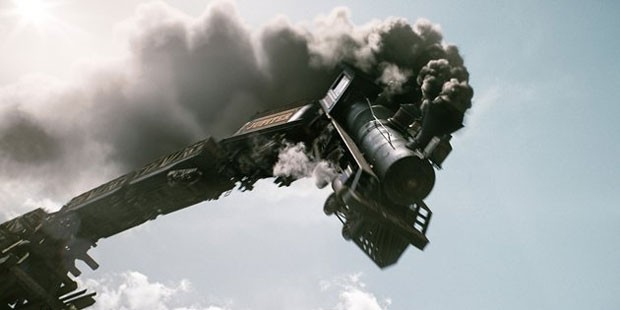
This morning I checked four news sources and caught stories about”fake news” in all of them. Some of this has been fueled by the flesh-meltingly idiotic Comet Ping Pong pizzeria story out of D.C., which culminated in a moron named Edgar Maddison Welch firing an AR-15 inside the joint, saying later that he was horrified at the reports that the establishment was at the center of a child sex ring run by…wait for it…the Clinton campaign. He got some bad information, Welch told authorities. Ya think???
No, Ed, you got a really bad education in America’s rotten public schools, and before that you were playing hop-scotch when the brains were handed out.
What prompted Ethics Alarms to officially move the fake news uproar into Ethics Train Wreck status, however, was the interview CNN had this morning with two small business owners in the same block as the evil pizza place. “The internet isn’t regulated like it could or should be,” one said, with no comment or clarification from CNN’s Alisyn Camerota. Politicians are among those who have to address this problem, agreed her partner.
In other words, we need internet censorship. Oh, they did say that citizens should be a bit more discerning before grabbing an AR-15 and shooting up a pizza parlor because someone on Instagram said that John Podesta was selling little girls and boys, but obviously the big arm of the State has to step in.
In other developments:
- The fake Washington Post news story about fake news that I highlighted here may prompt a defamation law suit from one of the organizations that the Post accused, without checking their source, of spreading fake news.
“You did not provide even a single example of ‘fake news’ allegedly distributed or promoted by Naked Capitalism or indeed any of the 200 sites on the PropOrNot blacklist,” James A. Moody, attorney for Naked Capitalism, a finance and economics blog with a stated mission of “shedding light on the dark and seamy corners of finance,” wrote to the Post. “You provided no discussion or assessment of the credentials or backgrounds of these so-called ‘researchers’ (Clint Watts, Andrew Weisburd, and J.M. Berger and the ‘team’ at PropOrNot), and no discussion or analysis of the methodology, protocol or algorithms such ‘researchers’ may or may not have followed.”*
- For months, and even after the election, the Obama administration, Democrats and the news media claimed that the economy is rebounding big time. “President Obama Is Handing a Strong Economy to His Successor,” gushed the New York Times just last week. Fake news. A report released this week makes a strong case that the economy is struggling badly.
Highlights from that 120-page report:
- Since 1980, U.S. GDP per capita growth has been far below its long run average, and since 2007 it has been almost negligible.
- Deterioration in the quality-to-cost ratio for healthcare, housing and education is dragging down economic growth. After spiraling price increases, these sectors accounted for 36 percent of total national spending in 2015, up from 25 percent in 1980.
- The U.S. population’s health has stagnated or even declined on several measures since 1980, especially for the working-age population.
- Housing costs have swallowed up a larger share of income without a corresponding increase in quality.
- Educational quality is weak and stagnant at all levels. The U.S. education system has failed to instill any measurable gains in the cognitive performance of children and young adults for decades, as U.S. students and adults struggle with poor rates of literacy and numeracy despite high spending growth.
You know…”a strong economy.”
Would you like to speculate on which fake news had a greater likely impact on the popular vote for President—the Pope’s endorsement, Podesta’s pizza parlor sex ring, or that nifty Democratic policies had the national economy working like a Swiss watch? Continue reading
Ethics Observations On This Kind Of Post-Election Hate, Those Who Write It, And Those Who Believe It [UPDATED]
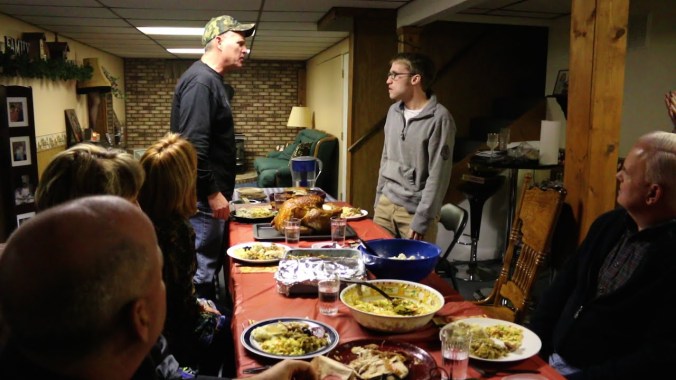
The piece in question is one published in The Daily Banter. The author is Justin Rosario, self-described as a “center-left Jewish-Puerto Rican atheist liberal.” His essay came out just before Thanksgiving, and he titled it, Yes, You Should Shame Your Trump Voting Relatives At Thanksgiving Dinner
(They’ve gone beyond politics and should be treated like the pariahs they are).
Here are the guts of it, when he explains exactly what your Trump-voting relatives “are”:
They’re the people in Germany who stood by and watched the Jews be herded into concentration camps and murdered. Except they’re worse because at least the Germans had never seen anything like the rise of Hitler before. They had no frame of reference to understand what was happening to their country. Your Donald voting relatives have heard and read about Nazis their entire lives. They know and they didn’t care.
Yes, they will have a million excuses for why they voted for someone they knew was a monster but they’re all bullshit. It wasn’t the economy. It wasn’t ISIS. It wasn’t unemployment. It wasn’t Hillary’s emails. It wasn’t Bill’s affairs. It wasn’t Washington corruption. Every single reason they give is a lie and they know it. They wanted one thing and one thing only: To take “their” country back from that fucking n*gger in the White House. That’s it. End of line. Full stop.
Your Donald voting relatives were so freaked out that a black man was president that once Donald told them it was not just permissible to be racist but necessary, they leapt at the chance to put Those People back in their place. And in doing so, they knowingly elected a man that will be all the things they were so afraid Obama was going to be: A tyrant. A dictator. A bully. An autocratic pig that will disregard the rule of law and treat America like his own personal playground. A brutal despot that will silence the media, arrest his political opponents and use the full power of the government to destroy his enemies.
Observations: Continue reading
“The 2016 Election Is a Disaster Without a Moral”? Only If You’re In Denial, Mr. Chait!
That should be “lessons,” plural...
The many outbursts of liberal anger, resentment, accusations and denial over the election have been revealing, and not in a good way. Few have been as directly and stubbornly misguided and biased, however, as the current New York Magazine article by Jonathan Chait, with the clickbait title, “The 2016 Election Is a Disaster Without a Moral.”
It is, in essence, yet another example of Democrats attempting to argue away any accountability for their own misfortune, making Chait’s piece itself a denial of several moral lessons, such as “I am the architect of my own destiny,” “Take responsibility for your failures,” and “Don’t blame others for your own mistakes.” The post-election progressive freak-out, of which Chait is a part, also has a very important moral lesson in store, the one embodied in the Serenity Prayer authored by theologian and philosopher Reinhold Niebuhr (1892–1971):
God, grant me the serenity to accept the things I cannot change, the courage to change the things I can, and wisdom to know the difference.
Clearly, this moral lesson is completely elusive, with pointless recounts underway supported by the Clinton campaign; round the clock complaining about the Electoral College, part of the 225 year-old rules of the game the Democrats accepted when they ran a candidate in the election; unethical and futile attempts intimidate electors or convince them to violate their vows; embarrassingly infantile laments and near-breakdowns of whining students on college campuses,; and “Not My President!” protests and riots.
The lessons are there to learn, Jonathan, you just don’t want to learn them. He actually writes—and if this isn’t denial, I don’t know what is, “It is hard to think of an election defeat more singularly absent of important lessons.” What??? To the contrary, it is hard to think of an election that taught more important lessons than this one. Continue reading
 Ethics Alarms

Bill Maher, role model…
Steve-O-in-NJ‘s reaction to the JetBlue flight harassment of Ivanka Trump by a lawyer could just as easily been written as a comment on this Ethics Alarms post, from shortly after the election, which began..
Here is Steve-O-in-NJ‘s Comment of the Day on the post, “Late Nominations For 2016 Jerk Of The Year: Lena Dunham And Daniel Goldstein, Ivanka’s Jet Blue Harasser,” and I’ll have a few comments at the end: