Unethical Restaurant of The Month, Busted Ethics Alarms Division: Joe’s Crab Shack

Joes Crab Shack

“Wait, someone took offense at the photo of a lynching that we had as a placemat? Who could have predicted that?”

Yes, in a case of a staff-wide ethics alarms breakdown that defies the laws of probability, Joe’s Crab Shack in Roseville, Minnesota thought it would be cute and entertaining to its diners to place on a table a large photo depicting the hanging of a black man before white onlookers. Labeled “Hanging at Groesbeck, Texas on April 12th 1895,” the placemat included a speech bubble coming from the doomed black man that  says, “All I said was that I didn’t like the gumbo.”

I don’t understand this at all. I know that Minnesota has as many African Americans as Washington, D.C. has albinos, but still: who would think this was appropriate decor anywhere in the U.S.?  And if there was one employee who did, due to a lesion or something, how did no other employee or no one in management intercept this atrocity, saying, “Whoops! Gotta watch Cletus the Closed Head Injury Busboy more closely, everyone. Look what he put on this table!” 

Surely most people in 2016 have better racism detectors than this. Please. Tell me this was a social science experiment or something. Please.

The evidence, though, suggests that the entire establishment is run by Cletuses…or maybe crabs! That would explain it—the Joe’s Crab Shack chain is operated by crabs! Crabs are notoriously insensitive. That would explain the restaurant’s apology: Continue reading
The Unethical Web-Shaming Destruction Of Holly Jones

kilroysFB.0

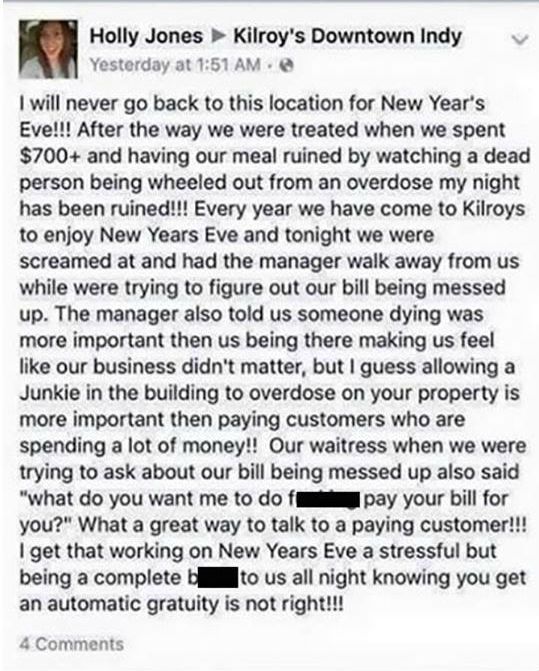
“I will never go back to this location for New Year’s Eve!!!” young Holly Jones ranted on an Indianapolis bar and restaurant’s Facebook page. “After the way we were treated when we spent $700+ and having our meal ruined by watching a dead person being wheeled out from an overdose my night has been ruined!” The angry post accused the evening’s restaurant manager of rudeness, the party’s waitress of profanity and the establishment itself of inattention.

After a sharp on-line rebuttal by the restaurant, the Web Furies were unleashed. Jones’ post became the latest web-shaming catalyst and an invitation to join a cyber-mob where fun could be had by all turning an ordinary jerk into a national villain. Lots of people signed up. The mob tracked down Jones and bombarded her own Facebook page with hate—she took the page down—then moved on to the salon where she worked as a hairdresser, threatening a boycott unless it fired Jones.

So it did.

These exercises in vicious web shaming can be ranked along an ethics spectrum. At the most unethical end is the destruction of Justine Sacco, who had her legitimate marketing career destroyed by social media’s  hysterical over-reaction to a self-deprecating, politically incorrect tweet. Now she works promoting a fantasy sports gambling website, a sleazy enterprise that entices chumps into losing serious cash with a business model derived from internet poker—she not only had her life derailed, she was corrupted too.

At the other end is Adam Smith, the one-time executive who wrecked his own career, with the help of another cyber-mob, by proudly posting a video of himself abusing an innocent Chic-fil-A  employee because Smith didn’t like her boss’s objections to gay marriage.  Somewhere between the two is Lindsay Stone, who lost her job by posting a photo showing her pretending–she later said— to scream at the Tomb of the Unknown Soldier while flipping the bird at the “Silence and Respect” sign.

The distance between Smith and Jones is the difference between words and conduct. Smith’s video showed him abusing a young woman, and his posting of the video indicated that he saw nothing wrong with it. Jones, in contrast, did nothing, other than prove herself to be, at least at the moment she posted her rant, an utter jerk. Everyone along the spectrum, however, including Jones, were excessively and unjustly harmed by the web-shaming  campaign against them. Last I checked, Smith was unemployed and destitute three years after his episode of atrocious judgment.

In the current case, the cyber-mob forcing Holly’s employer to fire her is ethically worse, by far, than anything she can reasonably be accused of doing by posting her criticism of the restaurant. Continue reading

Ethics Quiz: The Memories Pizza Stunt

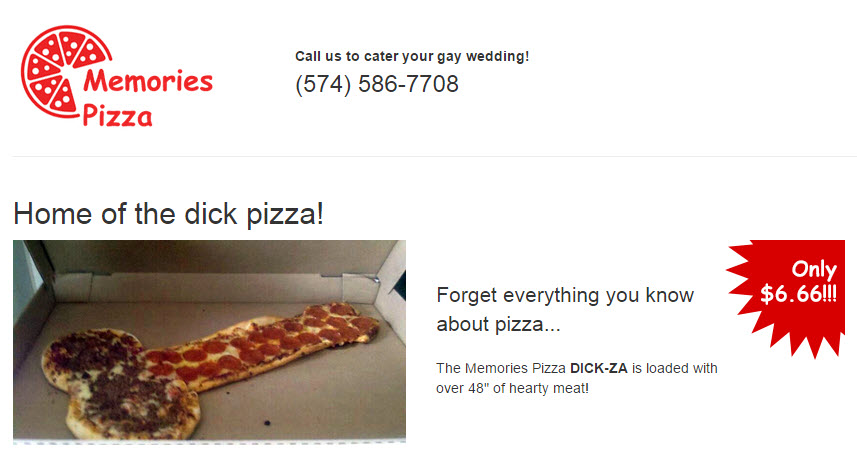
Memories Pizza, you will recall, rushed to let everyone know that it supported Indiana’s short-lived “Let’s discriminate against gays” law, which Pope Francis would have approved of, apparently.  The poor, naive little establishment, which was about as likely to cater a gay wedding as a White House state dinner, became the immediate target of social justice warrior bullies, who nearly succeeded in running them out of business.

On September 25, 2015, comic Robin Trevino, a member of the gay theatrical ensemble GayCo, drove to Walkerton, Indiana, bought pizzas at  Memories Pizza, , and served Memories Pizza to all the guests at his September 26, 2015 same-sex wedding reception, then released a video to alert the world that Memories Pizza had unknowingly catered a gay wedding  after all.

Your Ethics Alarms Ethics Quiz of the Day:

Was it ethical to do this?

Continue reading

Ethics Quiz: A Minimum Wage Lecture Instead Of A Tip?

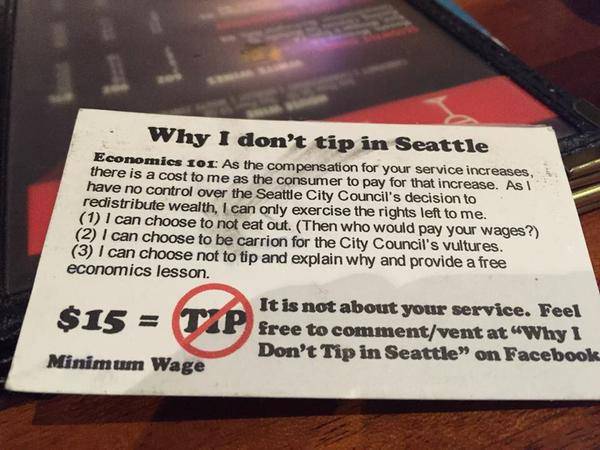
Diners and bar patrons in Seattle are apparently registering their displeasure over the city’s whopping minimum wage hike (to $15 an hour) by leaving this card instead of a tip:

why-i-dont-tip-in-seattle

Your Ethics Alarms Ethics Quiz:

Is this an ethical protest?

My view?  There are minimum wage employees in bars and restaurants, but waiters and bartenders often aren’t among them. In the case of the bartender who publicized this patron’s printed rant, we learn, he is not a beneficiary of the minimum wage increase, and his livelihood depends on tips.

A tip, as Ethics Alarms has stated before, should be based on quality of service. To withhold a tip from a server or bartender—which should be message about service—to register an objection regarding the city’s wage statutes is neither logical nor just. Among the card’s three options, the first is completely reasonable, the second is a necessary consequence of living in a democracy, and the third is just behaving like a jerk. I bet the guy that left this card kicks his dog after a bad day too.

___________________

Pointer: Fred

The Great Maine Diner Controversy

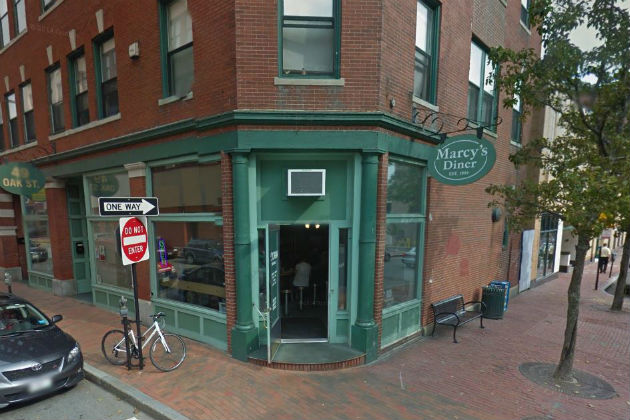
Marcys-Diner

Thanks to the internet, every day conflicts between ordinary citizens become opportunities for society-wide ethical evaluation . This can be extremely beneficial, helping to reveal disagreements regarding ethical conduct in common situations, and establishing social norms with efficiency that once would have been impossible. Of course, that requires that society reaches a reasonable consensus.

Last week a controversy emanating from a Portland, Maine diner called Marcy’s had blogs bloviating, pundits punditting and social media boiling over. Vacationing parents took their toddler to a crowded diner for breakfast, waited 30 minutes for a table and another 40 minutes for their food. The hungry child went on a crying jag that went on too long for the owner, who  suggested that the couple to leave in a less than polite manner, and finally shouted at the little girl to  “shut the hell up!” The couple left the diner.

The mother, Tara Carson, couldn’t resist registering her indignation on the Marcy’s Facebook page, the owner responded with even more colorful language than she did in the original confrontation, and social media appeared to divide into the “it takes a village so be sympathetic to parents of young kids and give them a break” camp and the “serves these entitled and incompetent parents right for being so inconsiderate and not controlling their child” camp, with the latter considerably smaller than the former. Then, not content to let the matter blow over, Carson got the Washington Post to publish her op-ed about the episode, which concluded, Continue reading

Ethics Dunce: Grandstanding Topeka Waitress Chloe Hough

tip the schoolsToday was apparently “Popular Unethical Conduct Day.” This isn’t as bad as a mother having a police officer terrorize her little boy, because governor abuse isn’t as bad as child abuse. It’s still wrong, and in several ways.

Waitress Chloe Hough was in her final shift in her last day as a waitress at a Kansas barbecue restaurant, and found herself serving conservative Kansas governor Sam Brownback. The controversial  Republican  recently pushed to replace Kansas’s education funding system with a  “block grant” program that cuts millions of dollars from  public school budgets.

Hough decided to use the opportunity to make a snarky, meaningless protest comment on his check, and grandstanded by posting a photo of it on Facebook.

“I just knew I had to say something or I would regret it,” she told a TV station.  Of course, she really would have regretted it if she hadn’t already quit her job. She was rude to a customer (wrong), compromised the service of her employer (wrong); embarrassed her employer (wrong);used her job illicitly to make a personal political statement (wrong), and posted the restaurant’s document without permission on Facebook. If the restaurant shares tips among servers, she also gave away money belonging to her colleagues without their permission. Wrong, wrong, wrong.  She did all of this knowing that she wouldn’t suffer any consequences, since she had already quit. It was hit and run unethical conduct, and a cowardly betrayal of trust. The legitimacy of her political critique is irrelevant.

I hope the restaurant withholds her final paycheck, and to any other employers out there, remember that name: Chloe Hough. She’s untrustworthy and disloyal, and if you hire her, you deserve what you get.

Planet Ethics To Earth’s Gay Marriage Combatants: “You’re Mean, You’re Disgusting, And You’re Embarrassing The Human Race”

earth-from-space

It is hard to mediate a dispute where both sides feel entitled to use scorched earth tactics that ensure that innocent people get hurt. The gay (or same-sex) marriage wars have quickly escalated to that point, and while it may have been predictable, it was not necessary.

Gay marriage advocates, who were winning and, it is now clear, will win, could have shown patience and compassion toward the unsuspecting Americans of faith who weren’t paying close attention to the epic cultural shift underway, and who are reacting like most human beings react when the basic traditions, assumptions, and beliefs that they grew up believing were good, fair and immutable suddenly move beneath their feet like unstable tectonic plates—with confusion, anger, fear, impulsive words and actions based on instinct and panic. The gay advocates couldn’t bring themselves to do it, though. They rationalized their aggressive strategy with the Goldwateresque “Extremism in the  defense of liberty is no vice” approach to social change. They insisted on demonizing opponents, without caring about their motives or their lack of understanding of the issues. Even passive acceptance wasn’t enough: the pro-gay marriage warriors had to purge contrary thoughts from the culture. Forget about tangible opposition: anyone who wasn’t thinking friendly thoughts about gays and their unions had to be destroyed. Use the fear of the tradition-bound against them. Crush them…beat them into submission.

It has been ugly, destructive, and wrong. American shouldn’t lose their jobs for signing a petition or voting for a referendum. States, and all their businesses and individual livelihoods, shouldn’t be boycotted because of misguided laws. This week, a family that just want to make and sell good pizza was drawn into a controversy it neither understood nor could be expected to, and was targeted for destruction after the owner made a comment rife with ignorance about, well, everything. Does it really matter that a pizza seller mistakenly thinks that it would be honorable and virtuous not to cater a hypothetical same-sex wedding reception? Does the family really have to be brought to its knees, made an example of, and ruined to teach anyone else what can happen to them if they don’t conform to the new, mandated belief system?

Who respects or likes people who act this way? We call them bullies. We call them cruel. We call them fanatics. ( This hateful CBS reporter tried to derail the GoFundMe effort to raise funds to rescue the pizza place.) Unless we are determined to understand their motives, we are very likely to hate them.

So the advocates of gay marriage really think it advances their cause, and it is a just cause, to make people hate and fear them.

What utter, utter folly.

Naturally, as in any war, the other side has responded in an equally brutal and ugly manner, just worse—dumber, to begin with. It’s Dresden for Coventry all over again.  Continue reading

Well-Earned But Wrong: The Parody Website And The Attack On Memories Pizza

Memoriespizza

It is difficult to work up much sympathy for Memories Pizza, the Indiana pizza place that rushed to be known as the first business to announce that it plans on refusing to serve gay customers under the cover of Indiana’s new and poorly thought-out religious freedom law.  Oh, I agree that it was thoughtful of the owners to help show that the law, regardless of the neutral words used, was intended to be a rallying point for anti-gay advocates who want to fight back against what they see as a frightening cultural shift that they don’t understand and can’t accept, but the owners are still, to be blunt, morons.

Announcing that the law would allow them to refuse to cater a gay wedding, they injected their biases into a debate they were neither legally, ethically, morally or intellectually equipped to participate in. Crystal O’Connor, whose family owns the small-town pizzeria, spouted off  that “If a gay couple came in and wanted us to provide pizzas for their wedding, we would have to say no,”  as the national debate over the law was heating up. Well, no, Crystal, you wouldn’t have to, and the law probably wouldn’t protect you if you did. Baking pizza is not the exercise of religion, and nothing in the Bible says “Thou shalt not send pizza to the reception of a wedding you disapprove of.

I just heard one of the law’s supporters from a “family values” group that spends much of its time, words and money attacking homosexuality swear to Chris Cuomo on CNN that the law has nothing whatsoever to do with Indiana embracing anti-gay bigots (and tricking them into thinking that stunts like Crystal’s are acceptable). “It’s about conscience, ” he intoned, without giggling. But the law says nothing about conscience either.It prevents the government from  substantially burdening the exercise of religion. Catering an event, religious or not, is not a religious act, nor is a wedding reception a religious ceremony. It is no more legitimate to say that your conscience forbids you from selling pizza to strangers than it is to say that your conscience forbids you from letting a transsexual into your cab. O’Connor, not surprisingly, doesn’t comprehend the law. Continue reading

Fair vs Fair: Ethics and the “No-Tip” Restaurant

You know, this looks like a place that would believe that dishwashers deserve as much pay as waiters...or as bankers, for that matter.

You know, this looks like a place that would believe that dishwashers deserve as much pay as waiters…or as bankers, for that matter.

William Street Common is a new restaurant in Philadelphia, and is getting publicity for, we are told, experimenting with a different and (maybe?) fairer compensation model. Owner Avram Hornik  pays all of its employees, from the servers to the dishwashers, at least $15 an hour plus paid sick leave and health insurance benefits. There is a 20 percent service charge for drinks, and that goes into a common fund that makes that  $15 an hour wage affordable. Money left over at the end of a pay period is divided up among employees based on a point system related to various factors.

Hornik came up with this structure, he says, to deal with the well-debated problems of tipping. “Some people just tip the same amount, but some people base it on how quickly the food was there, whether we were out of something, whether the server was there when they wanted them to be,” he says. “So much of that is out of the control of the individual server… So why would it be fair for the service employee to be responsible for the poor decisions of management?”

Hornik argues that his model “essentially creates a guaranteed floor. But we’re also capping the ceiling,” he points out, because the tipping gets shared equally with all employees. “We didn’t think it was fair [that] in some places you have dishwashers earning 10 dollars an hour and the bartender earning 30 dollars an hour.” He also is convinced that the customers will benefit.  “That atmosphere among the employees, a sense of community and empowerment and happiness with the job, is going to translate into a better environment for customers,” he said. “By having happy staff customers are going to be happier too.”

Is this system really fairer than the current one? Progressives are cheering it, because it represents a “living wage,” or at least something close to it. OK, but it would be nice not to feel hyped: ThinkProgress, for example, had headlines that the William Street Common “got rid of tipping” and writes “tips aren’t mandatory.”

Inept reporting or lies, take your pick. A 20% “service charge” is a mandatory tip, so tips ARE mandatory. The reports don’t explain how voluntary tipping has been eliminated, or whether a server would be prohibited from keeping a ten-dollar bill that a diner hands him, saying, “You know, the food was lousy, but you were so gracious and accommodating that you single-handedly made the evening bearable. Thank you. If I ever come back, it will be because of you.” If so, is that fair?  I don’t think so. In fact, it’s exactly as unfair as a diner not rewarding excellent service, and tipping a dime. Continue reading

Comment of the Day: “Someone Explain To Senator Tillis That It’s Unethical To Make People Sick On Principle”

hand-washing

Refusing to rest on his laurels, recently crowned Ethics Alarms “Commenter of the Year” texagg04 delivers a helpful, clarifying, erudite examination of the balancing process brought into play with the regulation of businesses for health and safety reasons. Here is his Comment of the Day on the post “Someone Explain To Senator Tillis That It’s Unethical To Make People Sick On Principle”:

Let’s unpackage this.

Purchasing Products and Services

When we buy a product or service, we don’t just buy the end result. We buy a long string of tasks leading up to that final product and sometimes we buy even more things than just the final product*. In this instance, that doesn’t just mean the food on your plate, as tasks, upon deep consideration are actually HUMONGOUS things that are composed of the Time necessary to complete, Material either used up in preparation or as a component of the end item, Personnel Knowledge needed to perform, Equipment which facilitates, and Space needed to complete the task.. You don’t purchase just the food. You purchase the time and care EACH employee puts into the process. From Day 1, you purchase the time a procurer makes a deal with a vendor OR personally hand selects the ingredients of your meal. You purchase the time and quality of the food storage in the pantry/refrigerator. You purchase the chef’s level of knowledge. You purchase the time he devotes to ensuring the burners are a certain temperature. You purchase the manager’s level of knowledge in keeping things efficient and cost effective. You purchase EACH AND EVERY action the server takes that could affect the final, tangible product or service. Continue reading