Once Again, Fairness vs. Integrity In A Baseball Controversy

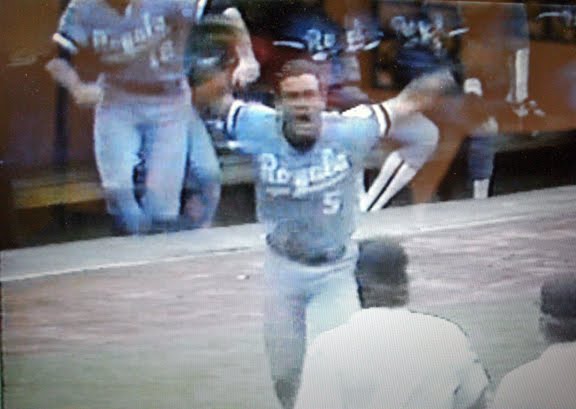
George Brett was a bit chagrined when his home run was disallowed...

George Brett was a bit chagrined when his home run was disallowed…

It has happened again, as it has thousands of times since the great game of baseball was invented. A result that is permitted by the rules violates the sense of fairness of  objective observers, who thereupon demand that the result be “fixed,” after the fact, by baseball’s powers that be. The most infamous recent example of this scenario was in 2010, when umpire Jim Joyce robbed a deserving pitcher of the perfect game he had pitched (27 batters, 27 outs) by calling the final batter safe at first on a close play, when the player was obviously (to all but Joyce, that is), out. The umpire quickly and openly admitted his error after the game, but there is no provision in the baseball rules for the League or Major League Baseball reversing an umpire’s judgment call after the fact, no matter how bad it was or how unjust the results. Baseball’s Commissioner Bud Selig, to his credit, refused to yield to the popular outcry to give the unfortunate Detroit Tigers pitcher, Armando Galarraga, the achievement and place in baseball history that should have been his. The rules say that unless umpires have actually misinterpreted the black letter rules of the game, there is no remedy. Umpire errors, like player errors, are part of the game.

Last night, what should have been a game-winning home run was called a double by umpires, and what was worse, they held to their mistaken call even after the mandated video review MLB now allows for disputed home run calls. The umpires viewed video that clearly shows the Oakland A’s Adam Rosales’ hit clearing the wall, but crew chief Angel Hernandez bizarrely claimed that the video wasn’t conclusive enough to justify a reversal. Since the A’s lost the game by one run, this altered the result, and there have been calls for an official reversal with the game being replayed. Continue reading

Gen. Allen, Lockheed, John Edwards, Restraint Bias,and Further Musings on the Petraeus-Broadwell Ethics Train Wreck

Run away!

In no particular order:

  • In a tack that is being duplicated by other commentators on the left, MSNBC’s Rachel Maddow essentially pronounced the scandal as much ado about nothing (Columnist E.J. Dionne dismissively referred to Petraeus’s affair as his “little secret”). See, as long as an incident involves sex, the Left’s default position is that it can’t be that bad. Maddow mocked the actions of Jill Kelley, the woman who Broadwell threatened and who alerted the FBI, saying, “Who contacts the FBI because of threatening e-mails? If I did that, they would have to set up a special division just for me.” Ha ha.  How many of your threatening e-mails credibly suggested that the head of an intelligence agency was having an illicit affair with an unstable wacko, Rachel? Kelley did the responsible, intelligent thing given the possible national security implications. But it’s certainly good to know that you wouldn’t…because it’s only sex, of course.
  • Other pundits are complaining that the FBI became involved when what Petraeus did “wasn’t a crime.”  Yes,  it’s the “It’s legal” rationalization. Why people who can’t comprehend that dangerous, destructive, serious misconduct can occur without breaking any laws are allowed to write newspaper columns, I’ll never understand. Petraeus’s affair was a violation of the ethics rules, in an intelligence agency with major responsibilities in national security. That is serious, inherently dangerous, and easily could have led to security breaches that were illegal. If a leader materially, knowingly and publicly violates an ethics rule, he cannot lead. This is why Petraeus, who understands this, resigned, despite the certainty that the Rachel Maddows of the media would have been happy to shrug off his actions as “no big deal.” because it’s only sex, and “it’s legal.”
  • Kelley still boarded the ethics train wreck, not because of her actions in response to Broadwell’s threat, but in light of the revelation that she was maintaining a hot e-mail relationship with Gen. John R. Allen, the commander of U.S. and NATO troops in Afghanistan. The FBI has uncovered between 20,000 and 30,000 pages of primarily e-mails containing “potentially inappropriate” communication between Allen and Kelley. Wait, what? Between 20,000 and 30,000 pages? What the hell is going on with our generals? This is obsessive, unhealthy behavior, even if he’s just writing her limericks and recipes. Something is serious amiss in the ethical culture of the U.S. military leadership Continue reading

Comment of the Day: “Randy Cohen’s Scofflaw Cycling: How Did THIS Guy Ever Get To Be Called ‘The Ethicist’?”

Reader Lance Jacobs, a New York bicycle instructor, was moved by last month’s Ethics Alarms Post “Randy Cohen’s Scofflaw Cycling: How Did THIS Guy Ever Get To Be Called ‘The Ethicist’?” to write the New York Times about their scofflaw, erstwhile “Ethicist,” who had proudly confessed in a an essay that he routinely broke the law while cycling, and believed that he was right to do so. The Times didn’t print Lance’s letter, an open letter to Randy, and sadly, this blog does not (Yet! Yet!) have the circulation of the Times, but it is an excellent rebuff to Cohen, and a most deserving “Comment of the Day.”

Here it is:

“Dear Mr Cohen, Continue reading

Randy Cohen’s Scofflaw Cycling: How Did THIS Guy Ever Get To Be Called “The Ethicist”?

Stop means “stop,’ unless Randy decides it means “yield”—after all, he knows best.

Randy Cohen was the original author of the New York Times Magazine’s column “The Ethicist.” During his tenure he made a name for himself with lively and sometimes witty prose, and on Ethics Alarms, at least, a disturbing tendency to rationalize clearly unethical conduct when it suited his political agenda, which was unapologetically left of center. In one notorious example, he told a student whose wealthy and famous father was paying her college tuition that it would be ethical for her to cash a partial tuition refund check she received from the university to her mother and stepfather, who believed that the father had not paid his fair share of child support. Cash that check, advised Cohen….“You are entitled to this money not because he is successful while you struggle. Such rough justice would also encourage you to sneak into his house, swipe his sofa and sell it on some kind of furniture black market. That would be stealing; this is merely claiming what he owes you.”  Of course, this is also stealing: cashing a check not intended for you because you believe it should be used to settle a disputed debt between the owner and someone else is not honest or fair, regardless of the merits of that belief. But Randy is a class warrior: as “The Ethicist,” he routinely took the position that it was “ethical” for people to use dubious means to get an edge on the evil rich, which in his world apparently means anyone richer than him.

I don’t know what Cohen has been doing since the Times sacked him; it isn’t practicing ethics, as he didn’t do this before his tenure, and confessed when he left the job that writing about ethics didn’t make him practice ethics while he was “The Ethicist” either, something I found and still find incomprehensible. Now, he tells us in a recent Times piece, the Ex-Ethicist is riding around New York City on his bicycle, running stop signs and red lights.

He tells us, moreover, that this is ethical, though it is certainly illegal. “I roll through a red light if and only if no pedestrian is in the crosswalk and no car is in the intersection — that is, if it will not endanger myself or anybody else, ” Cohen says. “To put it another way, I treat red lights and stop signs as if they were yield signs. A fundamental concern of ethics is the effect of our actions on others. My actions harm no one. This moral reasoning may not sway the police officer writing me a ticket, but it would pass the test of Kant’s categorical imperative: I think all cyclists could — and should — ride like me.”

This is arrogant, fatuous, reckless and wrong. But that’s Randy.

Even Coehn’s reading of Kant is wrong. The categorical imperative says that an action is ethical only if it could be the universal rule without harm, and this, despite Cohen’s rationalizations, could not. Who says the cyclist’s judgment of when it is safe to run a red light or stop sign is correct or reasonable in every instance? Why couldn’t motorists also use this same justification for running red lights at will? Continue reading

Graduation Ethics: the Cheering Mom and the Jerk’s Advantage

Stipulated: for police to arrest proud South Carolina mother Shannon Cooper for loudly cheering during her daughter’s high school graduation over the weekend  was excessive, unreasonable, and stupid.  The graduation crowd  had been asked to hold their cheering until all students’ names had been called, and warned relatives of the graduates that they would be removed from the facility if they disobeyed the rule. As some parents inevitably do at every graduation, Cooper ignored the reasonable request, but this time, the defiant parent paid a steep price. Police charged her with disorderly conduct and placed her in a detention center.

Let me also make this clear, however: Cooper behaved like a selfish jerk. She is being showered with sympathy now, cast as Innocent Parent Abused For Being Proud of Her Baby, but that’s not who she is. She is the theater audience member who ignores the request to turn off her cell phone, and disrupts the actors and the audience when it rings, and the movie audience member who chats loudly during the show. She is the pet owner who doesn’t clean up after her Great Dane at the dog park. She is the able-bodied shopper who parks in  a handicapped parking space to run into the store “for just a minute.” She is the person who breaks into line, who brings 30 items to the “15 items only” checkout station, who takes more than her share of free food at events. She is, in short, the kind of person who doesn’t believe reasonable rules apply to her, and who constantly challenges the rest of us to “make a big deal” out of relatively minor demonstrations of contempt for everyone she comes into contact with. Continue reading

Comment of the Day: “Ethics Quiz: The Case of the Abandoned Prom Date”

Well, I always wanted to be like Clint; not in this way, perhaps, but I'll take what I can get...

Jordan Gray posted the best of the counter-arguments to my resolution of an iron-fisted couples-only policy imposed on a high school junior whose feckless date left her with two tickets, an unworn dress, and a broken heart.

You almost have me convinced, guys. Maybe tgt is right, and I’m just telling the kids to get off my lawn…

Here is Jordan’s Comment of the Day on the post,  “Ethics Quiz: The Case of the Abandoned Prom Date”;

  “What makes proms special is that they are couples affairs, not just another dance.”

First, there are plenty of ways to enjoy the prom without being part of a “couple”. I’ve heard of singles going as groups, for example, or even being picked up by an existing couple who are more concerned with having fun than manufactured romance. Continue reading

Ethics Quiz: The Case of the Abandoned Prom Date

Today’s Ethics Quiz takes on the ethics of high school proms.

Oh, suck it up, girl!

Amanda Dougherty, a high school junior, had a prom date, tickets, an expensive dress and dreams of romance, glamor and life-long memories when her date, for reasons unrevealed to us, had to bale out of the big event too late for Amanda to find a replacement beau. She planned on attending stag, and was shocked when officials at Archbishop John Carroll High School told her she was not allowed to go without a date according to Archdiocese of Philadelphia policy. The office of Catholic Education explained that the school has “numerous dances and events throughout the year where dates are not required, but we view the prom as a special social event where a date is required to attend.”

“She’s been excited (about prom) for a couple of years,”  Jack Dougherty, Amanda’s father, told the CBS affiliate in Philly. “She went out around Christmas looking for her dress.” Amanda took a feminist line of attack. “For them to say we’re not good enough to go without a guy next to us, that’s kind of sickening,” she said.

Your Prom Season Ethics Quiz is this: Is the school heartless and overly rigid, or is its decision the right one? Continue reading

The Twins and the Amazing Hockey Shot: the Public Flunks Its Ethics Test…Badly

Lets's face it: twins are trouble.

I am depressed today, for it is increasingly likely that I am wasting my life.

I began writing about ethics on-line after being stunned by the letters to the editor and calls to C-Span, not to mention the articles in the press, regarding President Clinton’s conduct in the Monica Lewinsky affair. The commentary was virtually ethics-free, and I realized that the vast majority of the American public had no idea how to apply ethical analysis to an event or problem. Their judgment regarding who was right and who was wrong appeared to be based entirely on rationalizations, biases, and non-ethical considerations.If they liked Clinton, he did nothing wrong. If they opposed his policies, he was scum. Objectivity and fair analysis only occasionally surfaced in the discussion at all, and the media coverage, if anything, was worse.

Now I’ve been doing this for almost a decade, and the verdict is clear: nothing has changed. In fact, the situation may have worsened. The sad proof at hand is the public’s reaction to The Tale of the One-in-a –Million-Hockey-Shot Scam, a feel-good story from last month that just turned sour. Continue reading

Ethics Dunce: Crane Interiors in Woodbury, Tenn.

"Hi! I can't answer the phone now, but please leave a message!"

Teresa Danford’s son, Lance Cpl. Mark Rhyne, is deployed in Afghanistan, where he is only able to call home once or twice a month. He has been overseas for seven months. On Valentine’s Day, Teresa, an employee of Crane Interiors in Woodbury, Tennessee, received one of her son’s precious phone calls at her job, on her personal cell phone. She was promptly suspended for three days without pay, for Crane has a no cell phone call policy for employees. Her manager informed her that she would be fired if it ever happened again. Continue reading

Why Students Lose Respect for School Authorities, Case Study 309,456: “The Red Scare”

Inappropriate, Thomas!

It is not directly relevant to Natalie Munroe’s complaints perhaps, but when students today seem less than in awe of those adults who claim to be qualified to guide them to wisdom and success in school, they often have good cause to be wary. Take the example of Stephanie Plato, a sixth grader at Cobb Elementary School in Houston’s Channelview school district.

Stephanie was suspended from school because the red and blonde highlights her mother let her get died into her hair as a 12th birthday present violated the school’s code of conduct.

You read that right.

We are not talking electric orange here, or anything strange and disruptive. Just a few red highlights in her naturally brown hair. But the school dress code bans “inappropriate hair color”…such as red.  Don’t ask me why. It doesn’t matter why. It is stupid. Continue reading