Unethical Quote of the Month: The Washington Post

“When will America choose to protect children instead of guns?”

—- The headline writer for the Washington Post, introducing columnist Petula Dvorak’s column this morning on the Newtown, Connecticut elementary school shooting, which took the lives of 26, including 20 children.

Newtown shooting

Presumably the Post’s headline writer was inspired to come up with that headline by the similar statement from Marian Wright Edelman, president of the Children’s Defense Fund, who was quoted in Dvorak’s essay. Edelman said,

“This latest terrible tragedy at Sandy Hook Elementary School is no fluke. It is a result of the senseless, immoral neglect of all of us as a nation to fail to protect children instead of guns and to speak out against the pervasive culture of violence. It is up to us to stop these preventable tragedies.”

This is not quite as irresponsible and dangerous as the Post’s headline, but it is close. The suggestion that greater safety and security compels and justifies abandoning the core rights that make the United States unique and free is the ticket to tyranny, benevolent or otherwise. Continue reading

Porn and the NFL: In Search of A Biased Referee

With condoms, what, 2.5 X’s?

55% of California voters decided yesterday to make porn stars wear condoms on the job—good for their health, bad for the health of the state’s booming XXX film industry. It is a reasonable guess that injecting condoms into the proceedings will put California’s porn products at a significant competitive disadvantage, and also a reasonable guess that the voters who enacted the measure couldn’t care less. So legal enterprises may go bust, their employees may lose their careers, and consumers may lose a form of entertainment they crave because of the policy priorities of those who hold all three in low regard, and who are unlikely to apply any kind of balancing standard. It’s safer for all concerned to require condoms, that’s all. Porn companies, porn careers, porn lovers—who cares about what they want? Continue reading

An Unreadable Traffic Sign Is A Dangerous Traffic Sign Is An Unethical Traffic Sign


Question: What does this speed limit sign tell us about the people who erected it?

Answer: They are reckless. They are negligent. They are lazy. They are careless. They are dim-witted. They are irresponsible. They are incompetent.

As drivers in Oakland County’s White Lake District (outside Detroit) complain that it is literally impossible to figure out what the speed limit is while driving past the sign above, various school officials and others are giving reasons for why the sign is so complicated. There are many schools in the area. An electronic sign is expensive. The devil made them do it.

No.

There is only one reason: they are utter incompetents. If a road sign can’t be read by drivers, than it takes the IQ of a slug to conclude that there is no point in erecting it, and in fact, it is dangerous to put it up. A sign that can’t convey information isn’t a sign, it’s a menace. Or pop art. Or a monument to stupidity, but it isn’t a road sign. That White Lake installed an unreadable road sign that was supposed to protect school children just puts the unethical frosting on the irresponsible cake.

Unbelievable.

Scylla and Charybdis in the Schools

This is Scylla. Charybdis is in the teachers lounge.

Responding to one of the recent posts here about the deteriorating relationships between students, teachers and administrator, teacher Brook Styler alerted us to his own crisis, a situation right out of “The Children’s Hour” in which vengeful female students, aided and abetted by parents, circulated rumors that lost him his job.

Styler has launched a website, Teacher Hunt, to collect the experiences of teachers, who, like him, have been victimized by false accusations from students. I plan on visiting it often. But the site appears at a time in which teachers using their students for sexual gratification is either on the rise, or is being uncovered with remarkable efficiency. Every day, one or more cases of teachers preying on students is in the news. Yesterday, it was Rachel L. Farrell, 25, a  Bangor, Maine  high school teacher  charged with having sex with a 17-year-old student on “numerous occasions” while she was supposed to be tutoring him in English. Authorities believe she had sexual relations with as many as three other students. Today, it was the still unfolding horror of Mark Berndt, 61, a teacher at Miramonte Elementary School in the Los Angeles community of Florence-Firestone, who was charged with 23 counts of committing lewd acts on children after over 400 photos were discovered by a CVS clerk, showing pornographic conduct involving his students (age 7-10) over a five year period. Berndt, now being held on $23 million bail, regularly told his students that they were going to play a “tasting game,” in which children were blindfolded and, in some cases, gagged with tape, authorities say. They were then fed the teacher’s semen, administered to them on a blue plastic spoon and, according to one alleged victim’s father, on cookies.

I can’t wait to see what tomorrow brings, can you? Continue reading

A Lesson From Georgia: Schools Too Stupid To Be Ethical Are Also Too Stupid To Be Trusted To Teach

Handy Tip: Don't trust this man to educate your children.

Rick Jones, proprietor of Curmudgeon Central,  launched his Curmie Award last year, “honoring” educational professionals who embarrass their profession. Rick discovered a  Curmie-worthy story that he blogs on here, from the Beaver Ridge Elementary School in Norcross, GA. A teacher gave her third-grade class a Monty Pythonesque math test in which all the questions revolved around slavery:

  • “Each tree had 56 oranges. If eight slaves pick them equally, then how much would each slave pick?”
  • “If Frederick got two beatings per day, how many beatings did he get in one week?”
  •  “Frederick had 6 baskets full of cotton. If each basket held 5 pounds, how many pounds did he have all together?”

Moron.

Naturally the school got an earful from parents, and naturally the school, which had no possible justification for such wretched judgement on its teacher’s part, apologized and backtracked. It’s not enough. Why are such incompetent idiots hired to teach anything more sentient than a poodle? How can a parent trust a school that allows teachers like this in the front door? If your child is taught by a moron—and technical definitions aside, that is not an unfair or uncivil description of a teacher who thinks it’s reasonable to give the question, “If Frederick got two beatings per day, how many beatings did he get in one week?” to a third-grader, your child’s likelihood of growing up moronic is vastly increased.

And yet, as Richard Dreyfus’s character says to Quint the shark-hunter as they compare scars in “Jaws,” “I got that beat.”In fact, Rick, I got that beat in Georgia. Continue reading

Comment of the Day: “Murder House Ethics and the Validity of Feelings”

"Oh THAT! You would have cared about THAT?"

Tgt, the ghosts of whose earlier argument in series of comments haunted me prompted a revisit to the issue of murder houses and a seller’s obligation to reveal their history to potential buyers, came back with this Comment of the Day, thought-provoking, as usual:

“…I still want to know the line that determines what ethically does and does not need to be disclosed. It was never settled. This post generally boils down to another emotional appeal that something should be done in some cases. I want to know which cases and why those. Otherwise, my argument holds fast. I don’t see multiple murders (the latest clearly having nothing to do with the earlier ones) as being any more relevant than one murder.

“I also believe Jack misrepresented my position on emotion in general. Us rational humanists still mourn our dead, though we try to celebrate their lives more than anything else. While humans are not special in the concept of the Universe, we understand that we are special to ourselves and in our relations with other people. Humanism is about celebrating human life and relationships.

“As for death specifically, I see no need of a grave or burial rites. A dead body is just decomposing flesh. It does not need to be prayed for and cleansed. The person though, the lasting effects they have had on others, the memories of them – these are all important. I cried when a somewhat distant high school friend died in a freak accident at 17. I sent his family flowers on the anniversary of his death for the next 2 years. Why? Because it let his family know that he wasn’t forgotten, that he made an impact on other lives. It let them knew that people cared… people they only knew by name. I cherish the cards they sent in response. Continue reading

Gov. Mitch Daniels’ Self-Validating Decision

"My wife, may she always be right, but my wife right or wrong!"

“Simply put, I find myself caught between two duties. I love my country; I love my family more.”

Thus did Indiana Governor Mitch Daniels remove himself from consideration for the 2012 GOP presidential nomination, breaking the hearts of Mitt Romney haters everywhere. Seldom have eighteen words launched so much ethical analysis, or what passes for it in the media.

Washington Post columnist Ruth Marcus, for example, applauded the Governor’s priorities while accusing Daniels of “throwing his wife under the bus.” Her point was that Daniels did not have to make it so crystal clear that his wife vetoed his own desire to run, that he should have simply said that he declined, and leave it at that. Indeed, that would have been chivalrous and kind. For a public servant and politician, however, it would also have been dishonest and wrong. Just as the public needs to know why a public figure is running for president (Gingrich: Because he’s deluded….Trump: Because its good for his TV ratings…), it needs to know why a public figure is not. Continue reading

Murder House Ethics and the Validity of Feelings

We last visited the issue of the ethical selling of murder houses in February, when  the Jon Benet Ramsey house went on sale. I opined that even though Colorado doesn’t have a legal requirement that a seller must reveal the history of the house as long as it has no structural implications, there is an ethical obligation to let prospective buyers know about house-related events that might cause them to reconsider their decision to buy it:

“The truth is still this: there is something about the $2,300,000 house that makes it undesirable to a lot of prospects, and that means that even if the law doesn’t require the seller to tell interested house-hunters the story of the little dead girl in the basement, fairness and the Golden Rule do.”

The debate over this issue was unexpectedly intense. Ethics Alarms’ resident rational humanist “tgt” objected strenuously, writing,

“I don’t see how you can avoid the slippery slope question. Your basis is 50% of the population having a desire. Is that the cutoff? I think over 50% of people would prefer to live in a house where there hasn’t been child abuse. Go back a few years, and I bet a significant portion of the population would prefer to live in a house that had never had black occupants. Back in today’s world, more than 50% of the population doesn’t want to live in a haunted house. If a previous tenant thought the house was haunted, does the complete nonexistence of ghosts make not mentioning this a material representation? If an event is uncommon, does a realtor need to take a poll before deciding what is material and what isn’t?”

Karl Penny, however, bolstered my position:

“…the question is, does the realtor have an ethical obligation to fully reveal the history of this house. Well, the funny thing about behaving ethically is, it often requires us to act in ways that are not in our own immediate best interest… this may give a potential buyer a leverage point to negotiate a lower price for the house, to the detriment of the realtor, who could end up taking a lower commission as a result. No surprise, then, that the realtor would love to find a reason not to opt for full disclosure. But, if that realtor successfully conceals the house’s history from an actual buyer, one who would not have bought had they known otherwise? The realtor had a simple, human duty to disclose, even if it cost him money (and, yes, even if it cost me money, were I the realtor)….Jack’s right: this is Golden Rule time. If I am willing to treat with someone else in a way that I would not want anyone to treat with me, is that logically consistent (much less ethically consistent)? And would any of us want to live in the resulting society should everyone behave in that fashion?”

Now another house with a Hitchcock-worthy past is on the market: 9337 Columbia Boulevard in Silver Spring, Maryland, a state that also doesn’t require its realtors to disclose when a house has been the scene of a murder…or, in this case, three murders in the last decade. Continue reading

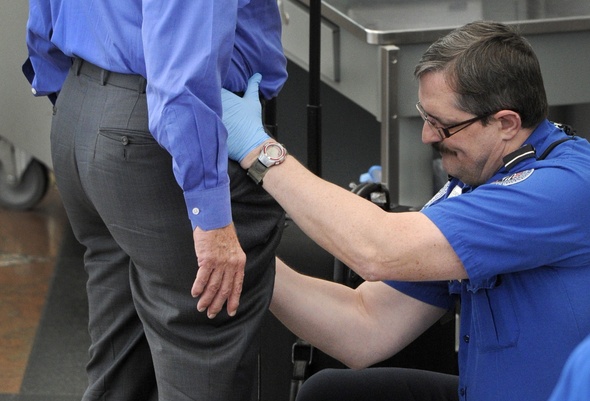
Final Ethics Verdict on TSA’s Feel-Up Pat-down

I was flying this week, and the security procedures were smoother than ever. Now I am certain that my molestation at check points last year was unethical, and have sufficient evidence to conclude that it was based on government incompetence and willful disregard for my comfort, dignity, and rights.  I am also wondering, more than ever, if the ardent, supposedly liberal defenders of the indefensible feel-up pat-downs have learned anything about the dangers of blind government obeisance and partisan loyalty. I hope so.

The saga so far: Continue reading

Ethics Heroes: NFL Owners

The less THIS happens, the better.

I was wrong about the N.F.L.

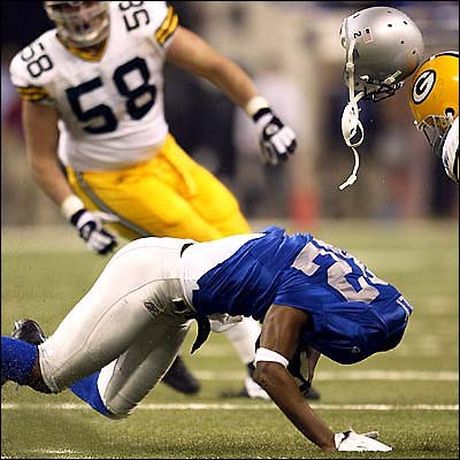
On Tuesday, the N.F.L. owners voted to move kickoffs back to the 35-yard line, where it was until 1994. The new rule will make the game less exciting but more safe. I didn’t think they’d do it.

The league has a problem—I mean, other than the impasse in labor negotiations that threatens to disrupt the coming season and lose owners and athletes millions. Its game is more popular than ever, but little by little, the evidence is mounting that it is also lethal. Playing pro football injures the brains of a higher percentage of the athletes than anyone suspected, and far worse than suspected. Players are quite literally sacrificing their lives, or at least two or three decades of them, for the Sunday entertainment of America. Continue reading