Ethics Quiz: The Conundrum of the Anti-Gay Marriage Diversity Officer

…But be sure to think about it who will see it before you do!

Ethics, law, fairness and common sense are locked in a complex battle in this story, which comes out of Gallaudet University, the famous Washington D.C. school for the deaf.

Dr. Angela McCaskill, Gallaudet’s chief diversity officer, has been put on administrative leave and may face dismissal because the school learned that she had signed a petition opposing Maryland’s same-sex marriage law.  McCaskill apparently signed the petition at her church after her preacher spoke against gay marriage. A measure is on the Maryland ballot that could overturn the recently-passed state law approving same-sex marriage.

Does she have an absolute right to sign a petition in favor or opposing any political or social policy? Yes. Is this a petition something a university official in charge of promoting diversity is wise to sign? No. Is a university whose diversity officer chooses to sign such a petition behaving fairly and responsibly to decide that it should have someone else in that position?

Hmmmm.

And that’s your weekend Ethics Alarms Quiz:

Is it fair and responsible for a university to fire its diversity chief because she signed a petition opposing gay marriage? Continue reading

Amendment 1: When Apathy Is Unethical

As you probably know by now, North Carolina voters went to the polls yesterday and passed a constitutional amendment that made same-sex marriages and even civil unions invalid under the law. Amendment 1, as it is called, is unusually brutal, as it will almost certainly take away the health insurance of many individuals in long-term committed relationships who were covered by their partner’s workplace insurance, and if they have pre-existing conditions, it will be difficult and expensive finding new coverage. Even that however, is less harmful and hurtful than having their home state declare that they are a second-class citizens, which is what this and similar provisions around the country do. Continue reading

Gays, Bridal Shops, Judges, and the Anger of Grief

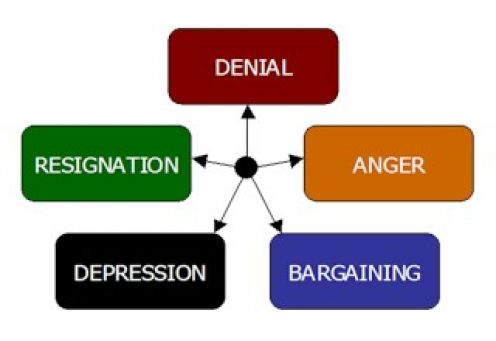
Gay rights opponents are locked in the anger stage of the five stages of grief identified by Dr. Elisabeth Kubler-Ross. Frankly, I thought they would be farther along by now.

The American public has made rapid progress in its acceptance of gay neighbors, gay sons and daughters and same-sex marriages, but those who regard homosexuals as practitioners of an aberrant and corrupting lifestyle, while recognizing, I think, that the cultural battle is lost, are deep in grief. Anger is only the second stage of the grieving process, and the most destructive as well as the stage that generates the most unethical and irrational conduct. If we can somehow get the grief-stricken to bargaining, depression and acceptance, the final three stages, everyone,including them, would be better off.

The signs are clear right now, however, that anger is the prevalent mood among anti-gay bitter-enders, after the first two stages, denial and isolation, have played  out. As a consequence we are seeing more and more instances of gratuitous cruelty and aggression against gays. It is usually diagnosed as hate, but its root is the anger of grief. The culture is changing in ways that some never dreamed it could or would, and they are furious. Continue reading

The Provocative T-Shirt Problem

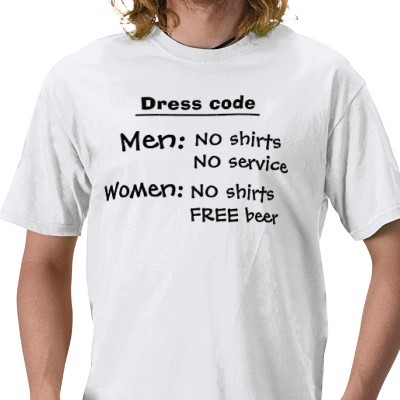
Dress codes+grievance-mongers+freedom to be rude...oh, it's hopeless.

An ethical dilemma occurs when a clear ethical principle clashes with a strong non-ethical consideration. An ethical conflict occurs when multiple ethical principles suggest diametrically opposed results. The question of what is ethical conduct when it comes to wearing apparel bearing controversial messages has the elements of both a dilemma and a conflict.

                                                                                Welcome to Dollywood!

A same-sex couple visiting Dollywood Splash Country with friends and their children was told by a park gatekeeper that one of the women had to wear her T-shirt inside-out because its message—“Marriage is so gay”— “might be objectionable” to some visitors at the “family-friendly” park.

   <Sigh.> Continue reading

Comment of the Day: “The Ethicists, Backing Judge Walker and Gay Marriage, At An Unacceptable Price”

The motion to vacate Judge Walker’s ruling on Proposition 8 has been filed, you can read it here. Since the original post, I have detected some cracks in the formerly near-united front of legal ethicists and journalists deriding Walker’s critics. Some of them are finally, grudgingly, admitting that the Judge might not have handled his potential conflict so well after all, and that the motion is not a frivolous, anti-gay outrage as they originally labelled it.  The most rickety of the rationalizations put forth on Walker’s behalf, advanced by some his most respected defenders, is that he had no obligation to reveal his own sexual orientation by disclosing his domestic arrangement because of its intimate and private nature. Yet the judge voluntarily disclosed it after his decision was in the books, raising a rebuttable presumption that his original silence was to avoid suggestions of conflict, not out of a desire for privacy.

First time commenter Jada adds her Comment of the Day to the discussion: Continue reading

The Ethicists, Backing Judge Walker and Gay Marriage, At An Unacceptable Price

"Oh, all right...as long as we like the decision."

Thanks to the Judge Walker controversy, now have proof that the best legal ethicists in the nation are human. I suppose that’s something.

My colleagues in the legal ethics field are arguing—decreeing, really— that Judge Vaughn Walker’s decade-long same-sex relationship didn’t need to be disclosed before he ruled against Proposition 8 (California’s voter-approved gay marriage ban) because, they say, it created no reasonable doubts about his impartiality. Coincidentally, they also really, really like his decision. But then, so do I. Continue reading

Ethics Hero: Attorney Paul Clement

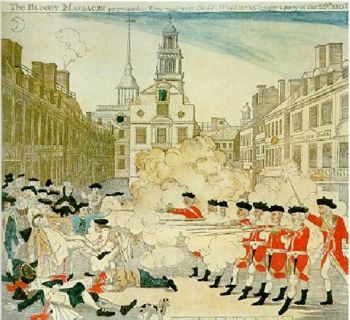
John Adams defended the guys in red, and Paul Clement understands why.

Law firm King & Spalding announced Monday that it would no longer represent congressional Republicans regarding the constitutionality of the Defense of Marriage Act (DOMA), the controversial 1996 legislation that defines marriage as being only between a man and a woman.. In response, the firm’s chief appellate lawyer, Paul Clement, who was handling the case, resigned from the firm.

In February, the Obama administration announced that its Justice Department would refuse to defend DOMA in a number of lawsuits, an unusual, controversial and troubling decision. It doesn’t take a lot of imagination to conceive of other federal laws another administration might decide to render dead letters by non-defense despite being duly passed by the people’s representatives. A government has an obligation to duly execute its laws or repeal them. The policy of the Administration regarding DOMA raised issues of governmental integrity quite separate from the provisions of the law itself. Continue reading

Judge Walker Was Wrong

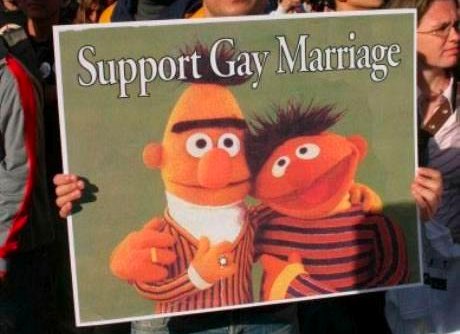
Now that we know about Bert, should Judge Ernie have recused himself?

Judge Vaughn Walker, the Federal District judge who a year ago ruled California’s Proposition 8, which banned same-sex marriages, unconstitutional, was wrong. No, not about the law, which is pretty clearly unconstitutional: his opinion was fair and well-reasoned, and is likely to be upheld on appeal. Walker was ethically wrong in his handling of the delicate issue of his own sexuality, which had raised a controversy about his objectivity and ability to be impartial.

Two weeks ago, following his retirement from the bench, Walker publicly disclosed for the first time that he has been in a same-sex relationship for the past ten years. This changes the analysis regarding the propriety of his ruling on Perry v. Schwarzenegger. Walker had long been rumored to be gay; supposedly “everybody” knew he was gay. My position, as well as that of many others considering the arguments of anti-gay marriage opponents that he should recuse himself, was that sexual orientation could not and should not create a presumption of bias, any more than gender, age, race or marital status. Continue reading

Ethics Dunce Follow-up: Justice Thomas’s False Disclosures

From the New York Times:

“Justice Clarence Thomas of the Supreme Court acknowledged in filings released on Monday that he erred by not disclosing his wife’s past employment as required by federal law.
Justice Thomas said that in his annual financial disclosure statements over the last six years, the employment of his wife, Virginia Thomas, was “inadvertently omitted due to a misunderstanding of the filing instructions. To rectify that situation, Justice Thomas filed seven pages of amended disclosures listing Mrs. Thomas’s employment in that time with the Heritage Foundation, a conservative policy group, and Hillsdale College in Michigan, for which she ran a constitutional law center in Washington.” Continue reading

Ethics Dunce: Justice Clarence Thomas

Will Supreme Court Justice Clarence Thomas be impeached because he failed to disclose his wife’s income, as required by Federal law, for at least five years? No.

Should he be? Probably not, though if it was proven that he intentionally used incorrect information, he could be found guilty of perjury. More likely is a civil penalty. In any event, his wife’s income isn’t a crucial piece of information in Thomas’s case, though his ideological enemies will argue otherwise. Such an omission is virtually never a cause for judicial discipline.

Is it a serious breach of his duties nonetheless? Yes. Continue reading