Yuri’s Tweets, Flawed Analogies and the School’s Defenders

[Why is it that when I’m traveling and stuck in airports where the supposedly free WiFi doesn’t work and on airplanes that can’t keep on schedule, some post that I assumed was fairly straightforward turns into the Battle of Antietam? I apologize to the various commenter’s whose work product languished waiting for moderation—I just didn’t have the chance. This odyssey ends tonight; I apologize for slowing things down. On the other hand, it’s good to know that my presence is not required for there to be lively and interesting discussions here…thanks, everyone. Good work.]

Don Bosco Prep High School, Class of 1917-1918

That is not to say that sending gross, obscene, or abusive tweets is exemplary conduct; obviously it is not. I have concluded, however, that the proper and ethical use of social media is something that people, including minors, have to learn for themselves by trial, error, research, observing the mistakes and experiences of others, making dumb mistakes and suffering because of them.  Parents and schools, as well as the popular media, have roles to play by giving advice and calling attention to cautionary tales, but heavy-handed attempts to manage social media conduct attempted by authority figures who, as a general rule, neither use nor understand what they are attempting to regulate are both irresponsible and doomed to failure. Like it or not, social media is a primary, and growing, means of communication and interaction in American society, and students are wise….that’s right, wise...to learn how to use it. I was just speaking to a room full of lawyers, and asked them how many used Twitter. The answer: none. But their clients use Twitter, and their client’s adversaries use it, and certainly their children. Their bar associations are making rules about what these lawyers and judges should and shouldn’t be able to do on social media, and most of those bar committee members don’t use Twitter either.As a result, the various jurisdictions have inconsistent rules, based on a lack of knowledge, that are already archaic.

It is fine and responsible for any adult to try to warn a young person that comments on social media need to be considered carefully, that they have a reach far beyond any intended audience and are essentially broadcasts, and that messages or photos can reach people who they hurt or upset, or cause to have a poor opinion of the sender. Ultimately, however, the pioneers in this new frontier of personal expression and mass communication are going to have to learn their own lessons, and better that they learn them now than when they are members of Congress. All punishing students for their tweets teaches them is that people with authority abuse it, and that adults just don’t understand. Because, for the most part, they don’t.

Now the analogies and comparisons:

Public schools vs. Private schools: I gather that the theory here is that if a student voluntarily attends a private school, the student has voluntarily submitted to whatever the school regards as proper discipline, whereas public schools, since they are mandatory and creatures of the government, are constrained by the Constitution. I think I may have encouraged this by a careless reference to the ACLU, which was, of course, a mistake (and I have removed it.) This is ethics, not Constitutional law, and the values are autonomy, fairness, respect, privacy and abuse of power and authority, not Freedom of Speech. I have dealt with several private schools and one Catholic school, and none of them suggested in their printed materials or regulations that they reserved the right to punish my child for what he said, wrote, or communicated during non-school hours, or when he wasn’t physically on school grounds. Neither does Don Bosco, which states as its “philosophy”:

“Don Bosco Prep educates young men so that, through a process of self discovery, each student will come to recognize and acknowledge his talents and limitations, while pursuing academic, athletic, artistic and personal excellence.

“Mindful of both our role and responsibility as a Salesian college prep school, we respect each student as a unique individual. Through active presence in his life, we promote a joyful spirit, intellectual curiosity, self-esteem and emotional maturity. We encourage the development of character and personal responsibility, love for one’s fellow human beings, a concern for the environment and an active commitment to social justice, all of which serve as the cornerstone of each student’s spiritual growth.”

I take none of that, including references to being “an active presence” in a student’s life, “promoting” emotional maturity, and “encouraging” development of character to mean “we can punish your child for absolutely anything he does or says that we disapprove of, no matter where or when it occurs.” It, the school, does all of the things relating to its philosophy in the school, based on the student’s activities and interactions in the school. Any other reading is giving a group of strangers whose biases, background and motivations I can only guess at a blank check to manipulate a child’s life, thoughts and personal activities.

When one teacher from a private school called me to tell me that she felt it was cruel of my son to exclude a classmate whom he did not like from his birthday party, I told her that it was none of her business, and filed a complaint with the school.. Private school does not mean “we can meddle in your child’s private–as opposed to school—activities.

Catholic vs. Secular: All schools should teach character; it happens that Catholic schools do it with more fervor, but that gives them neither a greater obligation nor additional authority. Schools teach good conduct and civility by insisting on appropriate conduct and deportment in school. Are people really prepared to argue that a Catholic school can justify punishing its students for not doing household chores, not washing their hands after using the bathroom in their homes, being cruel to a younger sibling or being disrespectful to a parent? Not only is personal social networking use as unrelated to the school  as any of these, it is also far less significant. How much of a blank check do we want school administrators to have? The right answer to that is that they shouldn’t have a blank check at all, and being a Catholic school changes nothing.

High schools vs. Military Academies: This is just a bad analogy. The student at a military academy has no personal life, and has no privacy. The academy is in loco parentis; the student lives there; authority is total. There is an honor code and a code of conduct, and it applies to everything a student does, including communications. That’s the military. That’s not high school.

High Schools vs. College: Several commenters have referenced the incident from last March when Brigham Young University suspended a star basketball player for having pre-marital sex. Brigham Young is famous for its strict and far-reaching conduct code, which bans drinking, pre-marital sex and many other activities that are virtually courses at other schools. If a student agrees to attend B.Y.U., the student has also agreed to certain conditions unique to the university. Should a more typical college be applauded for suspending a student who has sex with his high school girl friend over Christmas break, in his parents’ home? No; this is none of a college’s business, and attempting to extend its authority beyond the campus and even over state lines in such a fashion is intolerable. If Yuri Wright and his parents signed a document promising that Yuri would never send an offensive tweet during his years at the school, I withdraw my condemnation of Don Bosco’s punishment.

High schools vs. the Workplace: It is true that if an employee engages in conduct outside of work that embarrasses or reflects badly on an employer, ot that interferes with the employee’s ability to do his or her job, the employer is behaving ethically if it chooses to terminate the employee. It is not ethical for an employer to terminate an employee for any private conduct it happens to disapprove of, however. It can’t tell me that I can’t drink or smoke or have sex with men in my own home. It  better not tell me that I can’t vote for Ron Paul or root for the Red Sox, either. The Naked Teacher Principle applies, of course: if I’m a Coca-Cola VP and a Facebook picture shows me chugging Pepsi, that image could undermine my effectiveness at work, and Coke can can me; it’s ethical. If I write an ethics columns for a newspaper and I am caught in an adulterous affair with Marianne Gingrich, the newspaper is only being responsible to fire its unethical, untrustworthy ethicist. None of this applies to Yuri’s tweets. They don’t reflect on the school, or shouldn’t, because the school shouldn’t have any control over his personal communications. They  don’t interfere with his studies, or make him a worse football player.

Expression vs. Conduct: Tweets aren’t conduct. Even if I accept the proposition that a school may, in extreme situations, have some legitimate role in attempting to control student conduct outside of school (and I’m not sure I do), allowing a school to punish a student for the content of his words, uttered or written away from school, is a slippery slope with no braking. If sexually and racially objectionable tweets can get a student expelled, why not tweets critical of President Obama, or cheering on Newt Gingrich? Does Don Bosco’s commitment to “social justice” mean that Yuri can’t tweet that Occupy Wall Street is a crock?

Attention Schools: You Do Not Own Your Students

This must stop.

Yuri? Your school just called; they want slightly more understated smile from you in the future. Or else.

Yuri Wright, a top ranked high school football player who is being sought by schools in the Big Ten, Pac-12, ACC, SEC and Big East, was expelled from Don Bosco Prep High School in Ramsey, N.J.for sending sexually graphic and racial Twitter posts to his more than 1,600 followers. The action jeopardizes his chances of getting a big-time football scholarship. Continue reading →

Comment of the Day: “Let’s Have An Open Debate on Both Sides …”

Blameblakeart’s comment to my post about the school district that condemned a student’s high school newspaper anti-gay adoption column, part of a “pro vs. con” feature approved by the editors and faculty advisor, illustrates a point that was the subtext of my post but never explicitly stated.  It should have been, but blameblakeart shows how it’s done. The productive, educational, fair and persuasive way to rebut any argument is by using facts and logic, not to just condemn it as “offensive” or “bullying,” or to discourage future expressions of unpopular points of view. That is true in school and out of it.

Here is his Comment of the Day on the post, “Let’s Have An Open Debate on Both Sides of This Controversial Issue. Wait…Your Side Offends Me. Shut Up. You’re A Bully.”  I’ll have a comment at the end: Continue reading →

“Let’s Have An Open Debate on Both Sides of This Controversial Issue. Wait…Your Side Offends Me. Shut Up. You’re A Bully.”

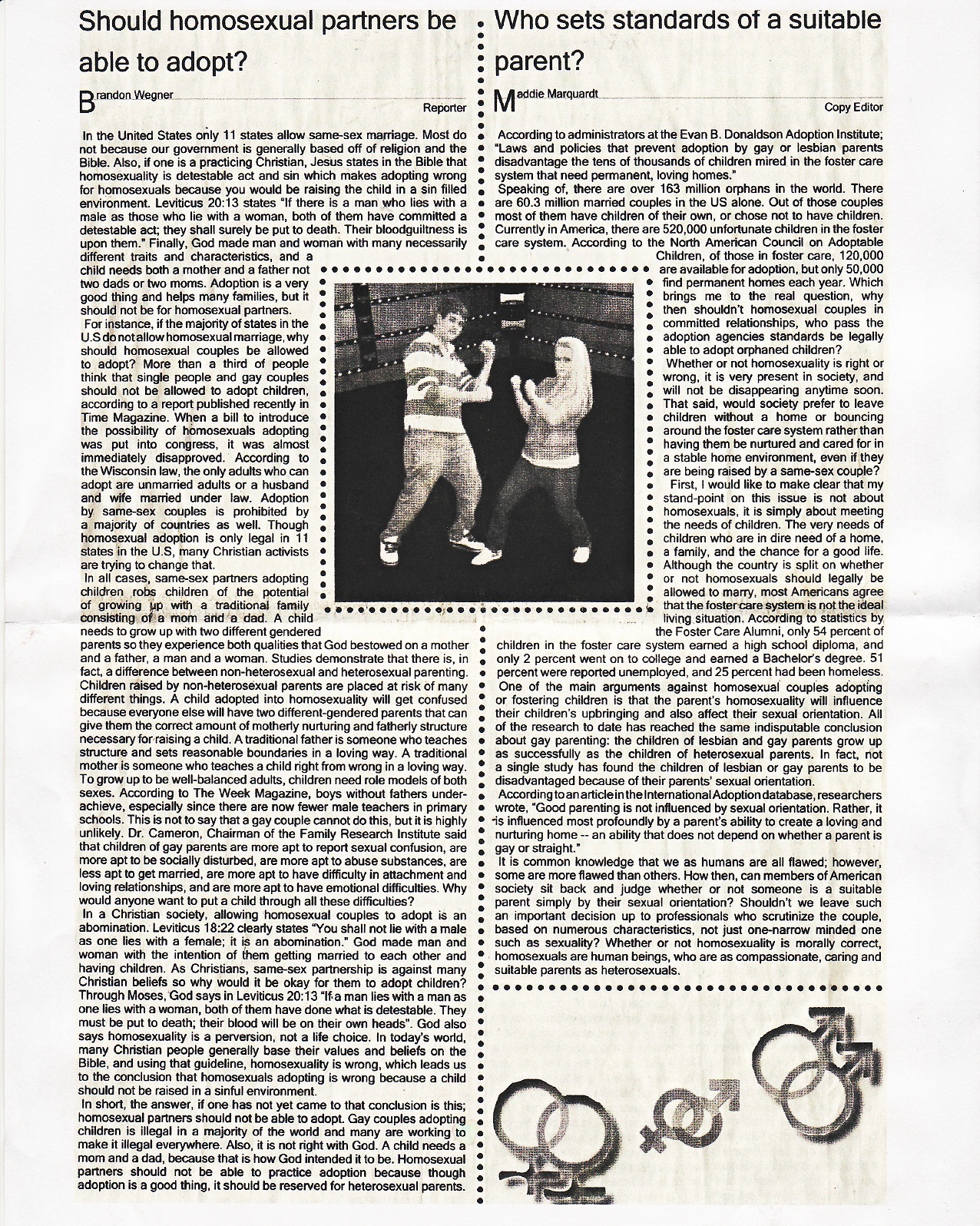
The Shawano (Wisconsin) High School’s student newspaper decided to publish a “Pro vs. Con” feature on the contentious issue of gay couples adopting children. A student wrote a column advocating each position.

In his column headlined “Should Gay Couples Be Allowed To Adopt?” student Brandon Wegner catalogued various arguments against gay adoption, and included this:

“If one is a practicing Christian, Jesus states in the Bible that homosexuality is (a) detestable act and sin which makes adopting wrong for homosexuals because you would be raising the child in a sin-filled environment….A child adopted into homosexuality will get confused because everyone else will have two different-gendered parents that can give them the correct amount of motherly nurturing and fatherly structure. In a Christian society, allowing homosexual couples to adopt is an abomination.”

A male couple raising a child who goes to the school saw the paper, and strenuously objected to school administrators, saying that the piece was hateful and would encourage bullying. Naturally, the school district immediately caved and threw the student, the paper and the column under a metaphorical bus, because that’s what school administrators do. If an anti-gay bigot had objected to the pro-gay adoption feature, it is even money that the school would have done the same.

An official mea culpa was immediately released: Continue reading →

Unethical Quote of the Week: Patrick Lott

Patrick Lott, hard working role model

“I have always given my best and tried to be a great role model. No one is perfect. Thanks for the memories.”

—-Patrick Lott, Assistant principal at Bernardsville Middle School in Somerville, New Jersey, in a cryptic Facebook post earlier this month that was explained, sort of, when he was arrested for allegedly using a hidden camera to videotape boys in the Immaculata High School showers for a period of nearly three years.

I say “allegedly” because people get mad at me when I don’t, and because he hasn’t been tried and convicted yet. On the other hand, videos of nude teenagers showering were found in his home. Maybe they flew in the window.

“Nobody’s perfect” is one of the great and infuriating rationalizations used by scoundrels and their apologists,  and goes hand in hand with all the other clichés designed to discourage people from making the kind of ethical judgments that keep societal standards sturdy, ethical, and clear. It is right up there with “It’s not the worst thing” and “Judge not, lest ye not be judged” as bumper sticker dodges that set my teeth on edge, but “Nobody’s perfect” may be the most outrageous of all….at least when employed by someone like Lott.

There is a pretty big chasm between “perfect” and taking secret videos of naked kids when you are a trusted school administrator. This guy couldn’t see “perfect” with the Hubble telescope. And he says he’s always given his best—-this was his best? I shudder to think about what Lott would have done if he wasn’t trying so hard. He tried to be a great role model? For who…Penn State assistant coaches?

Lott’s statement is an outrageous plea for sympathy for all the wrong reasons. His best would have been to seek help of find another line of work when he realized he couldn’t control his desire to watch naked young boys. Trying to be a great role model begins with not breaking the law. And  one who behaves outrageously should not insult the rest of humanity by trying to suggest that we’re really not so different. Oh yes we are.

This is Lott’s disgrace, Lott’s shame, and Lott’s crime. The very least he should be able to do is accept responsibility, and not try to minimize his misconduct or suggest that it’s not all that different from overeating or going 45 in a 35 mph zone.

Vote For The 2011 Curmie…and Education’s Shame!

Help Rick choose the most embarrassing educator of 2011

This is clearly Rick Jones Day. First he scores the Comment of the Day, and then I discover that over at his blog, Curmudgeon Central, he is holding a reader poll for the Curmie, his award that will go to the educator who most embarrassed the profession in 2011.

Among his list are several miscreants who were topics of Ethics Alarms posts, some warranting more than one. What is remarkable and depressing is how many of Rick’s nominees never were noted here for their unethical conduct, and also how many of the cases featured by Ethics Alarms didn’t make the cut for the Curmie finals. This is because the education profession had a truly wretched year. As I prepare the year end Ethics Alarms Best and Worst, there is really a chance that education may nose out the perennial winner in the “Least Ethical Profession” category, journalism. I wouldn’t believe any profession could sink that low

You can vote at Rick’s site, and follow the links to his commentary on the nominees. Here are Rick’s nominees (the following text is his): Continue reading →

Ethics Quiz, Killer Pizza Edition: Can School “No-Tolerance” Be Dumber Than THIS?

I grant you: THIS is a scary pizza. What Nick Taylor had, however, was not.

Nicholas Taylor is 10-years-old and attends David Youree Elementary School in Smyrna, Tenn., 30 miles southeast of Nashville. He is currently serving a week-long sentence at “the quiet table” during lunch time and has had to endure gun safety lectures. What was his terrible offense?

He “threatened” other students at his lunch table with a piece of pizza that was shaped vaguely like a gun because of the bites that had been taken out of it. Yes, some pathetic, parent and culture-warped weenie of a fellow student complained to a teacher that Nick was making “threatening gestures” with his partially-eaten pizza-gun.  Taylor denied it. That meant he was lying. More punishment.

Your Ethics Quiz Question—and you better not get this one wrong!—is : Can political correctness “no-tolerance” idiocy in the schools get any worse than punishing a child for the shape of his pizza slice? Continue reading →

The Emma Sullivan Affair: Not Just An Aberration

Time to double-down.

Yes, it's student-hating teacher Natalie Munroe, back again to remind us that the welfare of our children is no longer guranteed to be the #1 priority for your child's teacher, principal or school board member.

Over the weekend, I managed to ignite a controversy with one sentence I included in my discussion of the ridiculous incident which began when high school student Emma Sullivan tweeted that Kansas Governor Sam Brownback “sucks” and ended with her being called on the carpet for it by her principal. Noting that the incident should have been cut short by the school district administrator telling Brownback’s lackey to stop bullying kids, I wrote,

“But the school district administrator had neither the integrity, courage or common sense to do that, which permitted the fiasco to be passed on to the next spineless incompetent, and which also, I submit, tells us all we need to know about why public education in the U.S. is a disgrace.”

“I disagree with your statement and think it is an unfair generalization!” wrote Michael Boyd. Tim LeVier wrote, “…how many public schools are there in the U.S.? How many students are educated (enrolled) by those public schools in the U.S.? How many “social networking” fiascos have there been? Do the positive situations get the same amount of attention as the negative?”

Obviously, I was insufficiently precise, as both Michael and Tim are solid analysts and deft critics here. I was not suggesting that this one incident proves anything about the U.S. public education system. No one incident in a Kansas high school can prove anything about the system as a whole. I was, however, asserting that the deficits of character, warped priorities and lack of common sense displayed by the administrators in this incident are emblematic of the problems of the educational system as a whole. There are too many incompetents in high places, and too often the priorities of the system lie with staying on the right side of the political structure rather than being concerned about the welfare and development of students. To be broader still, my statement indicated that this is the kind of incident that shows why I believe that we can no longer trust the educational establishment, which has “jumped the shark,” “nuked the fridge”, or any other metaphor you  designate to describe when a profession has lost its moorings to professionalism and ethics. Continue reading →

Abuse of Government Power+ School Administrator Cowardice = Student Persecution

Enemy of the State.

Emma Sullivan, an 18-year-old high school senior at Fairway, Kansas’s Shawnee Mission East High School,  went with her class on a field trip to the Capitol and heard Gov. Sam Brownback speak. She tweeted her reactions to her Twitter followers, writing, “just made mean comments at gov brownback and told him he sucked, in person #heblowsalot”.

The part about making mean comments to the Governor was a lie, but on a scale of believability and damage done, not an especially momentous one. It was adults who turned this unremarkable student tweet into an ethics train wreck in three neat, unforgivable steps.

1. First, some over-zealous hack on the Brownback’s staff saw the tweet and complained to an administrator in the school district. This is a First Degree Ethics Foul. Nothing in Sullivan’s tweet brings it within his, the governor’s or the government’s legitimate concerns. For the staffer to complain was petty, vindictive and mean-spirited. Every second he spent on his vendetta was a waste of taxpayer dollars. Worst of all, he was bringing the power of the government to bear on a teenager for doing nothing more than expressing her opinion, which is that Governor Brownback sucks. I’m sure there have been foreign dictators who would punish a teen for doing no more than telling friends that she doesn’t like him, but I would have thought that someone who works in one of the United States governments would instinctively know that this kind of bullying mind-control isn’t allowed here. I was wrong. Brownback does suck, at least at picking staff. Continue reading →

Comment of the Day: “Better Late Than Never: The ACLU Finally Opposes the High School War On Off-Campus Speech”

Our often hyperbolic correspondent Elizabeth offers her rebuttal to the apparently unshakable conviction of commenter Xenophon that the needs of school discipline justify schools punishing students for a personal blog or Facebook post, in this case, one critical of a teacher. Here is her Comment of the Day on the post Better Late Than Never:  The ACLU Finally Opposes the High School War On Off-Campus Speech:

“…This kid wrote one post to ten friends only. He did not put it out for all to see. Apparently if the ACLU is willing to defend him he didn’t threaten/defame the teacher or anyone else, disrupt the school, or cause anything other than some kind of righteous anger on the part of one teacher, who, immaturely, went to “higher authorities” to have him “disciplined.” Ever had a teacher you didn’t like or who didn’t like you? Are you old enough to remember passing notes in class? It’s no different; just electronic. This is the classic and relatively new hubris of the education system… and the examples are sickening. Continue reading →