No, Dr. Gelman, Just Because You Think Your Toaster Is A Lawyer Doesn’t Mean What You Say To It Is Privileged

Its continues to amaze me whom the New York Times will give a platform to. Take Dr. Nils Gilman (please!), a historian who “works at the intersection of technology and public policy,” whatever that means.

He has written a supposedly learned column for the Times [gift link] claiming that human beings should have something akin to attorney-client privilege when they shoot off their mouths to their chatbots. His cautionary tale:

On New Year’s Day, Jonathan Rinderknecht purportedly asked ChatGPT: “Are you at fault if a fire is [lit]because of your cigarettes?”… “Yes,” ChatGPT replied…. Rinderknecht…had previously told the chatbot how “amazing” it had felt to burn a Bible months prior….and had also asked it to create a “dystopian” painting of a crowd of poor people fleeing a forest fire while a crowd of rich people mocked them behind a gate.

Somehow the bot squealed to federal authorities. Those conversations were considered sufficient evidence of Rinderknecht’s mind, motives and intent to start a fire that, along with GPS data that put him at the scene of the initial blaze, the feds arrested and chargeed him with several criminal counts, including destruction of property by means of fire, alleging that he was responsible for a small blaze that reignited a week later to start the horrific Palisades fire.

To the author, “this disturbing development is a warning for our legal system.” You see, lonely, stupid people are using A.I. chatbots as confidants, therapists and advisers now, and the damn things cannot be trusted. “We urgently need a new form of legal protection that would safeguard most private communications between people and A.I. chatbots. I call it A.I. interaction privilege,” he pleads.

Continue reading

Well, I Guess There Won’t Have To Be A Revolution THIS Time…

The Trump Deranged really do think this President is capable of being Hitler.

In a post on his usually rational and excellent blog “Simple Justice,” criminal defense lawyer Scott Greenfield embroils himself in an apocalyptic scenario where President Trump decides to break the law, defy the courts, and impose his will on the nation. Greenfield writes in part,

What mechanism exists to prevent a president from simply doing whatever he pleases? I gave the short list of how this works on the twitters.

There are three primary checks on presidential power:

1. Virtue
2. The military’s refusal to support unlawful action
3. Revolution

Some replied that this was wrong, ignoring the constitutional separation of powers, court rulings, Congress’ laws, even elections and impeachment. They missed the point. Honoring all the guardrails built into the system falls within the first check, virtue. It only matters if the president respects the law and the Constitution. Andrew Jackson realized this when he mumbled, “John Marshall has made his decision; now let him enforce it.” What if the president just says “no”?

What is Congress or the Supreme Court going to do if the President tells them to kiss his executive butt? Congress may have the spending authority, but it’s the Treasury that holds the cash and writes the checks. The Supreme Court may have the authority to hold an action unconstitutional, but the military serves under the Commander in Chief.

If the president abides by the limitations of law or constitutional authority, as has generally been the case up to now despite the occasional overstep, then the mechanics of our society work. But what if he doesn’t?

Continue reading

Ethics Quote of the Month: Blogger-Criminal Defense Lawyer Scott Greenfield

“If Hamas is not destroyed, or at least its capacity to attack Israel eliminated, then it will attack again. Hamas has made clear that it intends to do so, over and over. Until Hamas is destroyed, there can be no peace as Hamas has no interest in peace. There can be no “two-state solution” with one state controlled by terrorists bent on destroying the other state. For those anti-colonialists whose solution is the eradication of Israel, they will be surprised to learn that Israel is not inclined to commit suicide and disappear.”

—-Scott Greenfield, explaining in no uncertain terms why the progressive Left’s support for Gaza and condemnation of Israel is based on its determination to refuse to face facts

There are so many articles, grandstanding declarations and bad punditry bemoaning the fate of the Palestinians in Gaza—Jonathan Glazer’s fatuous speech at the Oscars being the most obnoxious recent example—that when an intelligent voice from the Left points out that the “Give Peace a Chance” whining is utter bunk, attention must be paid. I highlighted Hillary Clinton’s spot on and clear explanation of reality for the cement-headed ladies of “The View,” and now criminal defense lawyer and eloquent blogger Scott Greenfield has performed the same service in print. Bravo. Having read Greenfield for many years, I regard him as a traditional liberal but stubbornly unwoke. Like Althouse, bias seldom makes him stupid.

In an essay beginning with Biden’s foolish “red line” comment (what is it about Democratic Presidents that they think they can assert “red lines” when they have no intention of doing anything should their bluff be called?), Greenfield, like the good Democrat he almost surely is, briefly tries to mitigate President Biden’s cowardly and cynical attempts to mollify his anti-Semite base while still insisting that he supports Israel, recently highlighted as he ordered aid to Gaza while the US supports the Israeli attacks that make the aid necessary. But Greenfield still writes,

Continue reading

Ethics Hero: Criminal Defense Lawyer/Blogger Scott Greenfield

Scott Greenfield’s post yesterday on his blog Simple Justice was fortuitous, coming as it did shortly after my musings (item #2) about a trusted and respected legal ethics colleague whose ugly past ethical breach I only recently learned about. Greenfield isn’t quite discussing the same issue—my dilemma involves trusting someone’s judgment and integrity, his involves pure friendship—but his post is helpful nonetheless, and admirable.

In fact, it reminds me of my father.

Continue reading

Ethics Quote Of The Week: Criminal Defense Attorney Scott Greenfield

“A perpetual concern, particularly in criminal defense, is that the next generation of lawyers will lack the skills needed to do their job, to zealously represent their clients. They struggle to tolerate the language we encounter in the ordinary course of our work. They are blinded by hatred of their prosecutorial adversaries, the law enforcement witnesses, the judge who denies their pleas for “justice.” Can they mount effective arguments against their clients if they can’t tolerate hearing arguments with which they disagree?”

—Criminal defense lawyer Scott Greenfield, on his blog “Simple Justice,” reacting to the law students at UC Hastings shouting down Georgetown Law professor Illya Shapiro, who was supposed to be engaging in a civil debate with a Hastings professor.

Ethics Alarms discussed the Hastings incident here [#4]; I should have probably made a solo post of it, because as Greenfield correctly points out, it has wider implications. Later he writes,

The reaction to these students was split, with many woke law students and baby lawyers applauding their action while more experienced lawyers were appalled at what they viewed as a failure of a law school, of law students, to demonstrate the minimal capacity to engage in the manner that will be expected of them as lawyers. If tactics like this are what law students deem acceptable, will they ever be capable of being lawyers?

Continue reading

The Unethical Sentencing Of Dr. Lawrence Nassar

Non-lawyers and journalists mostly cheered Ingham County Court Judge Rosemarie Aquilina’s grandstanding, self-indulgent, unprofessional and unethical handling of Dr. Larry Nassars’s sentencing yesterday. Nobody bothered to seek the opinion of criminal lawyers and judges, much less ethicists. If they had, they would have heard a loud, collective, “Ugh.”

It was a disgrace. I object to victim impact statements in sentencing, a terrible idea pushed by victim’s rights advocates, because it misrepresents the purpose of the justice system. The objective is to punish citizens for violating laws, not to get revenge for victims or their families, not to get “closure,” and not to satisfy emotional needs. The process isn’t personal, or shouldn’t be. If it is personal, then it isn’t objective. Judge Aquila threw all of that out the window as she played to the cameras and the mob.

Criminal defense lawyer and blogger Scott Greenfield aptly explained what was unethical about the parade of victims:

Nassar’s sentencing hearing is a clear example of a judge straying from promoting the public’s trust in a fair and impartial judiciary. Let’s begin with Judge Aquilina’s decision allowing over one hundred and sixty victim impact statements across seven days. 

Victim impact statements are theoretically allowed as a means of giving a crime victim the chance to describe their experience to the court. Defense lawyers aren’t typically fans of them, and too many can arguably have a prejudicial effect against a defendant.

Contrast Nasssar’s hearing with that of Dylann Roof, the Charleston shooter responsible for the deaths of nine churchgoers. Judge Richard Gergel admonished the State’s list of thirty-eight statements, cautioning against a “spectacle”. David Bruck, the attorney assigned to advise Roof, claimed the proceeding violated “every principle restraining victim impact statements under the 8th Amendment.”

Strangely, no advocate stood to question admitting impact statements from over 160 victims, including gold medal Olympians, might prejudice a jurist’s decision. It’s hard to imagine Judge Aquilina even entertaining such an argument.

It is also hard to imagine Nassar’s sleepwalking defense attorney making such an objection. She was praised by the judge for taking on an unpopular client, but taking him on isn’t enough. She was supposed to protect his rights.

Then the judge delivered her sentence, turning her moment in the national spotlight into a self-aggrandizing, virtue-signalling, vainglorious soliloquy to the gallery. This was one more example of why televised court proceedings are a bad idea.

I’m going to give you the whole transcript of her remarks, bolding the sections before my comments. Cut to the bolded sections if you don’t care to experience the full measure of Judge Aquilina’s narcissism. One section,, however, was left out of all the published versions that I could find:

“Our Constitution does not allow for cruel and unusual punishment. If it did, I have to say, I might allow what he did to all of these beautiful souls—these young women in their childhood—I would allow someone or many people to do to him what he did to others.”

The judge apparently had this excised from the official transcript. No wonder. She is advocating prison rape and by doing so, endorsing it. Michigan’s judicial ethics standards require in part,

“A judge should respect and observe the law. At all times, the conduct and manner of a judge should promote public confidence in the integrity and impartiality of the judiciary. Without regard to a person’s race, gender, or other protected personal characteristic, a judge should treat every person fairly, with courtesy and respect.”

Needless to say—I hope—‘I wish I could have you gang raped’ does not meet this standard. It is also troubling that a judge would distort the record. She said what she said, and the public should know she is the kind of jurist would say something like that—an unethical one. The state’s judicial panel should also know.

Here is the rest: Continue reading

Ethics Hero: Lawyer/Blogger Scott Greenfield

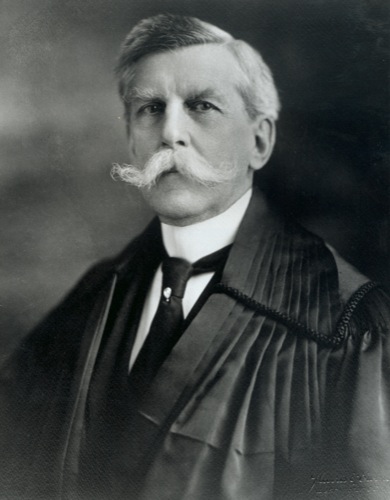
No question: Justice Holmes would think Scott Greenfield is a good man.

No question: Justice Holmes would think Scott Greenfield is a good man.

Criminal defense lawyer and caustic, if trenchant, blogger Scott Greenfield stakes out a noble and correct stand on legal ethics and ethics generally in a superb post titled, “What Tastes Good To You?” Read the entire post, but his essay springs from a question that has been posed in various forums (including,  in slightly different form,the Jack Lemmon comedy “How To Murder Your Wife”), to wit:

If you could commit any crime and get away with it, what would it be? 

Greenfield’s answer, the ethically correct one, is “none” : “Just because we can get away with it isn’t a reason to do wrong.” Thus does he definitively separate himself from what Justice Oliver Wendell Holmes referred to as “the Bad Man” in his famous 1897 essay, “The Path of the Law.”  For Holmes’ “bad man” never breaks a law, but only because he abhors punishment.From this starting point, Greenfield considers a professional debate about whether the legal marketing tactic (as determined by the courts) of buying up another firm’s name as a web “key word” to lead customers to one’s competing firm is “unseemly,” which is to say, unethical, though not technically unethical under the professional rules of conduct. One of the defenders of the practice describes the division on the issue to a difference in “taste,” leading Greenfield to aim carefully and fire: Continue reading

Spam Ethics

I was not previously familiar with the extent of that scourge of all blogs, spam. Nor did I realize that deciding which comments qualified for instant deletion would involve an ethical balancing act, but it does, and I am getting the hang of it.

WordPress, thankfully, gives its blogs a program that flags the most obvious spam, fake, automatically generated comments that have nothing to do with the post they are attached to, entered only to get publicity for websites that are selling something. Sending out this junk is pretty sleazy: it aims to junk up a serious website with dishonest drivel and use it as an unwilling billboard, usually for less-than-admirable products and services. The worst ones try to waste my time as well, falsely “alerting me” that my blog doesn’t work with their browser or that my RSS feed is malfunctioning. This kind of spam never gets through the door. Continue reading