Unethical Quote Of The Week: Jeff Shesol

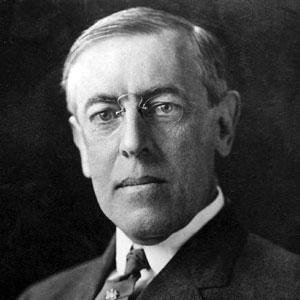
“Berg is not uncritical of Wilson’s biggest lapses — his tolerance of segregation, his suppression of civil liberties and his “highly questionable” actions (or paralytic inaction) after the stroke he suffered in 1919, during his grueling campaign to win Senate approval of the League of Nations.”

—Former Clinton Speechwriter and author Jeff Shesol, in his Washington Post book review of historian Scott Berg’s new biography of Woodrow Wilson, “Wilson.”

All right, he was a racist, but he was GREAT racist, right, Jeff?

All right, he was a racist, but he was GREAT racist, right, Jeff?

There is a nasty piece of dishonesty in this quote, all the more sinister because it slides right by, altering your understanding of history and reality without you even knowing it. (Is it any surprise that Shesol wrote speeches for Bill Clinton?) Did you catch it?

It is the phrase, “[President Woodrow Wilson’s] tolerance of segregation.”] Continue reading

Ethics Quote of the Week: Moses (Charlton Heston) in “The Ten Commandments”

The evil that men should turn their brothers into beasts of burden, to be stripped of spirit, and hope, and strength – only because they are of another race, another creed. If there is a god, he did not mean this to be so.

—-Moses, as played by Charlton Heston and scripted by seven writers, in Cecil B. DeMille’s “The Ten Commandments.” answering to the Pharoah Seti’s question, “Then why are you forcing me to destroy you? What evil has done this to you?”

The Ten Commandments“The Ten Commandments” is so extravagantly fun and entertaining that, I must confess, I never watched it as an ethics film until tonight, as ABC once again broadcast the Biblical epic on an Easter weekend. This quote especially struck me as remarkable for a film made by an infamously rigid conservative, DeMille, in 1956.

On Dec. 1, 1955, Rosa Parks was arrested for refusing to give up her seat on a Montgomery city bus. The next twelve months were tense, difficult days in which the entire U.S. population was undergoing a wrenching cultural debate regarding human rights.  On Dec. 6, 1955, the civil rights boycott, led by Marin Luther King, of Montgomery city buses began. January 1956 saw Autherine Lucy, a black woman, accepted for classes at the University of Alabama in Tuscaloosa, the first African-American ever allowed to enroll.  On Jan. 30, the home of Martin Luther King, Jr. was bombed in Montgomery. February 4 saw rioting and violence on the campus of the University of Alabama and in the streets of Tuscaloosa. Lucy had to flee the campus, and the university’s Board of Trustees barred her from returning. On the 22nd of that month, warrants were  issued for the arrest of the 115 leaders of the Montgomery bus boycott. A week later, courts ordered Lucy readmitted, but the school expelled her. Continue reading

And While We’re On The Topic Of Outrageous Lies, Who At The DNC Dreamed Up THIS One?

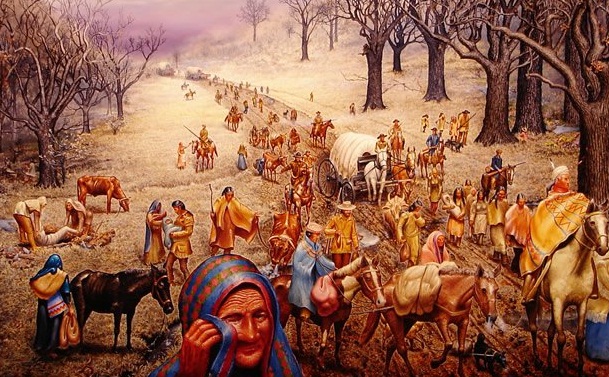
The Trail of Tears, just one of those pace-setting civil rights initiatives by President Andrew Jackson, father of the modern Democratic Party.

With my head swathed in ice and restraints, trying to stem the explosion (I have vacated the house of all other living things), I note this, which I happily was unaware of until a few hours ago, from a history of the Democratic Party, on a new Democratic National Committee web site .

 “For more than 200 years, our party has led the fight for civil rights, health care, Social Security, workers’ rights, and women’s rights.”

Health care? Okay.  Social Security? Obviously. Workers’ rights? A closer call, but sure. Women’s rights? Sold, though literally none of these can be traced back to 1812. Nobody was thinking about health care until the 20th Century. Worker’s rights became an issue in the late 19th. Social Security wasn’t a twinkle in any Democrat’s eye until the 1930’s, and the Democratic Party wasn’t very concerned about women’s rights until the 20th century either.

But can the Democrats claim 200 years’ support of civil rights? Absolutely not. To claim this is beyond mere lying, and reaches Orwellian proportions as an effort to re-write history. It is also blatant misinformation, clearly designed for the uneducated, the historically ignorant, the gullible or the stupid—you know, most people—or it was written and approved by members of this group who built the DNC site. Let’s be unequivocal: The Democratic Party did NOT lead the fight for civil rights for “more than 200 years.” No historian believes this or has written this. It is a complete, nonsensical, made-up, silly piece of dishonest puffery: Continue reading

Rest in Peace, Andy: Mayberry Wasn’t Racist

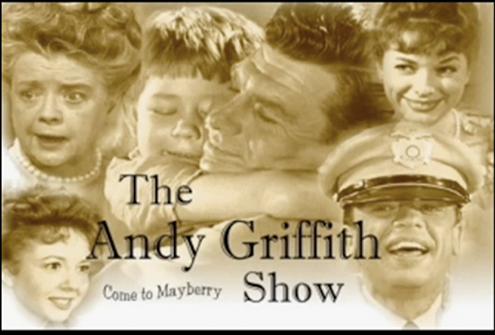
In the wake of Andy Griffith’s death today, a friend of mine wrote this on Facebook: “If you’re waxing nostalgic about Mayberry as an idyllic 1960s Southern town, remember that it had no Negroes living there. Is it any wonder that show was so popular in the midst of the turmoil of the civil rights movement?”

The sentiment was undoubtedly motivated by good intentions, but boy, it is unfair. America was a largely segregated society in 1960, when “The Andy Griffith Show” began its trek to television Valhalla, and it was not up to the producers or writers of a folksy sitcom set in small North Carolina town to remedy that, protest it, or comment on it. This wasn’t “Andy Kills a Mockingbird.” It was a comedy, and a comedy unique and precious for celebrating basic ethical values like kindness, loyalty, friendship, tolerance, community, cooperation, patience, respect and virtue. There were no racist sentiments or attitudes expressed in Mayberry, and no reason to doubt that if a black family moved into the town, they would have been embraced, appreciated, and treated like everyone else. The fact that this may not have been true of a real North Carolina town of that period is as irrelevant as pointing out that real Scottish villages don’t disappear and reappear centuries later like Brigadoon. Continue reading

My Theatrical Ethics Dilemma: Integrity or Fairness?

It doesn’t come up here often, but I am the artistic director for a professional regional theater company. It is dedicated to producing 20th Century stage works of artistic and historical value that other, more commercial (sensible?) companies wouldn’t touch with a ten-foot pole. Every now and again I find a play that is especially risky, challenging, and rich in theatrical possibilities, and those are the ones I direct myself.

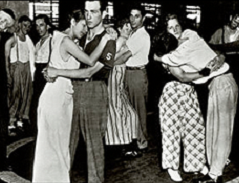
This summer, I will be directing such a production, a harrowing recreation of Depression era dance marathons called “Marathon 33.” It was written by the fascinating June Havoc, Gypsy Rose Lee’s sister who became a Hollywood star and who is perhaps best known as the irritating “Baby June,” the  blonde and perpetually juvenile vaudeville headliner in the musical “Gypsy.” Havoc survived the Depression by competing in dance marathons during the Thirties, and wrote two autobiographies about these terrible spectacles, in which desperate couples would stay on their feet for thousands of hours for food and the promise of a cash prize, as more fortunate Americans paid to see who would drop first.

The show, at least as I and my artistic collaborators envision it, involves recreating dance marathons as accurately as possible, down to the smallest detail. The audience for the show will be immersed in the action as if it were the heartless mob that cheered the real dancers on, and we will avoid anachronisms of any kind. And yet, as I prepare to cast the show after a wonderfully productive round of auditions, I face an ethical conflict. Several of the strongest candidates for dance contestants are African-American, and there were no black competitors in the real contests. Even if there had been, mixed-race couples would not have been tolerated, especially in Virginia, where we are setting the show. Yet if I cast the best actors available without reference to race, I will have both. Continue reading

Major League Baseball, Forgivability, and List Ethics

Unforgivable?*

Bleacher Reports is an enjoyable sports website, and it gives opportunities to aspiring writers and bloggers, some of whom are quite talented.  In addition to typical opinion pieces and reporting, the site has a fondness for lists, often trivial to the extreme, like “The 50 Ugliest Athletes of All Time.” The titles are all misnomers, because there is almost never any criteria given for the choices or their relative ranking. An accurate title would be, “The Fifty Athletes I Think Are The Ugliest.”  And of course, who cares? (Don Mossi, by the way, was the ugliest athlete ever, no matter what anybody says.)

A recent list, however did bother me. It is called “The Fifty Most Unforgivable Acts in Baseball History,“ and much of the problem with it lies in the title itself. If you are going to write about history, there is a duty perform diligent research, even for a silly online list. Misrepresentations online have a large probability of misleading people.  The title is a misrepresentation, like “The 50 Ugliest Athletes,” but unlike that list, there is some harm done. The list isn’t close to complete; it isn’t consistent; it isn’t well-researched. I’d bet that the author, Robert Knapel, wrote it off the top of his head.  Anyone who looked at the list and assumed, as the author represents, that these are truly the low points—“the dark side,” as the author puts it—of major league baseball would be seriously misinformed.

There are unequivocally, probably universally recognized incidents and events that are infinitely worse that most of the items on the list.  Just a  few samples: Continue reading

Let Us Not Forget Itawamba County, Miss.

I am haunted second thoughts about awarding Obion County the title of Unethical Community of the Year.

For one thing, it is only October, and there is a lot of time for another unethical community or more to reveal its lack of decency to the nation and the world (and then to have Keith Olbermann declare that it represents the ideal for Tea Partiers). Still, I am having a hard time imagining anything worse for an American community than directing its fire department to let a human being’s home burn down, whether or not the homeowner has three dogs and a cat (as Mr. Cranick did, and I emphasize did), because that human being didn’t pay a $75 fee.

The real reason I am having doubts, however, is the horrible tale that came to light this past spring.  Continue reading

Nettleton Middle School, Embracing Racism in 2010

Help me out here: which category does this story fall under:

  • School administrator incompetence?
  • Warped community ethical  standards?
  • Racial quotas run amuck?
  • Evidence of human devolution?
  • Proof that time travel is real?

I’m not sure. I do know that when a memo like this one is issued by a school principal, indicating that class officers for the sixth, seventh and eighth grades are restricted by race, there had better be a lot of firing going on, really soon, up and down the entire school system and maybe the town government as well, because the people in charge must not be trusted for one more second to have anything to do with educating American children. Continue reading

Ethics Dunce Deux: Rand Paul Whiffs on Accountability

G.O.P Kentucky Senate nominee Rand Paul has pulled off a record-worthy achievement: he has earned Ethics Dunce status twice in a week’s time, something no one else, even serial Ethics Dunces like Sen. John Kerry and Tom DeLay, were able to do in the nearly seven years the designation has been in existence. He did not earn it the old fashioned way, however, as the old Smith-Barney ads used to say. Most Ethics Dunces do something, but in both cases Paul has proven himself worthy by what he says he believes.  This makes him kind of a classic Ethics Dunce. He literally doesn’t understand basic ethical values, or if he does, can’t articulate them. Continue reading

Baseball and Civil Rights: Doing the Right Thing, Kicking and Screaming

“The Biz of Baseball” discusses a historical document proving that even as Jackie Robinson was preparing to make his color barrier-shattering debut with the Brooklyn Dodgers in 1946, an internal committee examining the race issue for Major League Baseball was arguing that integrating the teams at the time would be a mistake. Author Maury Brown concludes:

“As the 1946 steering committee document shows, there were those at the highest level of the sport that saw African-American players as beneath the quality of their White counterparts, and that they saw the influx of African-American fans as something that would lower franchise values. Take that in, as baseball takes credit for being at the front of the Civil Rights movement.”

Major League Baseball is engaged in just such a credit-taking exercise now, as it prepares to host its annual ” Civil Rights Game, “an  exhibition between the Cardinals and Reds in Cincinnati. Continue reading