On Liberals, Dignity, Dogs, Signature Significance and Toddlers On Leashes

But they LIKE it!

But they LIKE it!

The damndest essays ignite furious debates here. I raised CNN’s mid-day quiz about parents walking children on a leash-–did I mention it featured a video of one mother dragging her prone harnessed child through a store like the kid was a sack of potatoes? I should have—-primarily because 1) it reminded me of “The Simpsons,” 2) because I was struck by the fact that ethics was never brought into a conversation that I would deem as concerning an ethics issue, and 3) because it was notable that CNN wasn’t talking about sunken Malaysian airplanes.

Still, I have been enlightened by the unexpectedly lively discussion, if not encouraged. In particular, this never struck me as an ideological issue, but it certainly seems to be one. Upon reflection, I should have predicted it, though this is not flattering to liberals.

I’ll return to this in a bit.

The defenses of the demeaning practice have been mostly pragmatic, which involves a utilitarian argument: “It works, and the ethical violations either don’t exist, or are too small to care about.” The most annoying defense so far has required  intentionally taking a statement in my post literally that also has an important figurative message, as well as misstating even the literal meaning, all to make it easier to dismiss the intended point. That’s some kind of record for straw men. Or would that be straw dogs? No, I think that’s something else.

The phrase in question was “whether it was fair, kind, respectful or right to treat your child like a cocker spaniel…” To make it easier to attack, my critic has changed that to “…to treat your child in a manner associated with the treatment of dogs.” Sneaky. It is true that dogs are typically kept on a leash, but that is only half the message, as fair readers will acknowledge. The term “treated him-her-them like a dogs/dogs” means, and has meant for a very long time, treating a human being in an inhuman, demeaning, humiliating, unkind, unfair fashion showing a lack of respect and making the human being in question miserable. The description has been used to describe both treatment that is seen in the treatment of actual dogs—such as substandard living conditions, lack of autonomy, domineering oversight, feeding of food not fit for human consumption, and in this case, use of a leash in public, as well as used to describe treatment that would never be literally possible with real dogs, such as too many typing assignments, refusal to give credit or bonuses for effective research, not allowing a family member a sufficient allowance, forcing a child to dress in old, outdated or unattractive clothes, etc. In the current case, both meanings apply, and focusing on just one is intentionally misrepresenting the issue.

As to whether the use of leashes on human children is demeaning, try this thought experiment: Would any white nanny dare to walk in public with two black children on a leash? How about the mother in a mixed marriage, in which the mother is blonde and the children are black? Would not the imagery of whites leashing blacks be inherently distasteful, regardless of the age of the African-Americans involved? Continue reading

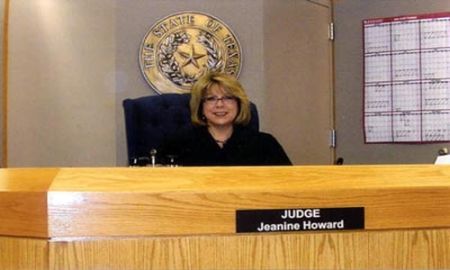
Unethical Quote Of The Month: Judge Jeanine Howard (Who Is Also The Incompetent Elected Official Of The Month, An Ethics Dunce, And Pretty Much A Blight On The Justice System And American Society In General)

judge Howard

“There are rape cases that deserve life. There are rape cases that deserve 20 years. Every now and then you have one of those that deserve probation. This is one of those and I stand by it.”

—-Texas District Judge Jeanine Howard explaining her stunningly lenient sentence of probation and community service—“250 hours of community service at a rape crisis center” !—for a confessed rapist of a 14-year old girl at her school.

The sentence  was not merely lenient but probably illegal, and a it seems likely that the sentence will be altered by another judge. Nonetheless, this kind of result, based on the judge’s assessment that the victim was promiscuous and had been pregnant (which she denies) will certainly make other rape victims think twice before they report the crime. Bobby Villareal, executive director of the Dallas Area Rape Crisis  Center, told reporters…

“This is an example of why people don’t come forward and report their sexual assaults because they are not only victimized at the time but the continuing game of shame and blame. They are put on trial again in the judiciary and the media. The things that were said were outrageous and some of them were actually untrue that were reported.”

Judge Howard seemed to be making up the law and sentencing guidelines on the fly. The rapist, 20-year old Sir Young, never denied that he had raped the girl, or that she hadn’t strenuously told him to stop. “Consent is not an issue and it wasn’t an issue because he admitted he didn’t have her consent,”  prosecutor Andrea Moseley said. “When consent is not an issue, a victim’s past is never appropriate for comment. That’s my problem with it as a woman and as a prosecutor. I was certainly disappointed in the message I think it sends to the community.”

The community can send a message back, as Judge Howard is up for re-election in the fall, but it won’t be easy. A Democrat, she is running unopposed. Continue reading

The Sterling Backlash: Signature Significance, Racism, Hypocrisy, and Double Standards

Bennie Thompson

“No big deal, he’s  just a Congressman…”

I often use the term “signature significance” in posts, and since it is a term that is not often applied to ethics, I thought today would be a perfect time to illustrate it in its original context, while clarifying the ethical murk around the Donald Sterling Ethics Train Wreck.

The original context of the phenomenon of signature significance is baseball, and I just watched an example of it. Today Red Sox left-hander John Lester beat the Oakland A’s, a very good team, by hurling eight innings in which he gave up no runs, only one hit, two bases on balls, while striking out 15 batters. If you don’t know anything about the game, let me tell you: this is extraordinarily good. Pitching performances can be measured and compared by using the “game score” method, developed by sabermetrics (that is, baseball statistics) pioneer Bill James. The best game score ever achieved was 105; the highest score in major league history for a pitcher who did not pitch all nine innings (as with Lester today) is 95, and has only been done once. (Theoretically, a game score could be as high as 145)

James also devised the term “signature significance” in the context of such games. His research showed that pitchers who were not outstanding talents never pitched a game with such a high game score even once—it simply didn’t happen. Thus, he reasoned, pitching a single game like Lester’s (the actual game he used was a similar performance by a young Roger Clemens before anyone knew what Clemens would become) was sufficient proof, all by itself, to conclude fairly and scientifically that the game was meaningful, without any other data. In cases of signature significance, he explained, the usual statistical rule that small sample sizes are not reliable indicators do not apply. Sometimes one incident, performance or episode is sufficient to make a confident verdict.

Signature significance is very useful, I have found, to rebut unethical rationalizations for unethical conduct that are used to excuse the agent of the ethical breach. “It’s only one mistake” and “Anyone can make a mistake” are the main ones. In the case of some serious kinds of bad conduct, this reasoning is misleading and false. Donald Sterling’s comments recorded and publicized by his whatever-you-call-her V. Stiviano have signature significance: they prove he’s a racist. Can you imagine any non-racist individual saying, in public or private, that he didn’t want his girlfriend being seen at his team’s games in the company of blacks?  How could this possibly occur? It wouldn’t, of course. Only those who hold racist attitudes and beliefs think and say such things. Sterling is a racist.

Stiviano, for her part, despite being the one who brought the media, the sports world and the public down on Sterling’s 80-year-old head, now says she doesn’t believe he’s a racist. Of course, she also says she’s his “silly rabbit” and that she is going to be President some day. She is an idiot. But I digress.

Other figures have made statements in the media that also have signature significance of the same sort as Sterling’s, yet the very same groups and journalists who have been whipped into a self-righteous froth over Sterling are strangely silent: Continue reading

The Maryland Supreme Court Clearly Doesn’t Believe In Signature Significance

PeepingTom

But I do.

The Maryland Supreme Court just reinstated a Clayton W. Boulware, a Montgomery County attorney who had been suspended for six months after being convicted of covertly filming up the skirts of two women, one of whom was a minor, in a public place.  Boulware was suspended in September for six months with a three-year probationary period to follow the suspension.

In his defense, Boulware blamed his upskirt peeping on an “open relationship” with a younger woman, introducing him to a “swinging lifestyle” that included filming themselves having sex. But that relationship is over now, the court notes, so, hey, no problem.

The bar disciplinary board noted in its report to the court that it believed  a more lenient approach to punishing Boulware was called for because of those “mitigating circumstances.”  Lawyers are, as everyone knows, putty in the hands of swinging young women, and this always results in them shooting up other women’s skirts.

I feel like I am losing my mind. Continue reading

Rationalizing Corruption

But remember: the trains ran on time!

But remember: the trains ran on time!

It is a debate that erupts here periodically: Do you vote for the honest and trustworthy politician whose policies you despise, or the lying rogue who stands for all the “right” things? Washington Post editor Hilary Krieger raises the issue with gusto in the Sunday Washington Post, with an essay titled (in the print edition) “Is a little political corruption all that bad?”

Yes, Hilary, it is.

Next question?

But perhaps that’s not sufficient to kill this particular snake, so let’s delve a bit deeper into this truly fatuous, ethically obtuse article. Continue reading

Signature Significance Lesson: Pazuzu, The Judge And The Racist Email

"Your Honor, uh, you're not quite yourself today.."

“Your Honor, uh, you’re not quite yourself today..”

How many racist e-mails does one have to send out before it proves one is a racist? At Above the Law, legal affairs blogger Ellie Mystal says the answer is one, and I agree. Mystal writes:

“If you send one horribly racist email that actually manages to leak out into public discourse, it’s probably not your only one. Seeing a racist email from someone is like seeing a mouse in your apartment: there’s never just one. I believe in temporary insanity, but I don’t believe in sudden onset racism that magically appears once and only once and then disappears forever. Of course, whenever anybody gets caught in a racist email scandal, they always say that it’s the only one. It’s always “Whoops, that email was racist, but I’m not racist.” The racist email is always allegedly “out of character,” and the person always claims to have shown “poor judgment.” And that person always has some apologists, as if sending one or two racist emails is just something that “happens” in the normal course of business to non-racist people.”

The “out of character” nonsense is what Ethics Alarms refers to as the “Pazuzu Excuse,” as when someone explains that his or her full-throated expression of a vile nature “just wasn’t me” and “doesn’t express how I feel,” as if their being was suddenly possessed by the evil demon that made Linda Blair spit pea soup in “The Exorcist.” People try that excuse—and absurdly often are allowed to get away with it—because, at their core, they realize that signature significance is persuasive when judging character. Non-racists simply don’t send out racist e-mails ever, even once, and one such episode, all by itself, is convincing evidence that the sender is, in fact, a racist.

The racist under discussion by Mystal was retired federal judge Richard F. Cebull, appointed chief judge for the District of Montana by President George W. Bush in 2001. In 2012, Cebull got in trouble when he sent the following e-mail to seven acquaintances: Continue reading

Signature Significance: The Sick Little Girl’s Stolen Puppy

pug-puppy

If you ever want to explain the concept of signature significance in ethics—how one act can be sufficient evidence to make a fair and valid judgment about someone’s character—to a friend or colleague, this story should do the trick.

In California, a kind woman named Shawna Hamon heard about a 7-year-old girl with leukemia whose Christmas wish was for Santa to bring her a pug puppy. So Hamon bought a pug puppy, and gave it to a friend who promised to deliver the little dog to the girl in Sacramento in time for the holidays.

The puppy never arrived, however.  The friend decided to keep it for herself. Hamon sent an animal delivery service and an attorney to the woman’s Los Angeles home, but the woman refused to give the dog back. Then Hamon  filed a theft complaint and police got a search warrant to search the home, but found no pug puppy. After searching some other nearby homes, they eventually found the little dog at a neighbor’s  house, where the pug-napper had hidden it.

Hamon now has the dog back, and learned her lesson. She will deliver it herself this time, a bit late, to the sick little girl. The child is currently receiving experimental treatment for leukemia in Philadelphia.

Now, what are the chances that the woman who took the dog, a desperately sick child’s Christmas gift, for herself, and foiled the compassionate act of a friend in the process, was just having a bad day, just made one mistake, really is a fine, upstanding, trustworthy individual and can’t be judged conclusively as an unethical cur (no offense, puppy…) based on this one incident, because a single episode has no statistical and predictive significance?

None.

____________________________

Pointer: Fark

Facts and graphic: NBC

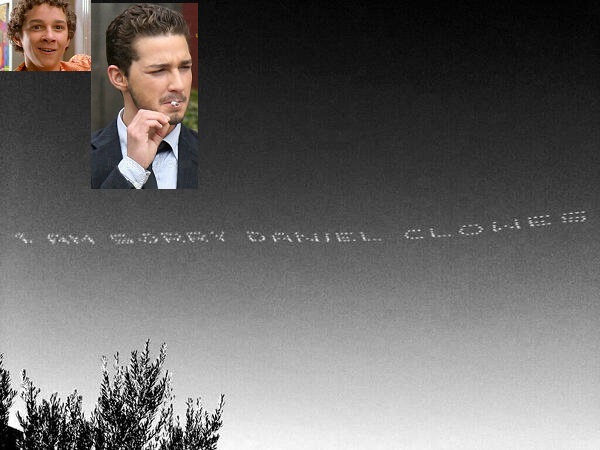
Shia LaBeouf, Plagiarism Addict, With Much Worse To Come

Shia past and present, with apology...

The child star past and present, with apology…

Actor Shia LaBeouf, known to Disney Channel aficionados as the annoying little brother on “Even Stevens” and to movie fans as Indiana Jones’ son and the Transformers Guy, is so much more, and not in a good way. His rapidly expanding list of reckless and socially-clueless episodes, including the obligatory misconduct behind the wheel of an expensive car, signals that he may be the new Lindsay Lohan, a talented former child-star raised to adulthood without basic life-skills, respect for others, and an appreciation of the difference between right and wrong. This is a tragic scenario that we are cursed to witness again and again—we saw it in 2013 in the increasingly obnoxious and desperate conduct of pop star Justin Bieber. Give a child wealth, power and adulation without first imbuing him or her with values, discipline and humility and what do you get? A menace.

As LaBeouf’s acting career has waned with his growing reputation as an untrustworthy (and sometimes violent) jerk, he has refashioned himself into an aspiring artist. Unfortunately, he lacks some basic traits of successful artists, like integrity and creativity. His inclination, being raised, like most child stars, in an unstable environment by self-absorbed and dysfunctional parents, is to cheat. In 2012, LaBeouf attached his name to three short graphic novels and a webcomic series. This year, we learned that at least two of the graphic novels contained text plagiarized from other writers. Then LaBeouf attached his name as writer to the short film (which he also directed) called “HowardCantour.com,” which was unveiled at the Cannes Film Festival and received some praise there. The  short, about an online film critic, included a strong resemblance to Daniel Clowes’ 2007 comic “Justin M. Damiano,” as well as large sections of dialogue directly lifted from it. No one picked up on the plagiarism until LaBeouf  released his film online.  Continue reading

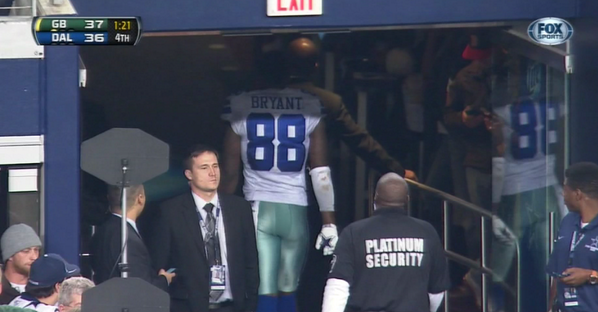
Ethics Dunce: Dallas Cowboys Wide Receiver Dez Bryant

Bryant quits

The NFL appears to be having a collective values breakdown. First the Miami Dolphins lose two players in an alleged bullying scandal, and last Sunday, star Cowboy wide receiver Dez Bryant walked off the field with more than a minute left to play in the game. After Dallas quarterback Tony Romo threw the last of his two second-half interceptions to virtually ensure a humiliating come-back defeat at the hands of the Green Bay Packers, cameras followed Bryant as he left his team for the locker room with 1:21 remaining on the clock. Later, he apologized and explained his actions by tweeting:

“I walked back to the locker room because I was emotional…it had nothing to do with my teammates we had it…We fought and didn’t finish”

Oh. What?

That’s no explanation. To reporters, he said that he didn’t want the cameras catching him crying. On the professionalism scale, this is minus 1000. He’s emotional? So what? Suck it up! He doesn’t like to lose? Who does? He couldn’t take it any more? Tough—he’s paid to take it, and damn well too. Continue reading

Ethics Note To Senator Cruz: You Can’t Begin A Principled Stand With A Lie

Little is more damaging to the public’s trust and faith in government than when elected officials engage in gratuitous lies—statements that can only convince those who don’t bother to check the facts underlying them, made for their momentary impact on the theory that the effect is worth the eventual exposure of the lie for what it is. Such lies are detestable, because they not only reinforce the impression that politicians lie when their lips are moving, they also convey the message that lies are merely tools of the politicians trade, and not even particularly shameful or worthy of criticism. When a politician engages in such transparent dishonesty, he or she is saying, quite literally, that lying is no big deal.

It is a big deal. It is especially a big deal when the point of the lie is to fool the public into believing something the politician is doing is a big deal itself, when it is really a sham.

Welcome to Sen. Ted Cruz and his fake filibuster, also known as Ted Cruz’s Bad Jimmy Stewart Impression.

"Ted, I knew Mr. Smith, and you're no Mr. Smith. You're not even Rand Paul..."

“Ted, I knew Mr. Smith, and you’re no Mr. Smith. You’re not even Rand Paul…”

Evoking memories of the Frank Capra classic, “Mr. Smith Goes To Washington,” Sen. Cruz told the world that he was going to talk on the floor of the Senate against Obamacare until he couldn’t stand any more…you know, just like the Jimmy’s idealistic junior Senator in the film, who finally collapses of exhaustion to end his filibuster but whose courage makes the corrupt, manipulating senior Senator from his state confess that he was trying to fund a lousy health care b…no, wait, it had something to do with a kids camp and influence peddling. I haven’t seen the film in a while.

Cruz, however, unlike Stewart, is not engaging in a filibuster, because he is not trying to block a vote or anything else: Senator Majority Leader Harry Reid has scheduled a vote on funding the Affordable Care Act for today, whereupon Cruz has to sit down and shut up whether he can still stand or not. Continue reading