As Usual When Gender Discrimination In Wages Is The Issue, There Is More To The Women’s Soccer Lawsuit Than The Media Wants You To Know

women's soccer

The gender wage discrimination issue makes my head start to hurt every time it is raised, which, I admit, has made me grateful that Hillary and Bernie have been concentrating on the other progressive issues they fill with half-truths and deceit. Some of those are the wealth gap, mass incarceration, the evil of big banks, discrimination against Muslims, trigger-happy police, campus sexual assault, climate change, gun violence  and the minimum wage. As with these pet progressive agenda items, it isn’t that there aren’t real problems there that require effective policy initiatives, but that advocates are so infuriatingly dishonest when debating them—exaggerating statistics, demonizing opponents, and persisting in using false facts, studies and myths long after they have been definitively disproved.

If the new media was competent and even-handed, challenging the false assertions as they should, this would not be such an impediment to rational debate. The news media is seldom objective, however. On all of these issues and more, it plays the role of advocate and partisan ally with depressing regularity. An activist on the keft has to make a truly outrageous statement to even be challenged, as when Black Lives Matter organizer Aaron Goggans suggested on CNN yesterday that black on black crime is a “myth.”

There is gender discrimination in wages; I have seen it up close, in my family and in companies and organizations I have worked for. I have personally taken action to address it. The issue is complicated, however, and not close to the absurd “77 cents on the dollar” figure that has been employed, unchanged and virtually unchallenged, for decades, nor is it fairly represented by studies that show how men in the same careers make more over their working lives than women.

Never mind; the news media allows the issue to be debated in an atmosphere dominated by misrepresentations. My reflex approach is that  until advocates for a position are willing to stop lying, spinning, and demonizing, I will pointedly avoid supporting them. Call it the Clean Hands Doctrine. Gun control is one example. Climate change is another.

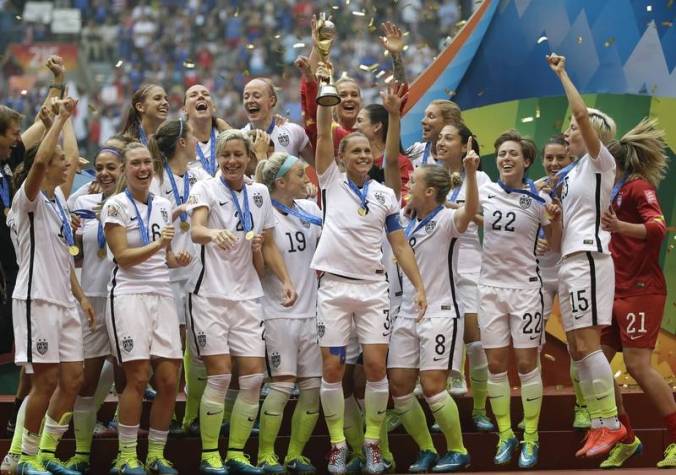
When  five players on the U.S. Women’s Soccer team filed a federal complaint last week accusing U.S. Soccer of wage discrimination because, they said, they earned as little as 40% of what players on the United States men’s national team earned despite reaching the team’s third World Cup championship last year, I read and heard nothing but cheers from women’s advocates, Democrats, pundits and Facebook posters I also read nothing but sexist snorting from the conservative side. (“Wanna know how to get paid the same as men for playing soccer? Try out for the men’s team! HAR!” ). The truth, as usual, is somewhere in the middle, but you wouldn’t know that from reading most accounts or watching the news channels. Continue reading

On Its 100th Anniversary: Remembering The Great War’s Christmas Truce Of 1914

christmas-truce-1914-H

On December 7, 1914, as the horrible, pointless, world-disrupting “War to End All Wars”  was only five months old, Pope Benedict XV suggested a truce for the celebration of Christmas. The governments of the battling nations rejected the idea, but in the days leading up to  Christmas and after, many of  the soldiers in the trenches of this ugly conflict took the Pope’s advice.

On December 20, Germans soldiers in some areas took in British wounded from the no man’s land between the warring armies. A German soldier reported on December 22 that both sides had been heard singing Christmas Carols in the trenches. German troops arriving into the lines had begun bringing Christmas trees, and some men placed them on the parapets of the fire trenches. Then, on Christmas Eve, many German and British troops serenaded each other across the lines. Allied soldiers reported that sometimes their singing was accompanied by German brass bands. Then, Christmas Day, 1914, some of the German soldiers left their trenches and  carefully approached Allied lines, shouting“Merry Christmas” in French and English. Allied soldiers climbed out of their trenches, and shook hands with the men who had only recently been trying to kill them. Some even exchanged exchanged gifts of cigarettes and and food. There were even instances where soldiers from opposing sides played soccer: in England, one organization is holding a match next week against a German team to commemorate such contests. Continue reading

Ethics Quiz: Silent Soccer

Zip_it_ball

The American culture’s grim determination to raise a race of wimps, weenies, hysterics and delicate snowflakes continues apace. Or is this a necessary adjustment to our growing incivility?

In Ohio, the Thunder United Metro Futbol Club, a kids’ soccer league, held an experimental “silent soccer weekend.” Parents and fans were told that there would be no shouting or cheering at the games. Clapping was permitted, but not whistling or using  noise makers. Team coaches were instructed to keep shouted instructions to a minimum. Printed signs and rally towels got a green light, since they are quiet.

The objective, of course, was to combat negative shouts and other demonstrations by parents and fans that might bruise youthful egos and squash self esteem.

Your Ethics Alarms Ethics Quiz for today:

Is banning crowd commentary at youth athletic events responsible, or irresponsible?

Continue reading

Comment of the Day: “The Asperger’s Child, the Company With A Heart, and the Cheapskate Parents: A Cynical Ethics Tale”

Death StarFrom new commenter Ron Bishop, a Comment of the Day on the post, The Asperger’s Child, the Company With A Heart, and the Cheapskate Parents: A Cynical Ethics Tale, It is self-explanatory. I would like to know, however, and have asked, what these parents would have done if, after all their son’s toil and planning, the Death Star had cost a hundred dollars or so more than he could raise. Would they have had him ask LEGO for help, or helped him out themselves?

“I believe it’s a real story, because my family has lived a very similar story. My 11 year old with Aspergers Disorder, also a Lego fan and in a social skills group, wanted the $400 Death Star set. Sensing a “learning moment”, I told him, if he saved up the money, he could purchase it. Continue reading

Ethical If We Want It To Be: NBA Flopping and Fooling the Ref

“And in the category of Best Feigned Foul in An NBA Play-Off Game, the nominees are….”

Once again, the issue of players in professional sports intentionally deceiving the referees is enlivening the sports pages. I welcome it: the intersection of sports and ethics is always fascinating. This particular intersection is as old as sports itself. Is deceiving the referee (or umpire) for the benefit of one’s team competitive gamesmanship or cheating? Is it an accepted tactic, or poor sportsmanship? In short, is it ethical or unethical?

The current version of this controversy has broken out in the National Basketball Association, where  Commissioner Daniel Stern  has declared war on “flopping”—the maneuver where a player draws an undeserved foul on an opposing player by acting as if minor contact or even no contact at all was near-criminal battery. Stern has suggested that the NBA needs to start handing out major fines for these performances, which in the heat and speed of the game are often only detectable with the aid of slow-motion replay after the fact Continue reading

Integrity, Soccer, and Ties

Kissing your sister is better than this.

Honest, this has nothing to do with disappointment over the U.S. women’s soccer team’s loss in the World Cup Finals: I couldn’t care less about soccer of any kind, at any level. But a lot of people do care (my sister and niece are probably under a suicide watch as I write this, so I think that the sport needs to address its integrity deficit.

To be specific: having a major title or tournament in any team sport decided by something as artificial and unteamlike as soccer’s shoot-out tie-breaker is a breach of that sport’s duty to its tradition and its fans. It is solution for solution’s sake, abandoning the purpose of the contest so as to have a resolution, no matter how unfair, cynical, or unrelated to what has gone before. Continue reading

A New Outrageous Excuse! Unfortunately, It Was True…

When the African nation of Togo protested that its embarrassing soccer loss to the Bahrain national team was due to a group of imposters masquerading as the Togo squad, I was excited: at least I had a new desperate, brazen and hopeless lie to enter the Ethics Alarms Futile Lie Hall of Fame, joining Jimmy Durante’s immortal “Elephant? What elephant?” line in the musical “Jumbo” (in response to being caught red-handed stealing the largest elephant in captivity, Lindsay Lohan’s explanation to police officers who had found cocaine in her pockets that “these aren’t my pants,” and comedian Michael Richards’ claim that he has no idea why he started yelling “Nigger!” at two black audience members when he has not a bigoted bone in his body—the  controversial “I was possessed!” excuse.

The “It’s not our fault: someone was impersonating me!” lie has great promise, not just for other disappointing athletic teams, but for politicians, John Edwards, the Democratic Congress, the producers of the “Sex in the City” movie sequel, Kanye West and Goldman Sachs. Thus I was devastated to find out that Togo wasn’t lying at all: their soccer team had been replaced by imposters.

Oh, well. And because the excuse now has validity, the “Someone was impersonating us!” excuse no longer qualifies as a sufficiently desperate and hopeless lie. It looks like Li-Lo, Kramer and “the Schnoz”  will have to wait a bit longer for their quartet.

Vuvuzela Ethics

Applied to an international soccer match, the argument that players, fans and broadcasters should be broad-minded and tolerant of the peculiar conduct of various national groups is a good one—up to a point. The point is reached when a custom begins ruining the game for everyone else. The vuvuzelas–those small plastic horns that produce an ear-splitting atonal drone like a horde of cicadas— go well beyond that point at the World Cup, and in any other sports setting are the equivalent of racist taunts, 400 pound naked men, on-field trespassers and giant fart machines. Continue reading

Ethics Hero: England World Cup Team Coach Fabio Capello

Just when I find myself staring disconsolately at the vast expanse of snow, thinking about how futile it is to try to sweep back the ethical apathy and self-serving tolerance for bad conduct that is burying our values as a blizzard buries a garden, along comes Fabio Capello, from the unlikely world of soccer, to give me hope.

Capello gets it. Mere days from his team’s embarking on the annual World Cup quest, he sacked his star Defender, John Terry, as team captain. Continue reading

Soccer Ethics, and the Duty to Self-Report in Sports

Back in January, Pope Benedict XVI opined that soccer was the perfect vehicle to teach young people moral lessons, “a tool,” in his words, “for the teaching of life’s ethical and spiritual values.” Since then, soccer players have been going out of their way, it seems, to prove him wrong, led by New Mexico women’s soccer player Elizabeth Lambert. Continue reading