I Suppose It Is Comforting To Know That I Wasn’t Unfair To Starbucks And Howard Schultz

Starbucks Quiz

If the Starbucks “Race Together” campaign had turned out to be carefully thought out, intelligent, sophisticated and responsible, and not  a facile, condescending and cynical effort to promote a brand while creating static and white noise in the midst of an important cultural discussion, I would be obligated to apologize for doubting CEO Howard Schultz’s wisdom and ethics. It would also have been an apology I would have enjoyed making.

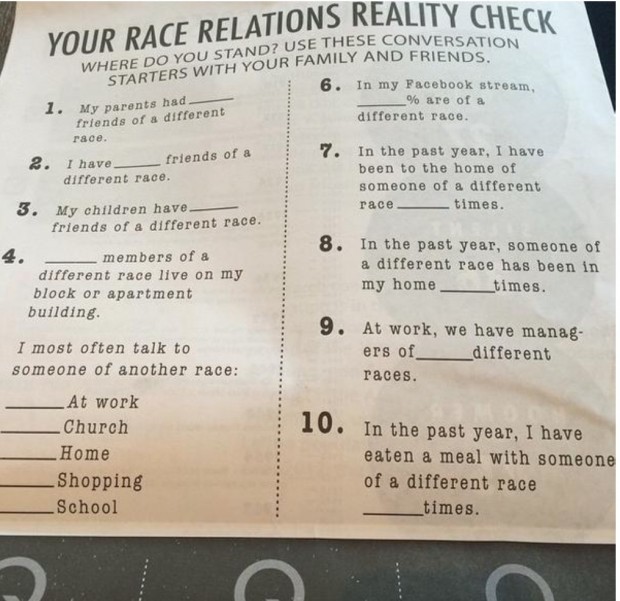
Sadly, I was not only correct in my assessment that this was a fiasco in the making, I was more correct than I suspected. Above is the “Race Relations Reality Check ” quiz that Starbucks has reportedly been distributing. The questions indicate a bottom-of-the-well level of comprehension about race and racism, not to mention demographics, culture and the human species. It appears that Starbucks favors some kind of affirmative action program on personal friendships, and believes that one can measure racism or incipient bias by how many individuals of other races one has regular contact with. I don’t even want to have a discussion with someone this shallow. A whole corporation this shallow is a nauseating thing to contemplate. A corporation this shallow that presumes to lead a national discussion on race is, oh I don’t know—Risible? Sad? Dangerous?

Starbucks seems to be thinking like George Costanza, during the period where he was trying to acquire black friends and managed to annoy and insult every African-American he met. The presumptions here are staggering, and so directly contrary to life, logic and the realities of human existence that i get angry just reading them. I was at an ethics conference in Nigeria, and met some of the most intelligent, charming, passionate people I have ever encountered in my life. I would be honored and enriched to have any of them in my life, and would hope that I could develop close friendships with them—but I can’t, because I live in the U.S. and they live in about 15 African nations, and it’s just too darn expensive to dine at each others’ homes. I live in an area, Northern Virginia, that is overwhelmingly white, not because it is white, but because it is convenient to my work and we found a great deal on a house. I work in two fields, theater and ethics, that do not afford a lot of contact with African Americans. The last time we had anyone other than immediate family to dinner was a decade or more ago; the last time anyone other than family, black or white, had us to dinner was longer ago than that—and I am a delightful dinner companion. Continue reading

Ethics Observations on Starbuck’s “Put Your Customer On The Spot” Program

Race together

Beginning this week, Starbucks baristas will have the option of handing coffee cups to customers on which the Starbucks employee has written the words “Race Together” as an invitation to start a discussion about race in America. Friday, each copy of USA Today will have the first of a series of insert with information about race relations, including a variety of perspectives on race. Starbucks coffee shops will also stock the insert.

Good golly Miss Molly. Where to begin? Continue reading

The Ethics Scrooge On The Starbucks Pay-It-Forward Ponzi Scheme

KONICA MINOLTA DIGITAL CAMERA

The Ethics Scrooge here.

If you think I’m going to get all misty eyed about the “random acts of kindness” fun and games Florida Starbucks customers have been amusing themselves with lately,  you are sadly mistaken.

The happy-talk story of the week—and I admit, the nation needed one—concerned a St. Petersburg, Florida Starbucks where an early morning customer at the drive-through window decided to “pay it forward” and buy coffee for the next person in line.That customer emulated the spirit of the Kevin Spacey weepie,  and bought a drink for the next person in line at the drive-through, and so it continued throughout the day, with 378 customers purchasing drinks for the strangers in line behind them, a so-called altruism chain that lasted 11 hours.

Awww. Continue reading

The Fifth Annual Ethics Alarms Awards: The Best of Ethics 2013

Ethics Story 2013

I decided to start with the Best in Ethics this year, in contrast to other years, on the theory that it would get things off to a positive start in 2014. What it did, instead, was make me realize how negative Ethics Alarms was in 2013. Either there wasn’t much positive going on in ethics, or I wasn’t seeing it. My thanks to those of you who send me nominations for Ethics Heroes (and other stories); even when I don’t write about them, they are valuable. Please keep them coming. In the meantime, I pledge to try to keep the jaundice out of my eye in 2014. Things just can’t be as dire as they seemed last year.

Could they?

Here are the 2013 Ethics Alarms Awards for the Best in Ethics:

Most Important Ethical Act of the Year:

The U.S. Supreme Court declared the Defense of Marriage Act unconstitutional, paving the way for the universal legalization of gay marriage. Yes, it was a legal decision, but it was also based, as all such culturally important decisions are, on a societal recognition that what was once thought to be wrong and immoral was, in fact, not. This is ethics, an ongoing process of enlightenment and wisdom about what is right and wrong, and the U.S. Supreme Court did its part. Continue reading

Web Ethics Complaint File: Rotten Etiquette in “Etiquette Hell”

The topic: rude behavior in public dining

There is nothing quite as exquisitely frustrating as having one’s commentary misrepresented elsewhere by a sloppy blogger, and then watching the nasty comments pile up by posters who never bother to read the original post. That is what is happening to Ethics Alarms, and thus me, over at an otherwise virtuous site called Etiquette Hell.

The site, or blog, or forum, or whatever the hell it is commented on the Starbucks post, with the inept headline: “Hogging all the tables in a crowded establishment.” That’s not what the post was about. That is a misrepresentation. The post was specifically about coffee shops that provide free wi-fi, and how customers abuse the privilege and benefit by camping out with their laptops for unreasonable amounts of time,  forcing patrons who need to use the tables for the primary purpose they exist to provide—allowing someone to eat and drink comfortably—to go elsewhere, or to stand. Continue reading

The Starbucks Principles

Hey you squatters! I'm coming over!

The First Starbucks Principle: If you create a free and open public benefit, the use of which is contingent on mutually understood conditions of fairness and reasonableness, eventually the utility of the benefit will be destroyed by individuals who refuse to be either fair or reasonable.

The Second Starbucks Principle: Once this occurs, there will necessarily  be rules and enforcement, conflict leading to consensus and a new social norm, or the elimination of the benefit.

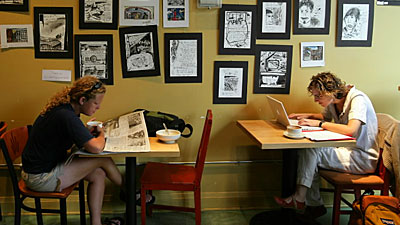
Starbucks is in the midst of the First Starbucks Principle, but the Second is on the way. The nice, absurdly expensive coffee shops that created a culture where coffee-lovers could drink their lattes at leisure while working at their laptops or perusing  books and newspapers, are being choked to death by arrogant and cheapskate squatters who stake out the tables and remain for hours on end, often driving out customers who just want to sit down briefly and sip.

I had read about Starbucks’ New York City shops covering up outlets at the store, limiting the squatters to the battery storage limits of their laptops, a pretty mild reform. Then, last week, I saw the problem up close: a companion and I purchased coffee at a Starbucks clone, Caribou Coffee, and found that every table was occupied by one squatter with a laptop. Out of eight tables, only one had a cup or food of any kind. We had to go outside and find a bench; I guarantee that Caribou lost some business, because I would have purchased another drink. Continue reading

Solution to the Starbucks Gun Controversy: Try Ethics!

Starbucks is under fire from anti-gun advocates for its policy of allowing patrons in states that permit open carrying of firearms to sip their espresso with guns on their hips. This has, of course, provoked the usual high dudgeon from Second Amendment supporters, NRA members, conservative media, and—who knows?—maybe a few postal workers getting ready to blow. Continue reading